
The Global Turn: How the Nasher Museum’s ‘Everything Now All At Once’ Redefines the Contemporary Canon
DURHAM, NC — In an era defined by the dizzying speed of digital consumption and the fractured nature of global discourse, the Nasher Museum of Art at Duke University has staged a definitive intervention. Its current exhibition, Everything Now All At Once, serves as both a title and a manifesto. By assembling a formidable array of works from its permanent collection, the museum offers a panoramic view of a contemporary art world that has finally begun to reckon with its own exclusions.
The exhibition features a "who’s who" of the 21st-century art world, including Nick Cave, Ai Weiwei, Nina Chanel Abney, Wangechi Mutu, and Amy Sherald. However, the show’s significance extends beyond the star power of its contributors. It represents the culmination of a twenty-year institutional pivot—a deliberate, strategic effort to decenter the traditional Western canon and elevate voices from historically marginalized backgrounds. Through a focus on globalism, diversity, and the tactile persistence of analog media, the Nasher is not just showing art; it is documenting a seismic shift in how history is recorded and how the future is imagined.
Main Facts: A Convergence of Global Perspectives
At its core, Everything Now All At Once is an exploration of the "Global Turn" in contemporary art. The exhibition brings together dozens of works that span various geographies and cultural identities, yet they are united by a shared interest in how the past informs the present.

The Focus on the Analog
One of the most striking aspects of the exhibition is its commitment to traditional, "analog" mediums. In a period marked by the rise of AI-generated imagery and digital NFTs, the Nasher has chosen to highlight painting, sculpture, and physical photography. This choice is a deliberate nod to the "high art" traditions of the Western canon—genres like oil on canvas and bronze sculpture—which were historically used to immortalize European nobility and white subjects. By utilizing these same "prestige" mediums to depict people of color and global cultures, the artists in this collection are effectively seizing the tools of the canon to rewrite its narrative.
Themes of Resilience and Joy
While many exhibitions focusing on marginalized identities lean heavily into trauma, Everything Now All At Once prioritizes expressions of joy, resilience, and individuality. The works on display do not merely ask for inclusion; they demand recognition of the vibrancy and complexity of the human experience outside the Eurocentric lens. From the fashion-forward subjects of Wangari Mathenge to the beaded, rhythmic sculptures of Jeffrey Gibson, the exhibition vibrates with a sense of agency and celebration.
Chronology: Two Decades of Institutional Evolution
The exhibition is not a temporary loan show but a showcase of the Nasher’s own permanent collection. To understand the depth of Everything Now All At Once, one must look at the museum’s trajectory over the last two decades.

-
2005–2015: The Foundation of Inclusion
Since its founding in 2005, the Nasher Museum has operated with a specific mandate to fill the gaps left by traditional art history. While many older institutions struggled to diversify their storerooms, the Nasher integrated this goal into its foundational DNA. During this first decade, the museum began acquiring works by artists who were then on the rise, such as Wangechi Mutu and Barkely L. Hendricks, anticipating the global demand for diverse representation. -
2015–2024: Strategic Accessioning
The last ten years saw an acceleration of this strategy. The museum focused on "iconic" pieces—works that define an artist’s career or a specific cultural moment. This period saw the acquisition of Jeffrey Gibson’s beaded punching bags and Amy Sherald’s distinctive portraits. The museum’s leadership recognized that to change the narrative of art history, they needed to own the masterpieces of the new era. -
August 2025 – Present: The Exhibition Launch
Everything Now All At Once opened in August 2025 as a living retrospective of this twenty-year journey. Rather than a static display, the exhibition was designed to be modular.
-
June 2026: The Summer Rotation
Next month, the museum will rotate new pieces into the gallery spaces. This "refresh" ensures that more of the permanent collection can be seen and allows for new dialogues to emerge between the works. -
November 1, 2026: Closing Date
The exhibition is scheduled to conclude its current run on November 1, 2026, marking over a year of continuous engagement with the Durham community and the broader academic world of Duke University.
Supporting Data: Examining the Masterworks
The strength of the exhibition lies in the specific visual arguments made by its individual pieces. Several works serve as anchors for the show’s thematic pillars.

The Intersection of Craft and Critique: Jeffrey Gibson
Jeffrey Gibson’s I PUT A SPELL ON YOU (2015) is a prime example of the exhibition’s focus on identity and material. A repurposed punching bag adorned with glass beads, artificial sinew, and steel, the work merges Indigenous craft traditions with the hyper-masculine imagery of boxing. By beading a punching bag—an object meant to be struck—Gibson transforms a tool of violence into an object of beauty and spiritual resonance, reclaiming space for Queer and Indigenous identities within the museum.
The New Portraiture: Amy Sherald and Nicolas Lambelet Coleman
The exhibition highlights a renaissance in figurative painting. Amy Sherald, famed for her portrait of Michelle Obama, is represented here by works that utilize her signature grisaille (gray-scale) skin tones against vibrant, flat backgrounds. This technique removes the "racialized" color of the skin to focus on the personhood and style of the subject.
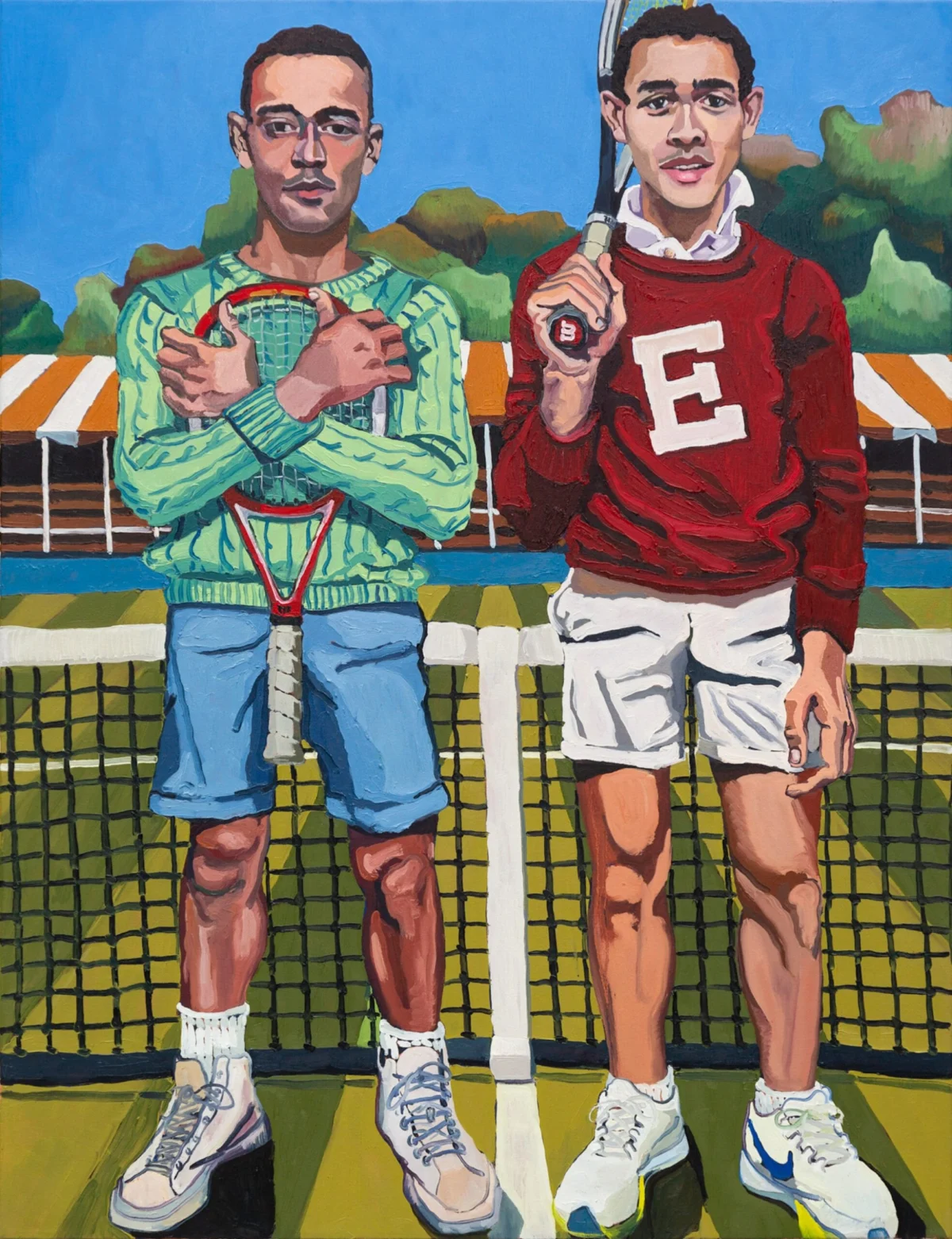
Similarly, Nicolas Lambelet Coleman’s We Don’t Sweat in These Clothes (2024) depicts two Black men at a tennis net. The work challenges historical tropes of athletic labor and country-club exclusion, presenting a scene of leisure and poise that would have been absent from the galleries of the 19th century.

Sculpture as Monument: Barbara Chase-Riboud
Barbara Chase-Riboud’s Malcolm X #5 (2003) stands as a monumental fusion of polished bronze and silk. The sculpture’s heavy, rigid top contrasts with the flowing, braided silk at its base, creating a metaphor for the complexities of the Civil Rights leader’s legacy. It exemplifies the exhibition’s "analog" focus, using traditional casting and textile work to honor a modern revolutionary.
Global Connectivity: Alfredo Jaar and Xaviera Simmons
Alfredo Jaar’s Lagos 2002 (1991), a lightbox installation, brings a documentary urgency to the gallery. By highlighting the names of world metropolises alongside images of Nigerian citizens, Jaar forces the viewer to confront the realities of globalism and the unequal visibility of different parts of the world. Xaviera Simmons’ Session Six: Kitty Hawk (2010) further explores landscape and history, grounding the exhibition in the specific geography of North Carolina while connecting it to broader themes of migration and memory.
Official Responses: The Curatorial Philosophy
The Nasher Museum’s leadership has framed Everything Now All At Once not just as a display of art, but as an act of institutional transparency. The museum’s curatorial team has emphasized that the "accession strategy" of the past twenty years was a deliberate attempt to rectify the "manifest omissions" of the past several centuries.

In gallery texts and institutional statements, the museum notes that the Western canon—the established "list" of great artists—has historically functioned as a gatekeeping mechanism. By prioritizing artists of color and global perspectives, the Nasher is participating in a broader movement to "decolonize" the museum space.
Critics and art historians have noted that the Nasher’s approach is unique because it integrates these works into its permanent collection rather than relying on temporary "diversity-themed" exhibitions. This provides a level of permanence and financial commitment that signals a deep-seated change in institutional values. The message from the Nasher is clear: these voices are not guests in the museum; they are the new foundation.
Implications: Rewriting the Future of the Museum
The impact of Everything Now All At Once extends far beyond the walls of the Duke University campus. It serves as a blueprint for how mid-sized museums can exert outsized influence on the global art stage.

Shifting the Canon
By collecting these artists early and often, the Nasher has helped validate their place in art history. When a museum of this caliber commits its resources to artists like Nina Chanel Abney or Wangechi Mutu, it influences the market, other curators, and the way art history is taught to the next generation of students.
The Persistence of the Physical
The exhibition’s emphasis on painting and sculpture suggests a belief in the enduring power of the physical object. In a world of fleeting digital "content," the Nasher argues that the weight of bronze and the texture of oil paint still offer the most profound way to capture the human condition. This "analog" focus provides a necessary grounding for the "everything now" nature of modern life.
A Model for Regional Institutions
The Nasher proves that a museum in Durham, North Carolina, can be a central hub for global contemporary art. By focusing on themes of resilience and joy, the exhibition avoids the trap of treating marginalized artists as mere subjects of political struggle, instead presenting them as masters of their craft and visionaries of the future.

As Everything Now All At Once prepares for its final months and its upcoming rotation of works, it stands as a testament to the power of intentionality. It is a reminder that the museum is not just a place where history is kept, but a place where history is actively, and sometimes radically, rewritten.




Leave a Comment