The Resurgence of Speculative Legacy: From the Hartwell Archives to the Frontiers of Deep Space
By [Your Name/Journalist Name]
The landscape of speculative fiction, spanning literature, television, and the burgeoning market of collectible gaming, is currently undergoing a period of profound retrospective and expansion. From the reopening of a historic bookstore in Connecticut housing the legendary collection of David G. Hartwell to the record-breaking financial success of Magic: The Gathering, the genre’s cultural footprint is deeper and more diverse than ever before. Simultaneously, astronomical phenomena and the casting of three former "Doctors" in a major mystery series underscore the enduring intersection between science, fiction, and mainstream entertainment.
Main Facts: A Convergence of Genre Milestones
The current week has seen several pivotal developments in the world of speculative fiction and science. Leading the headlines is the official reopening of Dragon Press in Westport, Connecticut. This unique establishment serves as a bookstore and art studio, but its primary draw is the massive inventory of the late David G. Hartwell, one of the most influential editors in the history of science fiction, fantasy, and horror.
In the realm of television, Hulu’s Only Murders in the Building has made waves by announcing a "Doctor Who" reunion for its sixth season. Peter Capaldi, the Twelfth Doctor, joins David Tennant and Jodie Whittaker in the cast, marking a significant crossover of British sci-fi royalty into the American mystery-comedy.
Financially, the speculative economy remains robust. Hasbro has reported that Magic: The Gathering achieved a record-breaking $545 million in revenue for the second quarter, a 32% increase. This surge in popularity for trading card games, which began during the pandemic, shows no signs of waning. Meanwhile, in the scientific community, the release of the largest 2D map of the universe—comprising 5.6 trillion pixels—and observations of the 2026 solar eclipse across Europe have captivated both researchers and the public alike.

Chronology: The Journey of a Collection and a Genre
The narrative of current speculative fiction is deeply rooted in the past. The journey of the Hartwell collection began when David G. Hartwell started collecting books at the age of 12. Over the decades, Hartwell became a titan of the industry, editing thousands of titles for Tor Books and Timescape Books at Simon & Schuster. His work with authors such as George R.R. Martin, Gene Wolfe, and Samuel R. Delany shaped the modern canon of the genre.
Following Hartwell’s passing in 2016 at the age of 74, his widow and literary executor, Kathryn Cramer, began the monumental task of managing his collection of over 20,000 volumes. While high-end antiquarian books are being handled by James Cummins Bookseller in New York City, the remainder of the collection has found a home at Dragon Press, which reopened its doors on July 22.
Parallel to this literary preservation is the evolution of media. The casting of the three "Doctors" for Only Murders in the Building Season 6 comes as the show moves its production to London, representing its first venture outside the United States. This move follows a timeline of increasing globalization for the series, which has consistently attracted A-list talent.
In the skies, the chronology of celestial events reached a peak on August 12, 2026, with a total solar eclipse visible from Spain, Iceland, and Greenland. This event mirrors the historic eclipse of July 8, 1842, where astronomers first documented the mysterious "shadow bands"—faint, undulating ripples of light that appear just before totality, a phenomenon that remains partially unexplained 184 years later.
Supporting Data: The Economics and Art of Fandom
The strength of the speculative fiction market is evidenced by both high-level financial reports and grassroots enthusiasm.

The Hasbro Performance
According to Hasbro’s second-quarter 2026 financial results, the Wizards of the Coast segment, driven primarily by Magic: The Gathering, has become a cornerstone of the company’s profitability. The 32% jump in revenue to $545 million highlights a shift in consumer behavior where "comfort and nostalgia" have transitioned into long-term investment and hobbyist dedication.
The Hartwell Inventory
At Dragon Press, approximately 3,500 of Hartwell’s books are currently on display. The shop offers a visceral connection to the editor’s life; his notorious neckties hang from the ceiling alongside book covers and convention ephemera. The collection is a rare repository of first editions in science fiction and horror, representing a lifetime of curation that spans from the early 1960s to the mid-2010s.
Deep Space Mapping
On the scientific front, the Dark Energy Spectroscopic Instrument (DESI) Legacy Imaging Surveys team has released a map containing nearly 4 billion cosmic objects. The data, collected over a decade from 263,000 telescope exposures, provides a 2D portrait of the universe at an unprecedented scale. This map is now considered essential infrastructure for astronomical research, used by scientists to identify targets for further study.
The Viral "Spooder-Man" Poster
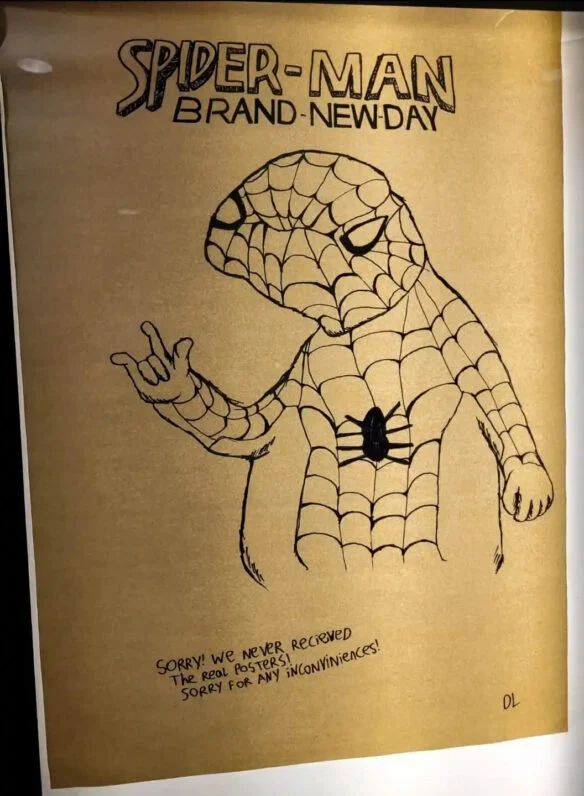
In a lighter but no less significant show of fandom, an employee at a Famous Players theater in Prince George, British Columbia, created a hand-drawn poster for Spider-Man: Brand New Day after official materials failed to arrive. The "Spooder-Man" inspired drawing went viral on Reddit, garnering over 51,000 upvotes, illustrating how grassroots creativity can occasionally eclipse professional marketing in the digital age.
Official Responses: Insights from the Guardians of the Genre
The reopening of Dragon Press and the ongoing celebration of genre pioneers have drawn commentary from those closest to the work.

Kathryn Cramer, Literary Executor and proprietor of Dragon Press, emphasized the breadth of Hartwell’s career: "He edited literally thousands of books… He really had a very broad impact over a long period of time. It’s a very impressive collection." Her efforts to keep the collection accessible to the public, both through the physical shop and a planned online store, reflect a commitment to maintaining the genre’s history.
Regarding the literary excellence of modern horror, the Pulitzer Prize Committee recently lauded author Daniel Kraus for his novel Angel Down. The committee described the work as a "stylistic tour-de-force that blends such genres as allegory, magical realism, and science fiction into a cohesive whole." Kraus, who has collaborated with Guillermo del Toro and George A. Romero, represents the modern vanguard of genre-bending literature.
In the world of radio, M. John Harrison recently appeared on BBC Radio 4’s Take Four Books to discuss his latest novel, The End of Everything. Harrison cited the influences of John Wyndham and J.G. Ballard, highlighting the "disaster fiction" lineage that continues to inform contemporary narratives about environmental and societal collapse.
Finally, in a tribute to the "Master of Suspense," Paul Weimer reflected on the 127th anniversary of Alfred Hitchcock’s birth. Weimer noted Hitchcock’s "economy of motion and action" and his "technical and narrative precision," arguing that films like Vertigo and The Birds remain essential studies for any creator in the thriller or horror genres.
Implications: The Future of Physical Media and Cosmic Inquiry
The convergence of these events suggests several long-term implications for culture and science.

The Persistence of Physical Archives
Despite the dominance of digital media, the reopening of Dragon Press and the interest in the Star Trek estate sale in Downer’s Grove, Illinois—which features potentially "lost" vintage slash fanfiction—demonstrates that physical artifacts remain the lifeblood of fandom. These archives provide a tangible link to the history of storytelling that digital databases cannot replicate.
The "Doctor Who" Effect on Mainstream TV
The casting of Peter Capaldi, David Tennant, and Jodie Whittaker in Only Murders in the Building suggests a "prestige-ification" of genre actors. As showrunners increasingly look to British sci-fi icons to bolster American productions, the boundaries between "cult" television and mainstream hits continue to blur. This trend is likely to increase as production becomes more globalized.
Scientific Literacy and the Public Imagination
The 2026 solar eclipse and the release of the DESI map serve as reminders that science and speculative fiction are two sides of the same coin. The public’s fascination with "shadow bands" and the vastness of the 5.6 trillion pixel map feeds back into the creative industry, inspiring the next generation of writers and designers.
The Economic Durability of TCGs
The record revenues for Magic: The Gathering indicate that trading card games have moved beyond a "pandemic fad" into a stable, high-growth financial sector. This suggests that the "experience economy"—where consumers pay for community, complex strategy, and physical collectibles—will remain a dominant force in the entertainment industry for the foreseeable future.
As we look toward the remainder of 2026, from the British Library’s American Writers’ Week to the continued rollout of Season 6 of Only Murders in the Building, it is clear that the legacies of the past—be they Hitchcock’s films, Hartwell’s books, or 19th-century eclipse observations—continue to illuminate the path forward for speculative culture.