
The Third Inflection Point: Navigating the Intersection of Hype, History, and the Blockchain Revolution
Executive Summary: A Legacy of Technological Disruption
In the rapidly evolving landscape of global technology and digital entertainment, few individuals possess the perspective of having stood at the epicenter of two separate industry-defining shifts. For Nicholas Lovell, a veteran financier, analyst, and strategist, the current climate surrounding blockchain, cryptocurrencies, and Non-Fungible Tokens (NFTs) represents a third major "inflection point."
Drawing on a career that spans the dot-com bubble of 2000 and the free-to-play mobile revolution of 2008, Lovell provides an analytical framework for understanding the present market volatility. This report examines the historical parallels between past technological bubbles and the current emergence of Web3, exploring the fine line between speculative mania and fundamental societal change. The core thesis posits that while much of the current market exhibits signs of "Ponzi-style" speculation, the underlying technology may fundamentally alter the building blocks of the digital economy, much as the internet and free-to-play models did in previous decades.
Chronology of Disruption: Three Eras of Transformation
1. The 2000 Dot-Com Era: The Birth of Digital Ubiquity
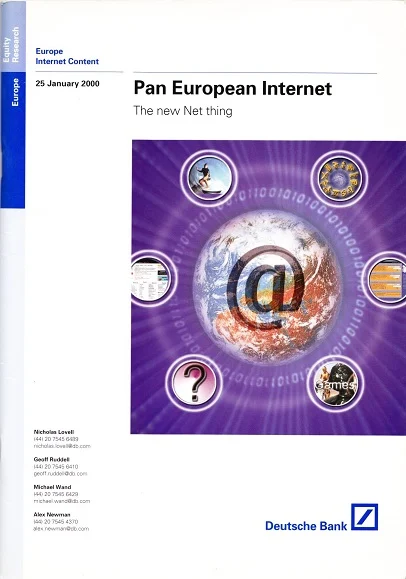
In the year 2000, the global economy was gripped by a feverish obsession with the "World Wide Web." At the time, Nicholas Lovell served as an Internet analyst at Deutsche Bank, a role that positioned him as a bridge between a burgeoning nerdy subculture and the traditional financial elite.
During this period, the market was dominated by "middle-aged men" in suits who struggled to comprehend how a decentralized network of computers could possibly justify stratospheric valuations. Lovell’s task was to advise these investors on the transformative potential of the internet just three months before the catastrophic dot-com crash.
The prevailing sentiment was one of "irrational exuberance." Companies with no path to profitability were seeing their stock prices soar based on "clicks" rather than "cash flow." However, beneath the noise, Lovell recognized a fundamental truth: the internet was a permanent change to human civilization. His primary advice to investors at the time was: “Investors should identify those business models and teams that will thrive in the Internet sector, rather than focusing on absolute valuation.”
This era taught a vital lesson: a sector can be simultaneously "ridiculously overvalued" and "fundamentally transformative." While most companies of the era (such as Pets.com) vanished, the "black swans" like Amazon emerged to redefine the global retail and technology landscape.
2. The 2008 Shift: The Free-to-Play and Mobile Revolution
Eight years later, the second major shift occurred. By 2008, Lovell had transitioned from banking to the games sector, specializing in helping small-to-medium enterprises (SMEs) navigate a changing market. This was the era when the "boxed product" model—buying a game on a disc for a one-time fee—began to crumble.
New phenomena were emerging from South Korea and Germany: browser-based games that were free to play but charged for progress, cosmetics, or virtual currencies. Simultaneously, the launch of the iPhone in 2007 acted as "rocket fuel" for the mobile sector.
Lovell found himself in high-level meetings with the titans of the industry, including John Riccitiello (then CEO of Electronic Arts), Bobby Kotick (Activision), and Phil Rogers (Eidos). These executives were struggling to process a model that seemed counter-intuitive: giving the product away for free to make more money in the long run.
The shift from "Games as a Product" to "Games as a Service" was met with intense skepticism. Critics called it a fad or "scammy" monetization. Yet, it became the dominant economic model for the gaming industry, giving rise to giants like Riot Games and Supercell.
3. The 2021 Frontier: Blockchain, Crypto, and the NFT Emergence
In 2021, the third wave arrived. The convergence of blockchain technology, decentralized finance (DeFi), and NFTs created a market environment that mirrored the chaos of 2000 and 2008.
Lovell notes that the current market is undeniably saturated with speculative bubbles. He describes certain sectors as "Ponzi schemes" where the primary goal is to sell a "hot potato" to a "greater fool" before the music stops. However, he also acknowledges the emergence of permanent changes.
The core of this new era lies in the concept of digital value. Just as free-to-play players learned to value their digital avatars as forms of self-expression—comparable to the clothes we wear or the cars we drive—the blockchain offers a mechanism for permanence and ownership in a digital realm.
Supporting Data: The Economics of Digital Scarcity
The transition into the "Blockchain Era" is supported by several key economic indicators and psychological shifts within the consumer base:
- The Virtual Goods Precedent: In the pre-blockchain era of 2020, the global market for virtual goods in games was estimated to be worth over $50 billion. This confirms that consumers already attribute significant value to non-physical assets.
- The NFT Surge: In 2021, NFT trading volume hit $24.9 billion, up from just $94.9 million in 2020. While much of this is speculative, it indicates a massive influx of capital into the infrastructure of digital ownership.
- Cryptocurrency Resilience: Despite extreme volatility, the total market capitalization of cryptocurrencies has repeatedly surpassed the $2 trillion mark, suggesting that it has moved beyond a "niche hobby" into a recognized (albeit high-risk) asset class.
- Historical P/E Ratios: During the 2000 bubble, the P/E ratio of the S&P 500 reached 44.19, more than double its historical average. Lovell’s observation that "valuations were stratospheric" in 2000 serves as a warning for 2021’s NFT market, where "floor prices" for JPEG images often exceed the cost of real-world luxury items.
Official Responses and Industry Sentiment
The reaction to this third wave is deeply polarized, mirroring the executive confusion Lovell witnessed in 2008.
- Traditional Gaming Skepticism: Many "old guard" developers have voiced concerns. Valve (Steam) famously banned blockchain games and NFTs from its platform, citing the potential for fraud and the lack of underlying utility.
- The "New Guard" Adoption: Conversely, companies like Ubisoft (via their Quartz platform) and Epic Games have shown a willingness to experiment with the technology, viewing it as the next logical step in the evolution of player-driven economies.
- The Regulatory Lens: Financial regulators, including the SEC in the United States and the FCA in the UK, have issued stern warnings regarding the "meme-stock" nature of crypto investments. Their "official response" has been one of caution, focusing on consumer protection in an environment where "no underlying value" is often the norm.
- Lovell’s Perspective: Lovell himself admits to a sense of cognitive dissonance. While he recognizes the "Ponzi-nonsense," he refuses to write it off entirely, stating, "I am fighting the urge to write it off… because both [the internet and F2P] were and are permanent changes."
Implications: The Future of Digital Value and Governance
The implications of this third inflection point are profound, affecting not just gaming, but the very nature of how society interacts with digital assets.
The Shift from "Service" to "Ownership"
If the 2008 shift was about "Games as a Service," the 2021 shift is about "Games as an Economy." The implication is that players will no longer be mere consumers but stakeholders. Through blockchain, players can theoretically own their assets independently of the game developer, creating a secondary market that the developer cannot unilaterally shut down.
The Challenge for the "Experienced" Investor
A recurring theme in Lovell’s career is the "curse of experience." In 2000 and 2008, he was the young expert explaining the future to older men. In 2021, he admits, "I’m the older investor trying to figure out how this new technology is going to change the business." The implication for the broader industry is that past success can be a barrier to understanding future disruption. Those who dismiss NFTs as "nonsense" today may find themselves in the same position as the 2008 executives who dismissed "free" games.
The Evolution of Self-Expression
The integration of NFTs into the gaming ecosystem suggests a future where digital identity is as portable and verifiable as a physical passport. The blockchain provides a "tool for creating value" through permanence. If a digital item can exist forever, its value as a form of self-expression increases exponentially.
Final Outlook: The Search for the "Amazon" of Web3
As the market moves through this speculative phase, the ultimate goal for analysts and investors remains the same as it was in 2000: to look beneath the hype and identify the "Black Swans." While 99% of current blockchain projects may fail—just as 99% of dot-com companies did—the remaining 1% will likely define the next twenty years of the global digital economy.
Nicholas Lovell’s journey serves as a reminder that being right about the technology does not mean the market isn’t a bubble. The challenge lies in surviving the bubble to witness the world the technology eventually builds.

Leave a Comment