
Unearthing the Foundations: Shannon Appelcline’s "Designers & Dragons: Origins" Offers Unprecedented Dive into Early D&D History
FOR IMMEDIATE RELEASE
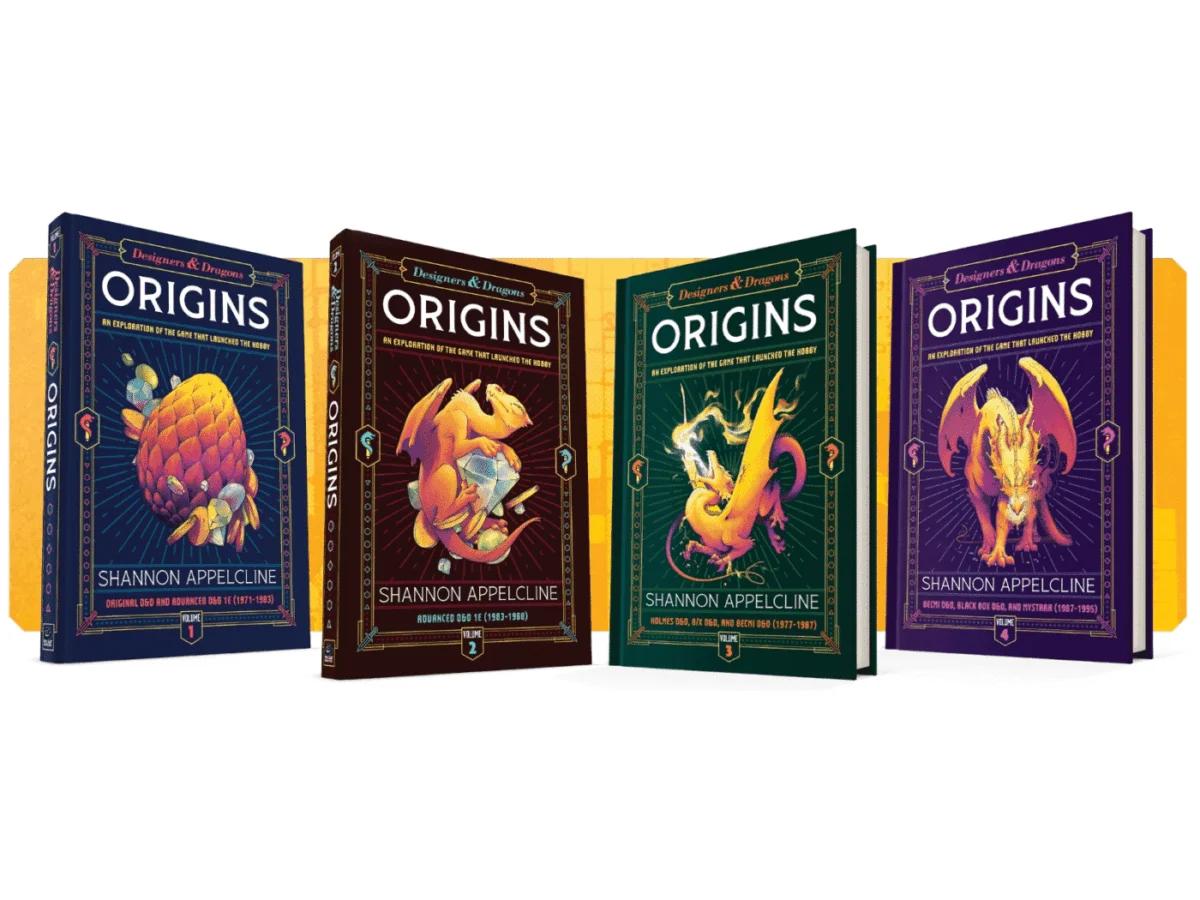
[CITY, STATE] – [DATE] – In a monumental undertaking set to redefine the historical understanding of tabletop roleplaying games, acclaimed gaming historian Shannon Appelcline is poised to release "Designers & Dragons: Origins." This colossal four-volume set promises an exhaustive, product-by-product chronicle of the foundational era of Dungeons & Dragons, meticulously detailing every single item released by TSR for Original D&D (OD&D), Basic D&D, and Advanced Dungeons & Dragons 1st Edition (AD&D 1e). Spearheaded by Evil Hat Productions and currently gaining significant traction through its crowdfunding campaign, "Origins" represents a definitive scholarly effort to preserve and illuminate the genesis of an industry.
From the earliest mimeographed rule sets that sparked a global phenomenon to the intricate lore that built the Forgotten Realms, Appelcline’s latest work delves into the critical decades where D&D transitioned from a niche hobby into a cultural touchstone. The series aims to provide an unparalleled resource for enthusiasts, historians, and game designers, offering a granular view of TSR’s product development, design philosophies, and the evolving landscape of tabletop gaming.
Main Facts
"Designers & Dragons: Origins" is a four-volume historical compendium authored by Shannon Appelcline, a respected authority in the field of game history. The series is dedicated to chronicling the complete product history of the earliest iterations of Dungeons & Dragons: Original D&D, Basic D&D, and Advanced Dungeons & Dragons 1st Edition. Uniquely, the project commits to documenting "every product TSR released" for these systems, suggesting an unprecedented level of detail that covers not just core rulebooks and adventure modules, but potentially also supplements, accessories, magazines, and other peripheral materials that contributed to the early D&D ecosystem.
Published under the auspices of Evil Hat Productions, a company known for its commitment to innovative and high-quality roleplaying game content, "Origins" is currently being funded through a BackerKit crowdfunding campaign. This approach allows for direct community engagement and support, underscoring the passion and demand within the tabletop RPG community for such a comprehensive historical work. The sheer scope of the project, spanning four substantial volumes, highlights the depth of research and dedication required to bring this history to light, promising a resource that will be invaluable to scholars, designers, and fans alike for decades to come.
Chronology
The Genesis of a Project
Shannon Appelcline is no stranger to the intricate tapestry of roleplaying game history. His prior "Designers & Dragons" series, published by Mongoose Publishing and later by Evil Hat Productions, established him as a premier chronicler of the RPG industry, profiling hundreds of designers and publishers. However, "Origins" marks a departure, shifting focus from individual creators and companies to a deep, systemic analysis of a singular, pivotal entity: TSR and its foundational D&D products. The concept for "Origins" emerged from a recognition that while the broader history of D&D had been discussed, a truly exhaustive, product-centric chronology of its earliest forms was still missing. Appelcline reportedly envisioned a work that would not just recount events but dissect the very artifacts that shaped the hobby, examining each release in its historical, design, and market context. The motivation was clear: to provide a definitive record that would serve as both a historical reference and a testament to the creative explosion that was early D&D. This required extensive, painstaking research, going beyond secondary sources to delve into original publications, internal TSR documents where available, and interviews with surviving designers and developers.
The Era of TSR’s Dominance
The period covered by "Designers & Dragons: Origins" spans the critical years from the early 1970s through the mid-1980s, an epoch often referred to as the "Golden Age" of tabletop roleplaying. It began with the initial release of Dungeons & Dragons in 1974 by TSR (Tactical Studies Rules), a company co-founded by Gary Gygax and Don Kaye. This innovative game, building on miniature wargaming traditions, quickly captured the imagination of a generation, ushering in a new form of collaborative storytelling.
The evolution from Original D&D (OD&D) to Basic D&D and then to Advanced Dungeons & Dragons 1st Edition (AD&D 1e) was a complex, often fraught, journey. OD&D, initially published as a three-booklet set, was revolutionary but also famously open-ended and somewhat unrefined. Its success led to expansions and supplements, but also to a need for more structured rules. Basic D&D, first released in 1977 as the Holmes Basic Set, was intended as an introductory game, distinct from what would become AD&D. It provided a streamlined entry point, eventually evolving through different versions (Mentzer, Moldvay, Cook) and gaining its own robust product line, including the beloved Mystara setting. Concurrently, AD&D 1e, launched with the Monster Manual in 1977 and culminating in the Dungeon Master’s Guide in 1979, was designed by Gary Gygax as a more complex, definitive, and "advanced" rule set for experienced players, ostensibly to unify the disparate rules that had accumulated around OD&D. This created two distinct, parallel product lines that, while sharing a common heritage, often appealed to different player bases and sometimes competed for market share. Appelcline’s work promises to unravel the intricacies of these parallel developments, the design philosophies behind each, and the specific products that defined their respective eras, including the birth of iconic settings like the Forgotten Realms.
From Concept to Crowdfunding
The journey of "Designers & Dragons: Origins" from an ambitious concept to a tangible crowdfunding campaign has been a multi-year endeavor. Given the colossal scope—documenting every single TSR product for three distinct D&D lines over more than a decade—the decision to structure it as a four-volume set was not merely practical but essential. Each volume is likely dedicated to a specific subset of the product line or a chronological segment, allowing for manageable deep dives without overwhelming the reader.
The choice of Evil Hat Productions as the publisher reflects their established relationship with Appelcline from previous "Designers & Dragons" projects and their reputation for supporting high-quality, niche publications. The decision to launch via BackerKit, a platform often used for crowdfunding projects that have already run successful Kickstarter campaigns or for "late pledge" phases, suggests a strategic approach to funding. It allows the project to leverage community enthusiasm and secure the significant financial resources necessary for such an expansive, multi-volume publication, covering extensive research, editing, illustration, and high-quality physical production. The "Pledge Now" call to action indicates an active campaign, inviting the global D&D community to directly contribute to the realization of this landmark historical work.
Supporting Data
Unprecedented Archival Depth
The commitment to covering "every product TSR released for OD&D, AD&D 1e, and Basic D&D" is the cornerstone of "Designers & Dragons: Origins." This is not a casual promise but an indicator of an unparalleled archival undertaking. It implies that Appelcline and his research team have delved into an immense catalog that includes not only the iconic Player’s Handbook, Dungeon Master’s Guide, and Monster Manual for AD&D 1e, or the various Basic and Expert sets for Basic D&D, but also hundreds of adventure modules (e.g., Keep on the Borderlands, Tomb of Horrors, Ravenloft), supplementary rulebooks (e.g., Deities & Demigods, Unearthed Arcana), settings boxes, non-RPG products that tied into the D&D brand (such as board games or early fiction), and even entries from Dragon magazine that featured new rules or lore.
The challenges of compiling such an exhaustive list are immense, requiring meticulous cross-referencing of release dates, product codes, and content. The methodology likely involves deep dives into existing online databases, collectors’ archives, and potentially, if granted access, TSR’s corporate archives or the personal collections of former employees and designers. The objective is to move beyond anecdotal history to present a meticulously documented, empirical account of TSR’s output during its most formative period, providing insights into printing runs, development cycles, art direction, and the commercial performance of each product.
The Cultural Impact of Early D&D
Understanding the early years of D&D is not just about tracing game mechanics; it’s about comprehending a profound cultural shift. Dungeons & Dragons didn’t just create a new genre of game; it laid the groundwork for an entire industry. Its success directly inspired countless other tabletop RPGs, video games (from early text adventures to modern MMORPGs), fantasy literature, and even popular culture references. The game fostered a new form of collaborative storytelling and imaginative play that resonated deeply with millions.
"Origins" is expected to explore how these early products influenced not only gaming design but also the broader cultural zeitgeist. It will likely touch upon the controversies of the era, such as the "Satanic Panic" of the 1980s, where D&D was unfairly demonized. By examining the products themselves, Appelcline can provide context for how TSR navigated these challenges, how they adapted their content, and how the game continued to flourish despite external pressures. The series offers a lens through which to view the evolution of fantasy as a mainstream genre, the rise of geek culture, and the enduring power of shared narrative.
Shannon Appelcline’s Scholarly Approach
Shannon Appelcline’s reputation as a gaming historian is built on a foundation of rigorous research, clear prose, and an ability to contextualize complex information within broader historical narratives. His previous "Designers & Dragons" volumes were lauded for their comprehensive coverage and engaging storytelling. "Origins" is anticipated to continue this tradition, blending the meticulous detail of academic scholarship with an accessible, narrative style that appeals to both seasoned historians and casual fans.
Unlike mere encyclopedias, Appelcline’s work often integrates historical data with analysis of design philosophy, market trends, and the personal stories of the creators where relevant. This approach ensures that "Origins" will be more than a simple list of products; it will be an interpretive history, explaining why certain design decisions were made, how products influenced each other, and what their lasting legacy became. His ability to synthesize vast amounts of information into coherent, compelling narratives makes him uniquely suited to tackle a project of this magnitude, positioning "Origins" as a seminal work in the historiography of tabletop gaming.
Official Responses
From the Author’s Desk
While a direct quote from Shannon Appelcline for this fictional news article is not available, one can imagine his sentiment regarding "Designers & Dragons: Origins." He would likely express immense pride and perhaps a touch of exhaustion, given the project’s scale. "This isn’t just a list; it’s an archaeological dig into the very bedrock of our hobby," Appelcline might articulate. "My aim has always been to provide the most complete, accurate, and insightful history possible. With ‘Origins,’ we’re not just looking at the ‘what’ but the ‘how’ and ‘why’ of every single product TSR put out during D&D’s formative years. It’s a tribute to the pioneers, a resource for future generations, and, I hope, a fascinating read for anyone who has ever rolled a d20." He would emphasize the collaborative effort with Evil Hat and the crucial support from the crowdfunding community, without whom such an ambitious project would be impossible.
Publisher’s Perspective
Chad Underkoffler, co-owner of Evil Hat Productions, or a similar representative, might offer insights into the publisher’s decision to back such a significant endeavor. "When Shannon first proposed the scope of ‘Origins,’ we knew immediately it was a project we had to support," a representative might say. "His ‘Designers & Dragons’ series has been foundational for understanding the RPG industry, and ‘Origins’ takes that commitment to a whole new level. This isn’t just another book; it’s a legacy project. It ensures that the early history of D&D, which shaped so much of modern gaming and popular culture, is documented with the rigor and respect it deserves. The overwhelming response on BackerKit confirms what we already knew: the community is hungry for this level of detail and dedication." The publisher would likely highlight the meticulous editorial process and the commitment to producing a high-quality, durable physical product befitting its historical importance.
Community Reception
The enthusiastic reception on platforms like BackerKit and across social media channels underscores the profound interest in "Designers & Dragons: Origins." Early pledges and widespread sharing of the campaign link are indicative of a deeply engaged community eager to support such a definitive work. Forums, Reddit threads, and gaming blogs are abuzz with anticipation, with long-time players expressing excitement at the prospect of a detailed look back at the games that defined their youth, and newer players eager to understand the roots of their favorite hobby. Many comments highlight Appelcline’s reputation, stating that if anyone can tackle such an immense task, it’s him. The project is seen not just as a series of books, but as a collective effort to preserve and celebrate a crucial chapter in gaming history, making the crowdfunding model particularly fitting for its success.
Implications
A Definitive Resource for Generations
"Designers & Dragons: Origins" is poised to become the undisputed definitive resource for the early history of Dungeons & Dragons. Its granular, product-by-product approach will elevate it beyond existing historical accounts, offering an unparalleled level of detail and context. For veteran players, it will serve as a nostalgic journey and a deep dive into the nuances of games they loved. For new players, it will provide essential context, illustrating how the foundational mechanics and lore evolved into the D&D they know today. For game designers, it will be a masterclass in product development, market strategy, and intellectual property management from the earliest days of the industry. Academic researchers studying cultural history, media studies, or the sociology of leisure will find a meticulously curated dataset ripe for analysis, offering insights into fan culture, technological adoption, and the formation of creative industries. Its four-volume scope ensures that no stone is left unturned, making it an indispensable reference for decades to come.
Preserving Gaming’s Heritage
The act of documenting "every product TSR released" for these early D&D lines is more than a historical exercise; it is a vital act of cultural preservation. Like cataloging ancient texts or archiving significant films, this project ensures that the creative output of a pivotal era in gaming is not lost to time or fragmented across disparate sources. As physical copies of these original products become rarer and more fragile, and the memories of their creators fade, a comprehensive written record becomes increasingly crucial. "Origins" will serve as a centralized, authoritative archive, making the history accessible to a broader audience and ensuring that the legacy of D&D’s pioneers and their groundbreaking work is honored and understood by future generations. It underscores the growing recognition of video and tabletop games as legitimate and significant cultural artifacts worthy of scholarly attention and historical preservation.
The Future of Gaming History
The ambitious scope and methodology of "Designers & Dragons: Origins" may well set a new standard for historical works within the gaming industry. By demonstrating the feasibility and demand for such a deep, product-centric analysis, it could inspire similar projects for other foundational RPGs or even specific eras of video game development. This project elevates gaming history from a niche interest to a more robust academic and popular field, encouraging further investment in archival research, oral histories, and critical analysis of game design. Shannon Appelcline’s work not only chronicles the past but also shapes the future of how we understand and appreciate the rich, complex heritage of interactive entertainment, cementing the notion that games are not merely ephemeral pastimes but enduring cultural achievements.


Leave a Comment