
Unearthing the Myth: E. B. Hudspeth’s "The Resurrectionist" Blurs the Lines Between Science and Legend
PHILADELPHIA, 1870s – In an era defined by rapid scientific advancement, gaslight illumination, and the clatter of horse-drawn carriages, a peculiar and profoundly unsettling hypothesis began to take root in the intellectual circles of Philadelphia. Dr. Spencer Black, a surgeon with a lineage tainted by the shadowy practice of grave robbing, and a brilliant alumnus of the city’s esteemed Academy of Medicine, posited a theory so audacious it threatened to unravel the very fabric of human understanding: What if the fantastical creatures of myth – mermaids, minotaurs, satyrs, sphinxes, sirens, and centaurs – were not mere figments of ancient imagination, but rather the evolutionary precursors to humankind? This radical notion forms the controversial core of E. B. Hudspeth’s seminal work, "The Resurrectionist," a book that meticulously blurs the boundaries between historical biography, scientific treatise, and a breathtaking exploration of the human psyche.
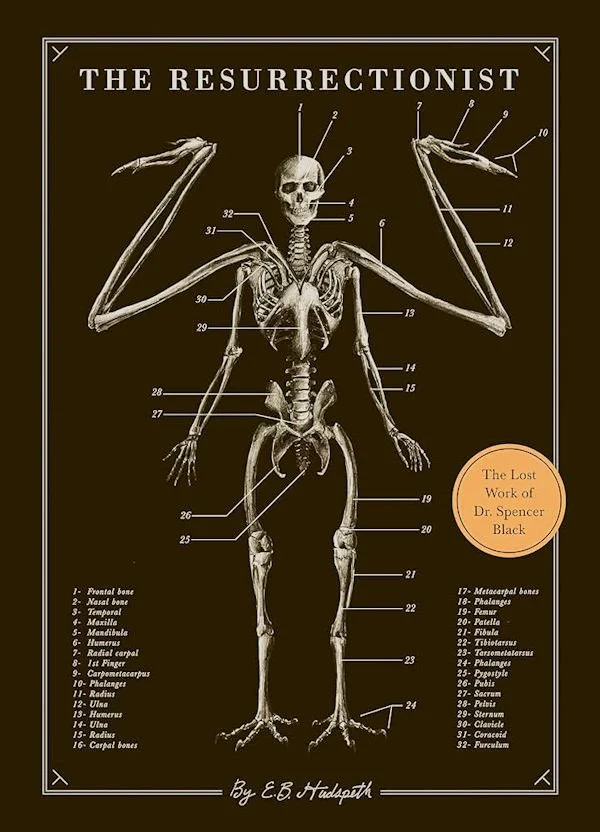
Published as a masterclass in the increasingly popular genre of "fictional non-fiction," Hudspeth’s creation presents itself as a lost academic text, a meticulously fabricated field guide, and a compelling, if tragic, biography. It chronicles the fictional Dr. Black’s descent from a respected, albeit unconventional, surgeon into a realm of obsession that challenges scientific orthodoxy and societal norms. The narrative is bifurcated: the first half meticulously details Dr. Black’s life and the genesis of his radical theory, while the second half unveils "The Codex Extinct Animalia," a stunning collection of anatomical plates depicting these mythological creatures with the chilling precision of a genuine medical textbook. This unique structure, combining narrative biography with detailed scientific illustration, elevates "The Resurrectionist" beyond a mere story, transforming it into an immersive intellectual experience that has firmly lodged itself in the minds of its readers.
Main Facts
"The Resurrectionist" by E. B. Hudspeth is a highly acclaimed work of speculative fiction presented in the guise of a historical document. Set in late 19th-century Philadelphia, it introduces the fictional character of Dr. Spencer Black, a brilliant but ultimately tragic surgeon whose unconventional theories on human evolution lead him down a path of scientific heresy and personal ruin. Black, whose background as the son of a grave robber subtly hints at his future transgressions against conventional decorum, studies at Philadelphia’s Academy of Medicine. Here, he cultivates a radical hypothesis: that legendary mythological creatures are, in fact, the evolutionary ancestors of humanity.
The book is celebrated for its innovative "fictional non-fiction" format, which meticulously crafts the illusion of an authentic historical and scientific artifact. It is comprised of two distinct, yet intrinsically linked, parts. The first segment is presented as a biographical account of Dr. Black, detailing his academic journey, the development of his controversial theories, and his gradual descent into an all-consuming obsession. This narrative is crucial in establishing the context and psychological underpinnings for the second, visually dominant section: "The Codex Extinct Animalia." This "codex" features a series of highly detailed, anatomically precise illustrations of various mythological creatures, rendered with the dry, objective aesthetic of a bona fide medical textbook. The combination of compelling narrative and startling visual documentation creates a unique literary experience that invites readers to suspend disbelief and contemplate the blurred lines between myth, science, and madness.
Chronology: The Unravelling of Dr. Spencer Black
The fictional journey of Dr. Spencer Black is a compelling, if disturbing, chronology of intellectual brilliance giving way to radical obsession, ultimately leading to professional and personal isolation.
Early Life and Academic Pursuits
Born into the shadowed world of a grave robber’s family, young Spencer Black’s early life likely instilled in him a unique perspective on anatomy and the impermanence of the human form, albeit through illicit means. This unconventional upbringing might have predisposed him to question established norms and seek knowledge in places others dared not tread. Despite this background, his intellectual prowess secured him a place at Philadelphia’s esteemed Academy of Medicine, a bastion of scientific learning in a burgeoning era of medical enlightenment. During his time at the Academy, Black would have been exposed to the cutting-edge anatomical and physiological knowledge of the late 19th century, a period when medical science was rapidly professionalizing and Darwinian evolutionary theories were beginning to reshape biological thought. His foundational training here would have equipped him with the precise methodologies and analytical skills that he would later apply, controversially, to his own research.
The Genesis of a Radical Hypothesis
It was within this crucible of burgeoning scientific understanding that Dr. Black’s unconventional hypothesis began to crystallize. While contemporary scientists grappled with Charles Darwin’s revolutionary concepts of natural selection and the common ancestry of species, Black pushed these ideas into a truly speculative realm. He dared to ask: if all life evolved from simpler forms, and if the human lineage could be traced through various primates, why couldn’t the fantastical creatures of ancient lore – mermaids, centaurs, satyrs, sphinxes, sirens – represent earlier, divergent branches of the hominid evolutionary tree, or even parallel developments with shared ancestral traits? This theory, while seemingly absurd to his peers, was rooted in Black’s meticulous observation of anatomical structures and an imaginative reinterpretation of mythological accounts, viewing them not as fables but as distorted historical records of real, albeit now extinct, species. He sought to bridge the chasm between human anatomy and the often-anthropomorphic descriptions of mythical beasts, envisioning a unified biological history where legend and science intersected.
The Descent into Obsession
As Dr. Black delved deeper into his research, the line between academic pursuit and consuming obsession began to blur. His initial intellectual curiosity transformed into an unyielding drive to prove his hypothesis, pushing him to increasingly extreme measures. The scientific community, initially intrigued by his brilliance, grew wary of his radical ideas and the methods he might employ to gather evidence. His research likely demanded specimens, raising questions about their provenance, particularly given his father’s profession. Ethical boundaries, once clear, became increasingly permeable as Black’s conviction hardened. He may have resorted to clandestine anatomical studies, perhaps even grave robbing himself, to acquire the necessary "comparative" material, further isolating him from mainstream medical practice and societal acceptance. This period marks the beginning of his transformation from a gifted, if eccentric, surgeon into a reclusive figure driven by a singular, all-consuming quest.
From Surgeon to Showman
The inevitable rejection by the established scientific community forced Dr. Black into an unconventional arena for showcasing his findings. Unable to gain academic validation, he turned to the sensationalism of the carnival, becoming a showman who exhibited his "discoveries" to a fascinated, albeit less discerning, public. This transition from the hallowed halls of medicine to the spectacle of a traveling sideshow represents a profound fall from grace, yet also a desperate attempt to legitimize his work and share his revolutionary (or perhaps delusional) insights. In this new role, Black’s anatomical dissections and preserved specimens of "mythological creatures" would have been presented as startling revelations, blurring the lines between education and entertainment, science and spectacle. While it offered him a platform, it further solidified his image as an outcast, a pariah whose genius had curdled into madness.
The Legacy of the Codex
Despite his professional and social ostracization, Dr. Black’s most enduring legacy is "The Codex Extinct Animalia." This monumental work, meticulously compiled throughout his increasingly isolated life, serves as both the culmination of his research and a testament to his unwavering conviction. The Codex is presented as a series of anatomical plates, each one a masterclass in scientific illustration, depicting the internal and external structures of various mythological beings with astonishing detail and precision. From the musculature of a minotaur to the skeletal structure of a mermaid, the illustrations are rendered with the dry, objective authority of a genuine medical textbook. This creation is more than just a collection of drawings; it is the ultimate expression of Dr. Black’s worldview, a desperate attempt to provide irrefutable "evidence" for his radical evolutionary theories. The Codex, therefore, stands as a chilling monument to a brilliant mind consumed by an idea, a document that reveals the profound depths of his obsession and the tragic trajectory of his scientific heresy.
Supporting Data: Deconstructing the Book’s Appeal
The profound impact of "The Resurrectionist" stems from its ingenious structural and thematic choices, which create a uniquely immersive reading experience.
The Allure of Fictional Non-Fiction
"The Resurrectionist" masterfully employs the literary subgenre of fictional non-fiction, a format that intrinsically appeals to readers who delight in intellectual puzzles and the suspension of disbelief. This genre, which often takes the form of fabricated academic texts, lost manuscripts, or forged field guides, thrives on its ability to present fantastical concepts with an air of scholarly authenticity. By mimicking the conventions of scientific biography and anatomical atlases, Hudspeth invites the reader to engage with the material not merely as a story, but as a potential "found document" – a window into a forgotten, alternative history. This structural choice lends an immediate weight and gravitas to Dr. Black’s narrative and his outlandish theories, compelling readers to consider the "what if" more seriously than a conventional fantasy novel might. It taps into a primal human fascination with secrets, hidden knowledge, and the tantalizing possibility that our understanding of reality is incomplete.
Artistic and Scientific Fusion: The Codex Extinct Animalia
The second half of "The Resurrectionist," "The Codex Extinct Animalia," is a triumph of artistic and scientific fusion. The anatomical plates within are not merely illustrations; they are meticulously detailed, scientifically plausible renderings of mythical creatures, presented with the dry precision one would expect from a genuine medical textbook. Each drawing showcases an intricate understanding of comparative anatomy, musculature, skeletal structures, and organ systems, applied with rigorous consistency to beings that exist only in folklore. This commitment to verisimilitude is astounding. The scales of a mermaid, the powerful hindquarters of a centaur, the intricate wing structure of a sphinx – all are depicted with a level of detail that speaks to an immense dedication to the "bit." These plates transcend simple artwork; they become artifacts within the fictional world, serving as the "evidence" of Dr. Black’s life’s work. Their impact is magnified precisely because they are presented through the lens of a scientific mind, however deranged, forcing the reader to confront the visual reality of these creatures as if they once roamed the Earth.
The Thin Line Between Genius and Madness
A central theme woven throughout Dr. Black’s biography is the perilous proximity of genius to madness. His initial hypothesis, though radical, springs from a genuinely brilliant mind capable of synthesizing complex scientific observations with imaginative leaps. However, as his theories diverge further from accepted science, and as he faces increasing ostracization, his pursuit transforms. The book subtly, yet powerfully, illustrates how an unyielding conviction, when untethered from external validation and ethical constraints, can lead to a complete unravelling of the self. Dr. Black’s descent from respected surgeon to carnival showman, and ultimately to a figure shrouded in mystery, is a poignant exploration of the psychological toll of intellectual isolation and the dangers of an obsession that consumes its host. It challenges the reader to consider where the boundary lies between revolutionary thought and delusion, and whether societal rejection can exacerbate a brilliant mind’s fracture.
Historical Context as a Narrative Canvas
The late 1870s Philadelphia setting is not merely a backdrop but an integral element of the narrative’s power. It was an era caught between the lingering mysticism of the past and the burgeoning rationalism of the scientific age. Darwin’s theories were still relatively new and hotly debated, creating a fertile ground for alternative evolutionary hypotheses. Medical ethics were evolving, and the line between legitimate scientific inquiry and sensationalist display was often blurred, particularly in burgeoning fields like anatomy and surgery. The city itself, with its gas lamps, cobblestone streets, and horse-drawn carriages, evokes a gothic sensibility, a perfect stage for Dr. Black’s shadowy practices and unconventional research. This historical context imbues Black’s story with a sense of authenticity and provides a plausible environment for his radical ideas to emerge and initially gain, then lose, traction. It grounds the fantastical elements in a tangible, recognizable past, making the "what if" all the more compelling.
Official Responses: Critical Acclaim and Reader Engagement
"The Resurrectionist" has garnered significant praise, particularly for its innovative approach and the compelling, unsettling atmosphere it creates. The reviewer’s immediate reaction—that it is "exactly that kind of book, and it has lodged itself somewhere permanent in my brain"—is indicative of the profound and lasting impression the work leaves on its audience.
Critical Acclaim and Reader Engagement
The book’s "gloriously unhinged" premise is consistently highlighted as a major draw, appealing to readers who appreciate intellectual audacity and genre-bending narratives. The detailed portrayal of Dr. Black’s character, from his early brilliance to his eventual madness, resonates deeply, offering a compelling psychological study wrapped in a scientific enigma. Readers are drawn into the story of a mind coming apart at the seams, fascinated by the blurring of lines between genius and insanity. The meticulous craftsmanship of the "Codex Extinct Animalia" is also a frequent subject of admiration, with its "stunning," "meticulously detailed" plates receiving accolades for their artistic merit and their commitment to the book’s overarching conceit. This dual appeal—a captivating narrative coupled with breathtaking visual "evidence"—contributes to its strong critical reception and enthusiastic reader engagement.
The Call for Deeper Immersion
Despite the widespread acclaim, a recurring sentiment among some readers and critics, as articulated in the review, is a desire for even greater depth and length in the narrative portion. The reviewer expressed a wish for "more length, yes, but also more depth" specifically regarding Dr. Black’s "descent from brilliant surgeon to carnival showman to whatever he became at the end." This critique suggests that while the current portrayal of Black’s unravelling is effective, a more expansive exploration of each step of his psychological and professional transformation could have amplified the emotional impact and allowed readers to "feel each step of that unravelling in more detail, not just watch it happen at a distance." Such an expansion, it is argued, might have elevated an already exceptional read to a "perfect" one, allowing for a more profound connection with Black’s tragic journey.
The Transformative Power of Narrative
A critical insight highlighted by the review is the symbiotic relationship between Dr. Black’s biography and "The Codex Extinct Animalia." The reviewer notes, "The art gets its meaning from the story. Without Dr. Black’s biography, the Codex is beautiful curiosity. With it, every plate becomes a document of a brilliant mind coming apart at the seams. That reframing is everything." This observation underscores the profound transformative power of narrative. The anatomical plates, while inherently fascinating and meticulously crafted, transcend mere illustration when contextualized by Black’s tragic story. They cease to be just drawings of mythical creatures and instead become chilling artifacts of a man’s intellectual obsession, ethical transgressions, and ultimate psychological disintegration. This narrative reframing elevates the entire work, imbuing the visual elements with a deeper, more unsettling significance and reinforcing the book’s thematic exploration of genius, madness, and the pursuit of forbidden knowledge.
Implications
"The Resurrectionist" stands as more than just an engaging read; it contributes significantly to discussions surrounding the nature of knowledge, the boundaries of science, and the enduring power of myth.
Enduring Appeal and Unique Contribution
The enduring appeal of "The Resurrectionist" lies in its profound uniqueness. It occupies a distinct niche in contemporary literature, often described as "genuinely unlike anything else on your shelf." This distinctiveness is a testament to Hudspeth’s creative vision and his masterful execution of the fictional non-fiction format. The book offers a fresh perspective on the relationship between science and folklore, challenging conventional perceptions of both. Its blend of historical fiction, scientific speculation, and gothic horror elements ensures its resonance with a broad audience, from enthusiasts of speculative fiction to those with an interest in medical history and the psychology of obsession. Its ability to create an immersive, believable alternate reality, replete with compelling "evidence," secures its place as a truly memorable and impactful work.
Broader Discussion on Science, Myth, and Human Curiosity
Beyond its narrative and artistic merits, "The Resurrectionist" sparks broader discussions on the very nature of scientific inquiry, the persistent influence of myth, and the boundless, sometimes dangerous, limits of human curiosity. Dr. Black’s story serves as a cautionary tale about the perils of unchecked ambition and the potential for a brilliant mind to stray into unethical territory in the relentless pursuit of knowledge. It also prompts reflection on how societies define and validate scientific truth, and how new, radical ideas are often met with skepticism or outright rejection before, or if ever, they gain acceptance. Furthermore, the book subtly explores the human need to rationalize the fantastical, suggesting that perhaps our myths are not merely stories but echoes of a forgotten past, waiting to be rediscovered or reinterpreted through a scientific lens. It pushes readers to consider how much of our reality is constructed by consensus and what might exist beyond our current understanding.
A Landmark in Speculative Fiction
Ultimately, "The Resurrectionist" by E. B. Hudspeth has cemented its place as a landmark work within the speculative fiction genre. By meticulously crafting a world where myth and science collide, and by presenting this world with an unparalleled commitment to verisimilitude, Hudspeth has created a book that transcends simple categorization. It is a work that challenges readers to question their own perceptions of reality, to ponder the thin veil between what is known and what is imagined, and to appreciate the intricate beauty of a mind, however flawed, dedicated to an extraordinary vision. For those who seek literature that is both intellectually stimulating and deeply unsettling, "The Resurrectionist" offers a compelling journey into the heart of a scientific mystery, a psychological tragedy, and a beautifully rendered alternate history.



Leave a Comment