
The Intersection of Satire and Statecraft: Analyzing the Turbulent 2026 Political Landscape
Main Facts: A Week of Political Friction and Satirical Reflection
In the early days of June 2026, the American political landscape finds itself at a peculiar crossroads where reality frequently outpaces the ability of satirists to lampoon it. The week has been defined by a series of high-stakes diplomatic shifts, internal legislative fractures, and burgeoning ethical controversies that have provided a wealth of material for the nation’s political cartoonists.
Central to the week’s discourse is the breakdown of negotiations with Iran—characterized by the administration as "boring"—and a burgeoning scandal regarding a proposed $1.8 billion "slush fund" intended to compensate individuals convicted in relation to the attempted coup. These events, coupled with significant legal setbacks regarding the Kennedy Center and transgender military recruitment, have painted a picture of an administration struggling to maintain its narrative amidst internal dissent and external legal challenges.
Furthermore, the intersection of private profit and public policy has once again come under scrutiny. Recent financial disclosures revealed significant stock purchases by the President in Dell Computers and Dana White’s UFC parent company shortly before major government contracts or White House-sponsored events were announced. As the nation approaches its 250th anniversary, the distinction between official state commemorations and partisan "grifting" organizations has become a focal point of congressional investigations, led by Senator Adam Schiff.
Chronology: Seven Days of Escalating Tension
The timeline of the week’s events illustrates a rapid succession of policy pivots and public relations challenges:
- May 29, 2026: Financial disclosures indicate the President purchased significant shares in Dana White’s business interests, coinciding with the announcement of an "MMA South Lawn Extravaganza."
- June 1, 2026: The administration publicly declares that ongoing negotiations with Iran have become "boring," signaling a potential withdrawal from diplomatic efforts. Simultaneously, reports surface of the President’s purchase of Dell stock prior to a $9.7 billion Pentagon contract award.
- June 1, 2026 (Evening): The "Freedom 250" Anniversary Concert is abruptly canceled following a backlash from musicians who discovered the event was organized by a partisan group rather than the official Congressional commission.
- June 2, 2026 (Morning): A meeting of Republican senators devolves into a "shouting match" as several members of the GOP reject a proposal for a $1.8 billion fund to pay those convicted of the January 6th-related coup attempt.
- June 2, 2026 (Afternoon): Judicial rulings are handed down, preventing the renaming of the Kennedy Center and blocking the administration’s "Hegseth Policy" aimed at discriminating against transgender recruits in the military.
- June 2, 2026 (Evening): Satirists and commentators, including Mike Peterson and Ann Telnaes, publish analyses of the week, noting the "sublime to the ridiculous" nature of the current political cycle.
Supporting Data: Satire as a Mirror to Reality
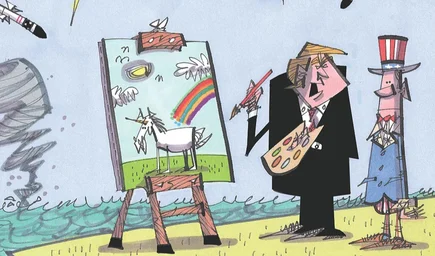
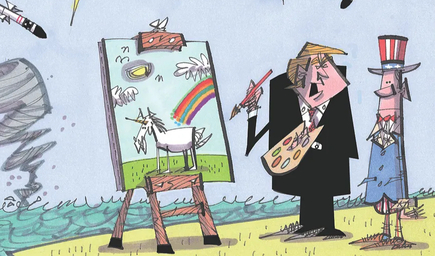
The role of the political cartoonist has evolved in 2026. As Mike Peterson notes, the "multi-panel" format, pioneered by creators like Tom Tomorrow, often struggles to keep pace with a news cycle that produces an overwhelming volume of content.
The Aesthetic of Excess
Cartoonists like David Rowe have adopted a style of "excess" to match the perceived absurdity of the administration’s actions. Rowe’s work often "tap-dances on the line between the sublime and the ridiculous," a necessary approach when the subject matter involves serving fast-food burgers in the White House while ignoring global humanitarian crises.
Understated Sarcasm vs. Hyperbole
In contrast to the loud, visceral style of Rowe, Ann Telnaes has utilized an understated approach. By stripping away the "aura of fame and power" from political figures, Telnaes presents the administration’s actions as they would appear if committed by an average citizen. This "de-mystification" of power serves as a critical tool for public understanding, particularly regarding the "boring" Iran negotiations.
The Grift and the Economy
Supporting data suggests that the public is becoming increasingly weary of the "grift" narrative. The "America 250" controversy is a prime example. While the official America250.org remains the congressionally approved body, the "bogus partisan" organization led by political allies has faced intense scrutiny. This confusion led to the mass cancellation of musical acts who feared their brands would be tarnished by association with a partisan "grift."
Official Responses and Internal Dissent
The response from within the Republican party suggests a growing rift between the executive branch and legislative loyalists.
The Senate "Shouting Match"
The proposal for a $1.8 billion fund for coup-related convicts proved to be a bridge too far for many Republican senators. Reports from the meeting indicate that the rejection was not just a policy disagreement but a visceral reaction to the optics of paying individuals who attacked the seat of government. This internal pushback forced the administration to quietly begin withdrawing the proposal, a move mocked by the comic strip La Cucaracha.
Judicial Setbacks
The court system remains one of the few effective checks on executive overreach in 2026.
- The Kennedy Center Case: The courts denied the President the right to affix his name to the Kennedy Center, a move seen by the administration as a personal affront.
- The Hegseth Policy: A federal court blocked the implementation of a policy designed by Defense Secretary Pete Hegseth to exclude transgender recruits. The court ruled that the policy was discriminatory and lacked a basis in military necessity.
The Health Narrative
Questions regarding the President’s physical and mental fitness have moved from the fringes of social media to mainstream news. Clips of the President "blinking" or appearing to fall asleep during high-level meetings have prompted calls for a full, transparent medical examination. The White House has dismissed these concerns, but poll data suggests that only the most "faithful followers" remain convinced of his fitness for the rigors of the office.
Implications: A Global Shift and Domestic Fatigue
The implications of this week’s events extend beyond the borders of the United States, particularly in the sectors of energy and international trade.
The Energy Transition Paradox
While the U.S. remains mired in debates over gas prices and protectionist tariffs, the rest of the world is moving forward with the electric vehicle (EV) transition.
- Australia: Record levels of EV adoption have been reported. Minister Chris Bowen noted that EV purchases have increased from one every 50 minutes to one every three minutes. This shift is fueled by a massive influx of affordable Chinese EVs.
- Europe: EV sales have surged by 44% since the onset of the conflict in Iran.
- The U.S. Isolation: In the United States, BYD EVs—which retail for roughly $21,000 in Canada—remain prohibited due to high tariffs and regulatory hurdles. This isolationist stance on green technology, while intended to protect domestic industry, has left American consumers vulnerable to fluctuating global oil prices.
The "Faux-Masculinity" Narrative
Culturally, the administration continues to lean into what satirist German mocks as a "cult of faux-masculinity." This narrative, amplified by media figures like Jesse Watters, seeks to weaponize traditional gender roles to distract from policy failures. However, sociologists suggest that this obsession with "manhood" reflects a deep-seated anxiety among the administration’s base, who feel they have little left to make them competitive in a modern, globalized workforce other than their identity.
The Ketchup on the Walls
The metaphor of "ketchup dripping from the walls" of the White House has become a shorthand for executive frustration. With the cancellation of the 250th Anniversary Concert, the rejection of the slush fund by his own party, and the mounting evidence of unethical stock trading, the President enters the second half of 2026 in a defensive posture.
The primary implication for the coming months is a likely increase in "non-operative" rhetoric—claims and proposals that are quickly abandoned when they face the slightest resistance, yet serve to keep the base in a state of constant agitation. As the line between the "sublime and the ridiculous" continues to blur, the role of the satirist remains more vital than ever, providing a necessary lens through which the public can interpret a reality that often defies logic.


Leave a Comment