
Kiraz: The Lost City – A Jewel of HârnWorld, Polished Yet Incomplete
FOR IMMEDIATE RELEASE
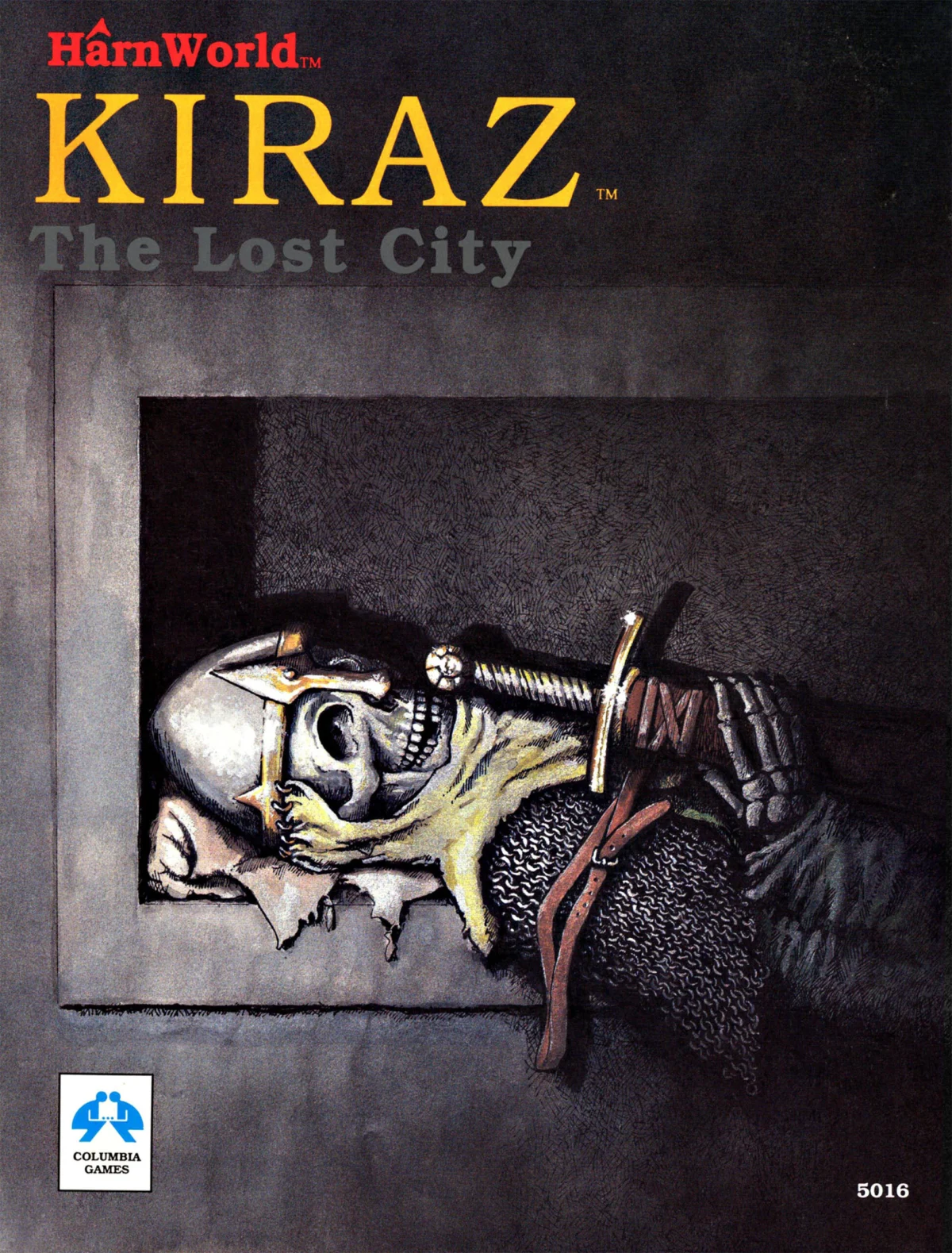
COLUMBIA, MD – October 26, 2023 – In the rich tapestry of tabletop role-playing games, certain supplements achieve legendary status not just for their content, but for the discussions they spark regarding design philosophy. Among these stands Kiraz: The Lost City, a supplement for Columbia Games’ critically acclaimed HârnWorld setting. Originally published in 1989, and revisited in a prominent review from October 2001, Kiraz presents a paradoxical offering: a masterclass in world-building detail marred, for some, by its intentional incompleteness. Described evocatively as "starving yourself for three days, and then eating a pecan," the module is celebrated for the exquisite quality of its developed material, yet simultaneously criticized for the vast stretches of information it leaves to the Game Master’s (GM) imagination.
This duality lies at the heart of Kiraz‘s enduring legacy, making it a pivotal case study in the ongoing debate between providing GMs with comprehensive, ready-to-play content and offering a detailed framework for their own creative expansion.
Main Facts: The Enigma of Kiraz
Kiraz: The Lost City, authored by N. Robin Crossby and published by Columbia Games Inc., serves a dual purpose within the HârnWorld ecosystem. It functions as the second adventure in the In Search of Panaga trilogy of modules, specifically featuring the Horns of Ikaras scenario. More significantly, it acts as a comprehensive sourcebook detailing the ancient dwarven citadel of Kiraz itself. The product’s technical specifications include a 28-page count, a price point of $14.98, ISBN 0-920711-28-6, and product code 5016.
The core of the product, the Kiraz sourcebook, has been lauded for its exceptional detail, logical consistency, and atmospheric quality. Reviewers have consistently praised the "beautiful and superbly executed" maps and the meticulous effort to make the city "make sense," creating a palpable sense of reality for the ancient dwarven stronghold. However, this praise is often tempered by a significant critique: the supplement’s deliberate design methodology, which intentionally omits substantial amounts of information, forcing GMs to undertake considerable developmental work. This approach, while lauded by some for fostering GM creativity, has been a point of contention for those seeking fully fleshed-out modules. The original review, published October 10th, 2001, ultimately assigned high ratings for both Style and Substance (4 out of 5), a testament to the undeniable quality of its present content despite the perceived gaps.
Chronology: From Concept to Critique
The journey of Kiraz: The Lost City begins not just with its publication, but with the established reputation of its publisher and the setting it supports.
HârnWorld: A Foundation of Detail
Before delving into Kiraz, it’s crucial to understand HârnWorld. Launched in the early 1980s, HârnWorld quickly distinguished itself from other fantasy RPG settings through its unparalleled commitment to realism, historical verisimilitude, and intricate detail. Columbia Games, known for its meticulous approach to world-building, fostered a setting where geography, politics, economics, religion, and culture were meticulously crafted. This level of detail often attracted a specific kind of GM and player – those who relished deep immersion and a grounded fantasy experience. This context is vital, as Kiraz was designed to fit seamlessly into this rich, established world, adhering to the same high standards of logical consistency and believable lore.
The Genesis of Kiraz: A Pragmatic Union (1989)
Kiraz: The Lost City was first published in 1989. Its creation, as revealed by author N. Robin Crossby in his preface, was a fascinating convergence of publisher demands and creative ambition. Crossby recounted:
"It was like this: Columbia wanted me to do Kiraz, and I wanted to complete the next volume of In Search of Panaga. Both modules were late. So, I thought, why not set the Horns of Ikarus in the Lost City?"
This candid insight into the development process sheds light on the product’s dual nature. What began as two separate projects — a dedicated sourcebook for Kiraz and the second installment of the In Search of Panaga adventure trilogy — were merged out of necessity and efficiency. This merger, while pragmatic, inherently shaped the final product, potentially influencing the balance between setting detail and adventure completeness. The decision to integrate an adventure into what was primarily conceived as a sourcebook created a unique hybrid, one that would later be scrutinized for its effectiveness in both roles.
The 2001 Review: A Retrospective Assessment
More than a decade after its initial release, Kiraz: The Lost City came under the critical lens of a reviewer on October 10th, 2001. This review offers a valuable retrospective look at the product, assessing its strengths and weaknesses from a perspective that had the benefit of the module having been in circulation for some time. The reviewer candidly admitted to being "largely unqualified to review the adventure portion of this product" due to not owning the first or third parts of the trilogy. However, this was deemed "not a major impediment" because the reviewer’s primary interest, and indeed the bulk of the book, lay in the Kiraz source material. This framing underscores the prevailing sentiment that Kiraz‘s strength was always its setting material, with the adventure being a secondary, and less complete, component.
Supporting Data: Deconstructing the Dwarven Citadel
The 28-page Kiraz: The Lost City module is meticulously structured, offering various components that contribute to its overall utility and, for some, its frustration. It is comprised of three main articles/modules: "Kiraz" (14 pages), "Ushet" (4 pages), and "Horns of Ikaras" (5 pages). Additionally, it features two pages of full-color illustrations, including maps of the surrounding areas and visual aids for players, along with two blank "GM Notes" pages.
KIRAZ: The Heart of the Module
This 14-page section is undeniably the core of the book and the primary reason for its enduring appeal. It unveils Kiraz as the venerable and oldest dwarven citadel in Hârn, a colossal complex that once epitomized dwarven civilization. Its tragic downfall approximately six centuries prior, during Lothrim the Foulspawner’s siege with his orc army, left the city sealed away, a somber monument to "dark memories." While most halls lie deserted, some lower levels have seen renewed occupation by orcs, setting the stage for potential adventures.
The "Kiraz" section breaks down as follows:
- History and Surroundings (3 pages): Provides a concise yet compelling overview of Kiraz’s past and the current geopolitical and geographical landscape around the ancient city. This contextualization is crucial for GMs integrating Kiraz into a broader Hârn campaign.
- Complex Overview (1 page summary, 1 page cut-away map): A high-level view of the entire dwarven complex, offering a sense of its immense scale and intricate layout. The cut-away map is a significant visual aid, allowing GMs to grasp the city’s verticality and interconnectedness.
- Detailed Area Breakdowns: The bulk of this section is dedicated to specific, major areas within the city, each receiving a one-page summary and accompanying map. These include:
- The High Halls: Once the vibrant center of royal and governmental power, housing the Great Hall, Royal Apartments, and Council Chamber.
- Gallreda Complex: A residential district designed for officers of the royal government, including the Hall of Galreda and the Hall of Zelanthu.
- West Gate: The primary entry point to the city, suggesting its historical importance for trade and defense.
- Ranzad Complex: Described as the largest cavern in Kiraz, this area served as the bustling marketplace and social heart of the city, hinting at its past vibrancy.
- Minehead: As its name suggests, this was the industrial nexus, providing access to the mines, workshops, and ore storage facilities.
- The Catacombs: A solemn area encompassing communal graves and the sacred Royal Tombs. Crucially, it also houses the Hall of the Godstone, an ancient earthmaster site predating dwarven civilization and considered the "birthplace of the Hârnic Khuzdul [dwarves]." This site adds immense historical and mythological depth to the city.
- GM Development and Artifacts (3 pages): An additional page guides GMs on how to further develop the presented material, while two pages detail several artifacts and special locations that can be strategically placed throughout Kiraz, encouraging customization.
The critical consensus on this section is overwhelmingly positive. Reviewers have highlighted the "excellent," "beyond par" quality of the content, emphasizing the "beautiful and superbly executed" maps and the "meticulous" logic and detail embedded in the city’s design. The author’s refusal to "simply wave his hands" in Kiraz’s construction results in a setting that feels genuinely plausible. As the original review states, "By the time you are done reading through this article, you will have the sense that a place like Kiraz really could exist. This is, by no means, a small or unvaluable accomplishment."
USHET: The Gateway and the Template
The four-page "Ushet" article details the Rock of Ushet, a former dwarven hunting lodge connected to Kiraz via spent mining tunnels. Following the fall of Kiraz, its entrance was sealed, only to be recently breached and occupied by orcs. This section serves two primary functions:
- Adventure Entry Point: Ushet acts as the designated point of entry to Kiraz for characters embarking on "The Horns of Ikaras" adventure.
- Generic Template: Given the numerous dwarven hunting lodges scattered around Kiraz, Ushet is presented as a generic template. GMs can adapt its layout and details for other similar locations, facilitating encounters between barbarian tribes (both orcs and humans) in the surrounding wilderness.
While not as grand in scope as Kiraz itself, the Ushet section is regarded as "solid material" and "very useful" both as a specific location and a versatile generic resource.
HORNS OF IKARAS: An Adventure in Outline
This five-page section, intended as the second part of the In Search of Panaga trilogy, is where the product receives its most pointed criticism. The reviewer, despite acknowledging a lack of familiarity with the first part of the trilogy, found himself "thoroughly unimpressed." The reason? It functions more as a four-page outline than a fully realized adventure.
The "Horns of Ikaras" section comprises:
- A one-page summary of events from the first adventure.
- A one-page detailed description of the NPC who provides the adventure hook.
- One page of player handouts.
- A brief, one-page summary of the adventure itself.
The adventure’s plot, as distilled by the reviewer, is remarkably succinct: "Several months have passed since the last adventure. The PCs should have heard some rumors about the Big Bad Guy’s activities (kidnapping three beautiful women, stealing some rare animals, and burning town officials in Aleath). They go to Kiraz – most likely gaining entrance via Ushet – where they need to find a key to gain access to the room where the Horn is kept." This brevity highlights the perceived lack of actionable content for a GM expecting a ready-to-run scenario.
Official Responses: Design Philosophy Under Scrutiny
The central tension within Kiraz: The Lost City arises directly from its stated design philosophy, which can be interpreted as Columbia Games’ "official response" to how their modules should function.
The Publisher’s Stance: Room for Customization
The design methodology explicitly outlined in the module states:
"In keeping with our long term policy, there is lots of room for the GM to customize his own version of the Golden City – even if a player should get hold of a copy of this module, it won’t help him much."
This statement reveals a deliberate choice to prioritize GM agency and replayability over complete, pre-written narratives. The intention was to provide a robust, detailed framework – a sandbox – within which GMs could craft their unique stories, ensuring that even players who had read the module wouldn’t gain an unfair advantage. This approach aligns with a particular school of RPG design that values setting over plot, providing evocative elements and allowing GMs to weave them into their campaigns as they see fit.
The Reviewer’s Counter-Argument: The Burden of Creation
However, this design philosophy met with strong opposition from the reviewer, who articulated a common sentiment among GMs:
"Folks, this just doesn’t cut it for me. The whole point of buying a supplement is so that I don’t have to do design work. Certainly keeping snoopy players on their toes is a laudable goal – but if I want to do that, I am quite capable of changing information. In fact, changing and rearranging information is vastly easier than being forced to create material out of wholecloth."
This perspective highlights the practical realities of GMing. While the idea of a highly customizable setting is appealing in theory, the time constraints and creative demands on GMs often lead them to seek products that minimize prep work. The distinction between modifying existing content and generating entirely new material from scratch is crucial. For many GMs, paying for a supplement implies a desire for a significant reduction in their own creative burden, a promise that Kiraz only partially fulfilled.
The Re-evaluation of Substance: A Reviewer’s Reflection
Interestingly, the original reviewer revisited his own assessment years later, providing an additional layer of "official response" from the critical perspective:
"Rereading this review, I was somewhat surprised to discover that I’d given it a rating of 4 in Substance. Flipping through my copy of the book, though, I understand where I was coming from: It was a little on the pricey side for 30 pages of material, but there’s a lot of great stuff in here and the maps are truly spectacular. The problems aren’t what’s on the page; it’s the mismatch between the scope of the product and the scope needed by the subject matter."
This reflection clarifies that the high Substance rating wasn’t an oversight but a recognition of the sheer quality of the developed content. The issue was never the excellence of what was provided, but rather the volume of what was not provided, especially given the monumental subject matter of a "Lost City." This "mismatch" points to a fundamental disagreement between the product’s intended scope and the reviewer’s expectation of what a supplement for such a significant location should deliver.
Implications: The Legacy of a Partial Masterpiece
The release and reception of Kiraz: The Lost City carry several significant implications for RPG design, GM practices, and the enduring appeal of the HârnWorld setting.
The Sandbox vs. Guided Adventure Debate
Kiraz stands as an early and prominent example of the ongoing debate within the RPG community: should modules be highly detailed sandboxes, offering a rich environment for GMs to populate, or should they be more guided, pre-written adventures that require minimal GM preparation? Kiraz‘s design firmly placed it in the former camp for its sourcebook components, while its adventure section leaned towards an outline. This dichotomy forced GMs to confront their own preferences and capabilities. For those who relish extensive world-building and customizing every detail, Kiraz was a treasure trove of inspiration. For those with limited prep time or a preference for ready-to-run scenarios, it was a frustratingly incomplete experience.
GM Burden and Value Proposition
The reviewer’s strong stance on the "design work" burden highlights a critical aspect of the value proposition for RPG supplements. GMs purchase modules to enhance their campaigns and, often, to reduce the amount of original content they need to create. When a module provides a magnificent shell but leaves the interior largely unfurnished, it shifts the creative labor back to the GM. While some GMs find this liberating, others view it as an unfulfilled promise for a paid product. This raises questions about how publishers communicate the nature of their products and how GMs manage their expectations.
Longevity and Reusability
Paradoxically, the very "incompleteness" of Kiraz‘s adventure elements might contribute to the longevity and reusability of its source material. Because the core setting is so meticulously crafted and largely unattached to a specific, tightly-scripted plot, GMs can easily adapt Kiraz for countless adventures across different campaigns. The detailed history, geography, and distinct districts of the dwarven city provide a robust foundation for various narratives, whether they involve delving into ancient mysteries, reclaiming lost treasures, or battling occupying forces. The "blank canvas" aspect, while initially frustrating, allows Kiraz to remain fresh and adaptable for decades.
Influence on HârnWorld and Columbia Games
Within the HârnWorld community, Kiraz: The Lost City remains a seminal work. Its detailed portrayal of the dwarven civilization’s pinnacle and tragic fall adds immense depth to the setting’s lore. It solidified Columbia Games’ reputation for meticulous world-building, even as it occasionally pushed the boundaries of what GMs expected from a published module. The ongoing discussion surrounding Kiraz likely influenced subsequent HârnWorld releases, potentially leading to a more balanced approach between providing rich setting details and offering more fully developed adventure hooks or scenarios.
Modern RPG Design Parallels
The debates sparked by Kiraz resonate strongly with contemporary discussions in RPG design. Modern products often strive for a middle ground, offering rich setting descriptions alongside modular adventure components that GMs can easily adapt or expand. The rise of "sandbox" playstyles and tools for procedural generation also speaks to the desire for adaptable content, acknowledging that GMs appreciate both pre-made excellence and the freedom to customize. Kiraz, in many ways, was ahead of its time in presenting a highly detailed sandbox, even if its adventure component suffered from the same design philosophy.
Conclusion: A Feast for the Imagination, A Famine of Plot
Kiraz: The Lost City remains a fascinating and highly recommended, albeit controversial, artifact of tabletop RPG history. Its strengths lie unequivocally in its superb world-building, its meticulously detailed dwarven citadel, and the sheer evocative power of its descriptions and maps. It is a testament to N. Robin Crossby’s genius for creating believable, immersive environments that truly feel like living, breathing places steeped in history. For those seeking to integrate a dwarven citadel of unparalleled quality into their campaigns, or for any HârnWorld enthusiast, Kiraz is an indispensable resource.
However, its legacy is also intertwined with the candid critique of its intentional incompleteness, particularly concerning its adventure outline. The famous analogy — "starving yourself for three days and then eating a pecan" — perfectly encapsulates the experience: the taste of quality is undeniable, but it leaves one hungry for more. This tension between sublime detail and significant gaps defines Kiraz‘s unique place in RPG lore. It is a product that demands effort from its GM, but rewards that effort with a foundation of extraordinary depth and realism. Ultimately, Kiraz: The Lost City stands as a powerful reminder that even partial masterpieces can profoundly shape the landscape of imaginative play, leaving an indelible mark on the worlds they describe and the players who dare to explore them.


Leave a Comment