
The Dexterity Breakthrough: How Eka’s AI is Solving Robotics’ Most Intransigent Challenge
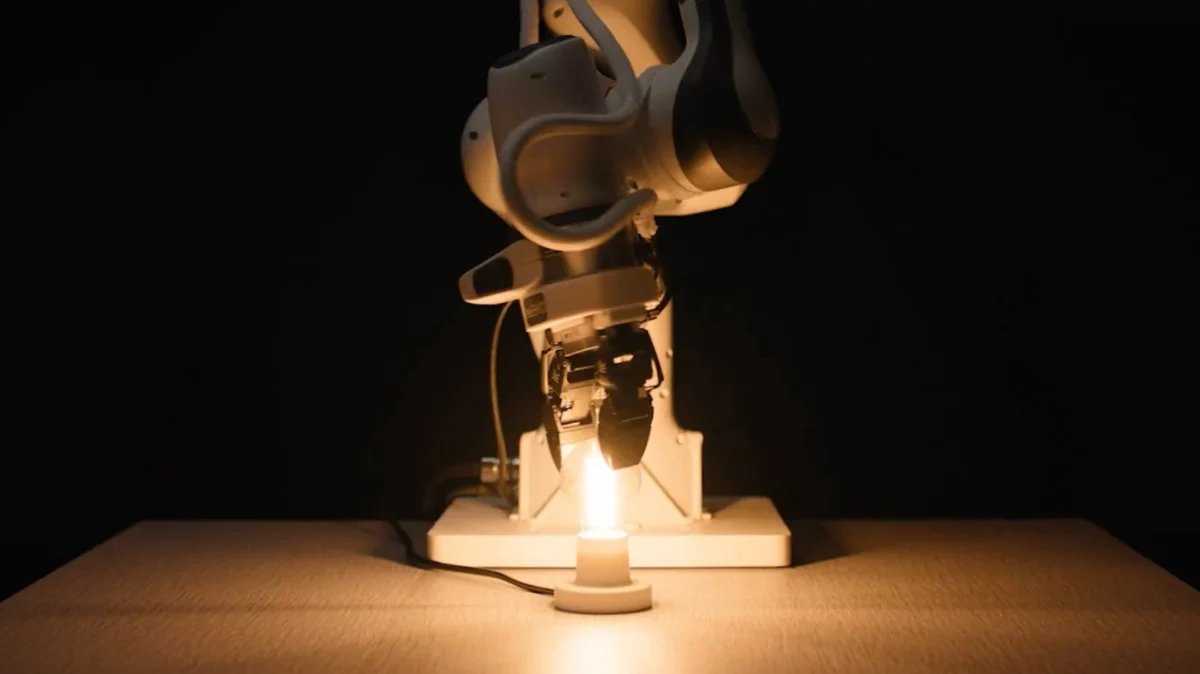
For decades, a classic joke has circulated among engineers: "How many robots does it take to screw in a lightbulb?" Until recently, the answer was a frustrating "zero." While industrial robots have long mastered the art of lifting heavy car chassis or welding steel with micron-level precision, they have remained notoriously clumsy when faced with the mundane complexities of the human world. The simple act of grasping a strawberry without crushing it, or fumbling for a set of keys in a pocket, represents a "dexterity bottleneck" that has kept full-scale automation at bay in sectors ranging from agriculture to domestic service.
However, a technological shift is underway in Cambridge, Massachusetts. Eka, a robotics startup founded by luminaries from MIT and Google DeepMind, is unveiling a new approach to robotic tactile intelligence. By moving beyond mere visual imitation and into the realm of physical forces, Eka’s "Vision Force Action" (VFA) model aims to provide the "ChatGPT moment" for physical machines. If successful, the implications will reach far beyond the laboratory, potentially transforming the global labor market and the trillions of dollars currently tied to manual human dexterity.
The Main Facts: Defining the Dexterity Gap
The fundamental challenge in robotics has never been strength; it has been sensitivity. Most contemporary robotic arms operate on pre-programmed paths or "Vision-Language-Action" (VLA) models. These systems are trained on massive datasets of video, teaching a robot to recognize an object and move toward it. However, these models often lack a sense of "touch." When a robot trained only on vision encounters a material that is slippery, squishy, or oddly weighted, it lacks the haptic feedback loop required to adjust its grip in real-time.
Eka, led by MIT professor Pulkit Agrawal and former Google DeepMind researcher Tuomas Haarnoja, is tackling this by introducing the "Vision Force Action" (VFA) framework. Unlike its predecessors, VFA integrates the physics of touch—mass, inertia, and friction—directly into the AI’s decision-making process. The result is a robotic appendage that does not just "see" a task but "feels" its way through it. Recent demonstrations have shown Eka’s hardware performing tasks once thought impossible for general-purpose robots: sorting irregularly shaped chicken nuggets on a moving conveyor belt, retrieving a single strawberry from a human palm, and, yes, successfully screwing in a lightbulb.
Chronology: From Rigid Automation to Fluid Intelligence
The journey toward dexterous robotics has moved through three distinct eras:
- The Era of Rigid Automation (1960s–2010s): This period was defined by the "Unimate" style of robotics. These machines were fast and powerful but blind and "numb." They succeeded in controlled environments, like automotive assembly lines, where every part was exactly where it was expected to be.
- The Vision Revolution (2010s–2023): With the rise of deep learning, robots gained "eyes." Using cameras and AI, they could begin to identify objects. However, they remained prone to the "sim-to-real gap"—the difficulty of translating a clean computer simulation into the messy, unpredictable physical world.
- The Haptic/Force Era (2024–Present): This is the stage Eka is currently spearheading. By utilizing reinforcement learning and physics-based simulations, the focus has shifted from what a robot sees to how it interacts with the physical laws of nature.
Founded by Agrawal and Haarnoja, Eka emerged from the high-pressure research environments of MIT’s Improbable AI Lab and the cutting-edge reinforcement learning divisions of Google. Their goal was to move past the "data hunger" of VLA models, which require millions of hours of human video to learn a simple task, and instead create a system that understands the "rules" of the physical world.
Supporting Data: The Physics of the "Sim-to-Real" Gap
To understand why Eka’s approach is revolutionary, one must look at the data problem. Training a robot to pick up a strawberry using traditional methods requires a gargantuan amount of visual data. A strawberry can be ripe or rotten, wet or dry, large or small. It can be buried under other berries or sitting on a reflective surface. To account for every variable, researchers would theoretically need to feed a model billions of images.
Eka bypasses this by using high-fidelity simulations that incorporate the laws of physics. In these virtual environments, the AI "practices" for thousands of hours in a matter of seconds.
- Mass and Inertia: The VFA model calculates how the weight of an object shifts as it moves.
- Tactile Feedback: Eka’s custom pinchers are equipped with sensors that provide a "sense of feel," allowing the AI to detect if an object is slipping before it actually falls.
- Improvisational Learning: In a recent report by Wired, journalist Will Knight observed the Eka arm sorting chicken nuggets. Unlike traditional robots that might freeze if a nugget was positioned awkwardly, the Eka arm took "a few nips"—adjusting its grip mid-action—to complete the task.
This "force-centric" data allows the robot to bridge the sim-to-real gap. Because the AI understands the physics of a strawberry rather than just the image of one, it can handle a berry it has never seen before with the same grace as a human picker.
Official Responses and Expert Perspectives
The leadership at Eka views their work not just as an engineering feat, but as a fundamental shift in how humanity interacts with the physical world. Pulkit Agrawal has stated that the VFA model creates "a new foundation uniting performance, generality, and safety for putting capable robots in everyone’s hands."
However, it is Agrawal’s more candid remarks that have caught the attention of economists. In an interview with Wired, Agrawal noted that the "biggest problem in the world to be solved" was the fact that "trillions of dollars flow through the human hand." From an engineering perspective, this refers to the untapped potential of automating the service, agricultural, and domestic sectors. From a labor perspective, it is a stark admission of the target: the manual tasks currently performed by billions of human workers.
Industry experts are watching closely. The robotics landscape is already shifting rapidly, particularly in China. "Dark factories"—facilities that operate entirely without human intervention—are already producing smartphones for brands like Xiaomi. Until now, these factories were limited to rigid electronic components. The introduction of Eka-style dexterity would allow these "dark factories" to expand into food processing, textile manufacturing, and delicate assembly.
Implications: Dexterity, Displacement, and the Future of Work
The emergence of dexterous robotics brings a dual promise of unprecedented productivity and significant economic disruption.
The Economic Promise
The potential for industrial automation at scale is staggering. In the agricultural sector, the ability to automate the harvesting of delicate fruits (like raspberries or strawberries) could solve chronic labor shortages and reduce food waste. In the logistics sector, robots capable of "feeling" their way through a cluttered warehouse could operate 24/7 with a level of efficiency humans cannot match. Eka believes they are "halfway there" in terms of achieving the level of mastery required for these massive shifts.
The Labor Crisis
The social implications are more sobering. According to a 2024 report from Goldman Sachs, approximately 300 million jobs globally are "exposed" to AI automation. While initial fears focused on "white-collar" generative AI (like ChatGPT), the "blue-collar" equivalent is now arriving in the form of dexterous pinchers.
The World Economic Forum’s Future of Jobs Report suggests that 58% of employers expect robotics to transform their business models by 2030. If a robot can handle a chicken nugget, it can eventually handle a surgical tool, a sewing needle, or a delicate electronic repair. As Agrawal noted, the "problem" of money flowing through human hands is exactly what these machines are designed to solve—by diverting that flow toward the owners of the automated capital.
The "Claw-Sized Hole"
As Eka scales its technology from the lab in Cambridge to the global factory floor, the conversation must shift from "Can they do it?" to "What happens when they do?" The "dexterity problem" was one of the last remaining moats protecting human labor from total automation. As that moat evaporates, the global economy will face a reckoning.
Eka’s robots are marketed as "mastery alongside humans," but the trajectory of the technology suggests a replacement rather than a partnership. The same "pinch" that can gently retrieve a strawberry is the same "pinch" that may soon be felt in the wallets of manual laborers worldwide. The question is no longer how many robots it takes to screw in a lightbulb, but rather, what will the humans do once the robots no longer need our help to do it?



Leave a Comment