Unveiling the Ancient Tapestry: "Fascinating Folklore" Explores Myths from Aspidochelone to Anteros
London, UK – From the depths of ancient seas to the intricate chambers of the human heart, folklore continues to captivate and instruct. A groundbreaking new compendium, "Fascinating Folklore," is set to become an essential guide for enthusiasts and newcomers alike, offering an unprecedented journey into the world of myths, legends, and forgotten tales. Crafted by the renowned comic world luminaries John Reppion and PJ Holden, this ambitious project began as a creative pact, ignited by the popular #FolkloreThursday hashtag, and has since blossomed into an extraordinary collection that marries scholarly insight with breathtaking graphic narration.
Published by Liminal11, "Fascinating Folklore" is more than just a book; it’s a sensory feast, where rich and informative essays dance hand in hand with evocative comics. This unique format offers an unparalleled pathway into the enchanting realm of folklore, promising to leave readers spellbound by the sheer depth and diversity of human storytelling traditions.
The Genesis of "Fascinating Folklore": From Hashtag to Heavyweight Compendium
The collaborative brainchild of John Reppion and PJ Holden, "Fascinating Folklore" emerges from a shared passion for the arcane and the narrative power of myth. Reppion, a celebrated writer known for his work in comics and horror, brings a meticulous researcher’s eye to the project, delving into the historical and cultural contexts of each tale. Holden, an acclaimed artist whose distinctive style has graced numerous comic book pages, translates these narratives into stunning visual sequences, breathing new life into ancient figures and forgotten landscapes.
Their journey began, as many modern cultural phenomena do, with a hashtag. #FolkloreThursday, a vibrant online community dedicated to sharing and discussing folklore from around the globe, served as the initial spark. What started as an informal exchange of ideas between the two creators soon evolved into a more structured endeavor, recognizing the immense potential in compiling and presenting these diverse stories in an accessible yet profound manner. The book’s development underscores the power of digital communities in fostering creative projects that bridge traditional scholarship with contemporary artistic expression.
This innovative approach positions "Fascinating Folklore" as a significant contribution to the field, making complex mythological narratives palatable and engaging for a broad audience. It moves beyond simple retellings, instead opting for a multi-layered experience where the written word and visual art complement each other, enhancing understanding and appreciation for the intricacies of folklore.
Unearthing Ancient Narratives: A Journey Through Time
The scope of "Fascinating Folklore" is vast, traversing continents and millennia to bring forth legends that resonate with universal themes of heroism, love, vengeance, and the mysterious forces of nature. The book promises to delve into the legends of historical figures like Boudicca, the iconic Iceni queen who led a rebellion against Roman rule, and the epic hero Beowulf, whose battles against monstrous foes form the bedrock of Old English literature. Beyond these well-known figures, the compendium explores the enthralling world of plantlore, where Mandrake, Willow, and Yedua whisper secrets of ancient wisdom, revealing the magical and medicinal properties attributed to flora across different cultures.
But it is in the exploration of more obscure yet equally compelling narratives that the book truly shines. Readers will encounter haunting ghosts like Okiku, the Japanese vengeful spirit, the enigmatic Wandjing spirits of Western Australia, and the resolute deity Anteros, the often-overlooked guardian of slighted love. Each entry serves as a portal to a distinct cultural worldview, demonstrating the incredible diversity and enduring power of human imagination.
Deep Dives into Enchanting Lore: Excerpts from "Fascinating Folklore"
The Deceptive Isle: Aspidochelone and the Zaratan
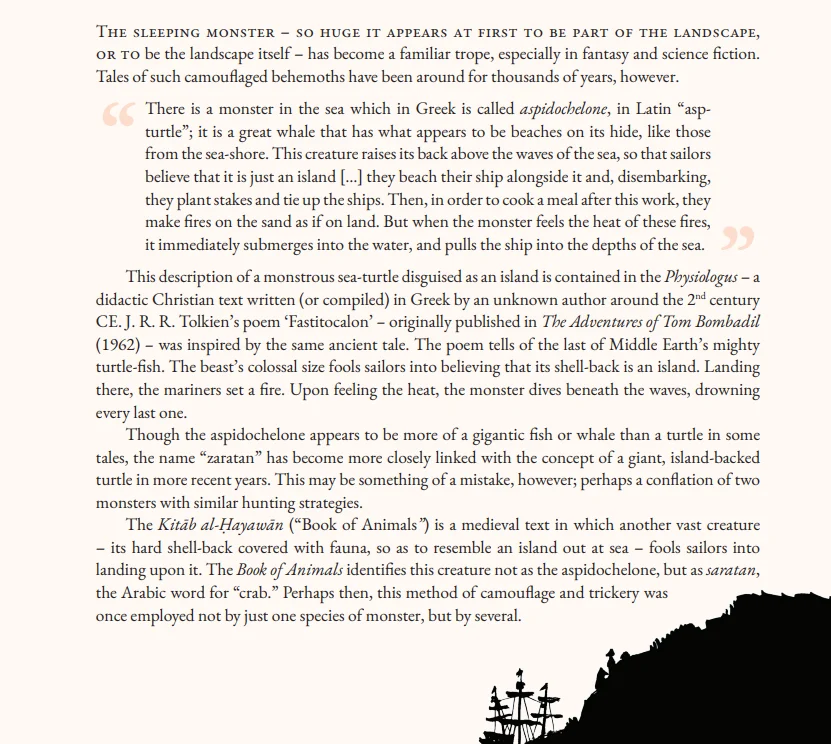
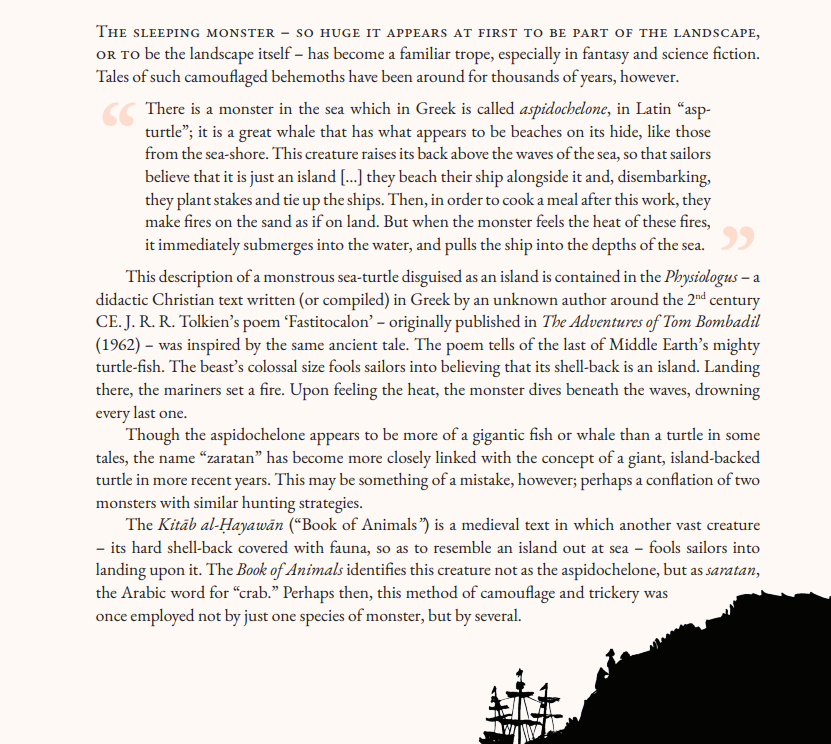
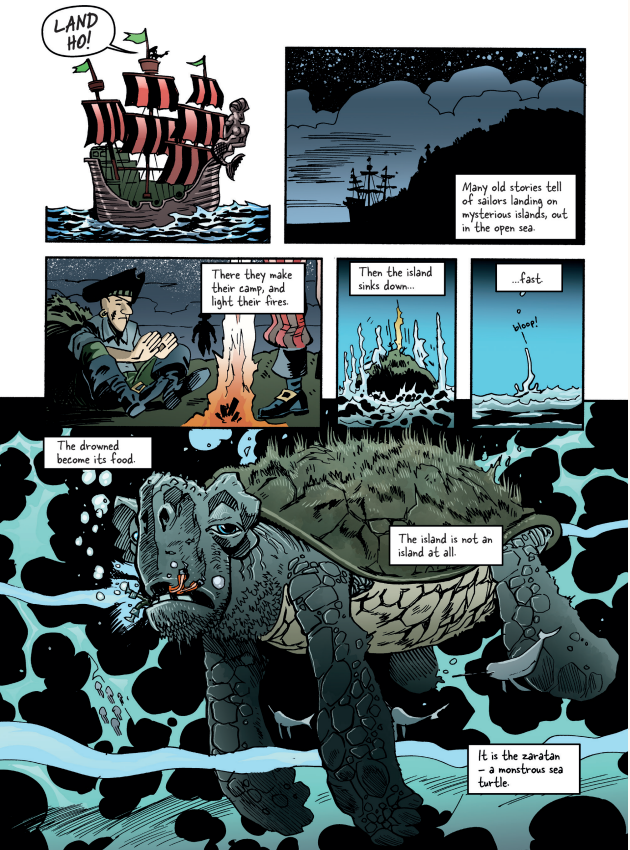
One of the book’s most captivating entries explores the legend of the aspidochelone, a monstrous sea creature so immense that it is mistaken for an island. The excerpt details:
"There is a monster in the sea which in Greek is called aspidochelone, in Latin ‘asp-turtle’; it is a great whale that has what appears to be beaches on its hide, like those from the sea-shore. This creature raises its back above the waves of the sea, so that sailors believe that it is just an island […] they beach their ship alongside it and, disembarking, they plant stakes and tie up the ships. Then, in order to cook a meal after this work, they make fires on the sand as if on land. But when the monster feels the heat of these fires, it immediately submerges into the water, and pulls the ship into the depths of the sea."
This chilling tale of the sleeping monster, so huge it appears to be part of the landscape, or even the landscape itself, has become a familiar trope, especially in fantasy and science fiction. However, tales of such camouflaged behemoths have existed for thousands of years. This particular description originates from the Physiologus, a didactic Christian text written (or compiled) in Greek by an unknown author around the 2nd century CE. The Physiologus was an influential work that described animals, real and mythical, and then offered allegorical interpretations, often connecting them to Christian doctrine. The aspidochelone, in this context, served as a powerful metaphor for the devil, who deceives unwary souls into a false sense of security before dragging them into perdition.
The legend of the island-whale found its way into medieval bestiaries and literature, evolving over centuries. J.R.R. Tolkien’s poem "Fastitocalon," originally published in The Adventures of Tom Bombadil (1962), was directly inspired by this ancient tale. Tolkien’s poem tells of the last of Middle-earth’s mighty turtle-fish, whose colossal size fools sailors into believing its shell-back is an island. Landing there, the mariners set a fire, and upon feeling the heat, the monster dives beneath the waves, drowning every last one. This illustrates the myth’s enduring appeal and its adaptability across different narrative universes.
While the aspidochelone often appears as a gigantic fish or whale, the name "zaratan" has become more closely linked with the concept of a giant, island-backed turtle in recent years. The book clarifies that this might be a conflation of two distinct monsters with similar hunting strategies. The Kitāb al-Ḥayawān ("Book of Animals"), a medieval Arabic text, describes another vast creature – its hard shell-back covered with fauna, resembling an island – that fools sailors. However, this text identifies the creature not as an aspidochelone, but as saratan, the Arabic word for "crab." This suggests that the method of camouflage and trickery, preying on human gullibility and the vastness of the sea, was perhaps employed by several species of mythical monsters across different cultures.
Anteros: The God of Reciprocated Affection and Vengeance
While most are familiar with Eros, the winged god of desire who evolved into the cherubic Cupid, his brother, Anteros, remains significantly less known. "Fascinating Folklore" sheds light on this intriguing deity:
"Anteros’ name means ‘love returned,’ and he was charged with the task of punishing those who did not return the affections of another."
Anteros’ lineage traces back to Aphrodite, the ancient Greek goddess of love, beauty, pleasure, passion, and procreation. With Ares, the god of war, Aphrodite bore several children known as the Erotes – winged gods who assisted their mother in her earthly duties as deities of love. While Eros governed love and sex, his brothers had more specific roles: Hedylogos (sweet talk), Pothos (longing), Hymenaeus (weddings), and Hermaphroditus (fertility).
Anteros, however, held a unique and powerful position. His name, derived from Greek ἀντέρως (antérōs), meaning "counter-love" or "love returned," defines his dual nature. He was not merely the embodiment of reciprocated affection but also the avenger of unrequited or slighted love. According to texts like Thomas Swinburne Carr’s A Manual of Classical Mythology (1846), Anteros was depicted contending with Eros in the palaestra at Elis, symbolizing the rivalry between lovers or the dynamic of love’s ebb and flow. Lore suggests that Eros only grew in strength and acquired his full wings when Anteros was born, implying that love can only truly flourish when it is returned. Anteros was often armed with arrows of lead or a club of solid gold, tools for meting out justice to those who scorned genuine affection.
The similarities between Anteros and Eros are so striking that they are often mistaken for each other. A prime example highlighted in the book is the famous statue atop the Shaftesbury Memorial Fountain in Piccadilly Circus, London. Widely known as "Eros" for decades, this first sculpture in the world to be cast in aluminum (1892) actually represents Anteros. The god was chosen to symbolize "love given blindly, or without expectation of return," as a metaphor for the philanthropy of Lord Shaftesbury, to whom the fountain is dedicated. This fascinating detail underscores how historical context and popular perception can shape, and sometimes misdirect, our understanding of ancient deities.
Okiku: The Haunting Echo of Injustice
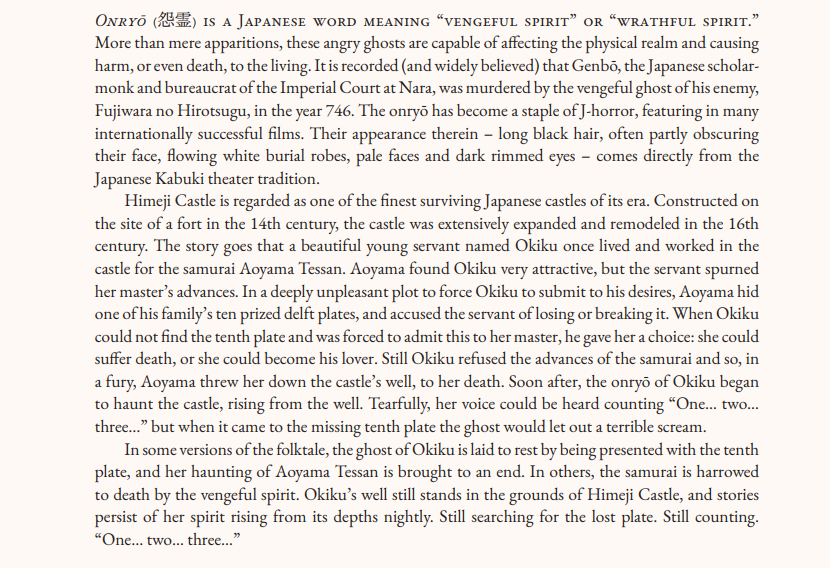
From the serene yet haunting grounds of Himeji Castle comes the tale of Okiku, a spectral figure whose story forms a cornerstone of Japanese folklore and has profoundly influenced modern horror. The book recounts:

"The story goes that a beautiful young servant named Okiku once lived and worked in the castle for the samurai Aoyama Tessan. Aoyama found Okiku very attractive, but the servant spurned her master’s advances. In a deeply unpleasant plot to force Okiku to submit to his desires, Aoyama hid one of his family’s ten prized delft plates, and accused the servant of losing or breaking it. When Okiku could not find the tenth plate and was forced to admit this to her master, he gave her a choice: she could suffer death, or she could become his lover. Still, Okiku refused the advances of the samurai and so, in a fury, Aoyama threw her down the castle’s well, to her death. Soon after, the onryō of Okiku began to haunt the castle, rising from the well. Tearfully, her voice could be heard counting ‘One… two… three…’ but when it came to the missing tenth plate the ghost would let out a terrible scream."
Okiku is an onryō (怨霊), a Japanese word meaning "vengeful spirit" or "wrathful spirit." More than mere apparitions, these angry ghosts are capable of affecting the physical realm, causing harm, or even death, to the living. The concept of the onryō is deeply embedded in Japanese history, with records of powerful figures like Genbō, a scholar-monk, being allegedly murdered by the vengeful ghost of his enemy, Fujiwara no Hirotsugu, in 746 CE.
The onryō has become a staple of J-horror, featuring prominently in internationally successful films such as Ringu (The Ring) and Ju-On (The Grudge). Their iconic appearance – long black hair often partly obscuring their face, flowing white burial robes, pale faces, and dark-rimmed eyes – comes directly from the Japanese Kabuki theater tradition, where Okiku’s story, known as "Banchō Sarayashiki" (The Dish Mansion of Banchō), was a popular play.
Himeji Castle, one of Japan’s finest surviving castles, constructed on the site of a 14th-century fort and extensively remodeled in the 16th century, serves as the real-world backdrop for Okiku’s tragedy. The well from which her spirit is said to rise still stands on the castle grounds, a chilling testament to the enduring power of her legend. Okiku’s story is a harrowing tale of injustice, sexual coercion, and murder, highlighting the vulnerable position of servants in feudal society. In some versions of the folktale, her ghost is eventually laid to rest when the missing tenth plate is presented, ending her torment. In others, the samurai Aoyama Tessan is haunted to his death by the relentless spirit. Regardless of the ending, Okiku’s spirit, endlessly counting and screaming for her lost plate, remains a potent symbol of unresolved suffering and righteous vengeance.
Critical Reception and Cultural Impact
"Fascinating Folklore" enters a vibrant landscape of cultural interest in mythology and legend. The unique blend of scholarly essays and comic book art positions it to appeal to a broad demographic, from academic researchers to casual readers and fans of graphic novels. Liminal11, known for its focus on esoteric and magical themes, is an ideal publisher for a work that seeks to illuminate the hidden corners of human belief systems.
The individual folklore entries themselves boast a rich history of cultural impact. The aspidochelone, for instance, has not only inspired literary giants like Tolkien but also found its way into popular culture, influencing fantastical creatures in role-playing games and modern narratives. Its allegorical depth ensures its continued relevance in discussions of deception and hidden dangers.
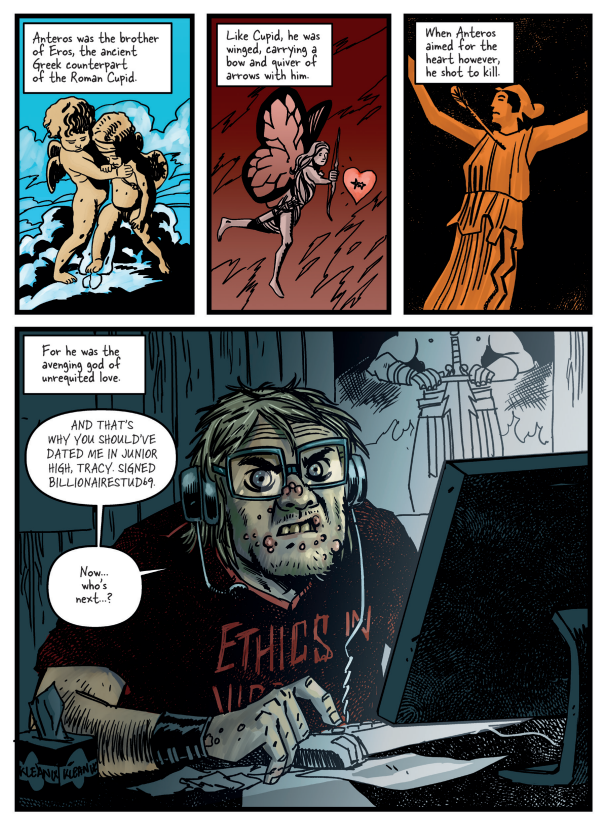
Anteros, despite his relative obscurity compared to Eros, represents a profound concept in human relationships: the necessity of reciprocation for love to truly flourish. His presence in classical scholarship and art, even when misidentified, underscores the ancient Greeks’ nuanced understanding of emotional dynamics. The continued debate around the Piccadilly Circus statue serves as a tangible reminder of the complex interplay between myth, art, and public perception.
Okiku, however, arguably has the most pervasive modern cultural impact among the three examples. Her archetype as a wronged female spirit seeking vengeance has become a cornerstone of Japanese horror, transcending national borders. The onryō, with its distinct visual motifs and unsettling psychological terror, is now instantly recognizable globally. Her story, and others like it, serve not only as entertainment but also as a powerful cultural commentary on injustice, societal pressures, and the lasting consequences of cruelty. The enduring belief in such spirits, particularly in sites like Himeji Castle, highlights the deep-seated connection between folklore and collective memory.
The Enduring Resonance of Folklore: Implications for the Modern World
"Fascinating Folklore" is more than just a collection of old stories; it’s an exploration of the human condition itself. Folklore serves as a mirror, reflecting our deepest fears, our highest aspirations, our moral frameworks, and our understanding of the natural and supernatural worlds. In an increasingly globalized and digital age, the role of such narratives becomes even more critical. They offer a connection to cultural roots, provide moral lessons without explicit dogma, and offer psychological insights into universal human experiences.
Reppion and Holden’s compendium makes these ancient tales accessible and engaging, bridging the gap between academic study and popular interest. The choice to combine detailed textual essays with graphic narratives is particularly astute, recognizing that different audiences connect with information in various ways. This multi-modal approach not only enhances comprehension but also amplifies the emotional and imaginative impact of each story. It transforms what could be dry historical accounts into vibrant, living narratives that speak to contemporary concerns.
The book’s exploration of diverse folklore, from European maritime monsters to Japanese vengeful spirits and Greek deities, reinforces the universality of certain human experiences while celebrating the unique cultural expressions of those experiences. It reminds us that across time and geography, humans have grappled with similar questions about life, death, love, justice, and the unknown, weaving intricate tales to make sense of their world.
"Fascinating Folklore" is poised to become a vital resource for anyone seeking to understand the enduring power of myth and legend. It is a testament to the fact that these stories, far from being relics of the past, continue to shape our present and inform our future, offering wisdom, wonder, and a touch of the spellbinding magic that defines the human imagination.
Enjoy a closer look with the excerpts above… and order your copy of "Fascinating Folklore" today from Liminal11.com!