The Universal Tapestry: "The Treasury of Folklore" Unveils a Unified Vision of Humanity’s Myths
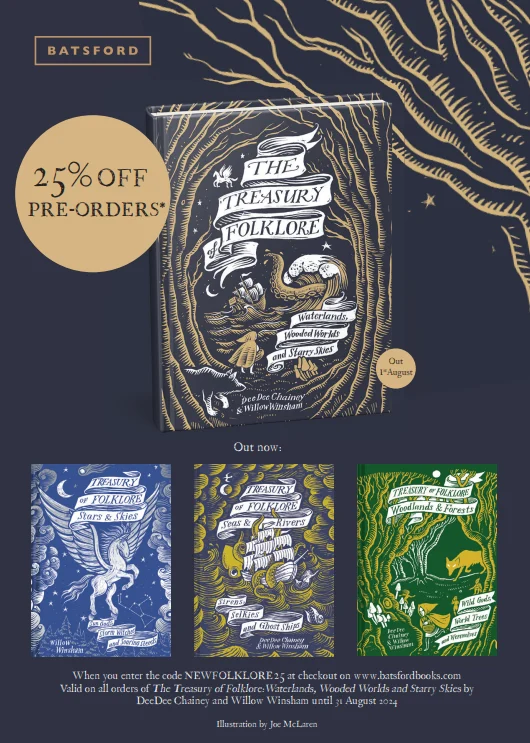
London, UK – A decade-long journey into the depths of global human experience culminates this August with the highly anticipated release of The Treasury of Folklore: Waterlands, Wooded Worlds and Starry Skies. This monumental compendium, published by Batsford Books and available for pre-order now, represents the definitive collection from the acclaimed Treasury of Folklore series. It brings together a curated selection of enchanting and insightful tales previously spread across three individual volumes, fulfilling the authors’ original vision of a single, encompassing exploration of humanity’s shared myths and beliefs.
Spearheaded by celebrated folklorists Dee Dee Chainey and Willow Winsham, and beautifully illustrated by Joe McLaren, this hefty tome promises to be more than just a collection of stories. It is a profound meditation on the universal human condition, revealing how diverse cultures across the globe articulate their deepest fears, grandest dreams, and enduring awe through the lens of their natural surroundings. The book, though comprising material drawn directly from its predecessors, offers a fresh perspective by presenting these narratives in a cohesive, beautifully bound edition designed to spark conversation and foster connection.
A Journey Forged in Narrative: The Chronology of the Treasury
The genesis of The Treasury of Folklore series was an ambitious one. When authors Dee Dee Chainey and Willow Winsham first conceived of the project nearly a decade ago, their initial aspiration was to create a single, encyclopedic volume that would traverse the myriad physical landscapes inhabited by humankind, cataloguing the rich tapestry of folklore woven into each. However, as their research deepened and the wealth of material they uncovered grew exponentially, it became abundantly clear that such an ambitious scope could not be adequately contained within the confines of a single book.
This realization led to the strategic decision to segment their findings into a thematic trilogy, each volume dedicated to a distinct aspect of the natural world. The first to emerge was Seas and Rivers, delving into the watery realms that have captivated human imagination since time immemorial. This was followed by Trees and Woodlands, exploring the profound spiritual and practical connections humanity has forged with forests and groves. Completing the original trio was Stars and Skies, casting its gaze upwards to the celestial wonders that have inspired wonder, fear, and myth-making throughout history.
The inspiration for this extensive undertaking was ignited by the vibrant, global community fostered by the #FolkloreThursday hashtag, which demonstrated a widespread and enthusiastic appetite for understanding and sharing traditional tales. The overwhelming outpouring of engagement and the surprising, heartwarming popularity of the three individual books underscored the unifying universality of folklore. It confirmed the authors’ belief in the profound resonance these stories hold for people from all walks of life.
The concept of a compendium, therefore, emerged as a natural evolution – an opportunity to return to that initial, grand vision. The decision to compile the "favourite folklore" from the existing books into one special volume was met with immediate enthusiasm by the authors. This involved a meticulous, behind-the-scenes process of re-reading and curating the beloved texts with fresh eyes, carefully selecting the most impactful and representative narratives. The goal was to weave them together seamlessly into a single, cohesive volume that would effectively span humanity’s shared landscapes across both time and place. The meticulous attention to detail in its production has resulted in a physical object that the authors describe as "beautifully bound" and a "hefty tome," a testament to the enduring power and importance of the stories within.
Unearthing Shared Human Truths: Supporting Data and Thematic Depths
The core premise underpinning The Treasury of Folklore series, and now its magnificent compendium, is the profound insight that despite the vast geographical and cultural distances separating human societies, we are, in so many fundamental ways, inherently the same. The authors embarked on their journey in search of understanding how customs, beliefs, and tales coalesce around the environments people inhabit. What they unearthed was a compelling truth: a shared human consciousness that manifests in primal fears, universal dreams, and an innate sense of wonder, irrespective of where we live, how we dress, or the names we give to the creatures of our myths.

This universal thread is masterfully illustrated through the curated extracts within the new compendium, which showcase the incredible diversity and underlying unity of global folklore. The volume is thoughtfully split into three sections, mirroring the original trilogy, each enriched by the distinctive original illustrations of Joe McLaren, whose evocative artwork breathes life into these ancient narratives.
Water Horses: Echoes of Danger in the Depths
The first section plunges into the perilous allure of the world’s waterways, presenting tales of Water Horses. These majestic yet malevolent creatures are a testament to humanity’s deep-seated fear of the unknown lurking beneath reflective surfaces. Across cultures, these folkloric steeds embody both the enticing beauty and the lethal danger of untamed nature.
In Scottish folklore, the kelpie is a particularly infamous example, often conflated with, but distinct from, the each-uisge (water horse), with the former frequenting rivers and the latter preferring the dark, deep lochs. These shapeshifting entities lure unsuspecting travellers onto their backs, only to drag them to a watery demise. The enduring power of these myths is tangible, evident in the towering 30-metre Kelpies sculptures near Falkirk, a modern tribute to an ancient legend. Their appearance in contemporary literature, from Lari Don to J.K. Rowling’s Fantastic Beasts, further solidifies their lasting grip on the popular imagination. Interestingly, English folklore largely lacks such aquatic equine terrors, a curious cultural lacuna.
Wales, however, offers its own compelling variant: the Ceffyl Dwr. A staple of Welsh belief well into the 19th century, this water horse displayed regional variations, sometimes a violent shapeshifting spirit in the north, and a consistently enchanting, yet deadly, small horse in the south. Known for impossible speed, it would carry riders vast distances before vanishing, leaving them to drown. A fascinating exception to its malice was its deferential treatment of clergymen of any creed, who could ride unharmed – a poignant reflection of the intertwining of ancient beliefs with prevailing religious structures.
Scandinavia’s contribution to this aquatic bestiary is the bäckahäst or ‘brook horse’. Often appearing in foggy conditions, this creature is described as luminous and majestic, beguiling victims into mounting before plunging into the depths. Tales frequently feature children as its prey, amplifying the sense of peril and tragedy. A particularly vivid story tells of boys saved from a bäckahäst by a child’s mispronunciation of "Jesus Christ," highlighting the power of sacred names in warding off malevolent spirits. Like the kelpie, the bäckahäst could, in some narratives, be tricked into servitude, a symbolic representation of humanity’s fleeting attempts to control the wild. These narratives collectively speak to a primal human need to personify and understand the dangers of water, and perhaps, to craft moral lessons about caution and respect for the natural world.
Lords of the Wild: Guardians and Tricksters of the Forest
Transitioning from watery depths to verdant canopies, the compendium then explores the Lords of the Wild, lordly spirits and creatures that command the forests and jungles of the world. These figures often embody the dual nature of the wilderness itself: a source of both sustenance and terror, protection and chaos.
From Finnish mythology emerges Tapio, also known as Metsähine or Hiisi, the venerable king of the forest realm. Depicted as tall and thin, with a coat of ermine fur or moss, and a head capped with a hat, he shares visual kinship with Europe’s Green Man figures. His gnarled tree-like back and mossy brows underscore his deep connection to the arboreal world. Tapio is both the personification and the protector of the forest, and historically, hunters would seek his blessing for a successful chase, pledging respect for the land and its creatures. He held the power to grant a plentiful haul or curse a hunter to return empty-handed, signifying the vital pact between humans and nature. His family, including his benevolent wife Mielikki (or Kuurikki when malevolent), and children Nyrikki and Tulikki, further illustrate the rich, anthropomorphic worldview of ancient Finnish belief.

The Slavic leshy (or leshii, lyeshy) presents a more complex figure: a tutelary spirit, protector of trees and animals, yet also a notorious trickster and abductor. Known by various names, all hinting at its forest domain, the leshy hibernates like the bears it sometimes serves. These shapeshifting entities can alter their size and form at will, appearing as anything from a blade of grass to a towering tree. Their human guise is subtly flawed, marked by an absence of eyelashes or brows, shoes worn on the wrong feet, or garments wrapped in reverse. Some possess only one eye, while all are covered in wild hair, often with cloven feet or even wings and a tail.
Leshies are masters of illusion and mimicry, their voices capable of sounding like creaking branches, rustling leaves, or even human speech, which they use to lure travellers astray. Those who ignore their shrieking laughter or howls risk being hopelessly lost, or worse, tickled to death. They inflict illness, abduct women and children, and are known to curse entire farms. Farmers in the Olonetsky District of Russia, for example, would sacrifice a cow annually to appease them. However, there are established ways to navigate their territory safely: prayers, offerings of bread and tobacco, or, more whimsically, turning one’s clothes inside out and shoes on the wrong feet – actions believed to elicit laughter from the leshy, thus returning the victim to the correct path. Swearing at them also works. The aversion of leshies to Christian symbols, such as the sign of the cross or the clubs suit in playing cards, speaks to the dynamic interplay between older pagan beliefs and later religious influences. For the brave or foolhardy, summoning a leshy involves a specific ritual: cutting young birch trees, arranging them in a circle, and calling out to the "grandfather of the forest" while devoid of Christian symbols. These detailed accounts of the leshy highlight the rich psychological landscape of forest-dwelling communities, reflecting anxieties about getting lost, the dangers of the wild, and the need for respectful engagement with the natural world.
The Hare on the Moon: Celestial Narratives and Mortal Fates
Finally, the compendium directs our gaze skyward, exploring one of the most enduring celestial motifs: The Hare in the Moon. This widespread idea, where lunar markings are interpreted as the image of a rabbit or hare, is found in numerous cultures, with the Sea of Tranquillity often seen as the creature’s head and other seas forming its ears.
Across Buddhist traditions, such as the Sasa-Jātaka, the hare is depicted as a figure of ultimate self-sacrifice. In one story, Hare, alongside his friends Otter, Jackal, and Monkey, pledges to give alms on a fast day. When the deity Sakka, disguised as a beggar, tests them, Hare, having only grass, offers his own body as food by leaping into a fire. For this profound act of faithfulness, Sakka immortalizes the hare by placing his image on the moon for all eternity. Similar tales of self-sacrificing hares appear in Sri Lankan folklore, where the hare offers itself to Buddha, and in Japan, where Tsuki no Usagi (the Moon Rabbit) sacrifices itself for the Man in the Moon. This Japanese tale is particularly popular and is traditionally recounted to children during the Harvest Moon and Mid-Autumn Festival, imbuing the celestial body with a powerful moral lesson about compassion and selflessness.
However, the narrative is not universally one of virtue and reward. A compelling counterpoint comes from a tale in South Africa, which casts the hare in a more mischievous, even calamitous, role. Here, the hare is held responsible for humanity’s mortal fate. The Moon, wishing to convey that humans would, like her, "die" and return (a metaphor for monthly cycles of waning and waxing), sends Hare with this message. But the flighty Hare misdelivers, telling humanity only that they would die, without the promise of return. Enraged, the Moon attacks Hare with a hatchet, scarring its lip, while Hare, retaliating, lashes out and scars the Moon’s face – imperfections still visible in the dark shapes on the moon today. This starkly different narrative underscores the diverse interpretations of shared cosmic phenomena, revealing how cultural anxieties and understandings of life and death are projected onto the heavens.
Authors’ Reflections and Publisher’s Pride: Official Responses
The journey from initial concept to this grand compendium has been a deeply personal and professionally rewarding one for the authors. As they reflect on the almost decade-long process, Chainey and Winsham express profound satisfaction. "When we began writing together nearly a decade ago, we could never have dreamed where it would take us," they share, highlighting the unexpected trajectory of their work. The popularity of the individual books, driven by a global community of folklore enthusiasts, has been both "surprising and heartwarming," prompting sincere gratitude to "each and every person who has bought and read these books."
The opportunity to finally realize their original vision of a single volume was clearly a pivotal moment. The meticulous process of revisiting and curating their well-known words with "fresh eyes" was a labor of love. They confess to being "utterly thrilled" and "blown away by the end result," emphasizing the physical beauty of the book itself. The "beautifully bound volume," its chosen "size and the cover combining everything," and the "beautiful cream paper" all contribute to its character as a "hefty tome" that is clearly a source of immense pride. While they explicitly state that the book contains "no new material," drawing directly from the existing three books, they stress its value as "a beautiful addition to any book case or coffee table, a conversation starter, a way to connect."

Batsford Books, the publisher, implicitly shares this pride in bringing such a significant work to fruition. The commitment to producing a high-quality physical product, combining the artistic vision of Joe McLaren with the comprehensive scholarship of Chainey and Winsham, underscores the belief in the lasting cultural importance of this collection.
Enduring Legacy: Implications for Folklore and Connection
The release of The Treasury of Folklore: Waterlands, Wooded Worlds and Starry Skies carries significant implications for both the study of folklore and its broader role in contemporary society. Firstly, it reaffirms the enduring universal appeal of folklore. By bringing together narratives from disparate cultures and landscapes, the compendium powerfully illustrates humanity’s shared intellectual and emotional landscape. It underscores that while the specifics of our myths may vary, the underlying human experiences – fear of the unknown, awe of nature, the quest for meaning, the struggle with mortality – remain constant.
This definitive compilation also serves as a crucial tool for cultural preservation. In an increasingly globalized world, the detailed cataloguing and presentation of these tales help to ensure their continued relevance and accessibility. For new readers, it offers an unparalleled entry point into the vast and fascinating world of folklore, providing a comprehensive overview that might otherwise require navigating multiple texts. For existing fans of the series, it offers the convenience of a unified edition, a single volume that can be returned to again and again for inspiration and reflection.
Furthermore, the book’s design as a "conversation starter" highlights folklore’s capacity to foster connection. In an era marked by division, shared stories offer a powerful means of understanding and empathy across cultural divides. They remind us of our common heritage and our shared humanity. The physical presence of such a substantial and beautiful volume on a bookshelf or coffee table invites interaction, prompting discussions about ancient beliefs, cultural diversity, and the profound ways in which human imagination has shaped our understanding of the world.
The Treasury of Folklore: Waterlands, Wooded Worlds and Starry Skies is now available for pre-order and is set for release on August 1st, 2024. For those eager to delve into this rich compilation, a special offer is available: 25% off when ordering from Batsford Books with the code NEWFOLKLORE25. This magnificent collection is more than just a book; it is an invitation to explore the timeless stories that bind us all.