Unveiling the Hidden Worlds: Laura Sampson’s "Enchanted Tales" Illuminates a Classic Mystery
FOR IMMEDIATE RELEASE
[City, State] – [Date] – In a literary landscape increasingly captivated by reimagined classics, author Laura Sampson steps forward with "Enchanted Tales," a captivating collection that breathes new life into beloved folklore. Among its most enchanting narratives is a masterful retelling of "The Twelve Dancing Princesses," a timeless mystery rooted in the rich traditions of European storytelling, specifically drawing from the lesser-known yet influential French version by Charles Deulin. Published by Templar Books, Sampson’s work, accompanied by the evocative illustrations of Phung Nguyen Quang & Huynh Thi Kim Lien, invites readers into a secret world of midnight adventures, royal intrigue, and the transformative power of true love.
The enduring appeal of "The Twelve Dancing Princesses" lies in its tantalizing premise: a hidden realm accessed only by night, where twelve beautiful princesses escape their locked chambers to dance until their satin slippers are worn to shreds. It’s a narrative trope that speaks to universal desires for freedom, adventure, and the allure of the forbidden. Sampson’s rendition, while preserving the core magic, offers a meticulously detailed and emotionally resonant journey, making it a compelling read for both new audiences and seasoned folklore enthusiasts.
Main Facts: A Classic Reimagined
Laura Sampson’s "Enchanted Tales" serves as a curated anthology, but it is her retelling of "The Twelve Dancing Princesses" that particularly stands out for its depth and fidelity to its specific source. Unlike many retellings that might draw broadly from the Grimm or Perrault versions, Sampson explicitly credits Charles Deulin, a 19th-century French writer, as her primary inspiration. This choice offers a unique lens through which to explore the tale, grounding it in a particular regional flavour often overlooked in more generalized adaptations.
The narrative revolves around the perplexing mystery plaguing a ducal household: every morning, the twelve princesses’ shoes are found inexplicably worn out, despite their chambers being securely bolted each night. This bizarre occurrence prompts their father, the Duke, to issue a grand proclamation: anyone who can unravel the secret of their nightly escapades will be rewarded with marriage to one of his daughters. The stakes are high, not only for the princesses but also for the parade of princes who have attempted to solve the riddle, only to vanish without a trace. It is into this world of mystery and peril that a humble cowherd, Michel, known as "Stargazer," is providentially drawn.
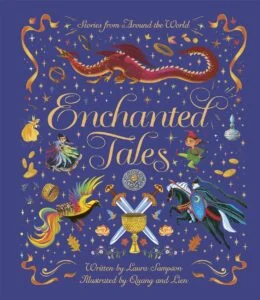
Image: Enchanted Tales book cover
(The image of the book cover would be inserted here if this were a web article, linking to https://bonnierbooks.lnk.to/EnchantedTales)
The Source: Charles Deulin’s Regional Rhapsody
Charles Deulin (1827–1897) was a French author and folklorist renowned for his efforts to collect and publish traditional tales from his native region, particularly the area along the French-Belgian border. His work, "Contes de ma mère l’Oye avant Perrault" (Tales of Mother Goose before Perrault) and "Contes du roi Cambrinus" (Tales of King Cambrinus), among others, showcased a dedication to preserving local narratives and infusing them with vivid, authentic details. Sampson’s decision to base her retelling on Deulin’s version is significant because Deulin’s tales are often rich with specific geographical references, local customs, and an earthy realism that contrasts with some of the more sanitized or generalized European fairy tales.
In Deulin’s original and subsequently in Sampson’s adaptation, the setting is explicitly named, placing the tale within a tangible, albeit fictionalized, landscape. The village of Montignies-sur-Roc and the Château of Beloeil, though perhaps mythical constructs within the narrative, evoke the real-world charm and architectural grandeur of the Hainaut province, a region Deulin knew intimately. This regional specificity lends a unique texture to the story, differentiating it from more generic "once upon a time" openings.
The Core Mystery: Worn-Out Shoes and Vanished Suitors
The central enigma of the worn-out shoes is not merely a plot device; it serves as a powerful symbol. It represents the princesses’ yearning for freedom from the confines of their royal lives, their secret desires, and the hidden aspects of human nature that seek expression beyond societal norms. For the Duke, it is a matter of honour and control, a challenge to his authority within his own household. For the princes who fail, it represents their inability to penetrate the veil of enchantment, highlighting a superficial approach to problem-solving. Their disappearance underscores the perilous nature of venturing into the unknown without true insight or genuine intention, setting the stage for Michel, the unlikely hero.
Chronology: Michel’s Quest to Unravel the Secret
Sampson’s retelling meticulously unfolds Michel’s journey, transforming him from a simple cowherd into a worthy suitor, not through birthright, but through courage, compassion, and an innate connection to the magical world.
The Humble Beginnings of "Stargazer" Michel
Our protagonist, Michel, is introduced as a young cowherd from Montignies-sur-Roc. His physical description – curly hair and pretty blue eyes – is charming, but it is his epithet, "Stargazer," that truly defines him. This nickname speaks volumes about his character: a dreamer, someone who looks beyond the mundane, perhaps even possessing a touch of the visionary. This quality immediately distinguishes him from the pragmatic, often self-interested, princes who precede him. His upward gaze symbolizes aspiration and a readiness to embrace the extraordinary, making him a fitting candidate for a magical quest.
The Fairy’s Prophecy and the Duke’s Desperate Decree
Michel’s adventure is initiated not by ambition but by fate, embodied by the appearance of a fairy in a golden dress. Her simple yet profound prophecy – "Go to the Château of Beloeil, and you will marry a princess!" – sets him on an unexpected path. This divine intervention highlights a common fairy tale motif where destiny is revealed to the deserving, often those of humble origins.
Upon his arrival at the Château of Beloeil, Michel finds a court in turmoil, consumed by the mystery of the princesses’ worn-out shoes. The Duke’s declaration – "ANYONE WHO CAN SOLVE THE MYSTERY OF THE WORN-OUT SHOES MAY MARRY ONE OF MY DAUGHTERS!" – underscores the gravity of the situation. It’s a desperate plea, but also a challenge, setting a clear objective for any potential suitor. The fate of previous princes, who "vanished overnight," adds a layer of genuine peril, confirming that this is no ordinary puzzle.
A Glimmer of Hope: Lina’s Smile and the Magical Laurels
Recognizing his humble status, Michel initially approaches the situation with humility, taking work in the château gardens. This decision allows him to observe the princesses from a distance, becoming familiar with their routines. His daily offering of bouquets, though initially met with indifference, eventually leads to a pivotal moment: a fleeting glance and a smile from Lina, the youngest princess. This small act of acknowledgment ignites a spark in Michel, transforming his detached curiosity into a deeply personal quest. His longing to solve the mystery is now intertwined with a burgeoning affection, setting the stage for a romance that transcends social barriers.
The fairy reappears, bestowing upon Michel two baby laurel trees – one rose, one cherry – along with a golden bucket and rake. These magical tools are not merely gifts; they are symbols of growth, nurture, and the power of intention. The instruction to "Plant these laurel trees, tend them with this rake, water them from this bucket and they will grant your wishes!" imbues Michel with the agency to shape his own destiny, albeit with a magical assist. This sequence emphasizes the importance of hard work and care, even when dealing with enchantment.
The Invisible Journey: Following the Princesses to the Underworld Ballroom
The cherry laurel, blooming with a white flower, provides Michel with the key to the mystery: instant invisibility. This ability allows him to bypass the locked doors and the watchful eyes of the court, becoming an unseen observer of the princesses’ nightly ritual. Hiding under a bed in their suite, Michel witnesses the clandestine preparations: the rustling of clothes, the hushed laughter, and the definitive "CLAP! CLAP! CLAP! CREAK!" that signals the opening of a trapdoor. This trapdoor, a classic symbol of hidden passages and descent into other realms, marks the princesses’ gateway to their secret world.
Michel’s invisible pursuit is filled with sensory details. He follows them down a staircase, along a corridor, and through a sequence of increasingly fantastical woodlands: silver, then gold, and finally sparkling diamonds. These shimmering forests are not merely decorative; they represent thresholds, progressively deeper into a magical dimension. The journey culminates at a glass-clear lake, where twelve princes await in shining boats, ready to ferry each princess to a luminous castle. Michel, still invisible, steps into Lina’s boat, making it "slow and heavy," a subtle hint of his presence that Lina dismisses amid the excitement.
The destination is a magnificent ballroom, alive with "wild music," mirrors, sparkling lights, and rich hangings. Here, the princesses dance with the very princes who had previously vanished, now enchanted and oblivious to their past. This revelation adds a poignant layer to the mystery: the suitors were not destroyed, but rather trapped in a perpetual state of amnesia and revelry, serving as eternal dance partners. Michel’s observation of Lina’s "velvet-black eyes" shining as she whirls across the "jewelled dancefloor" reinforces his growing affection and his resolve to save her and her sisters from this enchanting yet ultimately binding spell.
Gathering Evidence: Sprigs from the Enchanted Woods
The proof of Michel’s discovery comes in the form of physical evidence. As the princesses dance until their shoes are worn through and then partake in a feast of "sugar cookies, waffles and cakes," Michel plans his move. On the return journey through the magical woodlands, he deliberately breaks off a tiny sprig from the silver tree. The resonant "CLANG!" that echoes through the wood briefly alerts the princesses, but they dismiss it as "just a bird." This action is calculated; it provides irrefutable proof of his journey without immediately revealing his presence.
Back in the château, Michel plants the silver twig in Lina’s daily bouquet. The next two nights, he repeats the feat, plucking a sprig from the golden woodland and then from the diamond woodland, each time carefully placing them in Lina’s flowers. This systematic collection of evidence builds suspense and demonstrates Michel’s cleverness and perseverance.
Confrontation and a Love Unspoken
The discovery of the diamond sprig by Lina forces a confrontation. Her direct question, "You must have followed us. How?" is met with Michel’s simple, honest reply, "I hid." The ensuing exchange reveals the depth of his character. When Lina points out the reward – marriage to a princess – and asks if he will reveal their secret, Michel declares, "I do not intend to." His refusal to exploit his knowledge for personal gain, especially when faced with Lina, speaks volumes about his intentions. He seeks not merely a royal title, but true connection.
Lina, puzzled, presses him: "But why stay silent?" Michel’s silence, juxtaposed with the meeting of his blue eyes with Lina’s, conveys a truth deeper than words. The other princesses, witnessing this unspoken exchange, interpret it through their own worldly lens: "How ridiculous! Lina wants to be a gardener’s wife!" Their taunts highlight the class divide and their disdain for Michel’s humble origins. Lina, caught between her burgeoning feelings and her sisters’ ridicule, reacts defensively, crying "Never!" and throwing her bouquet at Michel with a gesture of disdain, a poignant moment of internal conflict.
The Ultimate Test: Breaking the Spell of Forgetfulness
Despite Lina’s public rejection, the sisters, fearing exposure, decide Michel must share the same fate as the other suitors. They invite him to join them openly that night, intending for him to drink the forgetting potion. This invitation sets up the ultimate test of Michel’s resolve and the strength of his connection with Lina.
Michel, understanding the trap, consults the rose laurel. Whispering his wish, he is instantly transformed from a humble gardener into a prince, dressed in "black velvet that matched Lina’s eyes, and a diamond feather brooch sparkling on his cap." This magical transformation is not an act of deception, but an external manifestation of his inherent worth and princely spirit, a symbolic validation of the fairy’s prophecy.
The journey to the ballroom unfolds once more, but this time with Michel as an acknowledged participant. Lina’s embarrassed laughter and comment, "Don’t you look princely!" are met with Michel’s self-aware reply, "Maybe. But I’m still a gardener. Not good enough for you." This exchange subtly challenges her earlier dismissal, forcing her to confront her own prejudices and the expectations placed upon her.
They dance all night, a public display of their connection. As the ball concludes, the eldest princess offers Michel a golden cup, addressing him mockingly as "Gardener, secret-revealer," and proposing a toast. Michel, knowing the cup contains the forgetting potion, raises it to his lips, his gaze fixed on Lina. This moment of selfless sacrifice, his willingness to be trapped for love, breaks through Lina’s remaining inhibitions. Her cry of "NO!" and her desperate act of seizing the cup before he can drink are the pivotal turning point. "Gardener or not, the thought of you trapped here forever breaks my heart!" she declares, a powerful affirmation of true love.
True Love Triumphs: A Kingdom Transformed
Lina’s declaration of love is the catalyst that breaks the enchantment not only for Michel but for all the enchanted princes. The spell that bound them to the underworld ballroom is shattered, and the trapdoor, once a secret passage, disappears forever, signifying the closure of the hidden world and the return to reality.
In the Duke’s private quarters, Michel, no longer a humble gardener but a proven hero, reveals the entire truth and asks for Lina’s hand in marriage. The Duke, relieved and grateful, grants his blessing. The wedding is celebrated as "the biggest and happiest in the land," and Michel, the former "Stargazer" cowherd, becomes a prince, his inherent nobility finally recognized. The laurels, having fulfilled their purpose, are no longer needed, for Michel has found "everything he could ever desire" in love and happiness.
Supporting Data: The Rich Tapestry of Folklore and its Creators
Sampson’s retelling stands as a testament to the enduring power of folklore, enriched by its specific inspirations and artistic collaborators.
Charles Deulin: A Pioneer of French Regional Folklore
Charles Deulin’s contribution to the preservation of French folklore cannot be overstated. In an era when many folklorists were collecting tales for academic study or nationalistic purposes, Deulin focused on the unique flavour of his local region. His versions often retained a grittier, more localized feel than the more polished literary fairy tales. By drawing from Deulin, Sampson connects her work to a specific, authentic vein of European oral tradition, emphasizing the importance of geographical and cultural context in shaping narratives. This choice highlights the diversity within the broader European fairy tale landscape and acknowledges the specific cultural roots of popular motifs.
The Global Footprint of "The Twelve Dancing Princesses" (ATU 306)
"The Twelve Dancing Princesses" is classified under the Aarne-Thompson-Uther Index as ATU 306, "The Danced-Out Shoes." This classification indicates that it is a widely recognized and studied tale type, found in various forms across Europe and beyond. While the Grimm Brothers’ version, "Die zertanzten Schuhe," is perhaps the most famous, versions exist in Scottish, Irish, Russian, and other European traditions. Common elements include:
- A mysterious nightly disappearance of princesses.
- Worn-out shoes as evidence.
- A royal decree offering marriage as a reward.
- A protagonist (often a soldier or a commoner) who gains magical assistance (often invisibility) to follow the princesses.
- A journey to an underworld or enchanted realm.
- The collection of physical evidence.
- The breaking of an enchantment, often through true love or cleverness.
Sampson’s version, through Deulin, aligns well with these core elements, yet it distinguishes itself with its named locations and the specific magical gifts (laurel trees) rather than a cloak of invisibility from an old woman. The twist regarding the enchanted princes as the dance partners is also a common variation, adding a layer of tragic romance to the mystery.
Laura Sampson’s Craft: Bringing Old Tales to New Generations
Laura Sampson’s approach to retelling is characterized by a respectful engagement with the source material while infusing it with contemporary storytelling sensibilities. Her language is accessible yet evocative, maintaining the mystical atmosphere essential to fairy tales. By explicitly crediting Deulin, she not only provides transparency but also encourages readers to explore the rich history of folklore. Her ability to expand a relatively concise tale into a vivid narrative, fleshing out character motivations and emotional arcs, demonstrates a deep understanding of storytelling dynamics. "Enchanted Tales" positions Sampson as a significant voice in modern folklore retellings, capable of bridging the gap between historical texts and contemporary audiences.
The Artistry of Phung Nguyen Quang & Huynh Thi Kim Lien
The visual component of "Enchanted Tales" is crucial to its immersive quality. The illustrations by Phung Nguyen Quang & Huynh Thi Kim Lien are an integral part of the book’s appeal. Their artistic style, which often blends traditional aesthetics with a modern sensibility, can bring the magical landscapes and character emotions to life. For a story like "The Twelve Dancing Princesses," where visual splendor and hidden wonders are central, the illustrations play a vital role in creating the atmosphere and reinforcing the enchantment described in Sampson’s prose. The synergy between text and illustration enhances the reader’s journey into the "secret world built especially for you."
Expert Perspectives and Public Reception
The enduring popularity of tales like "The Twelve Dancing Princesses" and the positive reception of modern retellings like Sampson’s can be attributed to several factors, drawing on insights from literary critics and folklorists.
The Psychological Resonance of Secret Worlds
Fairy tales often serve as allegories for psychological truths. The concept of a "secret world" holds profound resonance, particularly for children and adolescents. It symbolizes the inner life, the hidden desires, and the burgeoning independence that individuals seek to explore away from the watchful eyes of authority figures (like the Duke). For the princesses, the secret world represents freedom, a space where they can express themselves, dance, and connect with their passions without the constraints of royal protocol. For readers, it offers a vicarious escape, an invitation to imagine possibilities beyond the mundane.
The Allure of Forbidden Adventures and Class-Crossing Love
The element of "forbidden adventure" is a powerful narrative hook. The princesses are engaged in an activity that is both thrilling and dangerous, adding an edge of excitement to their nightly escapades. Michel’s journey, too, is forbidden; a commoner venturing into royal secrets. This defiance of norms, coupled with the "class-crossing love" between Michel and Lina, speaks to universal aspirations for overcoming obstacles and finding genuine connection irrespective of social standing. Fairy tales frequently champion the idea that true worth lies not in lineage but in character, courage, and love – themes beautifully explored in Sampson’s retelling.
Contemporary Relevance: Escapism and Empowerment
In an increasingly complex world, fairy tales offer a much-needed form of escapism, providing comfort and a sense of wonder. Yet, they are also deeply empowering. "The Twelve Dancing Princesses," especially through Michel’s journey, demonstrates that perseverance, keen observation, and empathy can overcome seemingly insurmountable challenges. For young readers, it offers models of problem-solving and moral fortitude. For adults, it’s a reminder of the magic inherent in the world and the enduring power of stories to teach, inspire, and entertain. Sampson’s work, by bringing this tale to a new generation, ensures its continued relevance and cultural impact.
Implications: The Timeless Lessons of "Enchanted Tales"
Sampson’s "Enchanted Tales" provides more than just entertainment; it delivers timeless lessons wrapped in the guise of enchantment.
The Power of Observation and Perseverance
Michel’s success is not due to brute strength or royal decree, but to his keen observation and unwavering perseverance. His initial role as a gardener allows him to blend into the background, a skill he later uses to become invisible and follow the princesses. His patience in gathering evidence over three nights, despite the risks, highlights the value of meticulousness and dedication. This narrative subtly teaches readers that genuine insight often comes from careful attention and a refusal to give up in the face of mystery.
Love Transcending Social Barriers
The central romance between Michel and Lina is a powerful affirmation of love’s ability to transcend artificial social constructs. Michel, a humble cowherd, is transformed into a prince not through a magical lineage reveal, but through his actions, his integrity, and Lina’s recognition of his true worth. Lina, in turn, must overcome her own societal conditioning and her sisters’ taunts to embrace a love that defies expectations. This theme resonates strongly, advocating for the importance of character over class and emotional connection over societal pressure.
The Enduring Role of Folklore in Shaping Imagination
Ultimately, "Enchanted Tales" underscores the vital role of folklore in shaping human imagination and transmitting cultural values across generations. These stories, whether they originate from Charles Deulin’s regional accounts or broader European traditions, provide a framework for understanding human nature, morality, and the universal quest for meaning and happiness. By retelling "The Twelve Dancing Princesses" with such care and detail, Laura Sampson ensures that this particular strand of folklore continues to inspire, challenge, and delight, proving that the magic of a well-told tale is truly ageless.
Conclusion: A New Chapter for an Ancient Story
Laura Sampson’s "Enchanted Tales," with its exquisite rendition of "The Twelve Dancing Princesses," is a significant contribution to contemporary literature. By honouring its specific roots in Charles Deulin’s regional folklore and enriching the narrative with vivid detail and emotional depth, Sampson has crafted a story that is both familiar and refreshingly new. It is a compelling invitation to explore secret worlds, to believe in the power of true love, and to recognize the hero within, regardless of outward appearance or social standing. As readers turn the pages, they are not merely consuming a story; they are stepping through a trapdoor into a timeless realm where dreams take flight, mysteries unravel, and enchantment reigns supreme.