The Backbone of the Metaverse: SpatialGen Zeus and the Future of Live Immersive Broadcasting
Main Facts: A New Era for High-Fidelity Streaming
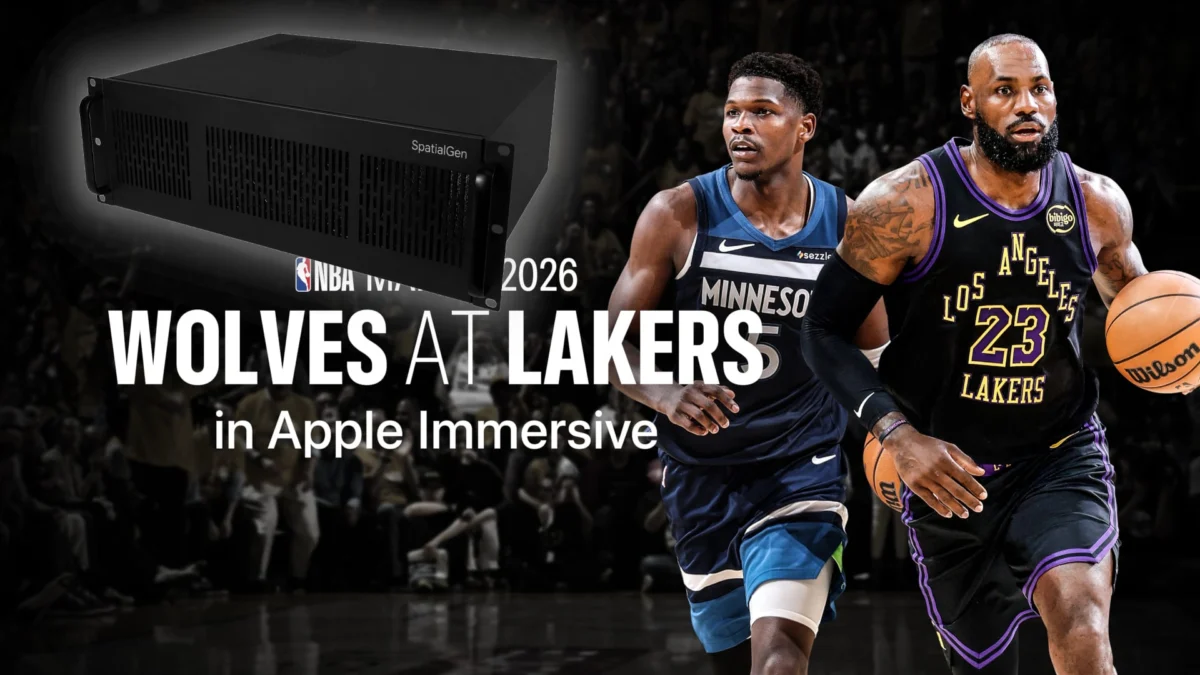
In the rapidly evolving landscape of spatial computing, the hardware on a user’s face is often the primary focus of public attention. However, the true bottleneck for the industry has long been the "plumbing"—the complex infrastructure required to capture, process, and deliver high-resolution, low-latency video to those devices. SpatialGen, a pioneer in immersive media delivery, has addressed this challenge head-on with the launch of Zeus, a 3U rack-mounted system specifically engineered for live immersive video workflows.
The SpatialGen Zeus is not a consumer device; it is a professional-grade powerhouse designed to facilitate the production of Apple Immersive Video. By providing the capability to ingest, encode, package, and distribute demanding Apple ProRes video in real-time, Zeus fills a critical void in the professional broadcast ecosystem. It allows for the seamless delivery of both live 2D and 180-degree stereoscopic 3D experiences, ensuring that the high-fidelity displays of headsets like the Apple Vision Pro are utilized to their full potential.
Key Specifications and Capabilities
The Zeus system is built around the ProRes 2110 standard, ensuring it fits into modern IP-based broadcast environments. Its technical specifications are aimed at the absolute ceiling of current video technology:
- 16K Ingest Support: Capable of handling massive raw data streams from next-generation camera arrays.
- 90+ FPS (Frames Per Second): Essential for reducing motion blur and preventing simulator sickness in immersive environments.
- 100 Gb/s Peak Throughput: A staggering data rate designed to handle the uncompressed or lightly compressed video required for "retina-quality" immersion.
- Multi-Cloud Distribution: Native integration with AWS CloudFront, Microsoft Azure, Google Cloud Platform, Akamai, and SpatialGen’s proprietary network.
- Ecosystem Integration: Direct compatibility with the Blackmagic URSA Cine Immersive 100G camera system.
Chronology: From Experimental VR to Professional Immersive Media
The journey to the SpatialGen Zeus reflects the broader evolution of the Virtual Reality (VR) and Extended Reality (XR) industries. For over a decade, immersive video was characterized by "360-degree" videos that often suffered from low resolution, poor stereoscopic alignment, and high latency.
2015–2020: The Era of Experimentation
Early immersive video attempts relied on "rigged" GoPro arrays and manual stitching processes. While companies like NextVR (later acquired by Apple) began experimenting with live sports, the headsets of the era—such as the original Oculus Rift or early Samsung Gear VR—lacked the pixel density to make the experience truly "transparent." The workflows were bespoke, often requiring months of post-production for a few minutes of content.
2021–2023: The Shift to 180-Degree Stereoscopy
Industry leaders realized that 180-degree stereoscopic video (3D) provided a more "cinematic" and higher-quality experience than 360-degree monoscopic video. This coincided with the development of better sensors and the SMPTE ST 2110 standards for professional media over IP. SpatialGen began developing the software backend necessary to handle these massive data loads during this period.
2024: The Apple Vision Pro Catalyst
The launch of the Apple Vision Pro in early 2024 changed the market dynamics. Apple introduced "Apple Immersive Video," a proprietary format featuring 8K resolution, 90 FPS, and spatial audio. This set a new benchmark that existing broadcast hardware could not easily meet.
In June 2024, during the AWE (Augmented World Expo), SpatialGen previewed the Zeus system, revealing that they were already the "silent engine" behind the majority of third-party immersive content on the Vision Pro. This included high-profile projects like the Los Angeles Lakers "Spectrum Front Row" experience, which allowed fans to sit virtually courtside in real-time.
Supporting Data: The Technical Hurdle of Immersive Data
To understand why the Zeus system is significant, one must look at the sheer volume of data involved in immersive broadcasting. A standard 4K Netflix stream requires roughly 15–25 Mbps. In contrast, high-quality Apple Immersive Video, which utilizes ProRes encoding to maintain color depth and detail, requires significantly more.
The Bitrate Challenge
Live immersive video isn’t just "wider" than 2D video; it is deeper. It requires:
- Dual Streams: One for each eye to create the 3D effect.
- High Frame Rates: 90 FPS is double the standard cinematic 24 FPS or broadcast 30/60 FPS.
- High Dynamic Range (HDR): 10-bit or 12-bit color data to mimic real-world lighting.
SpatialGen’s claim of 100 Gb/s peak sustained throughput is not hyperbole. In a professional stadium environment, the raw feed from a Blackmagic URSA Cine Immersive camera—which features a custom lens system designed specifically for the Vision Pro’s field of view—generates terabytes of data every hour. Zeus acts as the "translator," taking this firehose of data and compressing it into a stream that can be delivered over consumer fiber-optic internet without losing the "presence" that makes VR compelling.
Market Dominance
During industry briefings, SpatialGen claimed that its infrastructure powers more than 90% of third-party immersive video currently available on the Apple Vision Pro. This dominance suggests that while many companies are building cameras or headsets, very few have mastered the "middle mile" of the delivery pipeline.
Official Responses: Industry Alignment
The rollout of Zeus is not a solitary effort but part of a collaborative ecosystem involving hardware manufacturers and broadcasters.
Blackmagic Design Integration
The Zeus system is optimized for the Blackmagic URSA Cine Immersive. Grant Petty, CEO of Blackmagic Design, has frequently emphasized the need for end-to-end workflows. By supporting the 100G output of the URSA Cine, SpatialGen ensures that there is no data bottleneck between the lens and the encoder.
The Broadcaster’s Perspective: Spectrum SportsNet
The most prominent use case for SpatialGen’s technology has been the partnership with Spectrum SportsNet for the Los Angeles Lakers. Official statements from broadcasters indicate that the goal is to move away from "one-off technical experiments" and toward a repeatable, reliable broadcast model.
"Live sports streaming is the ‘killer app’ for immersive video," SpatialGen representatives noted during the AWE preview. "But to make it viable, it has to be as reliable as a standard HD broadcast. You can’t have the stream drop or the frame rate stutter when LeBron James is driving to the hoop. Zeus is built to provide that ‘broadcast-grade’ reliability."
Support and Maintenance
Recognizing the complexity of these workflows, SpatialGen includes one year of direct access to their engineers with every Zeus purchase. This "white-glove" service is a response to the reality that live immersive production involves a complex web of Digital Rights Management (DRM), key management, and multi-CDN (Content Delivery Network) routing that traditional IT teams may not be equipped to handle.
Implications: The "Invisible Infrastructure" of the Future
The release of the SpatialGen Zeus marks a transition for the immersive media industry from the "innovation phase" to the "industrialization phase." The implications of this shift are far-reaching.
1. The Democratization of Professional Immersive Content
Until now, only companies with the resources of Apple or Meta could produce high-quality live immersive content. By offering a "full-stack" hardware and software solution, SpatialGen allows mid-sized broadcasters, concert promoters, and event organizers to enter the space. We can expect a surge in live immersive concerts, educational seminars, and niche sporting events (such as surfing or extreme sports) where the "feeling of being there" adds significant value.
2. Setting a Standard for Quality
The "ProRes 2110" focus of Zeus ensures that the industry does not settle for "good enough" streaming quality. By supporting 16K ingest and 90 FPS, SpatialGen is effectively future-proofing the broadcast industry. As headsets become lighter and their displays even sharper over the next five years, the content being captured and distributed today via Zeus will still hold up.
3. The Shift in Consumer Expectations
As live immersive sports become more common through apps like "Spectrum Front Row" or the NBA app, consumer expectations for 2D media will likely shift. Once a viewer experiences the scale of a basketball game from the baseline in 8K 3D, a traditional 2D television screen may feel limiting. SpatialGen Zeus is the engine that will drive this change in consumer behavior by making these high-quality experiences frequent rather than occasional.
4. The "Invisible" Necessity
Perhaps the most significant implication is the realization that the "Metaverse" or "Spatial Computing" era is as much about rack-mounted servers in stadiums as it is about glass and silicon on the face. Zeus represents the "invisible infrastructure"—the technology that users will never see, but without which the Apple Vision Pro would be a powerful computer with nothing to watch.
Conclusion
The SpatialGen Zeus is a landmark product for the professional video industry. It solves the "heavy lifting" problems of live 180-degree 3D production, providing a bridge between the high-end cinema cameras of today and the spatial headsets of tomorrow. By simplifying the path from the camera lens to the virtual seat, SpatialGen is not just selling a server; they are building the foundation for the next generation of human entertainment and connection. As live events continue to migrate into the spatial realm, the "Zeus" system will likely be remembered as the tool that turned a technical experiment into a global broadcast standard.