Celestial Architecture: James Turrell Reaches Centennial Milestone with ‘As Seen Below’ in Denmark
The intersection of architecture, atmosphere, and human perception has found a new, monumental home in Aarhus, Denmark. This month, the world-renowned perceptual artist James Turrell inaugurated his 100th Skyspace, titled "As Seen Below," at the ARoS Aarhus Art Museum. The opening marks a definitive milestone in a career spanning six decades, solidifying Turrell’s status as the preeminent "sculptor of light" and completing a global circuit of installations that now spans 26 countries.
"As Seen Below" is not merely an addition to a museum; it is a profound architectural intervention. Stretching more than 50 feet high and 130 feet wide, the installation is one of the largest and most ambitious in the Skyspace series. It offers a singular experience: a domed chamber featuring a precision-carved oculus that directs the viewer’s gaze toward the heavens, effectively "bringing the sky down" to the level of the ceiling.
Main Facts: The Anatomy of ‘As Seen Below’
At its core, a Skyspace is a site-specific architectural environment that functions as an observatory. However, unlike traditional observatories designed for scientific data collection, Turrell’s structures are designed for the data of the human soul. "As Seen Below" utilizes a meticulously engineered aperture—the oculus—which is ground to a "knife-edge" so that the sky appears as a flat, vibrant plane of color rather than a distant void.

Technical Specifications and Scale
The Aarhus installation is characterized by its sheer scale. While many Skyspaces are intimate, room-sized chambers, "As Seen Below" takes on a civic, almost cathedral-like proportion. The dome spans 130 feet in width, creating a vast internal volume that can accommodate large groups of visitors simultaneously.
The installation operates in two primary modes:
- The Open Mode: During daylight and twilight hours, the oculus remains open, allowing the natural Danish sky to interact with the interior’s minimalist geometry.
- The Color Shift Mode: When the oculus is sealed—or during specific programmed sequences—the interior is bathed in artificial LED light. These "color shifts" are designed to manipulate the viewer’s perception of the sky’s color through the principle of simultaneous contrast. By flooding the interior with a specific hue (such as deep magenta), Turrell makes the sky seen through the oculus appear in its complementary color (such as a vivid, unearthly green).
The ARoS Context
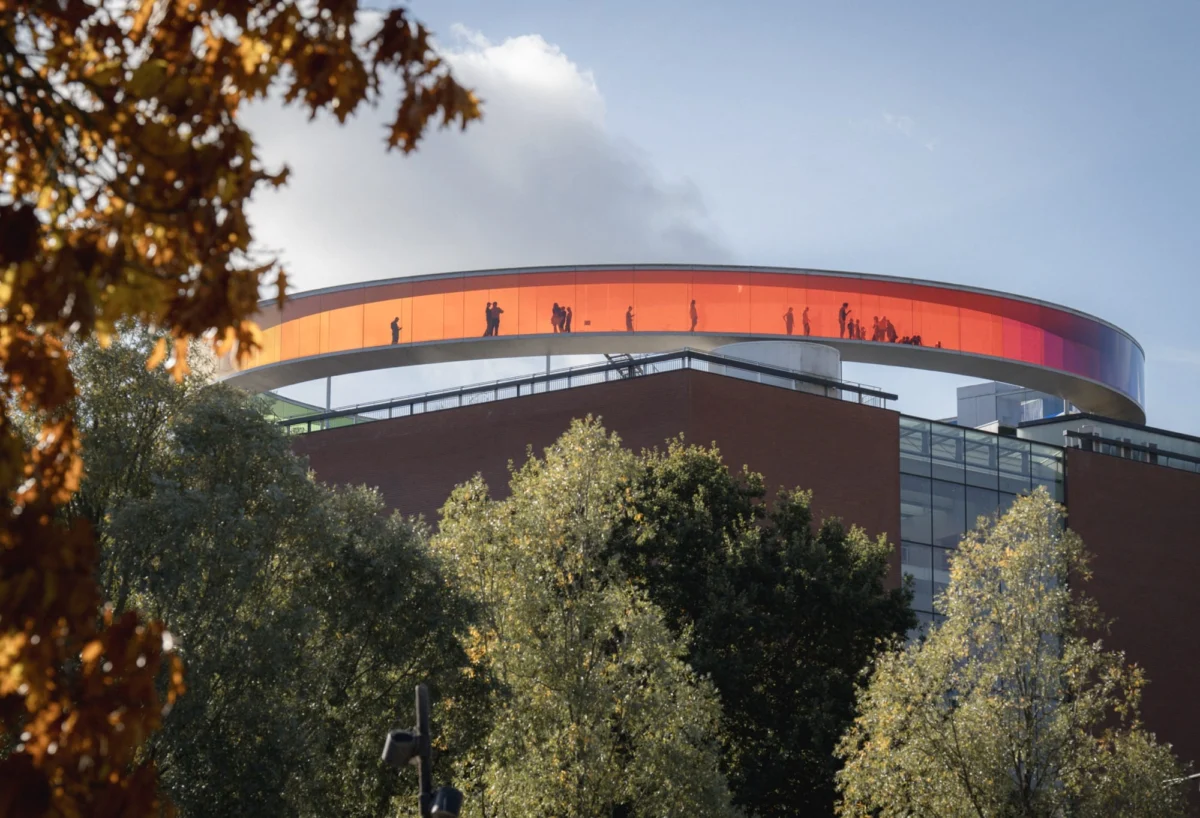
The ARoS Aarhus Art Museum is already globally recognized for its relationship with light and color, most notably for Olafur Eliasson’s "Your Rainbow Panorama," a circular walkway of colored glass that sits atop the museum roof. The addition of "As Seen Below" creates a powerful dialogue between two of the world’s most significant light artists. While Eliasson’s work looks outward at the city through a spectrum of color, Turrell’s work invites the viewer to look upward, focusing on the celestial and the internal.

Chronology: The Evolution of a Vision
To understand the significance of the 100th Skyspace, one must look back at the trajectory of James Turrell’s career and the birth of the Light and Space movement.
The 1960s: The Mendota Hotel and Early Experiments
In the mid-1960s, Turrell and a small group of artists in Southern California, including Robert Irwin and Douglas Wheeler, began experimenting with light as a primary medium. Turrell’s early work took place in the Mendota Hotel in Ocean Park, California, where he blocked out windows and used narrow slits to control how light entered a room. These "shallows" and "cross-corner projections" laid the groundwork for the first Skyspace concept.
1974: The First Skyspace
The first official Skyspace was created in 1974 at the Villa Panza in Varese, Italy. Count Giuseppe Panza di Biumo, a visionary collector, commissioned Turrell to create a work that would permanently alter a room in his 18th-century villa. This first iteration established the template: a clean, minimalist room with a bench along the walls and a square or rectangular opening in the ceiling.

The Decades of Expansion
Throughout the 1980s and 90s, the Skyspace series grew in complexity and geographic reach. Major installations were completed at MoMA PS1 in New York, the Kielder Forest in England, and the Naoshima "Art Island" in Japan. Each project required years of architectural planning to ensure the oculus remained perfectly sharp and the interior lighting was seamlessly integrated into the structure.
2026: The Centennial Milestone
The journey to the 100th Skyspace in Aarhus has been a decade-long endeavor. The project, titled "The Next Level," involved a massive underground expansion of the ARoS museum. Collaborating with the architectural firm Schmidt Hammer Lassen, Turrell designed "As Seen Below" to be the crown jewel of this expansion, a project that bridges the gap between the subterranean museum galleries and the open sky above.
Supporting Data: A Global Network of Light
The completion of the 100th Skyspace provides a moment to quantify the immense impact Turrell has had on the global art landscape.

- Global Footprint: With the Aarhus opening, Skyspaces are now located on every continent except Antarctica. The 26 countries hosting these works include Australia, Argentina, Israel, Switzerland, and India.
- Engineering Feats: "As Seen Below" is one of only a handful of "Super-Skyspaces" that exceed a 100-foot diameter. The structural integrity required to keep a 130-foot dome stable while maintaining a razor-thin edge around the oculus represents a significant feat of modern engineering.
- Visitor Impact: Statistics from other major Turrell sites, such as the "Twilight Epiphany" Skyspace at Rice University, suggest that these installations become major regional draws, often attracting hundreds of thousands of visitors annually who seek "slow art" experiences—meditative sessions that typically last 40 to 60 minutes during sunset or sunrise.
Official Responses: Curatorial and Artistic Perspectives
The opening of "As Seen Below" has been met with acclaim from the international art community and Danish cultural officials.
The Museum’s Vision:
The director of ARoS, in a statement regarding the opening, emphasized the transformative nature of the work: "With ‘As Seen Below,’ ARoS is no longer just a place to view art; it is a place to experience the cosmos. James Turrell has given us a space that challenges our very senses. It is a monumental achievement that completes the museum’s architectural journey from the underworld to the heavens."
The Architectural Partnership:
Schmidt Hammer Lassen, the architects who worked alongside Turrell to integrate the dome into the museum’s existing structure, noted the precision required: "Working with James Turrell is an exercise in absolute accuracy. In this project, the architecture must disappear to let the light speak. The 130-foot dome was designed to be as quiet as possible, providing a neutral stage for the sky’s natural drama."

Turrell’s Philosophy:
While the artist is known for being soft-spoken, his philosophy remains the driving force behind the 100th installation. Turrell has famously stated, "My work has no object, no image, and no focus. With no object, no image, and no focus, what are you looking at? You are looking at you looking. What is important to me is to create an experience of wordless thought." In Aarhus, this "wordless thought" is scaled up to a massive proportion, allowing for a collective experience of silence.
Implications: The Legacy of Perceptual Art
The inauguration of the 100th Skyspace carries significant implications for the future of contemporary art and the legacy of the Light and Space movement.
The "Slow Art" Movement
In an era dominated by rapid-fire digital media and short attention spans, Turrell’s work stands as a bastion of "slow art." A Skyspace cannot be experienced through a photograph or a 15-second video; it requires physical presence and the passage of time. The success and proliferation of these works suggest a growing public appetite for immersive, meditative experiences that reconnect humans with natural rhythms.

Redefining the Museum Experience
"As Seen Below" challenges the traditional museum model of "white cube" galleries filled with objects. By turning the sky itself into the artwork, Turrell forces museums to rethink their role. The museum becomes a facilitator of perception rather than a warehouse for artifacts. This shift is likely to influence a new generation of artists who seek to work with environmental and atmospheric phenomena.
The Culmination of a Life’s Work
While the Skyspace series has reached its 100th iteration, Turrell’s most ambitious project—Roden Crater in the Arizona desert—remains a work in progress. The lessons learned from "As Seen Below" and its 99 predecessors are all funneled into Roden Crater, which will eventually feature dozens of Skyspaces and viewing chambers carved into a volcanic cinder cone. The Aarhus milestone serves as a proof-of-concept for the artist’s ultimate vision: a world where light is recognized not just as a tool for seeing, but as a substance to be felt.
As visitors enter the massive dome in Aarhus and look up through the oculus, they are participating in a global tradition that has now been refined 100 times over. "As Seen Below" is more than just a career milestone; it is a testament to the enduring power of light to captivate the human imagination and a reminder that, even in the heart of a modern city, the sky remains the most profound canvas of all.