The Echoes of Urban Existence: Riccardo Magherini’s "The Shape of Memories" Reimagines Photographic Perception
Introduction: A Visceral Voyage Beyond the Captured Moment
In a world saturated with fleeting images, where the traditional photograph often serves as a static, ephemeral record, lens-based artist Riccardo Magherini is challenging our very understanding of visual storytelling. His ambitious, long-term body of work, aptly titled "The Shape of Memories," transcends conventional documentary photography, delving into the profound disorientation and visceral experience of navigating dense, pulsating urban environments. Magherini’s project is not about capturing a singular, frozen moment; instead, it is a meticulously crafted excavation of feeling, a testament to how memory and emotion intertwine with place. Through a unique process of fragment collection and layered composition, he reconstructs not what was seen, but what was profoundly felt, inviting viewers into a liminal space where the past, present, and the subjective experience of a city converge.
"The Shape of Memories" is the culmination of over fifteen years of dedicated artistic inquiry, a sustained effort to unravel the complexities of human perception and remembrance. Magherini’s journey has taken him through the labyrinthine streets and towering metropolises of Tokyo, Hong Kong, Bangkok, Hanoi, and numerous other global urban centers. These are not mere backdrops for his work; they are living, breathing entities that have shaped his artistic vision and the very fabric of his photographic language. The project’s essence lies in its departure from the notion of photography as a passive observer, a mere window onto reality. Instead, Magherini posits that to truly convey the intensity and layered nature of urban existence, a more immersive and interpretive approach is required.
The Genesis of a Paradigm Shift: Moving Beyond the "Frozen Moment"
Riccardo Magherini’s artistic journey is deeply rooted in a critical re-evaluation of photography’s capabilities. He articulates a fundamental realization that the conventional "frozen moment," the single, decisive shot, falls short in capturing the multifaceted reality of life in bustling urban landscapes. "I realised early on that the traditional ‘frozen moment’ of photography was fundamentally inadequate to tell the truth about a place," Magherini explains. "Life in these environments does not happen in a static fraction of a second. It is a continuous, layered vibration of noise, scents, colours and the relentless flow of people." This perception, born from years of immersion and observation, ignited a desire to shift his photographic paradigm.
This shift was not merely an aesthetic choice but a philosophical imperative. Magherini recognized that the overwhelming sensory input of a city – the cacophony of sounds, the kaleidoscope of colours, the constant ebb and flow of human activity – cannot be distilled into a single frame without losing its vital essence. The feeling of being present yet not entirely belonging, a common experience for travelers and outsiders in foreign lands, became a central theme that his work sought to encapsulate. This sense of estrangement, rather than being a barrier, became a fertile ground for his artistic exploration. He began to see his role not as a recorder of objective reality, but as a collector of subjective experience.
The impetus for this radical departure can be traced to Magherini’s own experiences of traversing these vibrant, often overwhelming, urban environments. The disorientation that arises from navigating unfamiliar streets, deciphering new cultural cues, and existing in a state of perpetual sensory bombardment resonated deeply with him. He observed how his own mind processed these experiences, not as a series of sharp, distinct photographs, but as a more fluid, sedimented accumulation of sensations, emotions, and fleeting impressions. This internal process of memory formation became the blueprint for his external artistic creation.
Methodology: The Alchemy of Fragmented Perception
Magherini’s artistic process is as intricate and layered as the final images themselves. He eschews the traditional practice of capturing a single, definitive photograph on location. Instead, his approach is akin to that of a meticulous archivist and an alchemist. In the studio, away from the immediate sensory overload of the urban environment, Magherini begins the painstaking process of assembling his visual narratives.
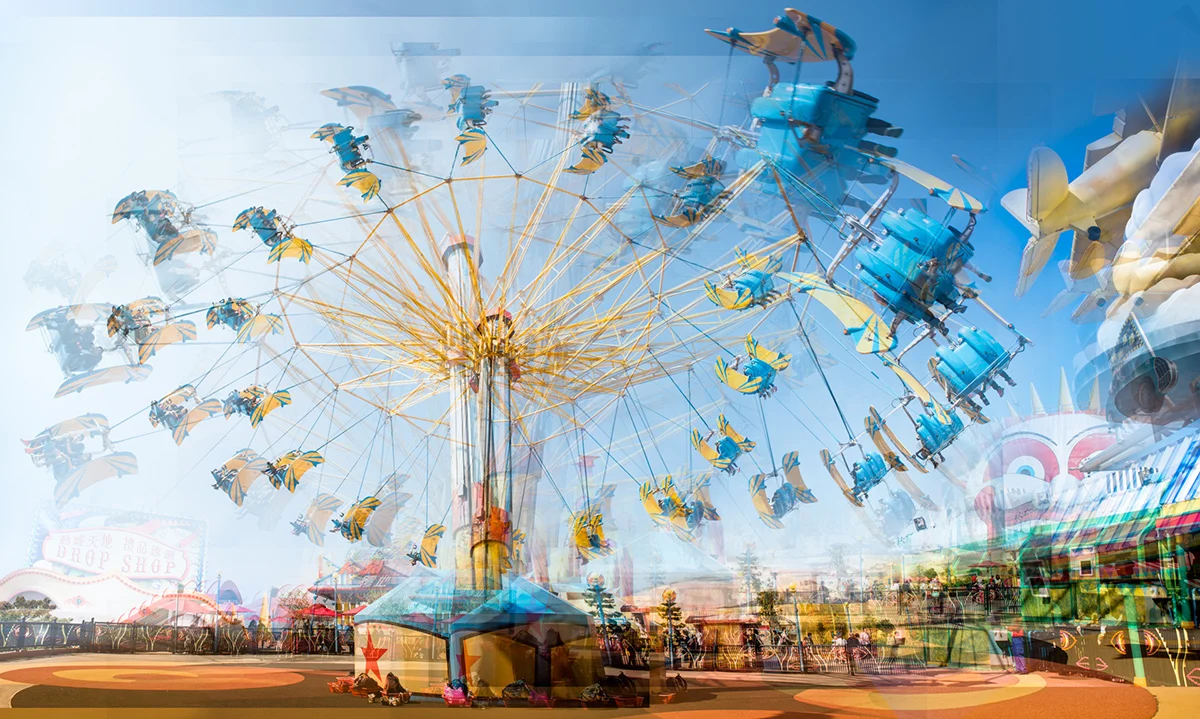
Each image in "The Shape of Memories" is a meticulously constructed composite, born from hundreds, and often thousands, of individual fragments. These fragments are not random snapshots but carefully selected elements gathered during his extensive travels. They represent moments, textures, colours, and forms that, in their aggregation, begin to carry the emotional weight of the experience. This is a deliberate act of translation, moving from the raw sensory data of the city to a visual language that can convey subjective feeling.
The layering process is not merely additive; it is transformative. Magherini’s studio becomes a crucible where these disparate elements are brought together, manipulated, and fused. Through digital collage and sophisticated post-production techniques, he creates images that are at once hyperreal and dreamlike. The boundaries between individual moments blur, creating a sense of temporal fluidity and spatial ambiguity. The viewer is not presented with a single viewpoint but with a multitude of perspectives, a visual echo of how memory and perception operate.
This method is crucial to achieving the project’s core objective: to evoke the feeling of a place rather than to document its factual appearance. The resultant images are not factual records of what was seen on a particular day, at a specific time. They are, rather, a reconstruction of what was felt, a distillation of the emotional resonance of navigating these complex urban ecosystems. The intensity of the experience, the constant flux, the sensory overload, and the profound sense of immersion are all meticulously woven into the visual fabric of each artwork.
Thematic Exploration: Displacement, Belonging, and the Urban Psyche
"The Shape of Memories" delves into profound psychological and sociological themes, offering a unique lens through which to examine the modern urban experience. At its heart, the project explores the inherent disorientation of moving through different places, a sensation Magherini describes as "being present but not belonging." This feeling of liminality, of existing on the periphery, is a common thread in the contemporary human condition, particularly in an increasingly globalized and interconnected world.
Magherini’s choice of cities – sprawling, densely populated metropolises like Tokyo, Hong Kong, Bangkok, and Hanoi – is deliberate. These are environments characterized by their rapid pace of change, their overwhelming scale, and their distinct cultural landscapes. Navigating these cities often triggers a sense of both wonder and alienation, a feeling of being simultaneously captivated and overwhelmed. The project captures this duality, presenting the beauty and dynamism of urban life alongside the inherent challenges of cultural and personal displacement.
The concept of memory itself is a central pillar of the work. Magherini challenges the linear, chronological model of memory, proposing instead a more fluid, associative, and emotionally driven understanding. He draws a parallel between his artistic process and the way the human mind retains information: "Just as our minds do not remember in sharp, single frames but rather in a sedimented accumulation of sensations, these images hold multiple moments at once." This idea of "sedimented accumulation" is key to understanding the visual language of "The Shape of Memories." The layered fragments are not simply superimposed; they coalesce, creating a sense of depth and history, mirroring the way past experiences and present sensations intertwine in our recollections.
Furthermore, the project touches upon the concept of the urban psyche. How do these immense, man-made environments shape our internal worlds? Magherini’s work suggests that cities are not merely inert backdrops but active participants in the formation of our identities and our emotional landscapes. The constant flow of people, the architectural marvels and the mundane details, the sounds and the silences – all contribute to a complex tapestry of urban existence that leaves an indelible mark on the individual.
Critical Reception and Artistic Significance
Riccardo Magherini’s "The Shape of Memories" has garnered significant attention within the contemporary art world for its innovative approach and its profound thematic resonance. Art critics and curators have lauded the project for its ability to push the boundaries of photographic practice, moving beyond traditional representation towards a more expressive and experiential form of visual art.
The project is frequently cited as an example of how artists are engaging with the complexities of the digital age, not just as a tool for image creation but as a medium for exploring the very nature of perception and memory in a technologically saturated world. The meticulous layering and digital manipulation employed by Magherini are seen not as a departure from artistic integrity, but as a sophisticated means of conveying a subjective truth that would be impossible to capture through conventional means.
The emotional depth and visceral impact of the images are also frequently highlighted. Viewers often report a sense of recognition, a feeling of having experienced something similar in their own journeys through urban landscapes. This universality of the themes of disorientation, memory, and the human connection to place has contributed to the project’s broad appeal and critical acclaim.
The artistic significance of "The Shape of Memories" lies in its successful reimagining of the photographic medium. Magherini has demonstrated that photography can be more than just a passive record of reality; it can be an active participant in the construction of meaning, a conduit for emotional expression, and a powerful tool for exploring the intricacies of human consciousness. His work offers a compelling argument for the continued evolution of artistic practice in response to the changing ways we experience and understand the world around us.
The Invitation: Entering a Living Space of Memory and Emotion
Ultimately, "The Shape of Memories" is an invitation. It is an invitation to step beyond the surface of the image, to move beyond the realm of mere observation, and to engage with the work on a deeper, more emotional level. Riccardo Magherini encourages viewers to enter his created worlds not as passive observers of historical documents, but as participants in a living space where memory, emotion, and place coalesce.
The project challenges us to consider our own relationship with memory and perception. How do we truly remember places? What are the emotional residues left behind by our travels and our daily experiences? By offering a visual representation of these complex internal processes, Magherini prompts introspection and a deeper appreciation for the subjective nature of our lived realities.
The strength of "The Shape of Memories" lies in its ability to resonate with a universal human experience. While the specific urban landscapes depicted may vary, the underlying feelings of wonder, disorientation, longing, and the intricate interplay of memory and emotion are shared by people across cultures and continents. Magherini’s artistic vision, born from his personal journey, offers a profound and moving exploration of what it means to be human in an increasingly complex and interconnected world. His work stands as a testament to the enduring power of art to capture the intangible, to give form to the formless, and to invite us into a deeper understanding of ourselves and the spaces we inhabit.