Unearthing the Enduring Legacy: A Review of Shan Winn’s "Heaven, Heroes, and Happiness"
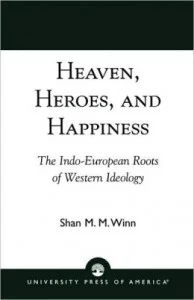
[Image: Heaven-Heroes-and-Happiness-194×300.jpg]
LONDON, UK – In an age often defined by rapid change and a perceived rupture with the past, the concept of deep historical continuity can offer a profound sense of grounding. Shan Winn’s "Heaven, Heroes, and Happiness: The Indo-European Roots of Western Ideology" embarks on an ambitious journey to illuminate precisely this enduring connection, arguing that the foundational ideologies and societal structures of the West are not merely products of recent history but are profoundly shaped by their Proto-Indo-European antecedents. This scholarly yet accessible work challenges readers to look beyond immediate historical narratives and recognize the ancient undercurrents that still shape our modern worldviews.
The book’s central premise posits that while the distinctions between our contemporary understanding of the world and that of pre-Christian Europeans are significant, an equally weighty degree of continuity persists. Winn, through a meticulous synthesis of archaeological, linguistic, and mythological evidence, contends that the influence of the Proto-Indo-Europeans—a group of peoples who emerged from the Pontic-Caspian steppe millennia ago—extends far beyond the linguistic family that underpins most European languages. Instead, she argues, they bequeathed a comprehensive ideological framework that continues to resonate within Western societies, from our social hierarchies to our deepest spiritual leanings.
The Genesis of Western Thought: Main Facts from "Heaven, Heroes, and Happiness"
"Heaven, Heroes, and Happiness" serves as a compelling introduction to the world of Indo-European studies, synthesizing complex academic research into a coherent narrative for a broader audience. At its core, the book asserts that Western civilization’s ideological bedrock was laid by the Proto-Indo-Europeans, a nomadic or semi-nomadic pastoralist people who flourished in the Bronze Age. Their innovations, particularly the domestication of horses and the use of wheeled carts, facilitated their expansive migrations, leading them to settle across vast swathes of Eurasia. This diaspora profoundly shaped the emerging societies of Europe—including the ancestors of the Celts, Slavs, Greeks, Romans, and Germanics—and parts of Asia.
Winn’s primary focus is not merely on the geographical spread or linguistic impact of these ancient peoples, but on the intellectual and social blueprint they established. She highlights several key enduring legacies:
- The Tripartite Societal and Cosmological Structure: A hierarchical division of society into three distinct functions: rulers/priests (sovereignty), warriors (force), and commoners (producers/fertility). This structure, according to Winn and drawing heavily from the work of Georges Dumézil, was not just a social arrangement but was mirrored in their cosmology, with deities often aligning with these functions.
- Shared Mythical Themes and Philosophical Underpinnings: The book explores how certain fundamental mythical themes and philosophical concepts, such as the struggle between order and chaos, the role of heroic figures, and the nature of happiness, find common expression across diverse Indo-European cultures.
- Influence on Later Religious Traditions: Winn meticulously traces how even revolutionary religious movements, such as Zoroastrianism, while distinct, nevertheless drew upon and reinterpreted existing Indo-European mythical and philosophical raw materials, thereby indirectly influencing later monotheistic religions like Christianity.
The work builds upon the foundational scholarship of two giants in Indo-European studies: Georges Dumézil, renowned for his trifunctional hypothesis, and Marija Gimbutas, whose "Kurgan hypothesis" and "Old Europe" theories have significantly shaped our understanding of prehistoric Europe. While the reviewer readily acknowledges the robustness of Dumézil’s contributions, a critical engagement with Gimbutas’s more controversial interpretations forms a significant subtext of the analysis, underscoring the ongoing debates within the field.
A Journey Through Time: Chronology of the Proto-Indo-Europeans
Understanding the chronological sweep of the Proto-Indo-Europeans is crucial to appreciating the depth of their influence. Winn’s narrative anchors itself in the Bronze Age, painting a vivid picture of a dynamic people whose migrations catalyzed immense cultural shifts across a continent.
Early Bronze Age (circa 4500-2500 BCE): The Pontic-Caspian Steppe Hearth
The story begins in the vast grasslands of the Pontic-Caspian steppe, a region spanning parts of modern-day Ukraine, Russia, and Kazakhstan. Here, the Proto-Indo-Europeans are believed to have coalesced as a distinct cultural and linguistic group. They were characterized by a semi-nomadic pastoralist lifestyle, centered around herding cattle, sheep, and goats. Crucially, this period saw their pioneering adoption of two transformative technologies: the domestication of the horse for riding and draft, and the invention of the wheeled cart. These innovations provided unprecedented mobility, enabling them to traverse vast distances and exploit new resources, setting the stage for their eventual expansion. Archaeological evidence from cultures like the Yamnaya (Pit Grave) culture is often cited as representing early Proto-Indo-European material culture, known for its distinctive burial mounds (kurgans).
Middle to Late Bronze Age (circa 2500-800 BCE): The Great Migrations
Armed with superior mobility and, later, advanced metallurgical skills (bronze working), the Proto-Indo-Europeans began a series of significant migrations out of their homeland. These movements were not necessarily mass invasions but rather a gradual spread, often involving elite dominance and cultural assimilation.
- Westward Expansion: Waves of Indo-European speakers moved into Central and Western Europe, leading to the formation of early Celtic, Italic, Germanic, and Balto-Slavic language groups. These migrations fundamentally altered the demographic and cultural landscape of the continent, interacting with and often supplanting pre-existing Neolithic cultures.
- Southward Expansion: Other groups migrated into the Aegean, laying the groundwork for Mycenaean Greek civilization, and into Anatolia, giving rise to empires like the Hittites.
- Eastward and South-Eastward Expansion: Perhaps one of the most significant migrations was that of the Indo-Iranians, who moved into Central Asia and eventually split, with one branch (Indo-Aryans) migrating into the Indian subcontinent and another (Iranians) settling the Iranian plateau. These groups left behind a rich linguistic and religious legacy, including the Vedic traditions of India and the ancient Persian faiths.
Iron Age and Beyond (circa 800 BCE onwards): Consolidation and Diversification
By the Iron Age, the various branches of the Indo-European family had largely settled in their historical territories. Their languages had diversified into distinct families (e.g., Celtic, Germanic, Italic, Hellenic, Indo-Iranian), and their cultures had evolved, often incorporating elements from the indigenous populations they encountered. Despite this diversification, Winn argues, the underlying ideological and structural patterns established by their Proto-Indo-European ancestors remained remarkably persistent, forming a deep substratum beneath the more visible cultural changes. This chronological journey underscores how a relatively small group of people, through their technological prowess and distinct worldview, managed to profoundly reshape the cultural and linguistic map of a continent and beyond.
Enduring Echoes: Supporting Data and Cultural Manifestations
Winn’s central argument is buttressed by a wealth of supporting data, primarily drawn from comparative mythology, linguistics, and social anthropology. The book meticulously illustrates how the abstract principles of Proto-Indo-European ideology materialized in diverse yet strikingly similar forms across distinct cultures.
The Tripartite Ideology: A Structural Blueprint
One of the most compelling pieces of evidence for Indo-European continuity is the pervasive tripartite hierarchical structure, a concept championed by Georges Dumézil. This "trifunctional hypothesis" posits that Indo-European societies and their associated pantheons were organized around three core functions:
- Sovereignty (Rulers and Priests): Representing sacred and juridical authority, often embodied by a dualistic godhead – one benevolent and priestly, the other powerful and kingly. In Roman mythology, this is seen in Jupiter (celestial sovereign) and Dius Fidius (oath god); in Norse, Odin (wisdom, magic, kingship); and in Vedic India, Mitra (contract, order) and Varuna (cosmic law, magic).
- Force (Warriors): Encompassing martial prowess, protection, and aggressive defense. This function is typically associated with a thunder god or a fierce warrior deity. Examples include Roman Mars, Norse Thor, Greek Ares, and Vedic Indra.
- Fertility/Production (Commoners): Representing the sustenance of society through agriculture, crafts, and trade, ensuring prosperity and well-being. This function often involves deities of fecundity, health, and abundance. Roman Quirinus, Norse Freyr and Freyja, and Vedic Nasatyas (Ashvins) are examples.
This structure was not merely an abstract concept but a lived reality. In ancient India, the Varna system, with its Brahmins (priests), Kshatriyas (warriors), Vaishyas (merchants/farmers), and later Shudras (laborers), directly reflects this trifunctional division. Similarly, Celtic societies had druids (priests/judges), flaith (warriors/nobles), and aithech (commoners). Even in modern Western societies, while not strictly adhered to, the echoes of this tripartite division can be discerned in the separation of powers (executive/legislative/judicial), the military, and the vast economic sector, highlighting its enduring influence as a "primary reference point."
Zoroastrianism: An Indo-European Spiritual Evolution
Winn delves into the figure of Zarathustra, the Iranian prophet of the second millennium BCE, whose teachings founded Zoroastrianism. She argues that Zarathustra, himself a priest from an Indo-European society, ingeniously re-worked existing Indo-European mythical themes into a radically new philosophical and religious system. While Zoroastrianism introduced profound concepts like ethical dualism (Ahura Mazda vs. Angra Mainyu), free will, and a linear eschatology culminating in a final judgment, its raw materials – such as the divine beings (Amesha Spentas), cosmic battles, and the emphasis on truth (asha) – bear clear resemblances to earlier Indo-Iranian religious ideas. The profound influence of Zoroastrianism on later monotheistic religions, particularly its concepts of heaven and hell, messianic figures, and the struggle between good and evil, thus represents a crucial, albeit indirect, channel through which Indo-European thought shaped global spirituality.
Common Mythological Motifs and Linguistic Connections
Beyond social structures and specific religious movements, Winn also points to a constellation of shared mythological motifs that attest to a common Indo-European heritage. These include:
- The Sky Father Deity: The concept of a supreme celestial deity, Dyeus Pater (literally "Sky Father"), from which names like Greek Zeus, Roman Jupiter, and Vedic Dyaus Pita derive.
- The Divine Twins: Often associated with horses, healing, and rescue, appearing as the Dioscuri (Castor and Pollux) in Greek myth and the Ashvins in Vedic tradition.
- Dragon Slaying Myths: The hero battling a chaos-serpent or dragon (e.g., Greek Apollo vs. Python, Norse Thor vs. Jörmungandr, Vedic Indra vs. Vritra), symbolizing the establishment of cosmic order.
- Chariot Symbolism: The chariot as a vehicle for gods and heroes, reflecting its practical importance in early Indo-European warfare and ritual.
Furthermore, the very existence of the Indo-European language family—from Sanskrit to Icelandic, Persian to Irish—provides irrefutable linguistic evidence of a common ancestry. Comparative philology allows scholars to reconstruct elements of the Proto-Indo-European language and, by extension, aspects of their culture, vocabulary (e.g., words for horse, wheel, chieftain, family kinship terms), and even religious concepts. This linguistic bedrock underpins all other cultural comparisons.
A Critical Lens: The Gimbutas Controversy
While Winn draws significantly from Dumézil, her reliance on Marija Gimbutas’s work elicits a critical assessment from the reviewer. Gimbutas, through her "Kurgan hypothesis," posited the Proto-Indo-European migrations as a series of invasions that fundamentally transformed Europe. However, her more controversial "Old Europe" theory describes pre-Indo-European European societies as uniformly peaceful, egalitarian, matriarchal, goddess-worshipping agrarian cultures that placed high value on art. In Gimbutas’s narrative, the arrival of the "patriarchal" Indo-Europeans violently conquered these harmonious societies, ushering in an era of patriarchy and warfare.
The reviewer acknowledges a kernel of truth in the idea that pre-Indo-European societies might have been closer to this imagined way of life, but critiques Gimbutas for vastly overstating her case. This overstatement creates a stark, almost Manichaean dichotomy, portraying Old Europe as an idealized, utopian model that, as the reviewer notes, "played directly into the unrealized hopes and dreams of mid-to-late-twentieth-century liberalism/progressivism." The critique extends to Winn’s largely uncritical acceptance of Gimbutas, particularly her assumption that any Indo-European goddess must be a "holdover" from Old Europe, thereby implying a "cartoonishly patriarchal" Indo-European culture incapable of developing its own female divinities. This overlooks the complexity of Indo-European pantheons, which included powerful goddesses of sovereignty, war, and fertility, such as the Norse Freyja, the Irish Morrígan, or the Vedic Ushas (dawn goddess). The reviewer’s passing reference to the "obvious, almost Zoroastrian dualism inherent in Gimbutas’s vision" further highlights the concern about her stark good-vs-evil framing.
Scholarly Dialogues: Official Responses and Ongoing Debates
The field of Indo-European studies, like any vibrant academic discipline, is characterized by robust debate and evolving consensus. Winn’s book, by synthesizing and presenting established theories, inevitably touches upon areas of ongoing scholarly discussion, particularly concerning the interpretations of Georges Dumézil and Marija Gimbutas.
Dumézil’s Enduring Legacy: Georges Dumézil’s trifunctional hypothesis has largely stood the test of time, albeit with refinements. While initially met with skepticism by some, his comparative method, which meticulously analyzes parallels in social structures, mythologies, and religious practices across diverse Indo-European cultures, has proven incredibly fruitful. Scholars largely accept the existence of these functional divisions as a significant aspect of Proto-Indo-European ideology, though the degree of their strictness and universality across all Indo-European societies remains a subject of nuanced discussion. Critics often point out that Dumézil’s focus on elite ideologies might overlook the complexities of commoners’ beliefs, but the core framework remains a powerful analytical tool for understanding ancient Indo-European thought. Winn’s reliance on Dumézil is thus placed on solid academic ground, representing a widely accepted interpretive framework.
Gimbutas’s Polarizing Influence: In contrast, Marija Gimbutas’s work, particularly her "Old Europe" construct, has generated far more controversy and a more polarized "official response" within archaeology and Indo-European studies. While her "Kurgan hypothesis" regarding the Indo-European homeland and migrations is largely accepted, her romanticized vision of a peaceful, egalitarian, goddess-worshipping "Old Europe" has been heavily scrutinized and, in many aspects, significantly challenged.
- Archaeological Scrutiny: Critics argue that Gimbutas’s interpretations of archaeological findings often lacked rigorous methodology, sometimes imposing her theoretical framework onto ambiguous data. The archaeological record for pre-Indo-European Europe, while showing signs of sophisticated cultures, does not consistently support a monolithic, entirely peaceful, or uniformly matriarchal society. Evidence of fortifications, weapons, and social stratification exists in various forms.
- The "Matriarchy" Debate: The concept of widespread prehistoric matriarchy, central to Gimbutas’s Old Europe, lacks substantial empirical support in the broader archaeological and anthropological record. While female deities and prominent female roles existed, this does not equate to a matriarchal social structure where women held primary power.
- Ethical and Political Overtones: As the reviewer points out, Gimbutas’s narrative resonated strongly with certain feminist and New Age movements of the late 20th century, providing a "historical utopian model." While scholars acknowledge the importance of considering gender and power dynamics in prehistory, the perception that Gimbutas’s work was influenced by contemporary political desires rather than purely objective scholarship has led to a cautious, often critical, reception among mainstream academics.
- The Nature of Cultural Interaction: The idea of Indo-European migrations as purely destructive "invasions" has also been refined. Many scholars now emphasize more complex models of cultural interaction, including elite emulation, gradual assimilation, trade, and localized conflicts, rather than a singular, violent conquest.
Winn’s uncritical adoption of Gimbutas’s more speculative claims, particularly regarding the origin of goddesses, places her book within this ongoing academic tension. While a synthesis of different scholarly perspectives is valuable, the lack of a more nuanced engagement with the controversies surrounding Gimbutas’s interpretations highlights a potential area for further critical discussion within the book itself. This makes "Heaven, Heroes, and Happiness" a useful entry point into the subject, but one that benefits from being read alongside a broader range of scholarship that critically evaluates all theories.
A Legacy Redefined: Implications for Modern Western Identity
The profound implications of Shan Winn’s "Heaven, Heroes, and Happiness" extend far beyond the academic sphere, touching upon our understanding of modern Western identity, cultural continuity, and even contemporary societal structures. By tracing the "Indo-European Roots of Western Ideology," Winn encourages a re-evaluation of what we consider "original" or "innate" in our cultures.
Deepening Our Self-Understanding: The most significant implication is a richer, more profound understanding of the historical depth of Western civilization. It challenges the common perception that Western thought began solely with classical Greece or Judeo-Christian traditions. Instead, it posits that these later developments were built upon an even older, deeply ingrained ideological substratum. Recognizing the ancient origins of concepts like tripartite social organization, the role of heroic archetypes, and the struggle for cosmic order can provide a sense of rootedness and continuity often lacking in modern narratives. It suggests that certain patterns of thought and social organization are not arbitrary but are products of millennia of cultural evolution.
Reconsidering "Western Values": If fundamental aspects of our worldview, such as the division of societal functions or certain ethical dualisms, have roots stretching back to the Bronze Age, it prompts us to reconsider the origins and universality of what are often termed "Western values." While these values have evolved significantly, their ancestral echoes suggest a deep-seated cultural predisposition that has shaped their development. This perspective can foster both humility—recognizing that our ideas are not entirely novel—and a greater appreciation for the resilience of cultural traditions.
Bridging Disciplines: Winn’s work, by its very nature, encourages interdisciplinary thinking. It demonstrates the power of combining linguistic, archaeological, mythological, and anthropological evidence to reconstruct the mental landscape of ancient peoples. This holistic approach is crucial for understanding complex cultural phenomena and has implications for how we approach history, sociology, and even psychology, by highlighting the persistent influence of deep cultural memory.
Navigating the Past Critically: The reviewer’s critique of Winn’s uncritical adoption of Gimbutas’s "Old Europe" also carries an important implication: the need for critical engagement with historical narratives. The past is not a blank slate, and its reconstruction can be influenced by contemporary desires or ideological frameworks. By highlighting the potential for projecting modern utopian ideals onto ancient societies, the book, indirectly, serves as a cautionary tale about the importance of rigorous scholarship and avoiding anachronism when interpreting historical data. This reinforces the idea that understanding our roots requires not just uncovering facts but also critically analyzing the frameworks through which we interpret them.
Conclusion: A Recommended Exploration of Enduring Heritage
Ultimately, "Heaven, Heroes, and Happiness" stands as an excellent introduction to the multifaceted world of Indo-European society and mythology. Despite some critical reservations regarding its treatment of Marija Gimbutas’s more controversial theories, the book offers a fascinating and generally sound study of the enduring ways in which the worldviews and ways of life of the Proto-Indo-Europeans have profoundly shaped and survived down to the present day. It illuminates the ancient foundations beneath the visible structures of Western civilization, inviting readers to embark on a journey of discovery that redefines our understanding of heritage and continuity. For anyone interested in the deep history of Western thought, language, and social organization, Shan Winn’s work comes highly recommended as a thought-provoking and enriching read.
[Click here to view or buy Heaven, Heroes, and Happiness at Amazon.com.]