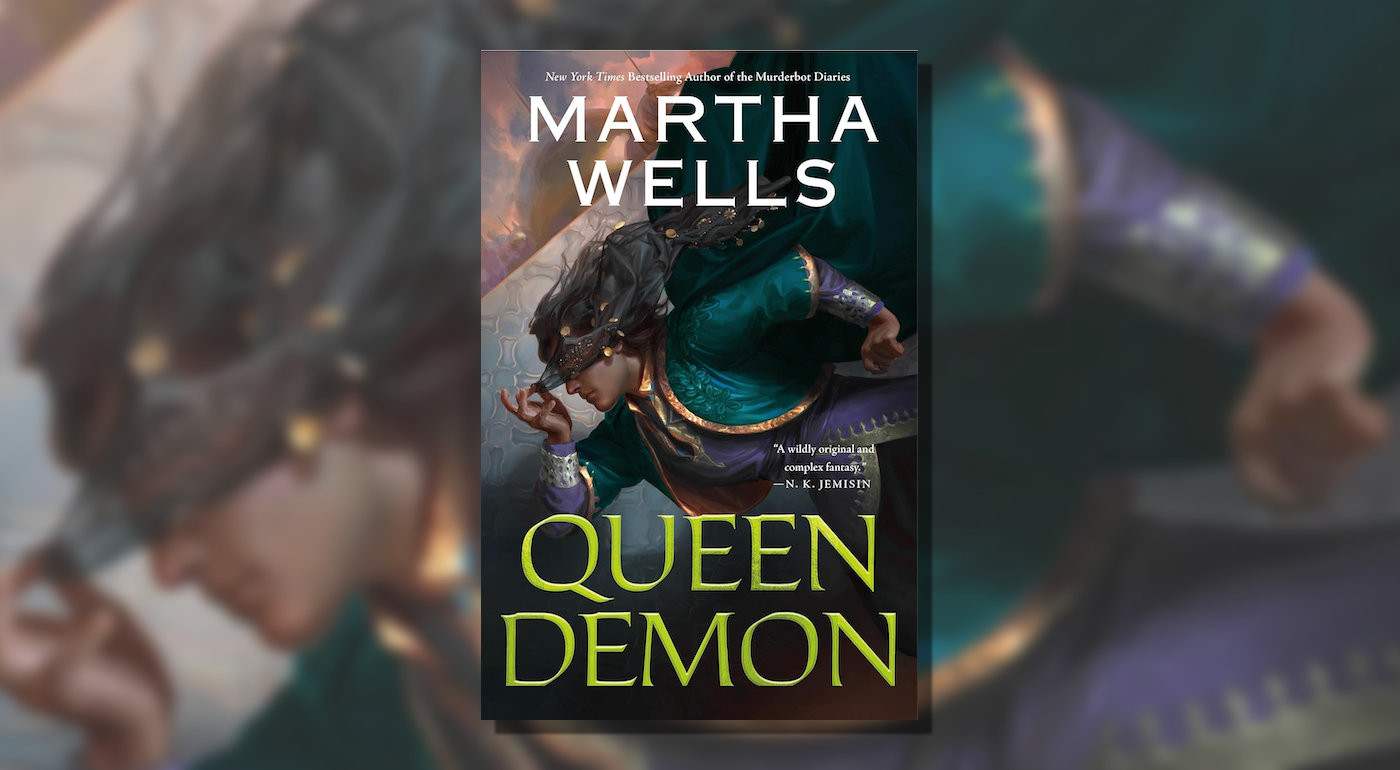
"Queen Demon" Reignites Martha Wells’s Epic Saga, Unveiling Profound Moral Labyrinths
FOR IMMEDIATE RELEASE
[City, State] – [Date] – Anticipation reached a fever pitch among fantasy enthusiasts as Martha Wells, the celebrated author of the Murderbot Diaries and Books of the Raksura, delivers another compelling chapter in her epic saga with Queen Demon. The third installment, following the critically acclaimed The Witch King, plunges readers deeper into a meticulously crafted world fraught with ancient powers, moral ambiguities, and the enduring struggle for agency. Early reviews commend Wells for her masterful narrative control, intricate character development, and unflinching exploration of power’s corrupting influence.
Main Facts
Queen Demon, the highly anticipated third novel in Martha Wells’s The Witch King series, continues the intricate narrative threads established in its predecessor. Set against a backdrop of ancient magic, warring factions, and profound ethical dilemmas, the book unfolds across dual timelines—the past and the present—each picking up shortly after the events of The Witch King.
In the present, the narrative follows Kai, Ziede, and Tahren as they navigate the aftermath of thwarting Bashat’s bid for emperorship of the Rising World. Concurrently, the past timeline chronicles their strategic machinations against the formidable Hierarchs. The novel delves into the nuanced complexities of power, demonstrating how its pursuit and application shape individuals and societies, often forcing "good people to do terrible things" in the face of greater evils. Key themes include the nature of leadership, the cost of sacrifice, and the profound impact of individual and collective choices, cementing Wells’s reputation for crafting morally resonant fantasy.
Chronology of Revelation and Narrative Unfolding
The journey into Queen Demon for many dedicated readers, including this reviewer, began not with the book’s official release, but with the coveted Advanced Reader Copy (ARC). Received in the summer of 2025, the ARC of Queen Demon became an object of intense, almost agonizing, anticipation. The decision to defer reading it, preserving its freshness for a critical column, transformed the experience of awaiting its pages into a prolonged exercise in literary self-control. This deliberate delay, while intellectually sound, underscored the emotional investment readers place in Wells’s narratives, leading to a palpable stress that only intensified upon the book’s completion. The immediate, visceral need for the next installment is a testament to the novel’s gripping power, leaving readers clamoring for resolution like a dustwitch craving dust—an apt metaphor drawn directly from Wells’s rich lore.
Queen Demon masterfully employs its dual timeline structure, weaving together events from the characters’ past struggles with their current challenges. This chronological interplay not only enriches the world-building but also provides crucial context, demonstrating how historical choices echo through the present.
The Past Timeline: This segment propels the narrative forward from the conclusion of Witch King, focusing on the escalating conflict between Kai, Ziede, Tahren, and the oppressive Hierarchs. The primary thrust of this storyline is the meticulous ramp-up to, and subsequent execution of, a daring confrontation with the Hierarchs and their legionaries in the pivotal port city of Descar-arik. Bashasa, a figure of burgeoning leadership, spearheads a strategic caravan of soldiers and civilian allies toward the city, while other rebel factions orchestrate diversions and incite revolts across the Hierarchs’ expansive conquered territories. This multi-pronged assault underscores the rebels’ ingenuity and the widespread discontent simmering beneath the Hierarchs’ tyrannical rule.
However, Wells deftly complicates the simple hero-villain dynamic by introducing internal threats. The emergence of a self-proclaimed Doyen, leader of a faction of Witches possessing the potent ability to manipulate dust, introduces a new layer of danger. This Doyen, depicted as a "mini Hierarch" in her own right, brainwashes her followers and terrorizes human populations. Her eventual, ill-fated attempt to assert control over Kai serves as a pivotal moment, ultimately leading to her downfall. In the wake of this internal struggle, the remaining dustwitches, freed from the Doyen’s thrall, align with Kai. Together, they launch a decisive assault on the Hierarch, the demonic entities, and the legionaries entrenched at Descar-arik. This segment powerfully explores the grim reality of rebellion: the necessity for good individuals to make morally compromising choices, to wield "stolen power in cruel ways," all in the service of dismantling a far greater and more pervasive threat. It forces readers to confront the uncomfortable truth that salvation often comes at a steep ethical price.
The Present Timeline: Concurrently, the present-day narrative unfolds directly from where Witch King left off, focusing on Dahin and another Immortal Blessed, Ilhanrun Highsun. Their quest leads them to a perilous discovery: what they believe to be a Hierarchs’ Well. The devastating capabilities of such a Well were starkly illustrated in Witch King, where it was brutally employed to eradicate the Saredi. While the Blessed possess their own Well of Thosaren, a source of power created through acts of life, the Hierarchs’ version stands as a chilling antithesis, forged through "a lot of death"—the sacrifice of thousands of lives. The sheer magnitude of this power, and its enduring presence, casts a long shadow over the Rising World. The prevailing fear is that surviving conquerors, who retreated to their homelands after Bashasa’s initial victory, will harness this formidable Well to resurrect a new Hierarch and unleash a fresh wave of devastating attacks. The converging paths of the main crew eventually lead them to Sun-Ar, but in a characteristic Wellsian twist, the primary threat they face is revealed not to be the Hierarchs, but something entirely unforeseen. The book concludes with a tantalizing "whisper of hope" in the past timeline, juxtaposed with a "shocking moment" in the present, leaving readers on an electrifying cliffhanger and intensifying the demand for the series’ continuation.
Supporting Data and Thematic Depth
Martha Wells’s narrative brilliance in Queen Demon is particularly evident in her nuanced portrayal of character relationships and her profound exploration of power and morality.
Complex Relationships: A cornerstone of Wells’s appeal lies in her ability to craft deeply resonant character dynamics. The evolving relationship between Kai and Bashasa in the past timeline has become a particular focal point for readers, drawing parallels to the beloved Moon and Chime from Wells’s Books of the Raksura. The internal monologue of "JUST KISS ALREADY!" perfectly encapsulates the collective longing for these two emotionally reserved, yet undeniably drawn, individuals. Bashasa’s endearing fluster in Kai’s presence, contrasted with Kai’s consistent oblivious or misunderstanding responses, forms a classic "emotionally constipated dorks" trope—a favorite among fans and a testament to Wells’s skill in portraying romance through subtle gestures and unspoken desires. This slow-burn dynamic builds on genuine mutual respect and shared purpose, making their eventual emotional realization all the more anticipated. Similarly, the budding attraction between Tahren and Ziede, observed even by Kai, hints at another layer of emotional complexity woven into the fabric of the rebellion.
The Multifaceted Nature of Power: Wells employs Queen Demon as a canvas to dissect the intricate and often insidious nature of power, demonstrating how it manifests differently across various characters and factions.
-
Kai vs. Other Demonic Entities: Kai’s unique position as a demon striving for good offers a powerful counterpoint to his kin. The reviewer notes Kai’s suspicion of the Doyen’s demonic ancestry, suggesting a broader tendency among some demons towards psychic control and manipulation of mortals. This is further underscored by the demons Kai previously freed from the Cageling Courts, who subsequently chose to fight for the Hierarchs. This highlights a troubling reality: that many demons, much like the Blessed and the Hierarchs, view mortals as expendable. The conflict between Kai and Arnsterath serves as a potent microcosm of this theme. Arnsterath, after the destruction of the Summer Halls, attacks Kai for the perceived transgression of inhabiting a body not "pre-approved" (specifically, an expositor’s). Yet, in a stark display of hypocrisy, she later adopts a similar strategy. Kai’s power is consistently depicted as self-sacrificial; he literally harms himself to access his magic, consciously avoiding the easier but more dangerous path of tapping into the Hierarchs’ Well. Arnsterath, in contrast, utilizes her power primarily for personal gain and control, a reaction to feeling powerless after the Saredi’s decimation. Her desire is not for "power for power’s sake," but rather to reclaim a sense of agency. Crucially, even when presented with the opportunity, she never considers seizing the Well for herself, demonstrating a nuanced form of ambition that differentiates her from the truly megalomaniacal Hierarchs.
-
The Entitlement of the Blessed (Dahin and Highsun): The dynamics between Dahin and Ilhanrun Highsun expose another facet of power’s corrupting influence: entitlement. Both Immortal Blessed characters exhibit a profound sense of self-importance, characteristic of their kind (with Tahren being a notable exception). Each believes themselves uniquely destined to find the Hierarchs’ Well and that their respective plans are inherently superior. Their shared tendency to treat mortals, even those considered friends, as mere pawns in a grand strategic game underscores a dangerous detachment. Despite their differing objectives for the Well, their tactics mirror each other, leading to tragically similar outcomes. The observation that "If Dahin stopped acting like a Blessed for five minutes (or if he had spent any of the last six decades learning from his sister instead of antagonizing her) things probably would’ve turned out much differently and with fewer deaths" serves as a poignant indictment of how personal pride and ingrained biases can exacerbate conflict and lead to unnecessary casualties.
Choice as the Crucible of Morality: Wells’s profound engagement with the concept of choice, and its inherent consequences, forms the philosophical backbone of Queen Demon. The reviewer aptly cites Liz Bourke’s Locus review, which posits that Wells’s narrative rejects the simplistic notion of evil as an extrinsic force. Instead, "The destructive selfishness that makes other people pay the price for your power, that produces an ideology of suÂpremacy and enacts it in violence, is not a single choice but a whole series of choices, personal choices but also social choices of what to build and what to tear down, what to support, and when."
This perspective is vividly illustrated throughout the novel. Bashasa, in a display of true leadership, consistently offers genuine choices to those under his command—whether to join the fight, remain in the civilian attachment, seek refuge in safe camps, or forge their own path. Kai, too, extends this courtesy to figures like Sanja and Tenes, presenting them with various options for safety and agency. Tenes, despite having compelling personal reasons to leave (namely, the search for her stolen family), repeatedly chooses to stay and fight, leveraging her limited power for the greater good. Her choices exemplify the novel’s core message: that even in the face of overwhelming odds and deeply personal desires, individuals possess the capacity for moral calculus, weighing options and consequences to act in alignment with their values. This emphasis on individual agency, even amidst vast, impersonal power struggles, elevates Queen Demon beyond a mere adventure story into a thoughtful examination of ethical decision-making.
Broader Context and Authorial Craft
Martha Wells has carved a formidable niche in contemporary fantasy, celebrated for her distinctive voice, complex world-building, and particularly for her nuanced characterizations. While widely known for the Murderbot Diaries, the Books of the Raksura and now The Witch King series demonstrate her exceptional ability to craft intricate, immersive fantasy worlds populated by non-human protagonists who grapple with universal themes of identity, belonging, and morality.
The dual timeline structure, a signature element of The Witch King series, is not merely a stylistic choice but a fundamental narrative engine. By interweaving past and present, Wells achieves several critical objectives. It allows for a gradual unveiling of ancient history, revealing the origins of conflicts and the deep-seated grievances that fuel present-day struggles. This chronological oscillation creates a dynamic tension, with revelations from one timeline often shedding new light or casting new shadows on events in the other. For instance, understanding the full horror of the Hierarchs’ Well in the past makes its discovery in the present all the more terrifying. This structural brilliance invites deeper engagement, prompting readers to connect dots and anticipate implications across time. The reviewer’s speculative desire to re-read the entire series chronologically (past sections then present sections) speaks to the structural integrity and the potential for new insights such a re-arrangement might offer, even while acknowledging the current structure’s inherent effectiveness in driving suspense and thematic resonance. Wells’s craft lies in her ability to make these complex narrative decisions feel organic and essential to the story she is telling.
Implications and Future Outlook
Queen Demon significantly raises the stakes for The Witch King series, broadening the scope of its conflicts and deepening the moral quandaries faced by its protagonists. The shocking twist in the present timeline, coupled with the fragile hope in the past, leaves a powerful impression, ensuring that fan anticipation for the next installment will be intense. Wells has masterfully expanded the universe, introducing new threats and complexities that challenge both the characters and the readers’ understanding of this world. The profound questions about power, choice, and the definition of ‘good’ are far from resolved, promising further exploration in future books.
The reviewer’s personal anticipation mirrors that of countless readers who eagerly await the continuation of Kai’s journey. Looking ahead, the next column will pivot to Martha Wells’s earlier Ile-Rien books, commencing with The Element of Fire. This intentional "fresh" approach, devoid of prior research, promises a unique critical perspective on another facet of Wells’s diverse bibliography. Readers interested in following along are encouraged to seek out the revised version of The Element of Fire, compiled within The Book of Ile-Rien, published in 2024.
Queen Demon solidifies Martha Wells’s standing as a preeminent voice in modern fantasy, an author capable of weaving intricate plots with deeply philosophical undertones. Her ongoing commitment to exploring the grayer areas of morality, the burdens of leadership, and the enduring power of connection ensures that her works remain not only entertaining but profoundly thought-provoking. The wait for the next chapter will undoubtedly be long, but utterly worthwhile.