
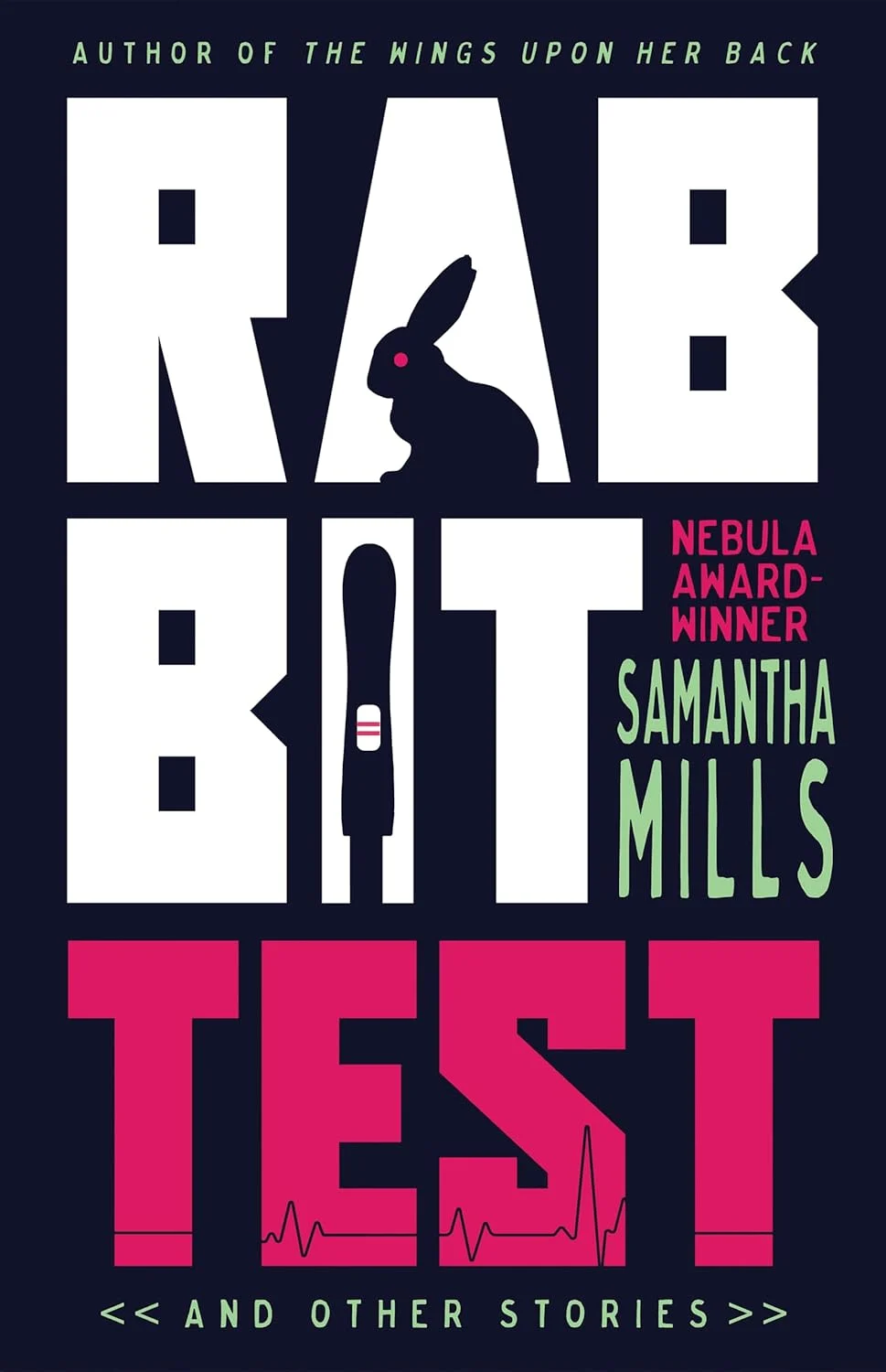
Samantha Mills’ "Rabbit Test and Other Stories": A Collection Grappling with the Gravity of a Masterpiece
Main Facts
Samantha Mills’ "Rabbit Test" burst onto the literary scene in 2022, quickly cementing its status as one of the most celebrated anglophone science fiction stories in recent memory. Its initial publication in the prestigious Uncanny Magazine heralded a cascade of accolades, including the Nebula, Theodore Sturgeon, and Locus Awards, alongside a Hugo Award which Mills herself notably disavowed, citing concerns about its legitimacy given its historical context. Beyond awards, its impact was further evidenced by its reprinting in The Best American Science Fiction and Fantasy (2023) and translations into seven languages, underscoring its profound resonance across cultures and within the genre.
This meteoric rise of a single short story inevitably led to the anticipation of a collection, culminating in Rabbit Test and Other Stories. Mills herself acknowledges the pivotal role of her titular work in her afterword, stating it "launched the whirlwind of awards and translations that made this collection possible." However, the very title of the collection, "Rabbit Test and Other Stories," encapsulates a formidable challenge for any author: the risk that the overwhelming brilliance of one piece might inadvertently overshadow the rest of their oeuvre, casting other potentially strong works into its long shadow. The critical question thus becomes whether the collection can stand on its own merits, or if it remains tragically caught in the orbit of its singular, visionary triumph.
Chronology and Critical Acclaim
The journey of "Rabbit Test" from its 2022 debut to its current legendary status is a testament to its singular power and timeliness. Published in Uncanny Magazine, a journal renowned for its high-quality speculative fiction, the story immediately captivated readers and critics alike. Uncanny has long been a beacon for diverse voices and innovative narratives, making it an ideal launchpad for a story as bold and politically charged as "Rabbit Test."
The subsequent avalanche of awards solidified its place in the pantheon of modern SFF. The Nebula Award, voted on by members of the Science Fiction and Fantasy Writers of America, signifies peer recognition of literary excellence. The Theodore Sturgeon Award, specifically for the best short science fiction, further highlighted its genre-defining qualities. The Locus Award, determined by reader poll, demonstrated its popular appeal. The Hugo Award, arguably the most famous award in speculative fiction, cemented its broad cultural impact, even with Mills’ principled decision to disavow it under specific circumstances that she elaborated on her personal blog. This unprecedented sweep across the major SFF awards underscores not just the quality of the writing, but also the profound resonance of its themes with contemporary audiences.
The story’s reach extended beyond the anglophone world, with translations into seven languages broadening its international dialogue. Its inclusion in The Best American Science Fiction and Fantasy anthology further confirmed its literary significance, positioning it as not just a genre standout but a piece of American literature worthy of broader academic and critical attention.
The collection itself arrives with this heavy legacy. Meg Elison, in her insightful introduction to Rabbit Test and Other Stories, articulates this very trepidation. She likens the book to a comet, confessing her initial anxiety: "what if none of the other stories were as good as the titular wonder? What if all the light of it was in the fireball, and the tail was simply ice and dust?" While Elison ultimately argues that Mills transcends the shadow of her masterpiece, going on to praise her ability to "turn a concept rancid with overuse into something fresh," to "populate the worlds of future and fantasy with people you’ve known all your life," and to "light up the sky in a flash of an image so indelible, you’ll believe ink on paper could burn your retina," the reviewer finds this optimism largely unfounded. Rabbit Test and Other Stories, while containing sparks of brilliance, ultimately struggles to escape the gravitational pull of its defining work, presenting a collection of lesser antecedents and diminishing returns that often feel like "ice and dust" compared to the fiery core.
Supporting Data: The Enduring Power of "Rabbit Test"
"Rabbit Test" stands as a monumental achievement, its excellence as palpable and resonant today as it was upon its initial release. At its core, the story is an extended fugue on reproductive justice within the United States, a complex and urgent narrative that masterfully interweaves a chilling future dystopia of pervasive surveillance and forced birth with lyrically described historical episodes detailing the evolution of abortion care and the development of pregnancy tests.
Consciously crafted as a direct and visceral response to the U.S. Supreme Court’s abhorrent 2022 decision in Dobbs v. Jackson Women’s Health Organization, which overturned Roe v. Wade and eliminated the constitutional right to abortion, "Rabbit Test" feels simultaneously timely and timeless. It captures the immediate shock and fury of a nation grappling with a regressive legal precedent while embedding this contemporary crisis within a sweeping historical context. The narrative’s dizzying historical scope, tracing centuries of women’s struggle for bodily autonomy, is matched by its laser-focused, righteous fury at the deep-seated misogyny and racism that have historically underpinned and continue to drive restrictions on reproductive freedom. Mills herself described the writing process as "a whirlwind," and indeed, the story’s propulsion is relentless. By the time one reaches its simultaneously rousing and bitter closing line – "It is 2022 and it is never over" – the reader is left buffeted by the rush of history, yet absolutely clear-eyed about the ongoing struggle and the vital work that lies ahead.
The story’s potent blend of politics and literary ambition has garnered widespread and deserved praise from numerous critics, including this reviewer in prior analyses. However, a re-reading reveals the profound subtlety embedded within Mills’ craft choices, a testament to her mastery of the form. The dystopia she constructs is not merely a backdrop; it is an all-encompassing force that permeates even the most mundane aspects of her characters’ lives and the language they use to describe them. For instance, the future dystopian protagonist monitors her menstrual cycle "like a surveillance drone over a labor march," a chilling analogy that instantly conveys the constant, intrusive oversight women face. Her experience of guilt is described with an unsettling scale, "the size of a rich man’s space station," highlighting the oppressive weight of societal expectations. When forced to carry her pregnancy to term, the nurse "holds up the infant, which is squalling in even more terror than its mother," a line that brutally encapsulates the generational trauma and fear perpetuated by the system. Every sentence feels meticulously chosen, imbued with urgency, effectively conveying the tension and fear inherent in the protagonists’ lives and compelling the reader to viscerally feel the injustice of their artificially limited horizons. "Rabbit Test" is that rare gem in speculative fiction: a story that not only earns its considerable hype but surpasses it, deserving its place as a landmark of short science fiction in the 2020s.
Supporting Data: The "Other Stories" – Precursors and Diminishing Returns
Given the sheer scale of "Rabbit Test’s" achievement, it is natural to search for its origins and evolution within Mills’ earlier works. Of the thirteen stories collected, nine were published prior to the titular piece, offering a glimpse into the thematic and stylistic interests that would eventually coalesce into her breakthrough.
Echoes of Brilliance: The Precursors
Recognizable themes and motifs abound in these earlier stories, serving as intriguing precursors to the fully realized vision of "Rabbit Test." In "Laugh Lines," when the narrator recounts being reluctantly dragged into the spotlight by her adoptive mother at "anti-vat marches," it’s impossible not to draw a parallel to the protagonist of "Rabbit Test" being held aloft as a "miracle child" at an anti-abortion protest. Both scenarios highlight the forced public performance of personal narratives within highly politicized environments, and the vulnerability of individuals used as symbols. Similarly, in "The Limits of Magic," the mother of the main character confesses that "it would be such a relief to be done" having children. This sentiment strongly echoes a poignant moment in "Rabbit Test" where the narrative voice observes that "her doctor said she couldn’t get her tubes tied unless she had three children already, but where’s the logic in giving birth to three children for the permission to have none?" Both passages powerfully critique the societal and medical gatekeeping of women’s reproductive choices, exposing the absurdity and cruelty of such restrictions.
These thematic similarities even extend to structural experimentation. "Strange Waters" follows the life of a fisherwoman navigating time both forwards and backwards in her relentless pursuit of returning home to her family. This non-linear, temporal fluidity feels like an early, less refined iteration of the later story’s fleet-footed historical conceit, which effortlessly traverses different eras of reproductive history.
None of these similarities are marks against the individual stories, of course. It is a common and often celebrated aspect of an author’s development to have recurring thematic interests and favorite images to which they repeatedly return. However, the striking element here is the experience of encountering the most potent, effective, and deeply impactful formulation of these ideas in "Rabbit Test" first, only to then find them reappearing in decidedly weaker, less urgent contexts. While these earlier pieces share some of the stylistic trappings and thematic concerns of "Rabbit Test," they largely lack that story’s exceptional force, its searing topicality, and its profound sense of daring. They feel like preliminary sketches rather than fully realized masterpieces.
Post-Breakthrough: Diminishing Returns?
The stories published after "Rabbit Test" present a different kind of challenge, often feeling like a step back from the groundbreaking innovation achieved. Chronologically, the first of these, "10 Visions of the Future; or, Self-Care for the End of Days," attempts a transition from cosmicomic horror into a meditation on existence in an age of permacrisis. While it retains a sense of political urgency characteristic of Mills’ work, the polemicism here feels less finely wrought, less seamlessly integrated into the narrative fabric. When the narrator opines that "[w]e are fighting and struggling and self-caring our way through the apocalypse, and every day there is something terrible but also something lovely," it’s difficult to object to the sentiment itself. Yet, the statement, while true, lacks the incisive punch and intricate layering that makes "Rabbit Test" so indelible. It’s difficult to imagine this story resonating with the same lasting impact.
Another recent story, and the one that opens the entire collection, is "The Death of the God-King." This is a fantasy narrative concerning a reincarnated ruler who must relinquish his immortality and his passionate love affair with Death for the greater good of his people. While the piece offers a pleasingly anti-monarchical bent, critiquing the inherent flaws and sacrifices demanded by absolute power, much of its imagery and foundational concepts feel remarkably stale. The grim reaper as a romantic lover is a motif that has been "done to death" (pun very much intended) across countless works of anglophone fantasy and gothic fiction. The literal description of Death’s interludes with the God-King as "liminal" further highlights the tired familiarity of these tropes. While the execution of these well-worn concepts is lively enough, a mere lively execution of standard tropes feels like the story’s primary, and ultimately limited, offering. It lacks the freshness and subversiveness that characterize Mills’ best work.
The Familiar Landscape of SFF
This sense of overfamiliarity, unfortunately, afflicts a number of other entries within the book. Loyal and discerning readers of contemporary short speculative fiction will recognize several of the usual suspects: wry metafictional reflections on the absurdities and wonders of space exploration; clever, often dark, rewrites of classic fairy tales; and narratives that self-referentially explore the transformative power of storytelling itself.
One particular piece, "Adrianna in Pomegranate," even features a "magic system" built around "calligramancy," which is essentially writing magic. The central calligramantic mantra, "[w]riting shapes reality. Writing changes the world," while ultimately recast as a tragedy by the story’s conclusion, is a sentiment so ubiquitous in contemporary genre fiction that even this inversion struggles to make a significant impact. The idea that words possess inherent magical power, or that narrative dictates existence, has been explored endlessly, making it difficult for new iterations to truly surprise or profound. Many of these stories, if encountered in a random issue of a genre magazine, would likely read perfectly well, perhaps even enjoyably. However, when packaged within a collection that features a genuine showstopper like "Rabbit Test," their relative conventionality and lack of groundbreaking originality render them overwhelmingly underwhelming. They fail to ignite the same intellectual and emotional fires that "Rabbit Test" so effortlessly sparks.
Supporting Data: Glimmers in the Tail – The Collection’s Strengths
Despite the overarching impression that many stories struggle in the shadow of "Rabbit Test," the collection is not without its individual merits and bright spots. There are indeed good stories here that showcase Mills’ versatility and narrative craftsmanship, hinting at the vast potential that "Rabbit Test" so brilliantly tapped.
"Anchorage" is one such standout. It begins with an intriguing premise centered around spacefaring spirituality, exploring themes of faith, isolation, and the search for meaning beyond Earth. The narrative meticulously builds tension and mystery, culminating in a pair of well-executed twists that genuinely surprise and satisfy the reader, demonstrating Mills’ ability to construct compelling plots with skillful reveals.
"Four of Seven" is another deeply affecting piece, a heartbreaking narrative about growing up in poverty on a harsh mining colony. The title itself is poignant, referring to the protagonist’s status as the middle child of seven sisters, a detail that immediately establishes a sense of crowded struggle and familial obligation. Her decision to leave home for the "Intercolony University" immediately places her at odds with her family, not just socially but temporally. The mode of travel to the university is a "sub-FTL ship […] The drawback: for every day that slipped by aboard the good ship Education Prime, slightly more than a year passed on the quietly orbiting colonies it left behind." This elegant narrative device serves as a powerful and poignant metaphor for the profound ambivalence and emotional cost of leaving behind a working-class upbringing for higher education. The protagonist’s escape is not simply a physical journey but a temporal one, creating an ever-widening chasm between her new life and the lives of those she left behind. Mills renders the narrator’s complex feelings about escaping the mines "in a boat only big enough for one" with remarkable empathy and wit, capturing the bittersweet triumph and inherent loneliness of upward mobility.
On a more upbeat and delightfully quirky note, "Kiki Hernández Beats the Devil" offers a charming, Classic Rock-fueled take on the classic "deal-with-the-devil" trope. The story stars a memorable desert-dwelling outlaw, Kiki, and her endearing companion: a cute hell hound who doubles as an emotional support animal. The narrative is infused with a vibrant energy and playful spirit, featuring imaginative details and unexpected turns, including the appearance of a truly formidable and giant evil toad. This story stands out for its sheer inventiveness and lighthearted tone, showcasing a different facet of Mills’ storytelling range—one that prioritizes adventure and character-driven charm over searing social commentary.
Implications: The Challenge of a Breakthrough and the Promise of "Phase Two"
In her afterword to Rabbit Test and Other Stories, Samantha Mills reflects candidly on her journey as a writer of short fiction. She frames this collection as representing "Phase One of Sam Getting Serious," a self-aware acknowledgment of her growth and dedication to the craft. She also offers a tantalizing promise: "[W]hen the short story bug strikes again, I’ll be back for Phase Two." This statement, coupled with the varied quality of the collection, opens up a crucial discussion about the implications for an author who achieves such monumental success with a single work so early in their career.
The challenge is immense. "Rabbit Test" has set an incredibly high bar, not just for Mills herself, but for the expectations of her readership. Every subsequent piece will inevitably be measured against that towering achievement. This creates a unique pressure, where the author must either strive to replicate that specific brilliance, risking stagnation, or pivot significantly, risking alienating readers who fell in love with her distinct voice in "Rabbit Test."
If much of this review has conveyed a sense of disappointment in parts of Mills’ work within this collection, it is primarily because the book itself, by showcasing her range, simultaneously highlights the vast potential that still appears untapped. Mills is undeniably a capable and versatile writer, whose talents extend beyond the specific horror-history fusion of "Rabbit Test." Stories like "Four of Seven" and "Kiki Hernández Beats the Devil" demonstrate her capacity for deep emotional resonance and imaginative, character-driven narrative, respectively. Her ability to craft intricate metaphors, explore complex social issues, and even inject humor into her work is evident throughout.
The collection, then, serves not as a definitive statement of her abilities, but rather as a foundation, a testament to her formative years as a short fiction writer leading up to her breakthrough. While "Rabbit Test" is undeniably a brilliant and deservedly celebrated story, it is entirely plausible that Mills’ best work, or at least work that consistently achieves the same level of impact across multiple stories, may yet be ahead of her. The "ice and dust" of some earlier or less refined pieces should not overshadow the promise of future "fireballs."
As readers and critics, the anticipation for "Phase Two" is considerable. It implies a conscious evolution, a renewed focus, and perhaps a more consistent application of the formidable talents evidenced in her most acclaimed work. This reviewer, certainly, will be eager to engage with whatever new stories emerge from Samantha Mills, whenever "Phase Two" appears, hopeful that the next collection will demonstrate a more sustained and even distribution of the visionary brilliance that made "Rabbit Test" a landmark of its genre. The journey of an author is rarely linear, and the trajectory of Samantha Mills’ career, especially post-"Rabbit Test," remains one of the most compelling narratives in contemporary speculative fiction.



Leave a Comment