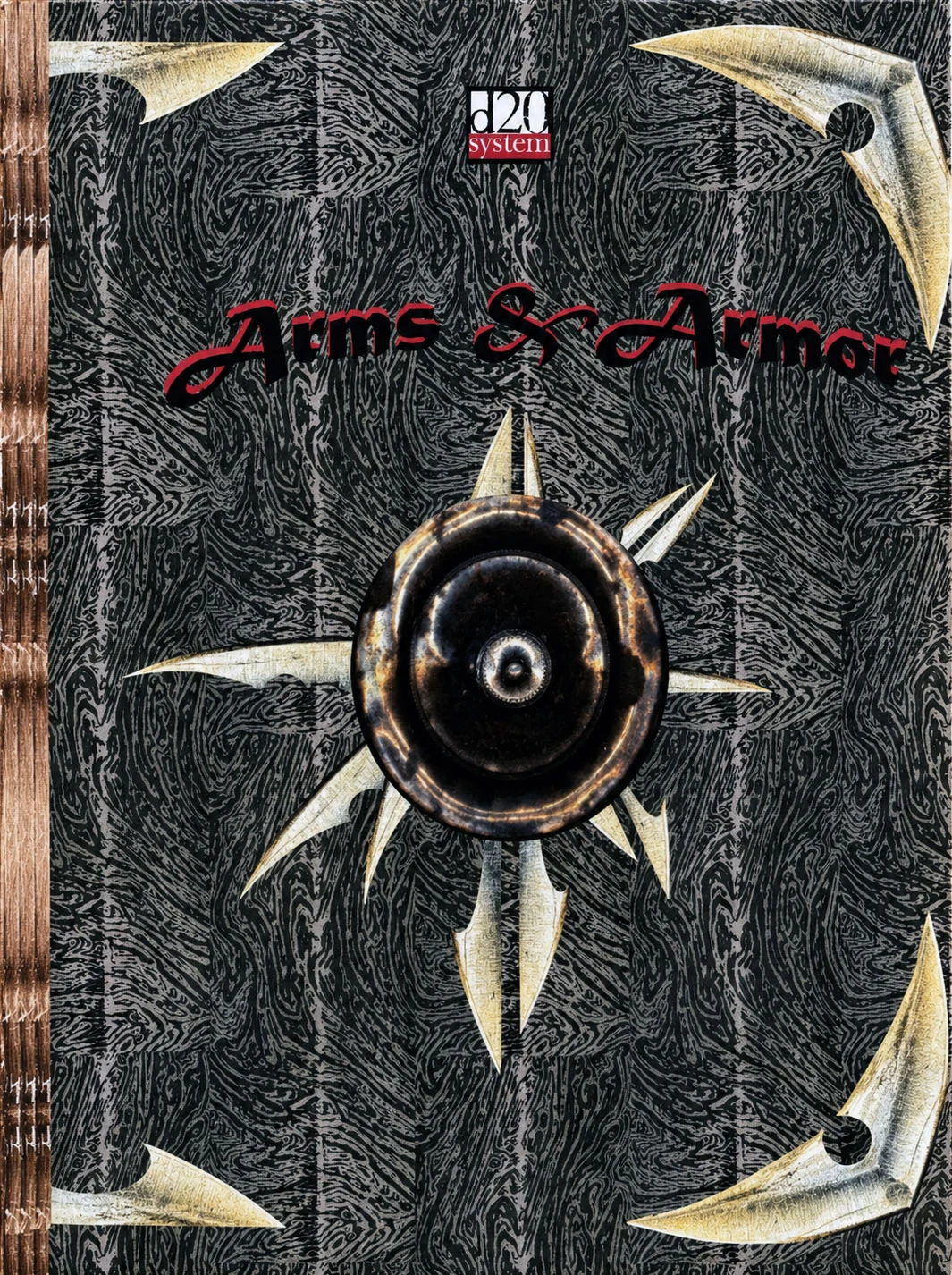
"Arms & Armor" Revisited: A Deep Dive into Bastion Press’s D20 Equipment Compendium
Review Originally Published March 13th, 2002
The early 2000s marked a vibrant, sometimes chaotic, era for tabletop role-playing games, spearheaded by the open licensing of the D20 System. This period saw an explosion of third-party content, eager to expand upon the foundational rules of Dungeons & Dragons 3rd Edition. Among these ambitious publishers was Bastion Press, which in early 2002 released Arms & Armor, a 96-page softcover supplement aiming to vastly enrich the armories and defensive options available to players and Dungeon Masters alike.
This review, originally published on March 13th, 2002, offers a contemporary look at Arms & Armor, highlighting its strengths as a "very crunchy, very useful supplement" while candidly addressing its perceived shortcomings, primarily its production value and price point. Decades later, examining such a product not only provides insight into its specific utility but also offers a window into the broader landscape of D20 System publishing and the intricate balance between content, presentation, and market value.
Main Facts: Unpacking Bastion Press’s Ambitious Gear Guide
Arms & Armor stands as Bastion Press’s second foray into the D20 System, following their debut with Minions: The Fearsome Foes. True to its title, this 96-page, full-color, glossy-paged compendium is dedicated entirely to expanding the repertoire of weapons and armor available in Dungeons & Dragons 3rd Edition. It delves into an impressive array of new equipment, categorized broadly into simple, martial, exotic, and magical variations, alongside unique concepts like martial constructs.
The supplement’s primary appeal lies in its "crunchiness"—a term in tabletop RPGs referring to a high degree of detailed rules, statistics, and mechanical options. Arms & Armor delivers on this promise with an abundance of new items designed to inject tactical depth and narrative flavor into any D20 campaign. It introduces over a hundred new weapons, dozens of new armor types, and an extensive collection of magical properties, specific magical items, and optional rules. Beyond mere statistics, the book attempts to offer genuinely creative additions, from weapons that can alter their form to armor that can resurrect its wearer.
However, the initial reception, as captured in this 2002 review, was not without reservations. While the sheer volume and utility of the content were lauded, the book faced criticism for its artistic direction, particularly the inconsistent and often mediocre quality of its illustrations. Furthermore, its retail price of $24.95 was deemed somewhat steep for a 96-page sourcebook, a concern that echoed the reviewer’s previous assessment of Minions. Despite these drawbacks, the underlying value for Dungeon Masters seeking to populate their worlds with diverse and mechanically interesting gear was undeniable, positioning Arms & Armor as a valuable, albeit flawed, resource for a specific niche of D20 players.
Chronology: The D20 Era and Bastion Press’s Rise
The genesis of Arms & Armor is inextricably linked to the revolutionary impact of the D20 System. Launched by Wizards of the Coast in 2000 with the release of Dungeons & Dragons 3rd Edition, the D20 System Open Game License (OGL) allowed third-party publishers to create and distribute content compatible with D&D 3E. This unprecedented openness sparked a gold rush, as countless companies—from established veterans to ambitious newcomers like Bastion Press—rushed to fill perceived gaps in the core rulebooks and offer innovative expansions.
Bastion Press emerged into this bustling market with a clear vision: to provide detailed, mechanically robust supplements that could enrich the D20 experience. Their first major offering, Minions: The Fearsome Foes, established their commitment to "crunchy" content, focusing on a wide array of adversaries. This initial release set the stage for Arms & Armor, which followed a similar template of comprehensive mechanical expansion. The reviewer explicitly notes the continuity, stating, "Like Minions, Bastion’s first offering, Arms & Armor is a 96-page soft-cover book featuring full-color printing on glossy pages." This suggests a consistent production philosophy and a recognizable brand identity for the nascent publisher.
Arms & Armor arrived in early 2002, a time when the D20 market was still relatively young but already maturing. GMs and players had begun to explore the possibilities of 3rd Edition and were actively seeking supplements that could flesh out their campaigns with new classes, monsters, spells, and, critically, equipment. The need for comprehensive gear books was particularly acute, as the core rulebooks, while extensive, couldn’t cover every conceivable item. Arms & Armor aimed to fill this void, offering a veritable encyclopedia of new implements for combat and defense.
The publication of this review on March 13th, 2002, provides a critical snapshot of the supplement’s immediate reception. It reflects the initial excitement surrounding a product that promised so much mechanical detail, tempered by the realities of its production. The review’s assessment of the artwork and price point was not unique; many third-party D20 publishers struggled with balancing content creation with high-quality artistic presentation and competitive pricing in a crowded market. Despite these common challenges, the fact that the reviewer continued to find "incredible value" in Bastion Press’s entire product line, often reaching for them to add "depth or a touch of the exotic," speaks to the enduring appeal and utility of their content-driven approach, cementing Arms & Armor‘s place as a notable, if imperfect, contribution to the D20 legacy.
Supporting Data: A Treasury of Tactical Options and Creative Flaws
Arms & Armor is a testament to the D20 System’s flexibility, offering a vast repository of new mechanics and conceptual items. Its core strength lies in its sheer volume of content, meticulously detailed for immediate integration into any D&D 3E campaign.
The Arsenal: Weapons Galore
The supplement introduces approximately 125 new weapons, ranging from the historically plausible to the fantastical. This includes mundane yet often overlooked items like the claymore and brass knuckles, which provide grounded options for specific character concepts. More unusual and exotic weapons, such as the combat hook, cicada wing sword, and the formidable double-bladed sword, expand the tactical and aesthetic choices for players, allowing for unique combat styles and character differentiation. The "cicada wing sword," for instance, evokes a sense of foreign martial arts, while the "double-bladed sword" offers a distinct mechanical advantage in two-weapon fighting.
Beyond basic weaponry, Arms & Armor dedicates significant space to magical enhancements. It presents roughly 70 new properties for magical weapons, providing DMs with a rich palette for item creation. Examples like "alterable weapons" suggest items that can dynamically change their form or function, offering tactical versatility. "Pivoting arrows" hint at projectiles with unusual flight paths or secondary effects, making ranged combat more dynamic. The book further elaborates with approximately 50 new pre-designed magical weapons, including class-specific items and artifacts. The "silent dagger," which projects a 5-foot field of silence, is a masterclass in utility and stealth, ideal for rogues and assassins. The "arrow of seeing," allowing the user to perceive the area around its landing spot, offers invaluable scouting and reconnaissance capabilities. The inclusion of new rules and options for intelligent weapons further enriches the narrative potential, allowing these sentient items to become active participants in the story.
Defensive Innovations: Armor and Beyond
The defensive counterpart to the weapon section is equally robust. Arms & Armor describes around 60 new types of armor, from the practical to the utterly imaginative. These new armors provide not only varying defensive stats but also unique aesthetic and functional qualities. The "bone mail," crafted from bone into a chain mail configuration, offers a distinct visual and thematic option for characters with a more primal or necromantic bent. "Daggered plate," which cleverly conceals daggers as armor decorations, exemplifies a blend of defense and offense. "Quick don armor" addresses a common logistical challenge in D&D, significantly reducing the time required to equip protective gear, which can be crucial in surprise encounters.
The magical armor section is similarly expansive, featuring roughly 70 new magical armor qualities and dozens of specific magical suits, including class-based armor. Among the standouts are "phoenix armor," a truly legendary item that can resurrect a character upon death (at the cost of the armor’s destruction), providing a powerful, once-in-a-lifetime boon. "Healing armor" offers ongoing restorative capabilities, significantly enhancing a character’s survivability. The book also introduces optional rules for armor, notably "the first published 3E system for armor as damage reduction." This mechanic, where armor directly reduces incoming damage rather than just increasing Armor Class, was a significant innovation for 3rd Edition, offering a more robust and intuitive representation of heavy armor’s protective qualities.
Esoteric Equipment and Constructs
Arms & Armor extends its scope beyond conventional gear, introducing several categories of unique items. "Cleric domain rods," "arcane school staves," and "racial masks" offer flavorful and mechanically distinct options that tie directly into character classes and backgrounds, enriching role-playing and tactical choices.
Perhaps most intriguing are the "martial constructs." These are essentially specialized golems or animated objects designed to serve as weapons or armor. Examples include "amulet servitors," golems that can collapse into small, portable amulets when not in use, offering a powerful companion on demand. "Golem armor" blurs the line between wearer and worn, with the armor itself being a living entity. "Silver steeds" represent magical mounts, offering enhanced mobility and combat capabilities. Finally, the book also covers several new materials for weapon and armor construction, allowing DMs to further customize items with unique properties and resistances.
Design Philosophy and Critiques
A notable positive aspect of Arms & Armor is its general avoidance of "incredibly goofy" items. While some items might stretch the bounds of realism for a fantasy setting, the reviewer found that the majority were usable and could be integrated without causing immersion-breaking laughter. This judicious balance between the fantastical and the practical is crucial for a supplement of this nature.
However, the book is not without its flaws. The most prominent criticism centers on the artwork by Todd Morasch, who served as Lead Artist and Art Director. The reviewer describes his work as "mediocre" and, more objectively problematic, often inconsistent with the accompanying text. For instance, the "chained axe" is described as having a haft, but the illustration omits it. Similarly, the "basket-hilted broadsword" is depicted without a basket hilt and, inexplicably, with a double blade. This disconnect between text and illustration is a significant drawback for a product heavily reliant on visual representation, especially when many items, particularly armor, are not illustrated at all, despite available page space.
Another design inconsistency is highlighted with the "axe-hammer." Described as a long-hafted weapon with an axe blade on one side and a hammer on the other, it is oddly statted as a double weapon. The reviewer correctly points out that a double weapon typically implies two distinct heads at opposite ends of a haft (like a quarterstaff or a specific type of polearm), not two heads on the same end. This kind of mechanical misinterpretation can lead to confusion and minor balance issues, requiring DM adjudication.
Finally, the price point of $24.95 for a 96-page softcover was a recurring concern. While full-color glossy pages added to production cost, this price was considered high in the D20 market, where many similar-sized supplements retailed for less. This cost-to-content ratio was a significant factor in the reviewer’s ultimate recommendation, suggesting that while the content was valuable, the overall package might not justify the premium for all users.
Official Responses and Enduring Utility
Given the historical context of this review (March 2002), specific "official responses" from Bastion Press regarding these criticisms are not readily available or easily verifiable in the public domain. The D20 era, particularly for smaller, independent publishers, often saw feedback primarily addressed through errata documents (if published) or implicitly through refinements in subsequent product lines. Publishers rarely issued formal press releases directly responding to individual reviews.
However, the reviewer’s concluding remarks offer an insightful indirect "response" and a testament to Bastion Press’s enduring utility. Despite noting that Bastion Press’s D20 supplements were "mechanically sloppy and often ugly," the reviewer unequivocally states, "as a GM I got an incredible amount of value out of them. They were often the first thing I would reach for when looking to add either depth or a touch of the exotic to an adventure." This powerful endorsement suggests that for many Dungeon Masters, the sheer creative and mechanical utility of Bastion Press’s content vastly outweighed its production flaws. The substance, in this case, trumped the style.
This perspective implies that Bastion Press, perhaps intentionally or due to resource constraints, prioritized content breadth and mechanical depth over pristine artwork or flawless editing. Their target audience, likely experienced DMs hungry for new material, was evidently willing to overlook aesthetic imperfections for the sake of innovative game mechanics and a wealth of new options. The continued presence of their entire product line on the reviewer’s gaming shelf, years after publication, further solidifies this point. It suggests that while direct official responses to individual critiques might have been absent, the market itself provided a form of validation: the products continued to be used and valued by their target demographic.
Implications: Legacy and Lessons from the D20 Boom
The release and reception of Arms & Armor carry several significant implications for the D20 System, third-party publishing, and the broader RPG community.
Impact on D20 System Gaming
Arms & Armor contributed significantly to the D20 ecosystem by demonstrating the potential for specialized supplements. While core rulebooks provided the foundation, products like Arms & Armor proved that dedicated tomes on specific aspects—be it equipment, monsters, or spells—could greatly enhance the depth and variety of campaigns. It empowered Dungeon Masters with a vast toolkit, allowing them to customize encounters, reward players with unique treasure, and imbue their worlds with distinct cultural flavors through specialized gear. The introduction of "armor as damage reduction" was particularly impactful, offering an alternative and often more satisfying mechanical representation of heavy armor’s resilience, influencing subsequent game design discussions.
Player and DM Experience
For DMs, Arms & Armor was a treasure trove of inspiration. The reviewer’s personal anecdote of using it to "redesigning and repopulating the lower levels of Khundrukar" for The Forge of Fury module perfectly illustrates its utility. It allowed for granular customization of loot and adversaries, making each dungeon delve feel fresh and unique. For players, it expanded character customization options, offering new tactical choices in combat and providing more diverse goals for character progression. The sheer variety meant that a fighter could specialize in an "axe-hammer" (despite its odd statting) or a rogue could seek out a "silent dagger," fostering unique character identities.
Legacy of Bastion Press
Arms & Armor is a quintessential example of Bastion Press’s legacy. As the reviewer noted, their products, while "mechanically sloppy and often ugly," delivered "incredible value." This dichotomy highlights a common challenge and strength of many smaller D20 publishers. Lacking the massive resources of Wizards of the Coast, they often compensated with raw creativity and a focus on mechanical utility. Bastion Press carved out a niche for itself by consistently providing GMs with innovative, "crunchy" content that, despite its flaws, was immensely practical and inspiring. Their books became go-to resources for DMs looking to add a touch of the exotic or a layer of depth to their adventures, proving that substance could indeed triumph over pristine presentation.
Evolution of RPG Publishing
The challenges faced by Arms & Armor—the struggle with consistent artwork, the pricing concerns—were emblematic of the D20 boom itself. Many third-party publishers grappled with these issues, often leading to a mixed bag of products in the market. This era ultimately fostered a discerning audience that learned to look past superficial flaws for truly valuable content. It also underscored the importance of clear design principles and the ongoing debate between high-volume, diverse content and polished, expensive presentation. The D20 era eventually evolved, with lessons learned about editorial rigor, art direction, and sustainable business models.
In conclusion, Arms & Armor, reviewed in 2002, remains a fascinating artifact of the D20 System’s heyday. It represents the ambitious spirit of third-party publishers eager to expand the horizons of Dungeons & Dragons. While imperfect in its execution, its wealth of innovative content ensured its place as a valuable resource for Dungeon Masters seeking to enrich their campaigns, leaving an enduring legacy as a prime example of "crunchy" utility from the prolific D20 era. It reminds us that in the world of tabletop RPGs, sometimes the most cherished supplements are those that offer immense creative potential, even if they arrive with a few rough edges.