"Traps & Treachery": A Deep Dive into a D20 Era Staple That Redefined Dungeon Hazards and Roguish Intrigue
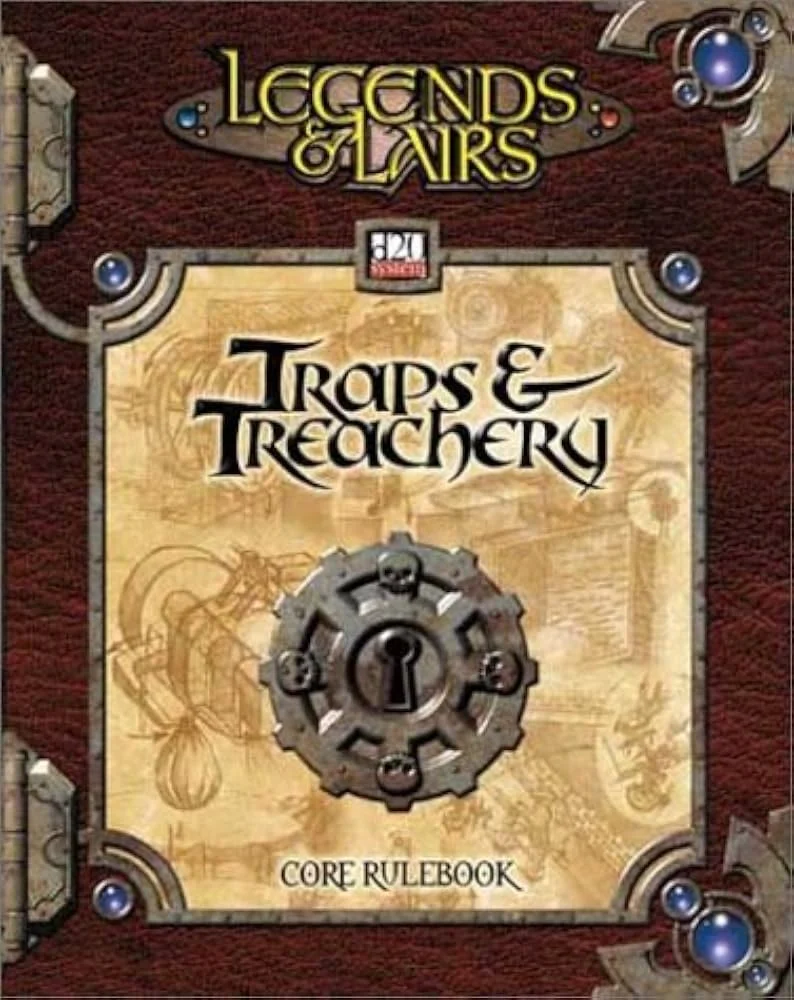
Originally Published: March 14th, 2002
(Image: "Traps & Treachery – Fantasy Flight Games" cover art)
Main Facts: A Landmark Supplement for the D20 System
In the annals of tabletop role-playing games, particularly within the bustling D20 era of the early 2000s, few supplementary texts earned the profound and consistent praise bestowed upon Fantasy Flight Games’ (FFG) Traps & Treachery. Released on March 14th, 2002, this 172-page, black-and-white hardback quickly established itself as an indispensable resource for Dungeon Masters (DMs) and players alike, retailing at a competitive price of $24.95.
Authored by a team including Greg Benage, Kurt Brown, Mark Chance, Brian Ferrenz, Lizard, David Lyons, and Brian Patterson, Traps & Treachery promised to elevate the often-overlooked elements of dungeon hazards and roguish mechanics to unprecedented levels of detail and utility. Its ambition was clear: to provide a comprehensive toolkit that moved beyond the basic guidelines found in core rulebooks, offering DMs an arsenal of innovative traps and puzzles, while simultaneously empowering rogue players with expanded skills, feats, and lore.
The initial reception, epitomized by a review from Justin Alexander, was nothing short of effusive. Alexander declared, "Traps & Treachery has received more use in my D&D games than any book outside of the core rules." Such a statement, placing it on par with the Player’s Handbook, Dungeon Master’s Guide, and Monster Manual in terms of practical application, underscored the book’s immediate and profound impact. It was positioned not merely as an optional add-on, but as a foundational text for any DM seeking to enrich their campaigns with cunning challenges and intricate thievery. The review further cemented its status by advising aspiring D20 publishers to "Buy a copy of Traps & Treachery so you can see how to do it right," a testament to its perceived excellence in design and execution within the burgeoning D20 market. This supplement was designed to be a definitive answer to the question of how to properly integrate complex, engaging traps and the rich narrative potential of rogues into fantasy campaigns.
Chronology: From D20 Boom to Enduring Legacy
The D20 System Landscape (Early 2000s)
The turn of the millennium saw a dramatic shift in the tabletop RPG industry with the release of Dungeons & Dragons 3rd Edition in 2000. This edition introduced the Open Game License (OGL) and the D20 System, allowing third-party publishers to create compatible content using a standardized ruleset. This sparked an explosion of creativity and production, leading to a "D20 boom" where countless supplements flooded the market. Publishers like Fantasy Flight Games quickly rose to prominence, distinguishing themselves through high-quality productions and innovative content.
The market, however, was not without its challenges. While many D20 books offered new classes, monsters, or settings, fewer delved deeply into specific game mechanics with the same rigor as the core rulebooks. Traps, in particular, often received cursory treatment, leaving DMs to improvise or rely on simplistic designs. The demand for well-designed, functional, and inspiring content that genuinely enhanced gameplay was high.
Publication and Initial Reception
It was into this dynamic environment that Traps & Treachery was launched on March 14th, 2002. Fantasy Flight Games, already known for its diverse portfolio, identified a clear niche: a comprehensive guide to one of D&D’s most iconic, yet often underdeveloped, elements. The book was a direct response to the need for more sophisticated dungeon design and more robust rogue character options.
Upon its release, Traps & Treachery immediately resonated with the D&D community, especially DMs who had long grappled with creating engaging and balanced traps. The glowing review from Justin Alexander, published shortly after its release, reflected a widespread sentiment that the book filled a critical void. Alexander’s declaration of its utility, surpassing even the Monster Manual for his games, highlighted its immediate practical value. It wasn’t just another collection of ideas; it was a carefully constructed toolkit designed to be immediately implementable and genuinely impactful at the game table. This initial wave of positive feedback positioned Traps & Treachery as a must-have for anyone serious about running or playing D20 System games with a focus on exploration and intrigue.
Long-Term Impact and Legacy
The true measure of a supplement’s success often lies in its enduring utility. For Traps & Treachery, its legacy extended far beyond the initial D20 boom. The reviewer’s continued reliance on the book years after its publication underscores its sustained relevance. While many D20 supplements faded into obscurity as new editions emerged, Traps & Treachery retained its value, not just for D20 purists, but also for DMs adapting its concepts to other systems, including OSR (Old School Renaissance) games that often value creative dungeon design.
It distinguished itself from earlier "trap books," such as the infamous Grimtooth’s Traps series, by striking a better balance. While Grimtooth’s was renowned for its outlandish and often lethally absurd designs, Traps & Treachery offered a more grounded yet still ingenious approach. It provided a spectrum of traps, from the subtly devious to the dramatically dangerous, but critically, it focused on usability and integration into a coherent narrative. This distinction allowed it to be embraced by a broader audience of DMs who sought challenges that were clever and believable within their campaign worlds, rather than purely comedic or overtly sadistic. Its detailed approach to trap detection and disabling, coupled with its robust rogue content, ensured its place as a foundational text for anyone looking to enrich the strategic and narrative depth of their D&D campaigns.
Supporting Data: Unpacking the Content and Its Value
Traps & Treachery is a densely packed resource, and its 172 pages are efficiently utilized to provide a wealth of information. The book’s content can be broadly categorized into several key sections, each contributing significantly to its overall utility.
Detailed Content Analysis
The Trap Compendium
Undoubtedly the core offering, seventy pages of Traps & Treachery are dedicated to an extensive collection of mechanical and magical traps. What sets this section apart is not just the sheer number of traps, but the ingenuity and narrative potential embedded within each design.
- Blackstone’s Clever Cage: This trap exemplifies the book’s ability to offer non-lethal yet impactful encounters. Designed primarily for imprisonment rather than annihilation, it provides DMs with a versatile tool for lower-level challenges or for situations where capture is a more desirable outcome than death. Such traps can serve as early-game encounters, testing a party’s resourcefulness without draining vital hit points or spell slots, making them perfect for setting an adventurous tone.
- Devilish Dungeon Double Slide: This sophisticated trap highlights the book’s understanding of dungeon dynamics. By physically splitting a party and funneling them into different, more dangerous areas, it forces DMs to manage multiple simultaneous narratives—a challenging but potentially highly rewarding scenario for experienced groups. It elevates traps from mere obstacles to complex tactical puzzles that demand adaptability and communication from players.
- One Last Coin: This entry showcases the narrative depth Traps & Treachery brings to even the simplest of temptations. A seemingly innocuous coin, when disturbed, releases a sealed demon. This type of trap transforms a mundane object into a powerful plot device, demonstrating how even minor elements can carry immense consequences, encouraging DMs to think beyond simple damage rolls and consider the broader implications of their traps.
- Blackstone’s Confining Conundrum: A masterclass in psychological and spatial manipulation, this trap shrinks characters as they descend a diminishing shaft, only to return them to full size at the bottom, effectively sealing them in a confined space. It’s a prime example of a trap that plays with perception and environmental interaction, creating a truly memorable and disorienting experience for players.
- Deep Dwarf Darknetter: This trap demonstrates excellent environmental integration, specifically triggered by the presence of light. It’s perfectly suited for underground races or creatures that thrive in darkness, providing DMs with a seamless way to integrate traps that make logical sense within the ecology of their dungeon. It encourages DMs to consider the denizens and their habits when designing hazards.
The general philosophy behind these traps strikes a commendable balance between the complex and the straightforward. Each entry provides not only its mechanical effects but also crucial details on how to detect and disable it, saving DMs invaluable preparation time and ensuring consistent adjudication at the table.
The Puzzle Chamber
While concise, the puzzles section is an invaluable addition, diversifying the types of challenges DMs can present. It includes logic puzzles, math puzzles, word puzzles, and chess puzzles, alongside unique challenges and tests. This variety is crucial for engaging players who enjoy intellectual challenges over pure combat, offering a welcome change of pace and encouraging critical thinking. Integrating puzzles can break the monotony of continuous combat and provide different avenues for character skills to shine.
The Art of Trap Design
Contrary to some initial dismissals, the chapter on trap design stands out as a "high point" for its practical utility. It expands significantly on the basic guidelines offered in the Dungeon Master’s Guide, delving into the nuances of conceptualizing, building, and implementing traps within an adventure. More importantly, it clarifies ambiguous rules, such as what it precisely means to "detect" or "disable" a trap. This section empowers DMs to move beyond pre-written examples and create their own ingenious hazards, providing a foundational understanding of trap mechanics and narrative integration. It transforms trap-setting from a mere stat-block exercise into an art form.
The Way of the Rogue
Kicking off the book, this comprehensive chapter is a veritable "catch-all" for all things rogue-related, offering significant depth for both DMs and players.
- Trap Lore: This section provides rich background material, invaluable for DMs in describing the detection and disabling of traps in a more immersive and less purely mechanical way. It offers narrative hooks and descriptive elements that enhance player engagement.
- The Business of Thievery: This expands on the social and economic aspects of the rogue’s world, detailing elements like guilds, extortion rackets, smuggling operations, and other illicit ventures. For DMs, this is a goldmine for world-building, populating urban environments with intriguing NPCs and plotlines. For players, it offers a framework for characters deeply embedded in the underworld.
- New Character Options: The book introduces a handful of compelling prestige classes (Discreet Companion, Guildmaster, Roofrunner, Trapmaster), each offering unique thematic and mechanical avenues for rogues to specialize. A new NPC class, the Thug, provides DMs with a versatile template for common antagonists or allies.
- Expanded Mechanics: New skills, feats, and equipment provide crunchy additions that deepen character customization and open up new tactical possibilities. The detailed rules for making and using poisons, along with a collection of new poisons, are particularly valuable, adding a layer of strategic depth for rogue players and a new threat for DMs.
- Magical Enhancements: Even magic is not overlooked, with a couple of new arcane spells, several divine spells, and a "thievery" domain for clerics. These additions broaden the magical toolkit available to characters with roguish inclinations, demonstrating the book’s holistic approach to the theme.
Usability and DM Value
The overwhelming strength of Traps & Treachery lies in its sheer volume of actionable information and "crunchy stuff." It’s a book designed for immediate utility. The detailed "detect and disable" mechanics for every trap save DMs countless hours of preparation, ensuring that encounters are fair, consistent, and engaging. Its applicability extends beyond traditional dungeon crawls, as demonstrated by the reviewer’s anecdote of replacing a "far too absurd" concrete mixer trap in Terror in Freeport with "Blackstone’s Killer Kennel," showcasing its versatility in adapting to various adventure types. For DMs, it’s a source of inspiration and a time-saver; for rogue players, it’s a guide to maximizing their character’s potential.
Critiques and Nuances
Despite its accolades, Traps & Treachery was not without its minor criticisms, which are important for a balanced perspective.
The Split Focus Dilemma
One notable point of contention for the reviewer was the book’s dual focus: roughly half on traps (for DMs) and half on rogue-oriented information (for players). The argument posited was that a narrower focus—either 172 pages purely on traps or 172 pages purely on thief mechanics—would have been more beneficial. This critique highlights a common challenge in supplement design: catering to diverse audiences within a single volume. The perceived issue was the limited crossover utility, particularly for DMs who would ideally want the trap information kept secret from players. This structural choice, while offering broad appeal, meant that neither segment received the absolute maximum possible depth.
Tolerance for Over-the-Top Traps
Another point of discussion revolved around the inclusion of certain "elaborately engineered and/or over-the-top traps." The reviewer expressed a "very low tolerance" for such designs, citing examples like traps that turn victims into mice to be eaten by housecats, treadmills feeding characters into spinning blades, or corridors shooting buzzsaws. These were deemed "atmosphere killers and deflators of suspension of disbelief." This personal preference underscores the subjective nature of what constitutes an "engaging" trap versus a "ludicrous" one.
However, the critique was tempered by the acknowledgment that such extreme traps were "rare" within Traps & Treachery. Crucially, the book was lauded as a "dream come true" for DMs who appreciated the idea of books like Grimtooth’s Traps but were put off by their "ludicrous and ridiculous" content. This comparison positions Traps & Treachery as a more refined, palatable alternative, offering cleverness without sacrificing believability for most of its content. It successfully navigated the difficult terrain between ingenious and absurd, largely favoring the former.
Official Responses: Publisher’s Vision and Community Endorsement
While there isn’t a specific "official response" from Fantasy Flight Games to a particular review, the very existence and content of Traps & Treachery serve as a testament to the publisher’s keen understanding of the D20 market and their commitment to quality.
Publisher’s Vision and Intent
Fantasy Flight Games, as a prolific third-party D20 publisher, aimed to fill critical gaps in the available content. With Traps & Treachery, their intent was clearly to provide a definitive, comprehensive resource for two intertwined aspects of D&D gameplay: complex environmental hazards and the mechanics of the rogue class. They recognized that while core rulebooks provided frameworks, detailed implementation often fell short. The book’s structured approach, from detailed trap descriptions to design principles and extensive rogue options, indicates a deliberate effort to create a product that was both inspiring and immediately usable. FFG’s reputation for producing high-quality, often innovative, supplements during the D20 era was further solidified by Traps & Treachery. The inclusion of multiple authors also suggests an effort to pool diverse creative talents to ensure a broad and inventive collection of ideas.
Community Reception and Endorsement
The overwhelmingly positive reception, as evidenced by the reviewer’s high praise, was indicative of a broader community endorsement. While specific sales figures or awards for this particular supplement are not readily available, the sentiment expressed by the reviewer—that it was used more than almost any other book—speaks volumes. It became a frequently recommended title in online forums and at gaming tables, signifying its status as a "go-to" resource for DMs struggling to create engaging traps or players looking to deepen their rogue character concepts.
In the landscape of D20 supplements, which ranged from exceptional to forgettable, Traps & Treachery firmly established itself in the former category. Its enduring presence on many DMs’ reference shelves, even years after its initial publication and the wane of the D20 System’s peak, is the strongest form of "official response" from the gaming community itself. It was, and for many, still is, considered an essential component for enriching the D&D experience, particularly for those who cherish the intrigue of a well-placed trap and the cunning of a master thief.
Implications: Reshaping Hazards and Roguish Archetypes
The impact of Traps & Treachery reverberated through the D20 System and left a lasting impression on how DMs and players approached two fundamental aspects of fantasy role-playing.
Impact on Game Mastering: Elevating Trap Integration
Before Traps & Treachery, traps in D&D were often simplistic, serving primarily as damage gates or minor annoyances. This book fundamentally transformed their role, elevating them from mere obstacles to intricate narrative and tactical challenges. DMs gained an unprecedented toolkit, allowing them to:
- Create Dynamic Encounters: Traps like the Devilish Dungeon Double Slide encouraged DMs to think about multi-pronged challenges, forcing party splits and simultaneous narratives, thereby increasing tension and complexity.
- Enhance Narrative Immersion: By providing detailed lore and descriptions for detecting and disabling, the book helped DMs integrate traps more seamlessly into the story, making them feel like organic parts of the environment rather than arbitrary mechanics.
- Reduce Preparation Time: The comprehensive "detect and disable" information for each trap was a godsend, saving DMs countless hours of homebrewing and ensuring consistent, fair rulings at the table. This efficiency allowed DMs to focus more on storytelling and less on rules adjudication.
- Diversify Challenge Types: The inclusion of puzzles alongside mechanical and magical traps provided DMs with a broader spectrum of challenges, appealing to players who enjoyed intellectual engagement as much as combat.
Influence on Rogue Archetypes: Beyond Lockpicking
The "Way of the Rogue" chapter significantly enriched the portrayal and capabilities of rogue characters. It moved beyond the stereotypical lockpicker and backstabber, offering pathways for more nuanced and specialized archetypes:
- Expanded Character Options: New prestige classes, skills, feats, and equipment provided players with unprecedented choices, allowing them to tailor their rogues to specific roles, from master spies and guild leaders to agile roof runners and deadly trapmasters.
- Deepened World Interaction: The sections on "the business of thievery" – guilds, extortion, smuggling – provided rogues with concrete ways to interact with the game world beyond dungeon delves. It offered compelling plot hooks for urban adventures and political intrigue, making rogues integral to broader narratives.
- Strategic Depth: The detailed rules for poisons, along with new poisons, added a layer of tactical complexity for rogues, turning them into potent controllers and damage dealers through careful preparation and application.
- Empowered Rogues: By providing such extensive mechanical and thematic support, the book empowered players to truly embody the cunning, resourcefulness, and specialized skills inherent in the rogue archetype, making them more dynamic and indispensable members of any adventuring party.
Legacy in RPG Design and Enduring Value
Traps & Treachery stands as a benchmark for how to effectively design and present supplementary content. Its comprehensive approach to a specific game element – traps and their associated character class – set a high standard for subsequent RPG product development. It demonstrated that even seemingly niche topics could be explored with incredible depth and utility, creating products that were not just add-ons but essential tools.
Its enduring value is perhaps its most significant implication. Even after the D20 System waned in popularity and new editions of D&D emerged, the concepts, trap designs, and rogue archetypes within Traps & Treachery remained highly adaptable. Many DMs continue to draw inspiration from its pages, adapting its traps and ideas to D&D 4th and 5th Editions, Pathfinder, or even Old School Renaissance (OSR) games. The core principles of clever design, narrative integration, and clear mechanics transcend specific rulesets.
The reviewer’s concluding statement – "Traps & Treachery sits right next to my PHB, DMG, and MM every single time I sit down to the gaming table. ‘Nuff said." – encapsulates its profound and lasting legacy. It is a testament to a book that not only met but exceeded expectations, becoming a truly special and indispensable resource that reshaped how a generation of D&D players and DMs engaged with the perils and intrigues of their fantasy worlds. It remains a shining example of how a well-crafted supplement can achieve iconic status and influence game design for years to come.