An Unfocused Revival: Reassessing "Slavers," A Greyhawk Contender Caught Between Eras
Main Facts
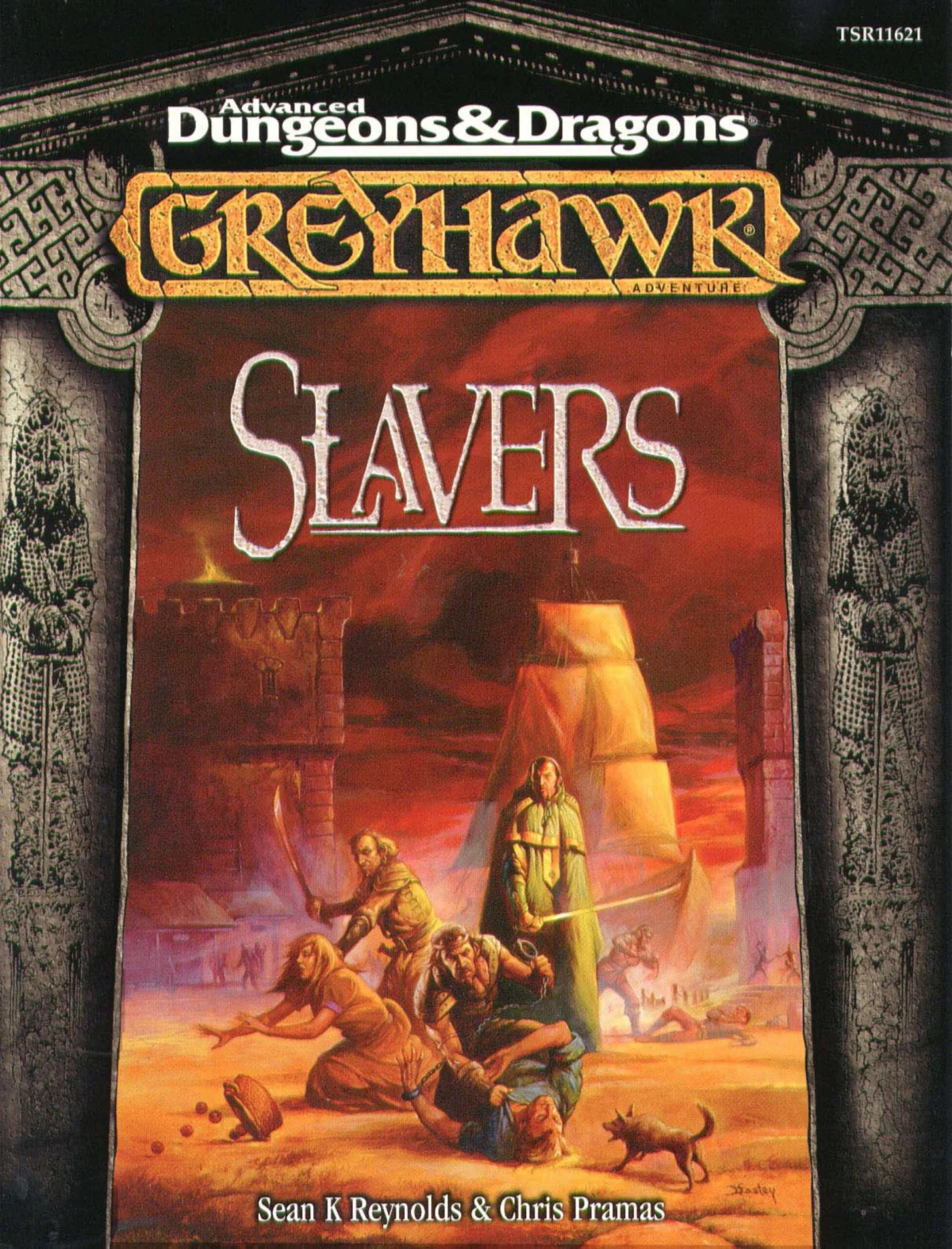
In the year 2000, Wizards of the Coast, then at the helm of the venerable Dungeons & Dragons franchise, released Slavers – a supplement intended to reignite the classic Greyhawk campaign setting. Billed as a direct sequel to the iconic "Slavelords Saga" (modules A1-A4 from the original Advanced Dungeons & Dragons), Slavers arrived for AD&D 2nd Edition amidst a significant transitional period for the game. However, as contemporary reviews, including a notable one published on March 14th, 2002, highlighted, the product suffered from a fundamental identity crisis. It attempted to function simultaneously as an expansive sourcebook and a compelling adventure, yet ultimately failed to excel in either capacity.
The core criticism leveled against Slavers was its inability to find a clear focus. As a sourcebook, it was deemed too broad and disparate, attempting to cover a variety of regions – from the contested lands of the Pomarj to the strategic waterways of Nyr Dyv – without offering sufficient depth or cohesive narrative links. Conversely, as an adventure, it was found to be too sparse and underdeveloped, presenting a heavily railroaded plot with "vague links" between locations and a repetitive series of encounters that lacked the epic scope or imaginative spark expected of a major D&D release. The review, published just as the third edition of D&D was gaining widespread traction, also raised a crucial question: was Slavers worth the significant effort required for conversion from AD&D 2nd Edition rules to the newer D&D 3rd Edition system, given its inherent flaws? For many, the answer leaned towards a resounding no, positioning Slavers as a product more likely to appeal to dedicated Greyhawk collectors than to the broader D&D player base seeking a robust adventure or comprehensive world-building resource.
Chronology: The Shifting Sands of Greyhawk and D&D
To fully appreciate the context and criticisms surrounding Slavers, it’s essential to trace the historical currents that shaped its release. The Advanced Dungeons & Dragons game, first published by TSR in 1977, quickly established itself as a cornerstone of the burgeoning tabletop role-playing game industry. Among its earliest and most influential campaign settings was Greyhawk, meticulously crafted by Gary Gygax himself. Greyhawk, with its rich lore, diverse cultures, and iconic locations, became a blueprint for fantasy worlds, inspiring countless adventures.
The original "Slavelords Saga" (A1: Slave Pits of the Undercity, A2: Secret of the Slavers Stockade, A3: Assault on the Aerie of the Slave Lords, and A4: In the Dungeon of the Slave Lords), published between 1981 and 1982, represented a pivotal moment for AD&D. These modules introduced players to a visceral struggle against a vast slaving organization, offering challenging dungeons, moral dilemmas, and a clear, progressive narrative arc. They quickly became classics, defining a generation’s understanding of high-level AD&D play and establishing a powerful, enduring threat within the Greyhawk setting. For years, these modules were foundational, reprinted multiple times and widely celebrated.
However, by the late 1980s and early 1990s, the original modules had fallen out of print, becoming increasingly difficult to acquire. This created a significant knowledge gap for newer players and Dungeon Masters (DMs). The landscape of D&D itself was also in flux. TSR, after years of financial struggles, was acquired by Wizards of the Coast in 1997, marking a new era for the game. Wizards embarked on an ambitious program to revitalize classic D&D lines, including Greyhawk. This initiative aimed to capitalize on nostalgia while also introducing these beloved settings to a new generation of players.
Slavers, published in 2000, was a direct product of this revival effort. Its timing, however, was fraught with challenges. The year 2000 also saw the launch of D&D 3rd Edition, a radical overhaul of the game’s rules system that promised greater flexibility, streamlined mechanics, and a more accessible entry point for new players. This meant that Slavers, released for the outgoing AD&D 2nd Edition, was almost immediately rendered obsolete for a rapidly growing segment of the D&D community. DMs and players were faced with the dilemma of investing in a product for a system they were actively moving away from, or undertaking the considerable effort of converting it to the new 3rd Edition ruleset. The 2002 review implicitly acknowledges this by making the "worth converting" question central to its final judgment, reflecting the prevailing sentiment of the time. This period of transition created a difficult environment for any product, particularly one attempting to bridge past and present narratives.
Supporting Data: The Anatomy of a Misfire
The detailed critique of Slavers reveals a product undermined by several critical design choices, leading to its ultimate failure to satisfy as either a standalone adventure or a comprehensive sourcebook.
The Identity Crisis: Sourcebook vs. Adventure, A Fatal Dichotomy
The most glaring flaw identified in Slavers was its lack of a cohesive identity. As a sourcebook, it ambitiously attempted to provide background material for diverse regions such as Dyvers, North Woolly Bay, the Orcish Wild Coast, and the Pomarj. However, these geographical areas, while all part of the larger Flanaess, were presented without a clear unifying theme or sufficient depth. The review pointed out that there was "no particular rhyme or reason" for these specific locations to be covered together, beyond their tangential connection to the accompanying adventure outline. This approach resulted in "paltry coverage" of each area, focusing only on a handful of locations relevant to the adventure rather than providing the comprehensive detail expected of a dedicated sourcebook. Consequently, it failed to serve as a valuable general-purpose resource for DMs looking to expand their Greyhawk campaigns.
Conversely, as an adventure, Slavers suffered from an equally debilitating lack of substance. The 128-page book, stretched thin by its sourcebook ambitions, could only offer a "rough outline of ideas" for its plot. The scenarios presented were characterized as "a series of very short, very boring, practically identical raids," lacking originality and any sense of epic scale. The review emphasized that an "epic requires scope," and Slavers simply never found it, with most encounter keys containing "a half dozen or less" adversaries, a far cry from the sprawling dungeons and intricate challenges that defined the original Slavelords Saga. This dual ambition ultimately led to a cascading problem: the sourcebook elements diluted the adventure, leaving it skeletal, while the weak adventure structure prevented the sourcebook material from achieving any meaningful coherence.
The Narrative Quagmire: Plotting and the Perils of Railroading
The plot of Slavers was heavily criticized for its "vague links" and excessive railroading, stripping players of agency and DMs of flexibility. The adventure begins with the PCs in Dyvers, encountering slavers operating out of Blackthorn Caverns. Crucially, the module explicitly instructs DMs to ensure "Care should be taken so that the heroes don’t discover the precise location of the entrance," preventing logical player actions like informing authorities. Furthermore, the plot dictates that the PCs "are supposed to lose at Blackthorn; and lose badly." This forced failure, a cardinal sin in modern RPG design, undermines player investment and immersion.
Following this preordained defeat, the PCs return to Dyvers only to witness a slave raid by the Pirates of the Yellow Veil. Again, the module dictates, "They can only stop a few of the raiders, and are too late to prevent the ship from setting sail and escaping." The explicit instruction that "the PCs’ friends are among those kidnapped by the Slavers" further tightens the narrative leash, forcing players down a predetermined path. From this point, the adventure devolves into a monotonous sequence of raids on "secret base in Nyr Dyv," "Slavers’ Cove," "slaver ship Eternal Sun," and a litany of "more slaver bases" before reaching the "Big Slaver Base." This repetitive structure, devoid of meaningful twists or strategic depth, quickly extinguishes any spark of excitement, replacing it with a sense of grinding obligation.
The Legacy Burden: A Sequel That Forgets Its Audience
Perhaps the most significant misstep of Slavers was its identity as a sequel to the Slavelords Saga. While ostensibly a nod to classic Greyhawk, the module made the critical error of assuming extensive prior knowledge of the original A1-A4 modules. These modules, having been out of print for over a decade by 2000, were largely inaccessible to newer DMs and players. The review correctly highlighted that Slavers "relies heavily on the DM’s knowledge of the previous adventures, and even (at some points) seems to assume that the players will at least have a passing knowledge of the importance of past events."
This reliance created an immediate barrier to entry, alienating a significant portion of the potential audience. Instead of crafting a narrative that could stand on its own while enriching the Greyhawk lore for veterans, Slavers became an exclusive club, only truly understandable and appreciable by those who had experienced the original adventures firsthand. The review also noted that this issue was not isolated, pointing to Return of the Eight, another Greyhawk revival product, which referenced material nearly three decades out of date. This pattern suggests a broader strategic flaw in Wizards of the Coast’s initial approach to reviving classic IP: an overestimation of the collective memory of the player base and an underestimation of the need for accessibility for new generations. A successful sequel must build upon its heritage without requiring it as a prerequisite, a lesson Slavers conspicuously failed to learn.
Official Responses and Industry Perspectives
Official responses from Wizards of the Coast regarding the specific criticisms of Slavers are not publicly documented in the original review. However, the product’s flaws can be viewed through the lens of broader industry challenges prevalent during the late 1990s and early 2000s.
The period following Wizards of the Coast’s acquisition of TSR was one of intense pressure and ambitious revitalization. There was a clear directive to breathe new life into classic D&D settings like Greyhawk, Dragonlance, and Forgotten Realms. This often meant balancing the demands of catering to a loyal, nostalgic fanbase with the need to attract new players, particularly with the looming and then actual launch of D&D 3rd Edition. Crafting a product that appealed to both camps while also being compatible with an outgoing game system proved to be an incredibly complex tightrope walk.
The issue of an unfocused product – attempting to be both a sourcebook and an adventure – likely stemmed from a desire to maximize value within a limited page count and budget. Publishers often aim to provide DMs with a comprehensive package, but without a clear design philosophy, this can lead to dilution rather than enrichment. The authors, Sean K. Reynolds and Chris Pramas, are respected figures in the RPG industry, known for their contributions to various D&D editions and other systems. This suggests that the issues within Slavers might have been less a reflection of their individual talents and more a consequence of editorial directives, tight deadlines, or the inherent challenges of the project’s scope and timing. The pressure to quickly release content for an established setting, while simultaneously managing a system transition, could easily lead to compromises in focus and depth.
Furthermore, the design philosophy for RPG adventures was evolving. Older modules, while often linear, were less overtly "railroaded" than Slavers. The shift towards more open-ended, sandbox, or "node-based" campaign structures (as the reviewer himself later explored) was gaining traction, moving away from the forced narrative paths seen in Slavers. The industry was learning, sometimes through products like this, the importance of player agency and emergent storytelling over rigid, pre-scripted plots. The difficulty of creating compelling sequels that honor their predecessors while remaining accessible to new audiences also became a recurring theme. Many publishers struggled with how much historical baggage to include and how much to reintroduce or reinterpret for a modern audience. Slavers stands as a clear example of the pitfalls awaiting those who lean too heavily on unaccessible lore.
Implications: Lessons Learned and Lasting Impact
The critical reception of Slavers offers several important implications for RPG design, publishing strategies, and the enduring legacy of classic settings.
For Greyhawk Lore: While Slavers aimed to expand the Greyhawk setting, its unfocused nature meant it contributed little meaningfully to the metaplot. The new locations and characters introduced, often thinly sketched or serving only a transient plot purpose, struggled to leave a lasting impression. Unlike the original Slavelords Saga, which firmly established a significant recurring threat and shaped the region’s geopolitical landscape, Slavers failed to integrate its narrative in a way that truly enriched or advanced the Greyhawk canon. Its primary contribution to Greyhawk lore may be more as a cautionary tale of how not to revive a beloved franchise than as a substantive addition to its storied history.
For RPG Design Principles: Slavers serves as a stark reminder of fundamental principles in RPG design:
- Clear Product Identity: A product must clearly define its purpose. Is it an adventure, a sourcebook, or a hybrid? If hybrid, the integration must be seamless and mutually supportive, not mutually undermining.
- Player Agency: Railroading a plot, forcing player failures, or dictating specific outcomes stifles player agency, leading to frustration and disengagement. A compelling adventure allows players to make meaningful choices with tangible consequences.
- Accessibility of Sequels: While sequels can draw on nostalgia, they must be accessible to new audiences. Relying heavily on out-of-print material alienates potential players and undermines the product’s reach.
- Scope and Depth: An adventure needs sufficient scope and imaginative encounters to feel epic, while a sourcebook requires depth and coherence to be useful. Sacrificing one for the other leads to mediocrity.
- System Compatibility: During periods of system transition, publishers face immense pressure. Releasing a product for an outgoing edition, without clear pathways for conversion or strong intrinsic merit, can severely limit its shelf life and appeal.
For Wizards of the Coast’s Revival Strategy: The experience with products like Slavers likely contributed to a more refined approach in subsequent revival efforts. Later D&D editions, particularly 5th Edition, have shown a greater emphasis on creating self-contained adventures that can be easily integrated into various settings, or comprehensive campaign guides that provide deep, actionable lore. There’s also been a more conscious effort to re-release classic material (often in updated formats) to ensure accessibility, rather than merely referencing it. This suggests that the lessons from the early 2000s, including the missteps of Slavers, informed a more strategic and player-centric approach to managing D&D’s vast intellectual property.
Conclusion:
Ultimately, Slavers stands as a complex artifact of a specific moment in D&D history. Its ambition to bridge the past and future of Greyhawk, and to serve multiple functions within a single volume, proved to be its undoing. The 2002 review’s final judgment – that it was "for compulsive collector[s] of Greyhawk material" or a niche audience of original Slavers fans – remains largely accurate.
Yet, the mitigating note in the original review offers a glimmer of redemption: "Those willing to dig a bit will find a lot of juicy material here that can be pried out and used in other places." This speaks to the enduring creativity of the authors and the inherent richness of the Greyhawk setting, even when presented in a flawed package. For the dedicated Dungeon Master, armed with imagination and a willingness to heavily adapt, Slavers could potentially serve as raw material – a collection of seeds from which a truly epic campaign might sprout. The reviewer’s personal attempt to salvage its elements for his own "Slave Lords campaign" (even if ultimately unfinished) underscores this potential. In this way, Slavers becomes a testament not only to the challenges of game design during transitional eras but also to the resourcefulness of DMs who, faced with imperfections, often transform them into something uniquely their own. Its legacy is perhaps less about what it was, and more about what it could be in the right hands.