
Old Umbrey Dominates Warmachine Meta as May 2026 Report Reveals Key Shifts and Brewing Balance Concerns
Tabletop Battles’ "Competitive Innovations" series delves into the latest competitive landscape of Warmachine, revealing Old Umbrey’s undisputed reign, Kithguard’s surprising surge, and the imminent impact of upcoming balance adjustments.
Main Facts
May 2026 proved to be a pivotal month in the competitive Warmachine scene, marked by significant tournament activity and stark shifts in the meta-game. Our second monthly meta report, leveraging comprehensive data from Longshanks.org, highlights a landscape increasingly shaped by a few dominant factions. Old Umbrey emerged as the undisputed frontrunner, topping both popularity and win rate charts, signaling a potential imbalance that has captured the attention of both players and developers.
With 1,575 ranked tournament games played across 79 events, including major spectacles like the Bokur Brawl and Lock and Load 2026, the data provides a robust snapshot of the game’s health. While Prime factions generally exhibited a healthy spread in play rates, Old Umbrey commanded a disproportionate 12% meta share and an alarming 58% win rate. Dark Operations and the Legacy faction Gyrmkin also maintained win rates exceeding 55%, indicating a top-heavy competitive environment.
However, May wasn’t solely about dominance. The Kithguard faction, previously struggling, experienced a remarkable resurgence, vaulting from a 41% win rate in April to a respectable 54%. This dramatic turnaround is largely attributed to the emerging prowess of Commander Stormcraw. Conversely, Necrofactorum, despite a strong win rate sustained by the influential Warcaster Sepsira, saw a notable dip in overall popularity. These shifts underscore the dynamic nature of the Warmachine meta, constantly evolving with new strategies, player mastery, and the looming threat of developer intervention. The community eagerly anticipates the June balance update, which is set to address key problem areas, notably targeting specific casters within Old Umbrey and Gyrmkin’s notorious Slaughterhouse unit.
Chronology
The Evolving Meta-Game: A Continuous Assessment
Welcome to "Competitive Innovations," Tabletop Battles’ dedicated feature tracking the pulse of the tabletop wargaming competitive scene. For Warmachine, our monthly meta reports serve as a vital compass, guiding players and enthusiasts through the ever-shifting currents of army list construction and tactical superiority. The objective is clear: to meticulously analyze faction performance, identify emerging trends, and provide insights into the delicate balance that defines high-level play. Each month, we cast a wide net across top tournaments, dissecting match-ups and outcomes to discern what strategies are proving effective, what’s falling by the wayside, and what unforeseen elements might be poised to disrupt the status quo. This ongoing assessment is crucial for both competitive players seeking an edge and for the developers at Steamforged Games (SFG) in their continuous efforts to refine the game’s balance.
Tracking the Trends: From April’s Struggles to May’s Surprises
The May 2026 report builds directly upon the observations made in previous months, particularly the April 2026 data. The competitive Warmachine landscape is far from static, and May’s statistics reveal a series of notable shifts that illustrate this dynamism. For instance, the drastic improvement in Kithguard’s win rate, from a challenging 41% in April to a robust 54% in May, signifies a significant breakthrough for the faction, demonstrating how player ingenuity and broader model availability can rapidly alter a faction’s standing. Similarly, the Gravediggers faction, which languished at the bottom of the Prime faction win rates in April, clawed its way back to an average 48%, indicating either a strategic adaptation by its player base or a more favorable tournament environment.
Conversely, some previously dominant forces, such as Infernals and AWR, experienced unexpected downturns, prompting questions about their long-term viability in the current meta. Necrofactorum’s journey also highlights a continuous narrative; having faced substantial nerfs in January, the faction has remarkably maintained a strong win rate, albeit with a concentrated reliance on specific Warcasters. These month-to-month fluctuations underscore the importance of consistent data analysis, allowing the community to track the competitive trajectory of each faction and identify patterns that might otherwise go unnoticed.
Anticipating June: The Looming Balance Update
Looking ahead, the competitive Warmachine community is abuzz with anticipation for the impending June balance update from Steamforged Games. The May data has clearly illuminated several areas requiring developer attention, and SFG has already signaled their intent to address some of the most prominent outliers. Specifically, two Warcasters from the dominant Old Umbrey faction, Lesnoi and Kovosky, have been identified for potential adjustments. These particular leaders have consistently showcased win rates exceeding 60%, making them prime candidates for reevaluation.
![[Warmachine] Competitive Innovations in the Iron Kingdoms, May 2026](https://assets.tabletopbattles.com/wp-content/uploads/2026/04/Warmachine-Banner-768x432.jpg)
Furthermore, the Gyrmkin faction’s formidable "Slaughterhouse Housing Crisis" list, which has propelled it to the top tier of Legacy armies, will also see its key component, the Slaughterhouse unit, undergo modifications. These targeted interventions represent the developers’ direct response to the community’s concerns and the statistical evidence of overperformance. The effectiveness of these upcoming changes will be a critical factor in shaping the meta-game for the latter half of 2026, potentially dethroning current powerhouses and opening avenues for a more diverse competitive environment. The balance update will not only test SFG’s ability to fine-tune the game but also challenge players to adapt their strategies and discover new optimal builds.
Supporting Data
Methodology and Scope: A Comprehensive Look at the Warmachine Competitive Scene
The insights presented in this report are meticulously derived from a comprehensive dataset compiled from Longshanks.org, the leading platform for competitive wargaming results. To ensure the highest degree of relevance and accuracy, our analysis exclusively focuses on ranked tournament games, deliberately excluding online-only events. This filter ensures that the data reflects the intense, high-stakes environment of physical tournaments, where player interaction, terrain considerations, and the pressure of face-to-face competition heavily influence outcomes.
May 2026 was a particularly vibrant month for Warmachine, boasting a significant volume of competitive play. A total of 1,575 games were logged across 79 distinct events, underscoring the robust health and active player base of the game. Two marquee events, in particular, contributed substantially to this data pool: the Bokur Brawl 2026 and the Lock and Load EU Iron Gauntlet 2026. The Bokur Brawl, a massive team-based tournament, offered unique insights into faction synergy and strategic diversity, while Lock and Load, a perennial staple, showcased individual mastery and meta-defining lists. The sheer scale and variety of these events provide a rich tapestry of competitive data, allowing for a detailed examination of faction performance across a wide spectrum of play.
Faction Popularity Breakdown: A Study in Distribution and Dominance
Analyzing the distribution of factions played offers crucial insights into player perception and the perceived strength of various armies. May’s data revealed a generally healthy spread among the Prime factions, with eight of them occupying a comfortable 6% to 10% share of the meta. This indicates a commendable level of internal balance in terms of player choice, suggesting that most core factions offer compelling reasons for engagement.
However, two factions notably deviated from this trend, highlighting areas of either overwhelming appeal or significant underrepresentation.
-
Old Umbrey’s Hegemony: At a commanding 12% meta share, Old Umbrey stood head and shoulders above its Prime faction counterparts in terms of popularity. This surge is hardly coincidental; the faction boasts a formidable toolkit characterized by potent movement tricks and an unparalleled powerhouse melee punch. These attributes allow Old Umbrey armies to dictate engagements, rapidly close distances, and deliver devastating blows, making them a favored choice for players seeking aggressive, tempo-driven strategies. Its consistent presence at the top tiers of competitive play has cemented its reputation as a strong, reliable contender, attracting a large segment of the player base.
-
Necrofactorum’s Resilience Amidst Declining Popularity: The drop-off in Necrofactorum’s player numbers to just 4% of the meta was a more surprising development. This decline comes despite the faction maintaining a strong win rate, even after enduring significant nerfs in January. The data clearly indicates that Necrofactorum’s competitive viability is almost singularly reliant on the strength of Sepsira. Her trademark Mechanithall mayhem—a strategy likely involving aggressive resource generation and sacrificial plays—has become the linchpin of the faction, propelling her to the most games played and an impressive 57% win rate. While other casters like Nekane and Dekathus do see some sporadic success, there is a steep and concerning drop-off in both their popularity and win rates, suggesting a severe lack of alternative competitive avenues for the faction. The plight of Mortenembra is particularly stark, with only 15 games played and an abysmal 27% win rate in May, indicating she is currently in dire straits within Cryx. This narrow competitive pathway may be contributing to the faction’s overall dip in player engagement, as fewer players are willing to invest in an army perceived to have only one truly viable competitive strategy.
-
The Niche Appeal of Fane of Nyrro: A special mention goes to the audacious players fielding Fane of Nyrro, registering 3 games played. While statistically insignificant, such instances highlight the passionate dedication within the community and the occasional emergence of "rogue" lists that defy meta conventions.
-
Legacy Factions and Gyrmkin’s Ascent: Among the non-Prime factions, Gyrmkin continues to exhibit a remarkable disparity in popularity, boasting over double the games played compared to the next most popular Legacy faction, Convergence. This overwhelming preference is widely attributed to the sheer strength of the "Slaughterhouse Housing Crisis" list. This specific build, likely leveraging multiple Slaughterhouse units, creates an overwhelming threat saturation and board control presence that has proven incredibly difficult for opponents to counter, effectively transforming Gyrmkin into a competitive terror. This dominance has not gone unnoticed, with the Slaughterhouse unit already confirmed for adjustments in the upcoming June balance update, a move that could significantly impact Gyrmkin’s future meta standing.
![[Warmachine] Competitive Innovations in the Iron Kingdoms, May 2026](https://assets.tabletopbattles.com/wp-content/uploads/2026/06/May-26-SR-Stats-Factions-Played-1024x525.png)
Win Rate Analysis: The Battle for Balance
When examining win rates, it’s crucial to filter out statistically insignificant data. Therefore, only Legacy factions with over 30 games played are included in our win rate chart, representing a reasonable threshold for reliable data within the current Warmachine player base. The May 2026 win rate statistics reveal a landscape strikingly similar to April, with a few key factions consistently outperforming the rest.
-
The Uncontested Leaders: Dark Operations, Old Umbrey, and Gyrmkin continued their reign at the top, each boasting win rates exceeding 55%. While Dark Operations’ high win rate, particularly for a Legacy faction with a smaller player base, certainly warrants attention for potential balance issues, it is Old Umbrey that stands out as the most significant "problem child" in the current metagame. Its massive player population combined with an average 58% win rate across all skill levels suggests a fundamental strength that is proving challenging to counteract. Even players with less experience seem to achieve at least average results, while skilled players are using the faction to devastating effect.
-
Old Umbrey: A Deeper Look at a "Problem Child": The data pinpoints specific Warcasters within Old Umbrey contributing to its overall dominance. Lesnoi and Kovosky are particularly problematic, rocking exceptional win rates of 61% and 60% respectively. These casters likely offer synergies, powerful spells, or robust defensive abilities that amplify the faction’s inherent strengths in movement and melee. Lesnoi, for instance, might offer unparalleled threat extension or damage amplification, while Kovosky could provide crucial defensive buffs or scenario control. While SFG has confirmed that these two models will be addressed in the June balance update, there remains a lingering concern within the community: will these targeted nerfs be enough to truly dethrone Old Umbrey? Warcaster Morozov has consistently shown above-average performance, and his lists often lean heavily into potent shape-shifter models. Furthermore, the Primeval heavy warbeast remains an exceptionally hard-hitting piece. It is entirely plausible that these elements could pick up the slack, maintaining Old Umbrey’s top-tier status even if Lesnoi and Kovosky receive substantial nerfs, leading to a meta where players simply pivot to other powerful Umbrey options.
-
Kithguard’s Remarkable Comeback: One of the most encouraging stories of May is the dramatic resurgence of Kithguard, which leaped from a challenging 41% win rate in April to a strong 54% this month. This significant improvement suggests that players are finally "finding the tools to make the faction sing" as the Kithguard model range becomes more widely available. The undisputed star of this comeback is Commander Stormcraw, who stands "head and shoulders above" other leaders in the faction. With 72 games played and a staggering 67% win rate, Stormcraw is a force to be reckoned with. His "excellent suite of spells and abilities" is a major factor: spells like Deceleration can allow his army to tank incoming gunlines, while Positive Charge delivers a nasty punch in protracted engagements. Crucially, his feat opens up "wild assassination vectors," allowing him to catch opponents off guard and secure decisive victories. As the Kithguard range continues to expand, Stormcraw is poised to become a significant meta menace, demanding careful consideration from opponents.
-
Volatile Shifts: Infernals, AWR, and Gravediggers: While much of the win rate chart mirrored April’s data, some factions experienced notable volatility. Both Infernals and AWR saw steep drop-offs in their win rates month-to-month. This is particularly shocking for Infernals, a faction that has dominated competitive charts for much of the year, raising questions about whether players are adapting to their strategies or if subtle meta shifts are weakening their position. On the other end of the spectrum, Gravediggers transformed their fortunes, moving from a "very poor showing" in April—holding the title of worst Prime faction outside Kithguard—to a respectable 48% win rate for May. These wild swings could potentially be attributed to the unique format of the Bokur Brawl team event. In team tournaments, players often have more flexibility in matchup selection, allowing them to potentially "dodge some of their worst matchups." This strategic flexibility might have provided Gravediggers with a more favorable environment. Regardless, for fans of the faction, this improvement is a welcome sight, reinforcing the idea that a balanced meta allows all Prime factions to at least perform at an average level rather than consistently struggle.
Event Highlights: Bokur Brawl 2026
May’s competitive calendar was anchored by two major events: the Bokur Brawl 2026 and the Lock and Load EU Iron Gauntlet 2026. While Lock and Load typically features individual competition, the Bokur Brawl’s team format provides a unique lens through which to examine meta trends and faction selection at the highest levels of play.
The Bokur Brawl 2026, a massive and prestigious team event, took place in New Jersey from May 2nd-3rd. It drew an impressive 31 five-man teams, totaling 155 players, competing over five rigorous rounds. Unlike individual events where a single player’s list is the focus, team events necessitate a broader strategic view, considering how each player’s faction and lists contribute to the team’s overall strength and ability to counter various threats.
Team Composition and Faction Distribution at Bokur Brawl
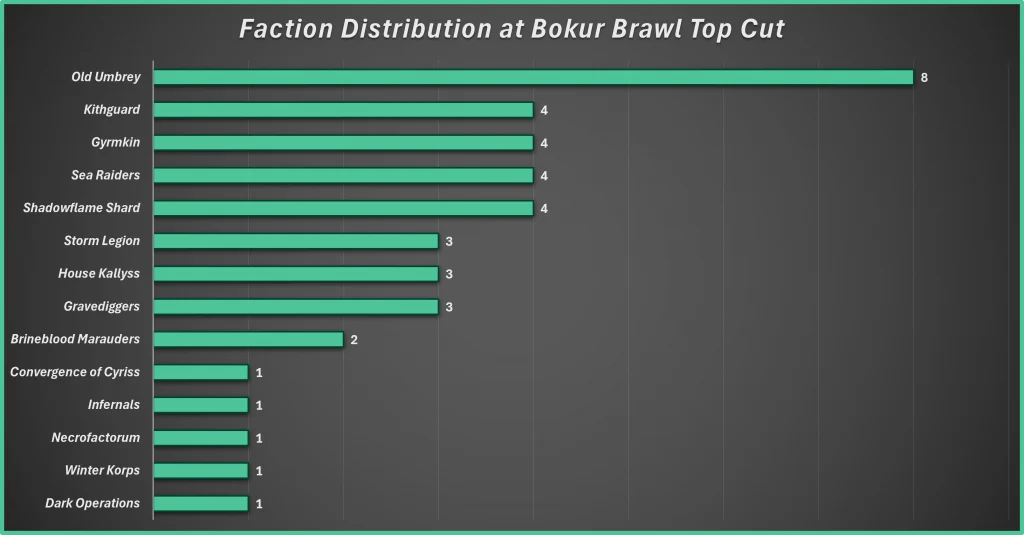
The rules for team composition at the Bokur Brawl allowed players on a team to share the same faction, with the crucial caveat that there could be no overlap in Warcasters. This rule encourages faction diversity within a team while still allowing for a strong "faction expert" to field their preferred army. Interestingly, only two of the top 8 teams opted to double up on a faction selection: fourth place brought two Kallyss players, and eighth place featured two Old Umbrey players.
The distribution of factions within the top 8 teams vividly illustrates Old Umbrey’s overwhelming presence. Out of the 8 top teams, only one elected not to include an Old Umbrey player on their roster. Furthermore, the faction was represented twice on one team, resulting in double the number of Old Umbrey players compared to the next most popular faction choice. This stark overrepresentation is a resounding endorsement from some of the best players in the world: to contend for victory in a high-stakes team event, Old Umbrey is considered an almost essential inclusion. This data strongly supports the conclusion that the faction is significantly overperforming.
Beyond Old Umbrey, the faction selection among the top teams was surprisingly evenly spread, with every Prime faction seeing at least one player represented in the top cut. However, Necrofactorum and Winter Korp each saw only a single selection. This low representation likely indicates that their inclusion on a team roster was due to those players being highly skilled "faction experts" or dedicated "diehards," rather than a reflection of the faction’s general meta strength for optimal team composition. Similarly, Convergence, Infernals, and Dark Operations also had only one selection each, though their status as Legacy armies with smaller overall player populations makes their lower representation less alarming than for the Prime factions.
![[Warmachine] Competitive Innovations in the Iron Kingdoms, May 2026](https://assets.tabletopbattles.com/wp-content/uploads/2026/06/May-26-SR-Stats-WR-1024x531.png)
First Place: Team F*ck Mammoth – A Strategic Masterclass
The winning team at Bokur Brawl, "F*ck Mammoth," exemplified strategic excellence and diverse faction selection, including the highly potent Dark Operations faction piloted by Brad Park. Brad Park’s contribution to the team’s victory through his Dark Operations lists provides a detailed look at high-level competitive builds.
Brad Park – Dark Operations
List 1: "Way to Rome" (Exulon Khythos)
This list is built around the formidable Exulon Khythos, known for his aggressive capabilities and ability to empower his force. It leverages a core of Malfessor and Warden, common support pieces, alongside the Agitator and Akulon Thaemestra, which provide crucial buffs and control elements. The inclusion of Magnus the Unstoppable and the Invictus speaks to a desire for resilient, heavy-hitting pieces that can anchor the frontline or execute powerful alpha strikes.
The infantry contingent is substantial, featuring two units of Criterions, versatile troopers capable of both ranged and melee engagements. Dominated Stormblade Legionnaires add a layer of hard-hitting melee potential, especially when supported by Khythos’s abilities. The lists also incorporate Drudge Conduits and Mind Benders (two units of each), which are vital for extending threat ranges, controlling enemy models, and generating resources or applying debuffs. Two units of Overlords provide additional ranged firepower and support.
The Command Cards chosen—Careful Reconnaissance, Duck and Cover!, Lucky Penny, Old Faithful, and Put the Fires Out—suggest a tactical approach emphasizing threat assessment, defensive maneuvers, resilience, consistent output, and potentially mitigating enemy ranged attacks or healing. This combination aims for a highly adaptable force capable of weathering enemy assaults while delivering precise, powerful counter-punches.
List 2: "Thunder Underground" (Exulon Thexus)
Brad Park’s second Dark Operations list features Exulon Thexus, a Warcaster often associated with control, attrition, and manipulating the battlefield. The list includes Subduer and Warden for core warjack presence, supported again by Agitator and Akulon Thaemestra. The inclusion of Exulon Nostilla and the Aberration points to a focus on disruptive elements and potentially powerful individual threats that can tear through enemy lines.
The defensive package is notable, featuring Barrier (twice) and a Powder Keg. These Defenses suggest a strategy focused on board control, funneling enemy forces, and creating zones of denial or explosive traps, allowing Thexus to dictate the pace of engagement.
Infantry choices include a unit of Criterions and Dominated Stormblade Legionnaires, providing reliable damage output. The Drudge contingent is expanded with two units of Drudge Conduits, a Mind Bender, Drudge Slayers, and a Mind Slaver. This emphasizes resource generation, additional melee threats, and more advanced control options through mind manipulation. Two units of Iconoclast Drudges and a unit of Overlords round out the list, providing further ranged and melee options, possibly focused on screening or zone control.
![[Warmachine] Competitive Innovations in the Iron Kingdoms, May 2026](https://assets.tabletopbattles.com/wp-content/uploads/2026/04/Kithguard-Warmachine-e1776950739810.png)
The Command Cards—Blessing of the Gods, Careful Reconnaissance, Defenses, Lucky Penny, and Put the Fires Out—mirror some of Khythos’s choices but also include Blessing of the Gods, hinting at a more resilient, attrition-focused game plan, perhaps to counter specific threats or ensure key models survive.
Collectively, Brad Park’s Dark Operations lists showcase the faction’s versatility, offering both aggressive, alpha-strike potential (Khythos) and a more controlling, attrition-based approach with strong defensive elements (Thexus). This ability to present varied threats likely allowed Team F*ck Mammoth to adapt to a wide range of opponent compositions and secure critical victories throughout the Bokur Brawl.
Official Responses
Developer’s Watch: Upcoming Balance Changes Confirmed
The competitive data from May 2026, particularly the overwhelming performance of Old Umbrey and Gyrmkin, has not gone unnoticed by Steamforged Games (SFG), the developers of Warmachine. In a proactive move signaling their commitment to game balance, SFG has officially confirmed that the upcoming June balance update will directly address these top-performing factions.
Specifically, two Warcasters from the Old Umbrey faction, Lesnoi and Kovosky, have been targeted for adjustments. Their consistently high win rates of 61% and 60% respectively have clearly indicated they are contributing disproportionately to the faction’s overall dominance. While the exact nature of these adjustments remains under wraps, they are expected to temper the most egregious aspects of their power, whether through changes to their spells, abilities, or even their personal statistics.
Furthermore, the Slaughterhouse unit from the Gyrmkin faction is also slated for modifications. This unit, central to the infamous "Slaughterhouse Housing Crisis" list, has been a key factor in Gyrmkin’s rise as a competitive terror among Legacy factions. The planned adjustments aim to reduce its overwhelming impact, likely by toning down its offensive output, resilience, or resource generation capabilities, thereby creating a more equitable playing field. These targeted interventions demonstrate SFG’s responsiveness to data-driven insights and their ongoing efforts to foster a diverse and competitive meta.
Implications

Leave a Comment