Beyond Human: How Modern and Classic Fiction Redraws the Boundaries of Being
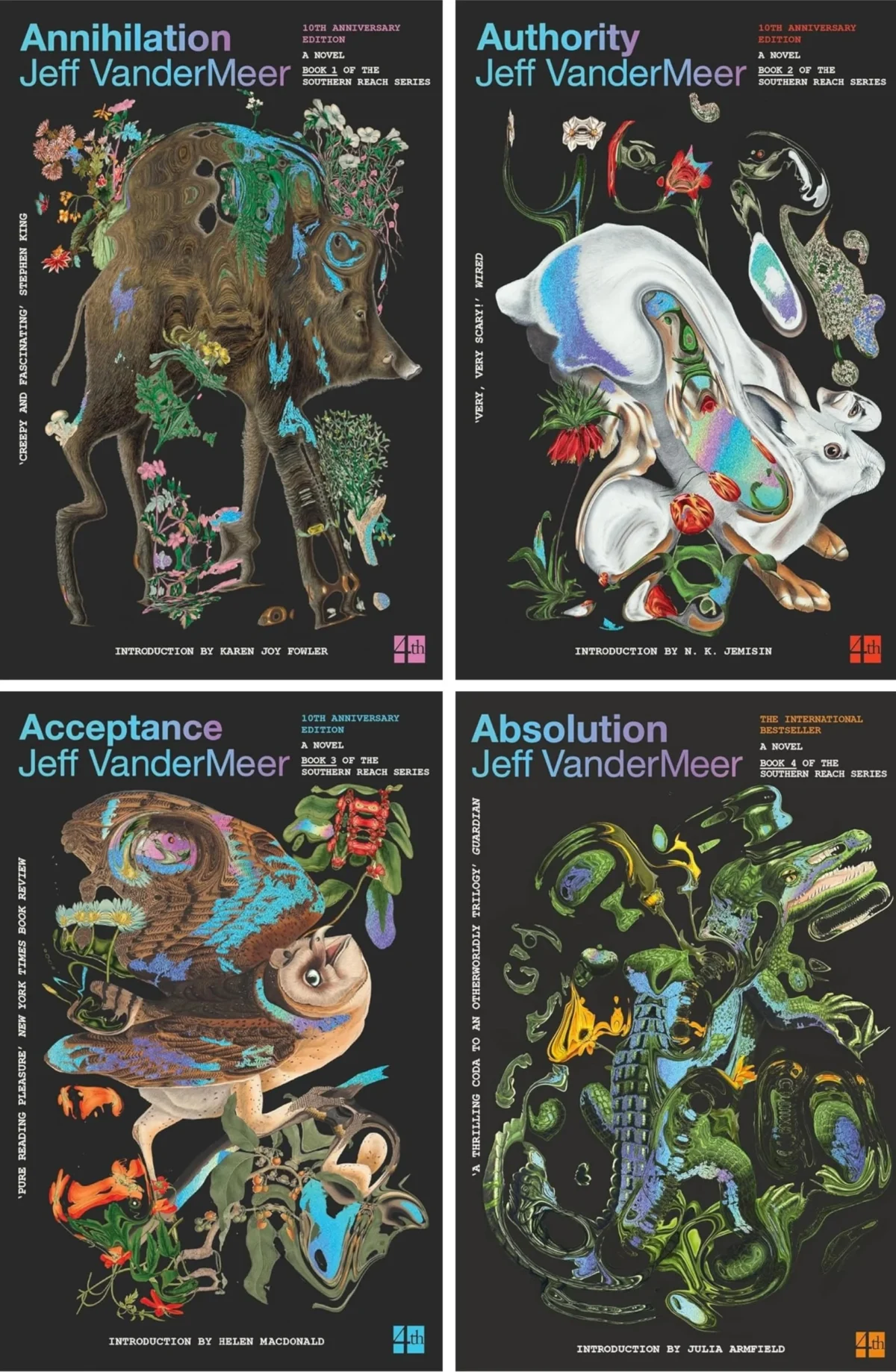
In a haunting landscape, a woman on the verge of ultimate transformation convulses on verdant grass, her mind consumed by visions of a "moat of vast sea creatures." Her very genetic code, in a profound and irreversible shift, begins to yearn for the oceanic abyss, signalling her relinquishment of human form. She embraces a nonhuman destiny, "descend[ing] into the light" of radical contamination and existential change (VanderMeer 114).
Miles away, on the stark concrete of a basketball court, a man’s bullet pierces a woman’s shoulder. As she writhes, her flesh violently tears, "her cheeks and chin tear with a wet sound and the bones crunch," a gruesome metamorphosis unfolding as past traumas violently press upon the present, culminating in her becoming "an elk. [An] Elk Head Woman" (Jones 278).
Centuries prior, within the dimly lit confines of a boarding house in Ingolstadt, a young scientist named Victor Frankenstein meticulously stitches together an assemblage of lifeless flesh. His ambition gives way to abject horror as "the dull yellow eye of the creature open[s]," and the disparate remains of the dead coalesce into a single, terrifyingly vibrant living being (Shelley 46).
These three vastly disparate literary works—Jeff VanderMeer’s critically acclaimed Southern Reach series (also known as Area X), Stephen Graham Jones’s visceral horror novel The Only Good Indians, and Mary Shelley’s timeless gothic masterpiece Frankenstein—collectively challenge and violently redraw the conventional relationality between "animals, humans, and living and dead things" (Chen 5). They invite profound fusions between what we perceive as living and dead, human and nonhuman. The hybrid beings at their core grapple with understanding the seemingly irreconcilable pieces of their new selves, navigating the language of the human alongside the burgeoning, alien tongues of the more-than-human, the animal, and the utterly strange.
A Legacy of Transformation: From Ingolstadt to Area X
This exploration delves into how these narratives, by reorienting familiar environments and bodies into contaminated and nonhuman trajectories, engage in a necessary "queering" of both the animate and inanimate, transcending conventional boundaries of space and time. The sheer chronological and geographical span of these works—from early 19th-century Europe to contemporary American landscapes—underscores that this radical interrogation of being is neither a fleeting fad nor a novel preoccupation in speculative fiction. By reading Frankenstein, often considered one of the genesis texts of science fiction and fantasy, against two recent contemporaries, we uncover a persistent and evolving discourse around identity, ecology, and existence.
At the heart of this analysis are the insights of several key theorists: Jane Bennett’s Vibrant Matter: A Political Ecology of Things, Mel Y. Chen’s Animacies: Biopolitics, Racial Mattering, and Queer Affect, Elizabeth Freeman’s Time Binds: Queer Temporalities, Queer Histories, Donna J. Haraway’s Staying with the Trouble: Making Kin in the Chthulucene, and Timothy Morton’s Hyperobjects: Philosophy and Ecology After the End of the World. These academic lenses illuminate how the transformations within these texts represent not merely monstrous aberrations, but profound challenges to Western modernity’s heteronormative modes of being.
Haunting the Present: Queer Time and Avenging Spirits
A queer reading of these core transformations posits queerness as "a powerful site […] of failure" for Western modernity’s entrenched narratives (Freeman XVI). It is here that the comforting myth of human exceptionalism and the idealized vision of a pristine natural world begin to crumble. Unlike what Chen terms the "neutral queer"—a figure that can be readily absorbed by capitalism and neoliberal frameworks—the queer beings of these texts resist assimilation (Chen 66). Their queering transcends simple human/nonhuman or natural/unnatural binaries; it is a fundamental queering of the very fabric of the world itself. As Jane Bennett describes it, this involves "the recognition of human participation in a shared vital materiality" (Bennett 14). Bennett challenges our ingrained need to "distinguish the human self from the field"—the entirety of matter existing outside the human body (Bennett 121). In these novels, the inherent vibrancy of all matter eclipses the need for human exceptionalism, giving rise to forms of queerness that encompass and extend beyond the human.
The very constructs of bodies, nature, and time itself are systematically dismantled throughout these narratives, folding into what Timothy Morton describes as "hyperobjects"—massive assemblages distributed across vast stretches of space and time, simultaneously living in the hauntings of both past and future. While Morton stresses that "the recognition of being caught in a hyperobject is precisely a feeling of strange familiarity and familiar strangeness" (Morton 63)—an experience familiar to queer individuals but not inherently queer—the specific interventions in these texts are. Mel Chen argues for queering as a site of disruption beyond sexuality, while Elizabeth Freeman emphasizes that "what makes queer theory queer as opposed to simply deconstructionist is also its insistence on risking a certain vulgar referentiality, its understanding of the sexual encounter" and its specific interventions into heteronormativity (Freeman 11).
To understand this deep queering, we must first confront the concept of "chrononormativity." Freeman defines this as the linear structure of existence that dictates a sequence of birth, childhood, "[heterosexual] marriage, accumulation of health and wealth for the future, reproduction, childbearing, and death"—a seemingly inevitable and unchangeable timeline (Freeman 4). The monster, in its very being, fundamentally troubles this organized past, present, and future. Queering time, however, necessitates more than simply queering the bodies involved in these linear destinies; it demands a queering of the ecologies surrounding them. It dismantles the notion that queerness in these bodies is an isolated anomaly within an otherwise "normal" or heterosexual world, where time flows on strict schedules. To truly queer the body, we must simultaneously accept the queering of the nature around it, situating queer time as something that impacts the "animacy" of all things, not solely the animal.

This queer time manifests as a form of "haunting," where history intrudes powerfully on the present. Expanding on Derrida’s concept of hauntology, Freeman defines queer hauntology as an "ethics of responsibility towards the other across time, toward the dead or toward that which was impossible in a given historical moment […] the present is thereby always split, but split by prior violence and future possibility rather than simply by the nature of signification" (Freeman 9). Hauntology allows different historical moments to reach out, to impose themselves onto the present: the past, forever lingering, and the many lost futures violently truncated, their unrealized potentials pressing back through time. Within these three texts, hauntology persistently manifests through objects, bodies, and nature itself, compelling those in the present to confront the violent histories that preceded and will follow them.
In The Only Good Indians, moments of hauntology repeatedly disrupt the linear sense of time the characters depend on, slowly but surely queering the natural world. This occurs in sharp instances of otherness and racist encounters, such as when Ricky is interviewed by a logging foreman in Minneapolis. A profound moment of hauntology propels Ricky backward through time, or perhaps, from another perspective, thrusts the past violently into the present: "When [the foreman] reached across the table to shake Ricky’s hand and look him in the eye while he did it, the modern world had fallen away for a long blink, and the two of them were standing in a canvas tent" (Jones 2).
Hauntology also appears in moments of both recognition and alienation. Ricky describes instances with Gabe where the past impinges upon them, until "it’d feel like he was holding a tomahawk in his hand. It’d feel like his face was painted in harsh crumbly blacks and whites, maybe a single finger-wide line of red on the right side" (Jones 7). As the novel vividly puts it, "The years can just fall away, man" (Jones 7). As Elk Head Woman exacts vengeance and retribution from the past, even the natural world begins to respond, transforming a seemingly pristine and undisturbed nature into a space beyond chronological time.
The climax of The Only Good Indians sees Gabe’s daughter, Denorah, confronting Elk Head Woman. In this harrowing chase, time itself appears to bleed, giving way to "another world [with] skeletons all around her" (Jones 299). The violence of the past that birthed Elk Head Woman surges forward in a hauntology that pierces the natural world. Life and death no longer exist along predictable, productive timelines; instead, they surge forth into monstrous new expressions, ultimately fostering a clearer, if terrifying, understanding between Denorah and Elk Head Woman.
The Hyperobject of Change: Nature Reimagined in Area X
This rupture of time within the natural world is similarly evident in VanderMeer’s Area X, where temporal disjunction produces entirely new formations in nature. When the Biologist crosses from the familiar Southern Reach into Area X, she initially encounters what appears to be a pristine, perfectly preserved natural landscape teeming with flora and fauna, notably devoid of human presence. Clocks, at first glance, seem to tick along as they do beyond the border. Only a distant lighthouse and a seemingly bottomless, dark pit—which the Biologist instinctively labels "the tower, which was not supposed to be there, plung[ing] into the Earth"—hint at something profoundly amiss (VanderMeer 1). However, as Timothy Morton cautions in Hyperobjects, "the abyss is not an empty container, but rather a surging crowd of beings" (Morton 80). That initial impression of Area X as pristine and untouched by human elements rapidly dissipates as the narrative progresses, revealing a queerer nature and a queerer human presence. Eventually, Area X accumulates enough queer time to reach a state where even reproduction is uncoupled from both linear time and heterosexuality, culminating in the Biologist becoming the parent of her own strange duplicate, Ghost Bird.
As in the culmination of Area X, VanderMeer’s nature unveils itself not as pristine, atemporal, or untouched. Instead, it echoes Morton’s assertion that "there is no ‘pristine,’ no nature, only history" (Morton 58). The landscape reveals itself to be teeming with strange and mutated life, both human and nonhuman, all inextricably enmeshed. Morton describes hyperobjects—entities so massively distributed in time and space that we remain too close to recognize them distinctly—as appearing to "taper off like a long street stretched into the distance. Time bends them and fattens them, the same way that an electromagnetic wave front shortens at its leading edge. Because we can’t see to the end of them […] [h]yperobjects seem to beckon us further into themselves, making us realize that we’re already lost inside them" (Morton 55). For Morton, hyperobjects encompass phenomena like the Earth’s biosphere, climate change, music, an oil spill, or a supernova. For VanderMeer, the bizarre and wild ecology of Area X is precisely such a hyperobject. Beginning as merely "[a] splinter […] large as worlds" in the thumb of a queer lighthouse keeper named Saul, it expands to envelop an entire coastline, becoming a singular entity too vast and strange to be fully perceived by the characters trapped within it (VanderMeer 583).
With her body and mind infiltrated by Area X, and the rest of her expedition deceased, the Biologist chooses to remain within its enigmatic borders, pursuing the trace of her vanished husband deeper into the hyperobject. What eventually returns to the outside world in her stead is a new identity, inhabiting a new body, known only as the Ghost Bird.
Much like Denorah confronting Elk Head Woman in her father’s place, resolution in Area X is not granted to the characters who initiated the journey, but rather to those who were created by or profoundly haunted by them. Denorah is not her father, and the Ghost Bird is not the Biologist, just as Frankenstein’s Monster can never truly be the sum of the many bodies from which he was stitched.
As the hyperobject’s borders swell and expand to encompass more and more of the world, Ghost Bird’s re-entry into Area X dramatically reveals the extent of this temporal queering. Discovering her double’s former diaries exposes that while the Ghost Bird spent weeks in the outside world, many years had elapsed within Area X. Re-entering Area X and its strangely moving, queerly warped time, she becomes a relic of the distant past, a fragmented memory returning to her past self’s future—a profound doubling of body and nature. VanderMeer queers time by presenting time within the hyperobject of Area X and time outside it as two bodies utterly out of sync. The Biologist and the Ghost Bird thus become two alternative pasts, presents, and futures, each haunting the other’s history, and alternative bodies, each representing divergent destinies that can no longer be fulfilled.

The Erotic Power of the Monster: Desiring Beyond Norms
However, not all hauntings are inherently queer. Here, we must turn to the body of the monster itself and the potent desire it embodies. Mary Shelley’s Frankenstein starkly illuminates the relationship between the monstrous and the body, and the body’s capacity to queer eroticism and relationality. Within the Monster’s very form, we find a powerful queer hauntology. His body, composed of disparate corpse pieces, "contains the history of bodies and of bodiliness and thus figures a gender and a sexuality that themselves write a history of genders and sexualities" (Freeman 103). The Monster’s body is, in essence, a cobbled-together history of desire and encounters, a canvas of flesh created from stitched remnants of other bodies, whose erotic yearnings now mingle in the very fabric of this new creature. Alongside this erotic haunting, the Monster represents a fusion of times and substances, an example of "agency [as] an interfolding network of humanity and nonhumanity" (Bennett 31), where dead and inanimate matter compel history into the present as corpses are fused to create life. His is both a queer creation story and a narrative profoundly marked by queer longing.
Victor Frankenstein explicitly frames his ambitious goals in terms of procreation, specifically a nonhuman form of it. He declares: "A new species would bless me as its creator and source; many happy and excellent natures would owe their being to me. No father could claim the gratitude of his child so completely as I should deserve there" (Shelley 43). Indeed, the Monster considers themself to be "not even of the same nature as man," but of a wholly different gendered and sexed species (Shelley 111). Only by observing the cottagers does the Monster recognize the concept of "the difference of sexes; and the birth of children" (Shelley 112). For the Monster, there is no cisfemale intervention in his genesis, no heteronormative parenthood. Victor is both inceptor and progenitor, enacting a queer creationism that explicitly eschews the demands of heterosexual reproduction.
In this regard, the Monster finds kinship with Area X’s Ghost Bird, who similarly comes into being without a clear creator save the Biologist. Though she carries no sexual history of her own, her body inherently carries the history of gender and sexual encounters inherited from her double, her "haunted twin" (VanderMeer 487). Similarly, Elk Head Woman embodies her own doubling of origin, emerging in her hybrid human/animal form through both natural creation and as a violent response to the men whose violence birthed her. These bodies share contained queer origins, but we can extend this reading further by exploring the queerness suggested by the actions and desires of these monstrous figures.
For these monstrous beings, even residual moments of seemingly heterosexual desire are inevitably queered. "You must create a female for me," the Monster demands of his progenitor, "for whom I can live in the interchanges of sympathy for my being […] my companion will be of the same nature as myself" (Shelley 137-139). On its surface, this might appear as Frankenstein relinquishing its queer potential, surrendering to an inevitable heterosexual destiny. Yet, the very nature of this desired companion, a being also cobbled together, also outside conventional origin, also a monstrous hybrid, radically queers the conventionality of the request. After years in Area X, the Biologist has become something akin to a colossal whale with "many, many glowing eyes […] all across its body, a living constellation ripped from the night sky" (VanderMeer 493), forever returning to an island where, transformed into an owl, her long-abandoned husband awaits her companionship. This is not a conventional reunion but a profound, trans-species, trans-formational relationality. Caught in a moment of queer time, Elk Head Woman ultimately abandons her quest for vengeance in favor of "The only thing [she’s] ever really wanted to do this whole time" (Jones 303): to protect the family she’d lost. Denorah reaches across the species divide, preventing her adopted second father from becoming "Just another hunter" (304), thereby breaking a cycle of violence and allowing a new understanding to blossom.
Implications and the Promise of Queer Empathy
The conclusion towards which these hauntings, queerings, and transformations lead the bodies in these stories is not one of violence, vengeance, or heteronormative coupling and normative reproduction. Instead, it points toward a profound queer animality, a "genre of queer animacy [serving as] a modulation of life force" that might allow for states of togetherness where animacy has superseded previous hierarchies (Chen 98). This "blur[s] the tenuous hierarchy of human-animal-vegetable-mineral" (Chen 98). This radical deprioritizing of species and the human/nonhuman divide, in favor of a lively animacy that does not distinguish between species in seeking queer companionship, is tragically and violently cut short in Frankenstein, but is ultimately achieved by the end of The Only Good Indians and is central throughout Area X.
These narratives powerfully attest to Chen’s argument that "animacy itself can be queer," as the distinctions and exceptionalism between differing modes of life and across time itself begin to dissolve (Chen 98). Within these texts, Elk Head Woman’s and the Biologist’s fusions of human and nonhuman, the Monster’s fusions of living and dead, and the profound fusions of past/present/future in all three texts collectively represent sites of this queer animacy. This allows differing types of matter to mingle, simultaneously troubling the rigid binaries of living/dead and natural/unnatural.
Queerness, through its disruption of linear time and its creation of monstrous, hybrid bodies, emerges as a vital path towards empathy and solidarity, companionship and compassion. Even the violent failure of this potentiality, as seen in Frankenstein, illuminates this way forward. Though the Monster is tragically denied compassion and finds resolution in violence and tragedy, his initial instinct is to strive to understand human beings—those creatures unlike himself—and then to seek a being whose matter might truly understand his own. Even in Area X, where the nonhuman natural world is initially experienced as strange and hostile, resolution is ultimately found in understanding and empathy. Saul—a man who had steadfastly refused to accept this queer hyperobject—finds himself drawn to its core, rushing down into the tower and "elongat[ing] down the final stair, jump[ing] into the light" (VanderMeer 573). In the heart of that brightness, which queers everything, the materia of human and alien ecology might finally read and understand each other.
This, then, is the profound promise inherent in queering the world: a chance to reach for a subjectivity and relationality that allows what was once deemed untouchable, monstrous, and utterly other to become an avenue for profound expression, for acceptance, and for a deeper, more inclusive understanding of existence itself. As these diverse works demonstrate, speculative fiction, through these radical lenses, becomes an essential space for grappling with the most complex contemporary issues of identity, ecology, and what it truly means to be.