The Enigma of Loch-Durnan: A Deep Dive into a Controversial D20 Adventure and its Tumultuous Legacy
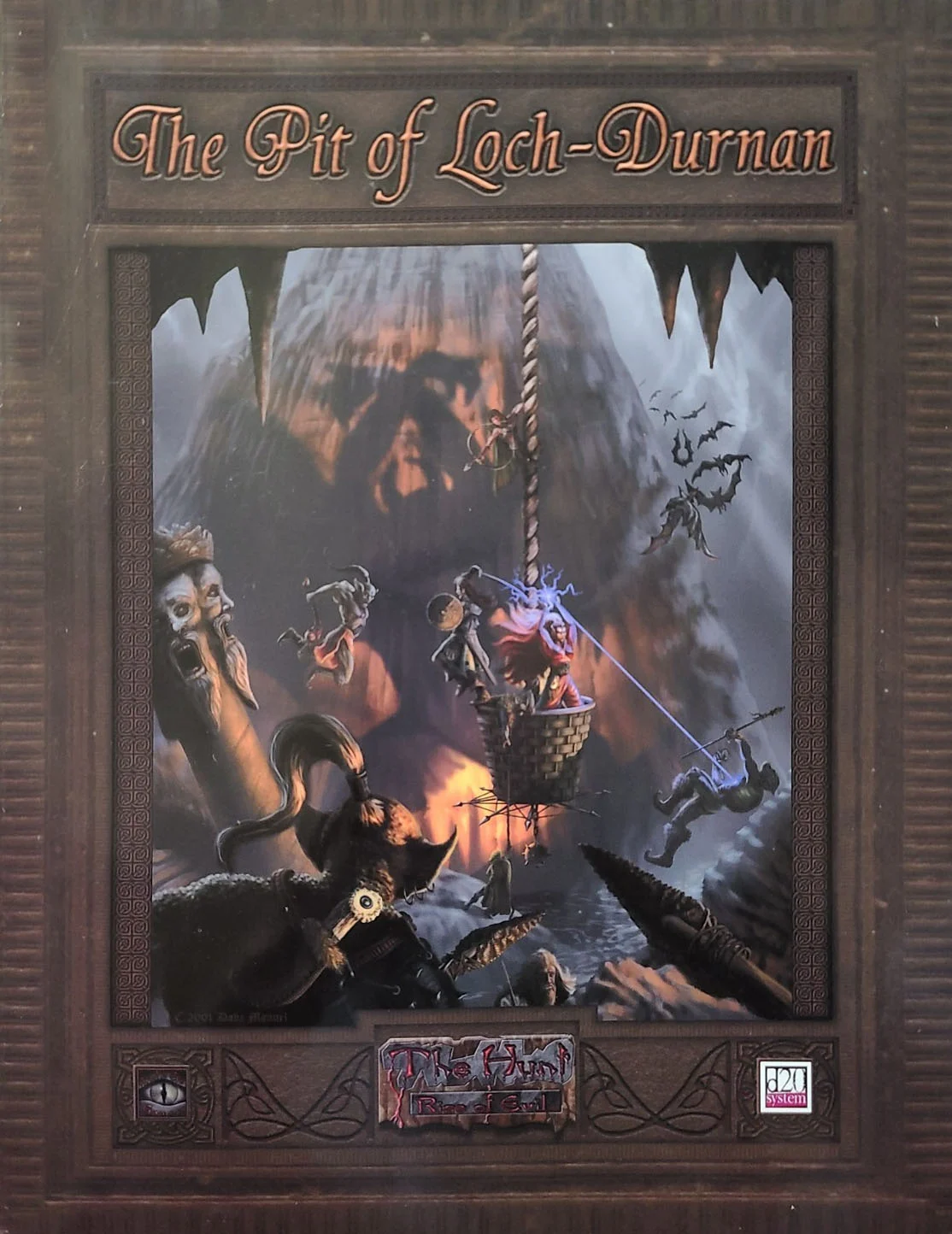
March 13th, 2002 (Retrospective 2024) – In the dynamic landscape of early 2000s tabletop role-playing games, the d20 system reigned supreme, fostering a proliferation of third-party content. Among the many releases, Mystic Eye Games garnered some attention for its Nightmares & series and the The Hunt: Rise of Evil campaign setting. However, one of its more obscure offerings, the adventure module The Pit of Loch-Durnan for 2nd to 4th level characters, would later become a focal point of critical debate, an industry "scandal," and a fascinating case study in the subjective nature of game design and review ethics.
Originally reviewed in 2002, The Pit of Loch-Durnan emerged as a paradox: a module simultaneously praised in some quarters and deeply flawed in others, eventually sparking a significant controversy for one reviewer who dared to challenge its initial, overwhelmingly positive reception. This article revisits the module, its original critique, the subsequent industry kerfuffle, and its enduring implications for game design and journalistic integrity.
Unearthing the Main Facts: A Tale of Deception and Dungeon Delving
The Pit of Loch-Durnan, authored by Doug Herring and Andrew Thompson, presented itself as a seemingly straightforward fantasy adventure. Players were introduced to a classic trope: distressed villagers appealing to heroes to clear a goblin infestation from their local mine. This familiar premise, however, quickly unravelled to reveal a far more insidious plot, a narrative twist that formed the module’s conceptual backbone and its most compelling element.
The truth concealed beneath the surface was that the mine, the titular "Pit of Loch-Durnan," harbored not merely goblins, but a powerful, imprisoned demon actively attempting to escape its confines. This malevolent entity had enslaved the entire village population, transforming their desperate plea into an elaborate trap. The adventurers, ostensibly saviours, were in fact being lured into a carefully constructed snare, destined to fall under the demon’s control.
Once ensnared, the player characters (PCs) would find themselves abandoned in the pit, compelled to navigate a labyrinthine dungeon. Their journey would involve battling undead minions, confronting goblin slaves, and ultimately destroying the demon’s crystal – the source of its power and influence. The adventure culminated in an escape into the mansion of the twin brothers responsible for the demon’s liberation, a final confrontation with these antagonists, and the ultimate liberation of the enslaved village.
Despite this intriguing premise – a deconstruction of a common fantasy cliché – the module was plagued by a multitude of execution problems, from its production quality to significant narrative and logical inconsistencies. These issues would be meticulously catalogued by critical reviewers, setting the stage for the later controversy.
A Chronology of Controversy: From Rave Reviews to Reviewer Retribution
The journey of The Pit of Loch-Durnan through the nascent online RPG review landscape was anything but smooth.
Early Buzz and Initial Acclaim (Pre-2002):
Mystic Eye Games had established a reputation through other products, particularly their Nightmares & books and The Hunt: Rise of Evil campaign setting. Against this backdrop, The Pit of Loch-Durnan initially enjoyed a surprisingly enthusiastic reception. Early reviews, some of which predated the 2002 critique, were overwhelmingly positive, describing the module in glowing terms. This initial wave of praise culminated in the module’s nomination for the Best Adventure ENnie Award in 2001, the inaugural year of the prestigious awards. This nomination, in retrospect, would become a point of contention for later critics, raising questions about the early standards of industry recognition.
The Critical Assessment (March 13th, 2002):
It was in this climate of widespread approval that a more critical perspective emerged. A review, originally published on March 13th, 2002, systematically dissected the module’s numerous shortcomings. While acknowledging the strength of the core concept – the deceptive villagers and the underlying demonic plot – the reviewer highlighted severe deficiencies in almost every other aspect, from amateurish production values to gaping plot holes and missed narrative opportunities. The review concluded that while the raw material possessed potential, it required "massive amounts of revision" to be genuinely enjoyable.
The Retrospective and "Scandal" (Post-2002, ongoing):
Years later, a retrospective note from the original reviewer illuminated the full extent of the module’s problems and the subsequent fallout. The reviewer openly admitted to finding The Pit of Loch-Durnan "quite likely the worst published adventure I’ve ever run," despite having a "really fantastic time" playing it after undertaking "35 pages of revisions." This stark contrast underscored the module’s dichotomy: a brilliant concept crippled by flawed execution.
The retrospective also revealed a significant "scandal" that erupted in the wake of the review’s publication. The reviewer, a pioneer in cross-posting reviews across multiple emerging RPG sites (such as RPGNet, ENWorld, and d20reviews.com), encountered a critical issue. Each site employed different scoring rubrics (e.g., Style & Substance vs. X out of 5 Stars). When the reviewer adapted the module’s score to fit each site’s specific criteria, Mystic Eye Games took offense. The publisher privately demanded the reviews be removed, threatening to withhold future review copies. Upon refusal, they went public, accusing the reviewer of intentionally "tanking" their review scores through inconsistent numerical ratings, framing it as a mathematical conversion error rather than an adaptation to different evaluation systems. This incident became a notable early example of publisher-reviewer friction in the digital age, highlighting the complexities of review ethics and the pressures faced by independent critics.
Supporting Data: A Deep Dive into the Module’s Flaws and Latent Potential
The original review provided extensive "supporting data" for its critical assessment by detailing the myriad problems encountered and, crucially, the specific changes made by the reviewer to render the module playable. This approach effectively transformed a standard critique into a practical guide for improvement, underscoring both the module’s deficiencies and its latent potential.
The "Bad Stuff": A Litany of Production and Design Failures
-
Atrocious Production Quality: The most immediate and glaring issue was the module’s presentation. The layout was described as "atrocious," with "god-awful illustrations" contributing to an overall "amateurism." Radical font shifts, rampant overuse of bold, italic, and underline text, and inconsistent, often "illegible," paragraph spacing created a jarring and unprofessional aesthetic. The sole exception was the front cover, whose quality stood in stark contrast to the interior, prompting the hyperbolic, yet illustrative, comment that if the entire product had matched the cover, "there would have been spontaneous dancing in the streets."
-
Narrative and Logical Inconsistencies (The Reviewer’s Revisions as Evidence): The core of the module’s problems lay in its underdeveloped narrative and logical gaps, which the reviewer addressed through extensive revisions:
- Jarring NPC Names: The module featured "silly and oddly jarring names" for NPCs like Gormon, Warphit, Sheepo the Goblin, and Tippi the Ghoul. These names, while pronounceable, evoked a "Sesame Street of Horrors" rather than a serious fantasy adventure, undermining the module’s darker themes.
- Demon’s Ambiguous Motivation: The original module lacked a clear, logical reason for the demon to specifically lure adventurers to the town. The reviewer provided this by establishing the demon’s desire to enslave powerful individuals to amplify its own strength, thus explaining why it would target capable PCs (but not so powerful as to easily defeat it).
- Undercut Betrayal: The powerful theme of betrayal – a core strength of the premise – was poorly executed. As written, the PCs would remain completely unaware of the deception until after defeating the demon. This lack of build-up or mystery rendered the betrayal incomprehensible and the initial dungeon crawl a "yawn-fest," culminating in an illogical attack by the villagers. The reviewer amplified this by introducing a sleeping poison that would strip PCs of their possessions before dumping them into the pit, enhancing the survival element and making the betrayal immediate and impactful.
- Inconsistent NPC Backstory: The character of Barlan, who provides crucial information to the PCs, had no credible explanation for how he acquired this knowledge. The reviewer had to construct a logical backstory to lend credibility to his role.
- Unexplained Goblin Presence: The module failed to explain the goblins’ presence in the Pit, their origin, or their purpose as demon slaves. Clarifying these elements was essential for a cohesive dungeon narrative.
- Incomplete Scenario Resolution: The module’s reaction tables for the final confrontation with the demon crystal were impractical, and crucially, it neglected to account for the villagers’ actions and reactions once the demon was defeated, leaving a significant narrative loose end.
These points collectively painted a picture of a product that was less a polished adventure and more "unmolded clay," requiring substantial effort from the Dungeon Master to sculpt it into a coherent and engaging experience.
The "Good Stuff": Glimmers of Potential
Despite its extensive flaws, the review identified several core strengths – the "raw material" – that made the module salvageable for a willing GM:
- Well-Designed Maps: The maps for the Pit itself were praised as "well thought out," featuring "strong encounters." While the reviewer desired more proactive goblins, the structural design of the dungeon was a solid foundation.
- Compelling Core Concept: The module’s central conceit was its greatest asset: the subversion of the classic "save the village" trope into an elaborate trap designed to enslave the heroes to a demon. This "deconstruction of the standard dungeon" was a "cool concept" with immense potential for a memorable experience, provided it was properly executed.
- Strong Characters and Memorable Scenes: The module contained "some really strong NPCs," both antagonists and victims. A particularly potent example cited was a scene involving a family whose five-year-old son was tortured to death by the demon. Later, as the PCs navigate the mansion, the son reappears as a "decayed and rotting zombie," forcing the PCs to physically restrain the grief-stricken father from embracing his undead child, who would "tear out his throat if given half a chance." This emotionally charged encounter showcased the module’s capacity for powerful, unsettling narrative moments.
These elements underscored the reviewer’s ultimate conclusion: The Pit of Loch-Durnan was a diamond in the rough, albeit one buried under layers of poor execution, demanding "a lot of spit and polish… and patching… and reconstructive surgery" to shine.
Official Responses: Mystic Eye Games and the Reviewer’s Standoff
The "scandal" surrounding the review provided a stark illustration of the challenges inherent in independent game journalism and publisher relations in the early digital age. The reviewer’s practice of cross-posting reviews across different platforms, each with its unique scoring system, became the flashpoint for Mystic Eye Games’ "official response."
The core of the publisher’s argument was that disparate numerical scores across different sites, even if generated by distinct rubrics, constituted an attempt to "tank" their product’s overall rating. They contended that a simple mathematical conversion should apply across all platforms, regardless of the criteria being evaluated. For example, if a module received 2/5 for Style and 2/5 for Substance on RPGNet, Mystic Eye Games argued that it should translate directly and consistently to a specific score on a 5-star system, or any other rubric, without variation.
The reviewer, however, firmly maintained that different scoring systems inherently evaluate different aspects or weight them differently. A 2/5 for "Style" and "Substance" on one site might not equate mathematically to a 1-star rating on a site that combines all factors into a single score, or one that specifically emphasizes "Graphics" and "Playability." The argument was one of qualitative assessment versus rigid quantitative conversion. The publisher’s public campaign, fueled by these mathematical discrepancies, created a "kerfluffle" that forced the reviewer to spend considerable time defending their methodology against accusations of bias.
This incident served as an early indicator of the delicate balance between a publisher’s desire for positive publicity and a reviewer’s commitment to objective, honest criticism. It also highlighted the then-nascent challenges of managing a consistent critical voice across a fragmented and evolving online media landscape.
Implications and Lasting Lessons: A Legacy Beyond the Pit
The story of The Pit of Loch-Durnan and its contentious review carries several significant implications, resonating far beyond the confines of a single d20 module.
Implications for Module Design and Publishing:
The module serves as a powerful cautionary tale regarding the importance of comprehensive development. A compelling core concept, however brilliant, cannot compensate for poor execution in areas such as layout, illustration, logical consistency, and narrative pacing. Mystic Eye Games’ experience underscored the necessity for rigorous editing, playtesting, and professional production values to translate raw ideas into a polished, enjoyable product. The reviewer’s extensive revisions, which transformed a deeply flawed adventure into a memorable play experience, highlighted the gap between an unrefined manuscript and a truly ready-to-play module. It also demonstrated that even "raw material" with inherent value demands significant "elbow grease" from the creator, not just the end-user.
Implications for RPG Review Ethics and Journalism:
The "scandal" surrounding the review had broader implications for the emerging field of online RPG journalism. It brought to the forefront the challenges of maintaining journalistic integrity in the face of publisher pressure. The reviewer’s refusal to retract or alter their assessment, despite threats of withheld review copies and public accusations, set a precedent for independent criticism. It ignited a crucial discussion about review methodologies, the validity of different scoring rubrics, and the ethical responsibilities of both reviewers and publishers. This incident was an early skirmish in what would become an ongoing debate about the objectivity of reviews and the often-complex relationship between content creators and their critics.
Implications for Industry Recognition (ENnie Awards):
The module’s nomination for the inaugural Best Adventure ENnie Award in 2001, juxtaposed with later critical assessments, raised questions about the early standards and perhaps the initial subjectivity of industry awards. For the reviewer, this specific nomination contributed to a long-standing skepticism towards the ENnies’ credibility. It suggested that initial "buzz" or superficial appeal might have sometimes overshadowed deeper analytical critiques in the early days of such awards. As the industry matured, so too did the scrutiny applied to award nominations and selections.
The Value of the Dungeon Master’s Craft:
Ultimately, The Pit of Loch-Durnan stands as a testament to the Dungeon Master’s vital role in bridging the gap between flawed material and a great game experience. While the module itself had "a lot of problems," its "salvageable" nature and the "fantastic time" had by the reviewer’s group post-revision underscore the transformative power of a dedicated GM. It illustrates that for those willing to invest "a little elbow grease," even a deeply flawed product can yield a highly entertaining and memorable module, particularly if its core concept resonates with a specific campaign or playstyle.
Evolution of the Industry:
Looking back from 2024, the narrative surrounding The Pit of Loch-Durnan serves as a fascinating snapshot of the d20 era and the early days of online RPG criticism. It reminds us how much the industry has evolved in terms of production standards, editorial rigor, and the professionalization of review outlets. While "definitely better D20 modules" existed then and exist now, the troubled journey of The Pit of Loch-Durnan provides invaluable lessons on the perennial challenges of game design, the integrity of criticism, and the enduring power of a good idea, even when poorly executed.
Conclusion: A Flawed Gem in the Annals of RPG History
The Pit of Loch-Durnan remains a complex entry in the annals of tabletop role-playing games. It represents a module of stark contrasts: a brilliant, deconstructive core concept overshadowed by amateurish production, significant narrative inconsistencies, and a challenging lack of polish. Its journey from initial acclaim to critical scrutiny, culminating in a public dispute with its publisher, encapsulates many of the growing pains experienced by the RPG industry and its burgeoning online review ecosystem in the early 2000s.
While it demanded extraordinary effort from Dungeon Masters to realize its potential, the underlying promise of a truly subversive adventure – one that weaponized a common trope against unsuspecting heroes – was undeniably strong. The review and its subsequent controversy not only provided a meticulous critique of the module itself but also ignited important discussions about review ethics, publisher accountability, and the standards of quality in a rapidly expanding market.
In the end, The Pit of Loch-Durnan stands as a potent reminder that innovation in concept must be matched by excellence in execution. It is a testament to the idea that even deeply flawed works can hold valuable lessons and, in the right hands, be transformed into truly memorable experiences, leaving a legacy far richer and more complex than its initial print might suggest.