The White Gold Standard: How Jingdezhen Defined the Global History of Porcelain
For nearly two millennia, a single geographic coordinate in China’s Jiangxi province has dictated the aesthetic and technical trajectory of the ceramic world. Jingdezhen, often referred to as the "Porcelain Capital," is not merely a city of industry but a living monument to human craftsmanship. Nestled among the lush mountains and riverbanks of eastern China, this hub has evolved from a regional workshop into the epicenter of a global trade that once rivaled the value of gold.
The story of Jingdezhen is one of geological fortune, imperial patronage, and an unparalleled system of labor specialization that prefigured the modern assembly line. Today, as the city navigates the complexities of the 21st century, it remains a vital nexus where ancient traditions meet contemporary innovation, drawing artists from across the globe to its "sacred" clay.
1. Main Facts: The Geological and Political Foundation of a Legend
Jingdezhen’s dominance was never an accident of history; it was a result of unique geological conditions. The city sits atop massive deposits of kaolin clay—named after the nearby Gaoling Mountain. Kaolin is the essential ingredient that allows porcelain to be fired at extremely high temperatures (up to 1,300°C or 2,372°F), resulting in a material that is remarkably strong, chemically inert, and uniquely translucent.
The Imperial Seal of Approval
While ceramic production in the region dates back to the Han Dynasty (206 BCE–220 CE), the city’s identity was solidified in 1004 CE during the Song Dynasty. Emperor Zhenzong was so impressed by the luminous quality of the local wares—often described as "as white as jade, as thin as paper, and as bright as a mirror"—that he bestowed his reign name, "Jingde," upon the town. From that moment, Jingdezhen became the official supplier to the imperial court, a status it maintained through the Yuan, Ming, and Qing dynasties.
Technical Superiority
The "Jingdezhen style" is defined by several key technical breakthroughs:
- Glaze Chemistry: The development of "qingbai" (bluish-white) glazes that mimicked the appearance of jade.
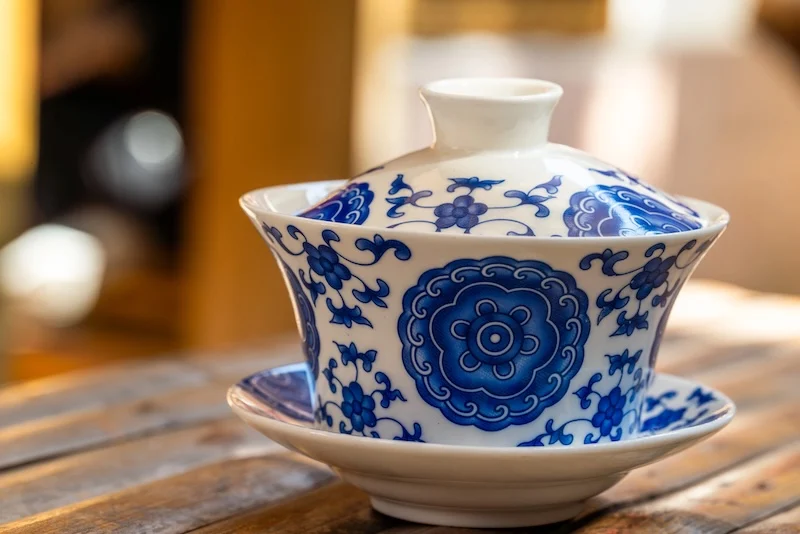
- Underglaze Blue: The perfection of using cobalt oxide to paint intricate designs that remained vivid after high-temperature firing.
- Kiln Engineering: The invention of the "Egg-shaped Kiln" (Zhenyao), which allowed for precise temperature control and massive production volumes.
2. Chronology: Two Millennia of Artistic Evolution
The history of Jingdezhen is traditionally categorized by the dynasties that shaped its output, each adding a layer of complexity to the medium.
The Song Dynasty (960–1279): The Birth of Elegance
During this era, Jingdezhen focused on "Qingbai" ware. These pieces were characterized by their minimalist aesthetic and subtle carvings. The Song preference for understated beauty pushed artisans to refine the purity of the clay and the clarity of the glazes.
The Yuan Dynasty (1279–1368): The Blue-and-White Revolution
The Mongol conquest brought China into closer contact with the Islamic world. It was during this time that cobalt ore was imported from Persia (modern-day Iran). Jingdezhen artisans combined this "Sumali Blue" pigment with their white porcelain, creating the iconic blue-and-white aesthetic that would eventually conquer the world’s markets.
The Ming Dynasty (1368–1644): The Golden Age of the Imperial Kiln
The Ming era saw the establishment of the Imperial Porcelain Academy. Production became strictly regulated, and the "Reign Mark" (the emperor’s name on the bottom of the vessel) became a standard of quality. This period introduced "doucaiv" (contending colors) and "wucai" (five colors), where overglaze enamels were added to underglaze blue designs.
The Qing Dynasty (1644–1911): Technical Perfection
Under the Kangxi, Yongzheng, and Qianlong emperors, Jingdezhen reached its zenith of technical complexity. Artisans developed "Famille Rose" (pink palette) and "Famille Verte" (green palette) enamels. The complexity of the designs reached such a level that porcelain often looked like oil paintings or intricately carved lacquer.
3. Supporting Data: The Industrialization of Art
What truly set Jingdezhen apart from other ceramic centers was its sophisticated division of labor. Long before the Industrial Revolution in Europe, Jingdezhen operated as a "factory city."
The "72 Hands" Concept
According to historical records, a single piece of porcelain could pass through the hands of up to 72 different specialists. This system ensured that every aspect of the process was handled by a master:
- The Clay Washers: Responsible for refining the kaolin to remove impurities.
- The Throwers: Experts at the wheel who shaped the vessels.
- The Trimmers: Artisans who shaved the walls of the pots to achieve paper-thin translucency.
- The Painters: Specialized by motif—one artist might only paint dragons, while another only painted clouds or borders.
- The Kiln Masters: Highly paid experts who "read" the fire by the color of the flames to determine when to stop the firing.
Global Trade and Economic Impact
By the 17th and 18th centuries, Jingdezhen was producing millions of pieces for export to Europe via the Dutch and British East India Companies. Known as "Kraak" porcelain, these wares influenced the development of Delftware in the Netherlands and Meissen porcelain in Germany. At its height, the porcelain trade was a cornerstone of the Chinese economy, acting as a primary source of foreign silver.
4. Official Responses and Cultural Preservation
In the modern era, the Chinese government and international bodies have recognized Jingdezhen as a site of immense cultural significance.
UNESCO and Heritage Status
Jingdezhen has been a focal point for UNESCO’s Creative Cities Network. The city is officially designated as a "City of Crafts and Folk Art." Furthermore, the "Traditional Firing Technology of Jingdezhen Kilns" was inscribed on the National List of Intangible Cultural Heritage of China in 2006.
Government Revitalization Projects
The Jiangxi provincial government has invested billions in the "Jingdezhen Ceramic Culture Transformation and Development Zone." This initiative has seen the repurposing of derelict state-owned factories into vibrant art districts. One notable success is the Taoxichuan Art District, a former ceramic machinery factory that now houses galleries, studios, and a massive weekend market for young makers.
The Imperial Kiln Museum
To honor its history, the city recently opened the Jingdezhen Imperial Kiln Museum. Built over the ruins of the Ming and Qing imperial kilns, the museum’s architecture—inspired by the shape of traditional kilns—has won international acclaim, serving as a bridge between the city’s archaeological past and its future as a tourist destination.
5. Implications: The "Jing-Drifters" and the Future of Porcelain
The contemporary significance of Jingdezhen extends far beyond its historical relics. The city is currently experiencing a "renaissance" driven by a new demographic known as the Jingpiao or "Jing-drifters."
The Rise of the Studio Artist
In the last decade, an estimated 30,000 artists—including thousands from overseas—have moved to Jingdezhen. Unlike the artisans of the past who worked in rigid factory systems, these modern makers are using the city’s infrastructure to create experimental, one-of-a-kind art. They are drawn by the "complete ecosystem" of the city; nowhere else in the world can an artist find a street dedicated entirely to brushes, another to glazes, and a 24-hour firing service.
From Mass Production to High Art
Jingdezhen is successfully pivoting from being a center of mass-produced functional ware to a center of "high art" and "cultural tourism." This transition has profound economic implications, shifting the local economy toward high-value intellectual property and luxury goods.
The Global Ceramic Dialogue
The continued relevance of Jingdezhen ensures that porcelain remains a medium of contemporary expression. By blending ancient techniques—such as the secret formulas for celadon or ox-blood glazes—with 3D printing and abstract sculpture, the city is ensuring that the "White Gold" of the Song Dynasty remains relevant in the digital age.
Conclusion
Jingdezhen stands as a testament to the endurance of craft. In an era of disposable goods and automated manufacturing, this city proves that there is still a global appetite for objects that carry the weight of 2,000 years of history. As the kilns of Jiangxi continue to burn, they do more than just fire clay; they refine the cultural identity of a nation and continue to shape the aesthetic sensibilities of the world.
Sources and Further Reading:
- The World Capital of Ceramics (Meridian International Center)
- The New Jingdezhen (Ceramics Monthly)
- Historical Records of the Jiangxi Provincial Heritage Bureau
- UNESCO Creative Cities Network: Jingdezhen Profile