The Mythic Collaboration: Jon Bernthal and Lupita Nyong’o on Christopher Nolan’s Vision for ‘The Odyssey’
The cinematic landscape is currently bracing for what promises to be one of the most ambitious undertakings in modern film history. Christopher Nolan, fresh off the Academy Award-winning success of Oppenheimer, has turned his sights from the birth of the atomic age to the foundational myths of Western civilization. His upcoming epic, The Odyssey, produced by Universal Pictures, is already generating significant industry buzz, not merely for its scale but for the caliber of the ensemble cast tasked with bringing Homer’s ancient archetypes to life.
In a recent exclusive interview during the film’s New York press junket, newcomers to the "Nolan-verse" Jon Bernthal and Lupita Nyong’o shared insights into the director’s meticulous process. Their reflections offer a rare glimpse into how a filmmaker known for technical precision fosters a deeply personal, collaborative environment—one that demands as much emotional honesty as it does physical endurance.
Main Facts: A New Chapter in the Nolan Filmography
Scheduled for a global theatrical release on July 17, 2026, The Odyssey represents a significant shift for Nolan. While the director has flirted with the concept of the "hero’s journey" in films like Interstellar and The Dark Knight Rises, this project is a direct engagement with the source material of that very trope.
The film features an expansive cast that blends Nolan veterans with high-profile debutants. Returning collaborators include Matt Damon, Anne Hathaway, Robert Pattinson, Elliot Page, and Benny Safdie. Joining them for the first time are Jon Bernthal, who portrays King Menelaus of Sparta, and Lupita Nyong’o, who takes on the dual roles of Helen of Troy and her twin sister, Clytemnestra. Tom Holland is also set to star as Telemachus, the son of Odysseus, marking another major addition to the director’s repertoire.
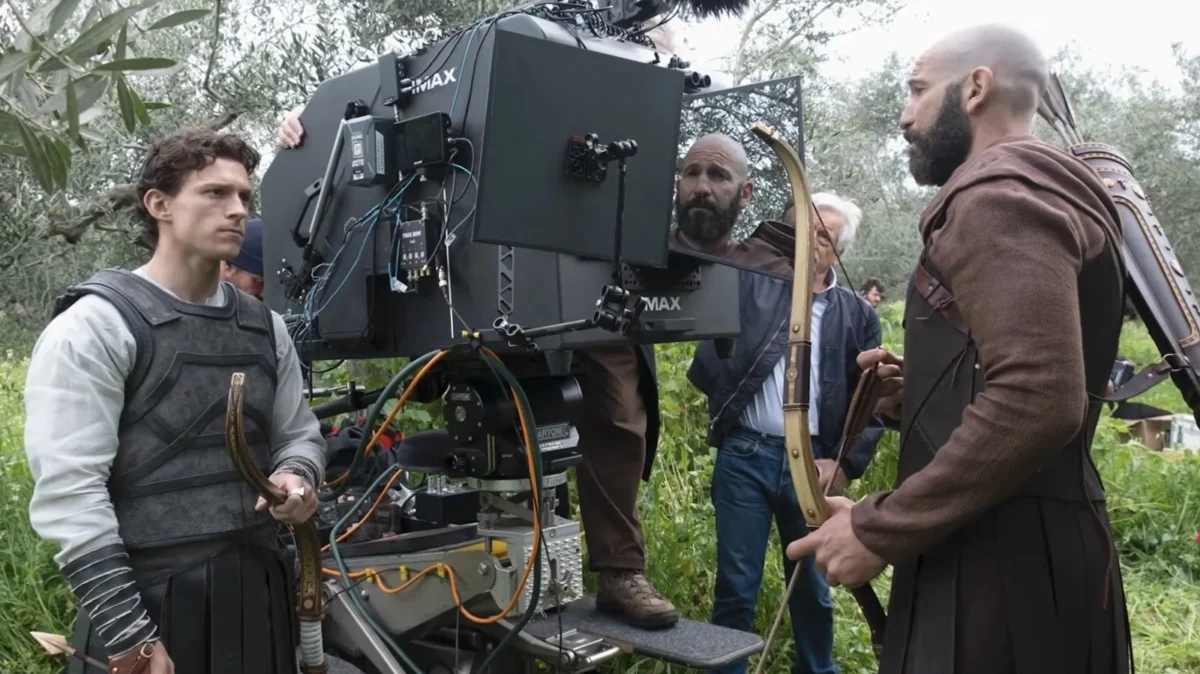
The production is characterized by Nolan’s signature commitment to practical filmmaking. Eschewing the industry’s heavy reliance on CGI and "The Volume" technology, Universal Pictures reportedly provided Nolan with a "blank check" to film on location across the Mediterranean, specifically in Italy and Greece, using high-resolution IMAX cameras to capture the rugged grandeur of the Aegean world.
![The Odyssey's Jon Bernthal Reveals What Christopher Nolan Has In Common With Other Great Directors [Exclusive]](https://www.slashfilm.com/img/gallery/the-odysseys-jon-bernthal-reveals-what-christopher-nolan-has-in-common-with-other-great-directors-exclusive/l-intro-1783084425.jpg)
Chronology: From Ancient Text to Modern Masterpiece
The development of The Odyssey has followed a timeline of intense secrecy and rapid mobilization, typical of a Christopher Nolan production.
- Post-Oppenheimer Pre-Production (Late 2023 – Early 2024): Following the massive critical and commercial success of Oppenheimer, rumors began to circulate regarding Nolan’s interest in a "large-scale period epic." Sources indicated that Nolan was looking to move away from the 20th-century history that defined his recent work.
- Casting and Script Finalization (Mid-2024): Reports surfaced that Nolan was hand-picking an ensemble that could handle the gravitas of Greek tragedy. Jon Bernthal and Lupita Nyong’o were among the first "new" names attached to the project, signaling a desire for actors known for intense, physical performances.
- Principal Photography (2025): The production moved to Europe. Filming locations included the rocky coastlines of the Peloponnese and historic sites in Southern Italy. These locations were chosen to replicate the Ithaca and Sparta of the Bronze Age without the need for digital set extensions.
- The New York Junket (Late 2025/Early 2026): As the film entered its final stages of post-production, the cast began revealing details about the shoot. It was during this period that Bernthal and Nyong’o spoke about the "demands" placed upon them by Nolan.
- Anticipated Release (July 17, 2026): The film is positioned as the definitive blockbuster of the 2026 summer season, utilizing the mid-July slot that has served Nolan well for over a decade.
Supporting Data: The Anatomy of a Master Director
Jon Bernthal’s perspective on Nolan is particularly noteworthy given the actor’s resume. Having worked with legendary directors such as Martin Scorsese (The Wolf of Wall Street), Denis Villeneuve (Sicario), Steve McQueen (Widows), and Edgar Wright (Baby Driver), Bernthal is uniquely qualified to categorize "greatness" in filmmaking.
According to Bernthal, the common denominator among these "masters" is not their specific style, but their clarity of purpose. He noted that Nolan possesses an "unbelievable intimacy with the story." This data point is supported by Nolan’s history of writing or co-writing his own scripts, ensuring that every frame serves a pre-determined narrative arc.
The technical data of the production further reinforces this "thoroughness." The use of 15/70mm IMAX film on location in the Mediterranean involves logistical hurdles—transporting heavy equipment across difficult terrain—that most modern directors avoid. Bernthal suggests that this level of detail provides a "comforting feeling" for the actor, as it removes the ambiguity often found on green-screen sets. When the environment is real and the director’s vision is "cogent and clear," the actor is free to focus entirely on the emotional truth of the scene.
Official Responses: The Actors’ Experience
The core of the recent revelations centers on the "demand" Nolan makes of his actors. While Nolan is often characterized in the media as a cold, clinical technician, the testimonies of Bernthal and Nyong’o paint a different picture—one of intense artistic collaboration.
![The Odyssey's Jon Bernthal Reveals What Christopher Nolan Has In Common With Other Great Directors [Exclusive]](https://www.slashfilm.com/img/gallery/the-odysseys-jon-bernthal-reveals-what-christopher-nolan-has-in-common-with-other-great-directors-exclusive/intro-1783084425.jpg)
Jon Bernthal on the "Demand" for Self
Bernthal explained that Nolan does not simply want a performance that fits a mold. Instead, he demands that actors bring their own "lived experience" to the role. "It’s not [simply] acceptable for you to fill [the role] yourself… they demand you to do it," Bernthal stated. He described the process as a "trio" or a partnership, where the director provides the framework and the actor is responsible for the "palpable life" within it. For Bernthal’s Menelaus—a character often depicted as a wronged, vengeful husband—this approach likely allowed for a more nuanced, human portrayal of the Spartan King.
Lupita Nyong’o on Taking Ownership
Nyong’o, who faces the daunting task of playing two of history’s most infamous women, echoed this sentiment. She noted that Nolan’s script for The Odyssey is "very specific" but also "spare," providing "important clues" rather than exhaustive instructions.
"Chris is interested in the lived experience of the characters that he’s written," Nyong’o explained. This ownership was vital for her dual roles. As Helen, the face that launched a thousand ships, and Clytemnestra, the woman who would eventually murder her husband Agamemnon, Nyong’o had to navigate complex emotional waters. She credited Nolan’s willingness to let the cast "take ownership" as the reason these characters feel like more than just mythic symbols.
Implications: A New Benchmark for the Epic Genre
The insights provided by Bernthal and Nyong’o have significant implications for both the film’s potential quality and the future of the epic genre.
1. The Humanization of Myth
By demanding that actors bring "themselves" to these ancient roles, Nolan is likely attempting to strip away the "statue-like" quality of traditional Greek epics. If The Odyssey succeeds, it could redefine how historical and mythological stories are told, moving away from the "swords and sandals" tropes of the early 2000s toward a more psychological, character-driven form of epic storytelling.
![The Odyssey's Jon Bernthal Reveals What Christopher Nolan Has In Common With Other Great Directors [Exclusive]](https://www.slashfilm.com/img/gallery/the-odysseys-jon-bernthal-reveals-what-christopher-nolan-has-in-common-with-other-great-directors-exclusive/christopher-nolan-had-one-important-demand-of-his-actors-in-the-odyssey-1783084426.jpg)
2. The Continued Viability of Practical Scale
The sheer scale of this production—filming in Greece and Italy with IMAX cameras—serves as a test case for the industry. In an era where many studios are cutting costs by using digital environments, Nolan’s "blank check" approach at Universal suggests that there is still a massive market for "tangible" cinema. The success of The Odyssey would reinforce the idea that audiences can sense the difference between a real Mediterranean horizon and a digital one.
3. The "Nolan Effect" on Careers
For Jon Bernthal and Lupita Nyong’o, The Odyssey represents a potential career milestone. Bernthal, often associated with gritty, contemporary roles, is being given the space to play a regal, historical figure. Nyong’o, already an Oscar winner, is being handed a complex dual role that will likely be a centerpiece of the film’s marketing. Their positive experience with Nolan’s "thoroughness" suggests that the director is evolving, becoming as much an "actor’s director" as he is a "visual stylist."
As the July 2026 release date approaches, the anticipation for The Odyssey will only grow. If Bernthal and Nyong’o are correct, audiences won’t just be seeing a retelling of Homer’s poem; they will be witnessing a deeply personal, high-stakes collaboration between a modern master and a cast of actors at the peak of their powers. The voyage home for Odysseus may be long, but for Christopher Nolan, it appears to be the journey of a lifetime.