"The Treasury of Folklore" Unveils Definitive Compendium, Celebrating Humanity’s Shared Myths
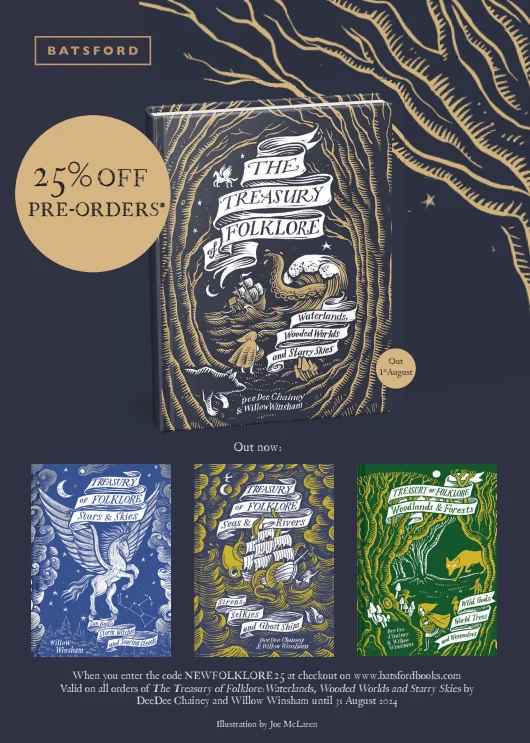
London, UK – Nearly a decade after its ambitious conception, the acclaimed Treasury of Folklore series is set to culminate in a magnificent single-volume compendium. Titled The Treasury of Folklore: Waterlands, Wooded Worlds and Starry Skies, this special edition brings together the most cherished tales, beliefs, and customs from the original three books, fulfilling the authors’ initial vision of a comprehensive global exploration of human myth-making.
Authored by Dee Dee Chainey and Willow Winsham, and beautifully illustrated by Joe McLaren, the compilation is poised to be a significant addition to any bookshelf or coffee table, serving as both a scholarly resource and a captivating journey into the heart of humanity’s collective imagination. The eagerly anticipated volume is available for pre-order now and will officially be released on August 1, 2024.
Main Facts: A Culmination of a Decade-Long Journey
The forthcoming publication, The Treasury of Folklore: Waterlands, Wooded Worlds and Starry Skies, represents a significant milestone for authors Dee Dee Chainey and Willow Winsham. This single, beautifully bound volume encapsulates the essence of their widely celebrated three-book series, consolidating a wealth of global folklore previously presented in Seas and Rivers, Trees and Woodlands, and Stars and Skies.
The new compendium is not merely a reprinting; it is a meticulously curated collection designed to present a unified narrative of humanity’s relationship with its environment through myth. While it does not introduce new material, it offers a fresh perspective on familiar tales, re-contextualized within a grander, overarching framework. Illustrated throughout with the distinctive artwork of Joe McLaren, the book promises an immersive experience, inviting readers to explore the primal fears, dreams, and awe that have shaped human cultures across the globe. Its release marks the realization of an initial dream, offering a definitive treasury for both long-time fans and new readers eager to delve into the universal tapestry of folklore.
Chronology: From Ambitious Concept to Beloved Series
The journey of The Treasury of Folklore series began almost a decade ago, stemming from an initial, singular ambition. The authors, Dee Dee Chainey and Willow Winsham, first envisioned a monumental tome that would traverse the diverse physical landscapes inhabited by humans worldwide, cataloguing the rich tapestry of folklore associated with each. This grand concept was born from a shared passion for myth and a profound curiosity about the human condition.
The Seed of an Idea: The initial spark for the project was a desire to understand how humans, irrespective of geographical or cultural divides, imbue their surroundings with meaning through stories, customs, and beliefs. The authors aimed to explore the fundamental human impulse to create narratives around the places they call home – from the deepest oceans to the highest stars.
A World Too Rich for One Book: As Chainey and Winsham delved deeper into their research, they quickly realized the monumental scope of their undertaking. The sheer volume and intricate detail of the material they uncovered far surpassed what could realistically be contained within a single volume. This revelation led to a natural evolution of the project, necessitating its expansion into a three-book series. Thus, Seas and Rivers, Trees and Woodlands, and Stars and Skies were born, each dedicated to exploring the folklore of specific environmental domains, allowing for a more thorough and nuanced examination of each theme.
Inspired by a Global Movement: A significant catalyst for the authors’ work, and indeed for a broader contemporary interest in folklore, was the overwhelming outpouring of shared narratives through the #FolkloreThursday hashtag. This vibrant online community, fostering global engagement with traditional tales, demonstrated the enduring power and universal appeal of folklore. It reinforced the authors’ belief in the need for a meaningful, lasting contribution that would reflect this unifying universality, transcending academic silos and reaching a wider audience.
A Decade of Dedication: The collaboration between Chainey and Winsham has been a testament to their shared vision and unwavering dedication. Their rigorous research, insightful analysis, and evocative storytelling have resonated deeply with readers, making the series a surprising and heartwarming success. The popularity of the individual volumes underscored the profound human connection to these ancient narratives.
The Call for a Compendium: The idea to bring out a compendium, consolidating the best of the series into a single volume, emerged as a natural progression. This suggestion resonated deeply with the authors, offering a serendipitous opportunity to finally realize their original dream. It was an invitation to return to the foundational concept, allowing the diverse threads of folklore to weave together into a cohesive, singular narrative that truly spanned "shared landscapes across time and place."

The Curatorial Process: The creation of the compendium was a meticulous undertaking. It involved revisiting the extensive material with "fresh eyes," a process of careful selection and refinement. Chainey and Winsham embarked on a thoughtful journey of sifting through words they knew intimately, deciding what to include and what to leave out, all with the goal of creating a harmonious, impactful single volume. This curatorial challenge was met with dedication, resulting in a product that has "blown away" the authors themselves, leaving them "utterly thrilled" to share this "beautifully bound volume" with their readers. The physical manifestation of this effort, described as a "hefty tome" with "beautiful cream paper," reflects the profound care and reverence invested in its creation.
Supporting Data: The Enduring Power of Universal Narratives
The Treasury of Folklore series, and now its definitive compendium, stands as a testament to the profound and often surprising commonalities that bind humanity. Through countless myths, legends, and customs, the authors have illuminated a shared psychological landscape that transcends geographical and cultural boundaries.
Thematic Unity and Artistic Vision:
The core exploration of the series revolves around how diverse human societies construct beliefs and narratives around their environments. What emerges from this extensive collection is a powerful revelation: beneath the superficial differences of costume, language, or nomenclature for mythical creatures, humans share fundamental primal fears and dreams. Whether gazing at the vastness of the ocean or huddling around a campfire in the dark forest, humanity collectively dreads the unknown, yearns for treasure and pleasure, and stands in awe of time’s eternity under ancient stars, pondering the brevity of life. This universality is not just an academic observation; it is the beating heart of the compendium.
Integral to the aesthetic and immersive quality of the books is the contribution of illustrator Joe McLaren. His original artworks, featured throughout the compilation, are more than mere decorations; they are visual interpretations that deepen the reader’s engagement with the narratives. McLaren’s style captures the mysterious, awe-inspiring, and sometimes terrifying essence of folklore, making the ancient tales feel vibrant and immediate. The physical attributes of the new volume—described as a "hefty tome" with "beautifully bound" construction and "beautiful cream paper"—further enhance the reading experience, positioning it as a treasured object designed for both intellectual exploration and tactile pleasure.
Spotlight on Shared Landscapes: Extracts from the Treasury
To illustrate the richness and thematic coherence of the new compendium, we present extracts showcasing the diverse folklore contained within its pages, spanning waterlands, wooded worlds, and starry skies.
Waterlands: Majestic and Malevolent Creatures from the Depths
The world’s waterways, from tranquil rivers to vast, mysterious lochs, have long been fertile ground for human imagination, giving birth to tales of magnificent yet perilous aquatic beasts. These water horses, often shapeshifters, embody the allure and danger of the untamed waters, a motif found in various forms across cultures, from the Irish Púca to the Greek Hippocampus.
The Scottish Kelpie: Perhaps the most renowned of these creatures is the Scottish kelpie, a shape-shifting water spirit often appearing as a horse. While the term is sometimes used interchangeably with "water horse," Scottish folklore distinguishes the kelpie as residing predominantly in rivers, whereas the more fearsome each-uisge inhabits lakes and lochs. Kelpies are notorious for luring unsuspecting travellers, particularly children, onto their backs before dragging them to a watery grave. Yet, tales also speak of ways to outwit them: a bridle marked with a cross might temporarily tame a kelpie, forcing it into servitude, though its control remains fleeting. The creature’s demise, in some narratives, is brought about by the touch of red-hot iron, a classic bane for many folkloric beings. The enduring power of the kelpie in the Scottish imagination is dramatically visible in the colossal 30-meter sculptures near Falkirk, a modern tribute since 2013, and its continued presence in contemporary literature, including works by Lari Don and J.K. Rowling’s Fantastic Beasts and Where to Find Them. Interestingly, despite its fame, the kelpie is largely absent from English folklore, highlighting regional specificities in shared mythologies.
The Welsh Ceffyl Dwr: Across the border in Wales, the "Water Horse" manifests as the Ceffyl Dwr, a staple of Welsh belief well into the 19th century. Its appearance and intent varied regionally; in the north, it was a shapeshifting spirit prone to violence, while in the south, it consistently presented as a small, enchanting horse, luring individuals onto its back. Stories emphasize the Ceffyl Dwr‘s incredible speed, covering vast distances in impossibly short times before vanishing, leaving its hapless rider to drown. A curious exception to this grim fate applied to clergymen of any creed, who were said to be immune to the horse’s malevolent trickery, often reaching their destinations unharmed while their accompanying laymen were plunged into the water. This detail underscores the interplay of pre-Christian folklore with later religious beliefs.
The Scandinavian Bäckahäst: In Scandinavia, the bäckahäst or "brook horse" often appears cloaked in fog, described as a majestic and luminous entity. Like its Celtic cousins, it entices riders to mount, only to plunge them into the water where they are unable to dismount, condemned to drown. Many tales feature children as victims, perhaps to heighten the sense of peril. A popular story recounts a group of boys playing by a frozen river when a beautiful horse appears. As they mount one by one, the last child, in awe, exclaims, inadvertently mispronouncing a phrase that rhymes with "Jesus Christ." The horse, abhorring the holy name, vanishes, leaving the boys sore but saved. Like the kelpie, the bäckahäst could also, in some narratives, be tricked into performing work, reflecting humanity’s perpetual desire to exert control over the wild forces of nature. These water spirits, whether guardians or predators, universally warn of the dangers of the unknown depths and the consequences of heedless curiosity.

Wooded Worlds: Lords of the Wild and Guardians of Nature
Venturing into the verdant heart of forests and jungles reveals a distinct pantheon of spirits and creatures—the Lords of the Wild. These entities often embody the dual nature of nature itself: beautiful and bountiful, yet also savage and unforgiving. From benevolent protectors to malevolent tricksters, they remind humanity of its place within the untamed wilderness, often paralleling the "Green Man" motif found throughout European folklore or deities like the Roman Silvanus and Greek Pan.
The Finnish Tapio (Metsähine, Hiisi): In Finnish mythology, Tapio, also known as Metsähine or Hiisi, reigns as the king of the forest realm. He is depicted as a tall, slender figure, often adorned in ermine fur or moss, his head crowned with a hat. Like the ancient foliate heads carved in European churches, his face peers out from under bushy eyebrows of moss and lichen, usually framed by a great beard, sometimes of straggling black hair. A distinctive feature, similar to the hulder of Scandinavian folklore, is his appearance: thoroughly human from the front, but with the gnarled, bark-like back of a tree. Tapio is both the personification and the fierce protector of the forest. Historically, hunters would seek his blessing before a chase, pledging respect for the wilderness and its creatures, hunting quietly and without disruption, in exchange for a plentiful haul. To disrespect Tapio meant returning empty-handed. His Estonian equivalent shares similar attributes, with the intriguing detail of having only one eye, akin to the Norse god Odin. Tapio also boasts a family: his wife Mielikki (or Kuurikki when malevolent), their son Nyrikki who guides hunters, and daughter Tulikki who directs prey.
The Slavic Leshy (Leshii, Lyeshy): The leshy is a prominent tutelary spirit of the Slavic woods, a protector of trees and animals, though some regional beliefs designate him as guardian of wolves (Ukraine) or servant to his favoured bear. Like bears, the leshy hibernates in winter. Known by a multitude of names, these creatures are intrinsically linked to the forest, often believed to be ruled by either a woodsman or the Devil himself. Many liken them to Greek satyrs, human above the waist but sporting horns, claws, and a bushy beard, sometimes described as forest green or entirely covered in moss. They are master shapeshifters, capable of altering their size and form at will—growing taller than a tree or shrinking to the size of a blade of grass. They can disguise themselves as any familiar forest inhabitant, be it human, animal, or plant. In human form, however, tell-tale signs betray them: a lack of eyelashes or brows, shoes worn on the wrong feet, or clothing wrapped contrary to local fashion (e.g., in Yaroslavl Province). Some possess only one eye, all are covered in wild hair, and bear the cloven feet reminiscent of fauns or even the Devil. Regional variations describe them with wings and black-furred tails, or clad in white with swollen eyes.
The leshy‘s presence is often heralded by powerful, howling winds as he surveys his territory, causing all creatures to flee in terror. Those who encroach upon his domain uninvited may be warned by his shrieking laughter, clapping, or howls. Should these warnings be ignored, the leshy will confuse and lure travellers from their path, altering their surroundings until they are hopelessly lost, never to be seen again. As quintessential trickster figures, leshies can mimic voices, luring people closer, where they are reputedly tickled to death. Their voices can also blend with the sounds of the forest—creaking branches or rustling leaves. Crossing a leshy can bring illness, and they are known to abduct women for marriage or take children who wander too far or are cursed by their parents. Farmers in the Olonetsky District of Russia once sacrificed a cow annually to appease leshies who were infamous for cursing entire farms and sucking milk from herds. Protection from their wrath could be found through prayer upon entering the forest or by leaving offerings of bread and tobacco.
Leshies are believed to live alone or with their wives, the lesovikha, and children, sometimes in secluded forest huts. They are not above battling their own kind, wielding clubs and uprooting trees in their skirmishes. A particularly colorful tale from Vologda District describes a leshy frequenting local taverns, driving his wolf pack, and guzzling buckets of vodka before returning to the night. They are also notorious gamblers, often bartering with squirrels instead of money, and enjoy card games, though notably without clubs, which too closely resemble the Christian cross. Like many fae folk, safety from leshies can be found by turning one’s shirt inside out and putting shoes on the wrong feet—actions said to provoke laughter, which returns the lost person to their rightful path. More specific methods include stripping naked and redressing backwards, or swearing remorselessly, which compels them to leave. The sign of the cross is a more direct, if less entertaining, banishment method. To summon a leshy, one simply cuts down young birch trees, arranges them in a circle with tops touching, stands in the center devoid of Christian symbols, and calls out to the "grandfather of the forest." These rich narratives underscore humanity’s enduring respect, fear, and desire to understand the wild, untamed aspects of nature.
Starry Skies: The Moon, Myths, and Mortality
Finally, our gaze turns skyward, to the greatest celestial body after the sun—the moon. Across cultures and throughout history, humankind has seen faces and images upon its luminous surface, inspiring a myriad of tales that seek to explain its mysteries and its connection to earthly existence. The common motif of a rabbit or hare living on the moon is a prime example, with features like the Sea of Tranquillity often perceived as the rabbit’s head, and the Seas of Fertility and Nectar as its ears, reflecting a universal human tendency to find patterns and stories in the heavens.
The Hare on the Moon: This widespread motif, a testament to human pattern-seeking and myth-making, finds expression in numerous cultures.
Buddhist Sasa-Jātaka: In a poignant Buddhist Jātaka tale, the hare, renowned for his virtue, lived with three friends: an otter, a jackal, and a monkey. The hare instructed his companions on the importance of giving alms, urging them to offer food to any beggar on the forthcoming fast day. When the day arrived, Sakka, the deity ruler of Trāyastriṃśa heaven and protector of Buddhism, descended to Earth disguised as an old man to test their generosity. While the otter, jackal, and monkey readily offered the food they had, the hare, possessing only grass, understood its inadequacy. In an ultimate act of self-sacrifice, he offered himself to Sakka to eat, leaping into a fire. Moved by such unwavering faithfulness, Sakka saved the hare from the flames and immortalized him in the moon for all to see. In some versions, Sakka squeezed a mountain’s essence to draw the faithful hare’s image on the moon. Similar narratives of self-sacrificing hares with different companions exist in other traditions, highlighting a shared reverence for selfless acts.
Sri Lankan Tale: A parallel story from Sri Lanka recounts Buddha, lost and hungry in a wood, encountering a hare who offered guidance. When Buddha revealed his poverty and inability to pay, the hare immediately offered himself as sustenance. As Buddha kindled a fire, the hare bravely threw himself into the flames. Using his divine powers, Buddha saved the selfless creature and elevated him to the moon, where he resides to this day, a symbol of ultimate compassion.
Japanese Tsuki no Usagi: Japan shares a beloved tale of the Tsuki no Usagi, the "Rabbit of the Moon." Here, the Man in the Moon descends to Earth disguised as a beggar. Other animals present him with food, but the rabbit, having only grass, performs the same heroic act of self-sacrifice by offering himself to the fire. The beggar then transforms into his true celestial form and carries the rabbit up to live with him on the moon, in recognition of its profound selflessness. This popular Japanese narrative is frequently recounted to children in September, coinciding with the Harvest Moon and the Mid-Autumn Festival, linking celestial observation with moral instruction.

South African Tale: In a starkly different vein, a tale from South Africa attributes humanity’s mortality to the hare. The Moon, wishing to convey that humans, like herself, would "die" only to return again (like the lunar cycle), dispatched Hare with this vital message. However, the flighty hare garbled the message, informing humanity that they would simply die, without the promise of return. Enraged upon discovering Hare’s blunder, Moon attacked him with a hatchet, intending to cleave him in two. She only succeeded in splitting his lip. In retaliation, Hare lashed out with his claws, scarring Moon’s face—scars that, according to the legend, can still be seen in the dark shapes on the moon today. These diverse tales, whether celebrating sacrifice or explaining mortality, underscore humanity’s ancient and ongoing dialogue with the cosmos, seeking meaning and understanding in the celestial ballet above.
Official Responses: Authors’ Reflections and Gratitude
The success of The Treasury of Folklore series has been a profound experience for authors Dee Dee Chainey and Willow Winsham. Reflecting on the journey, they have expressed immense gratitude for the overwhelming reception of their work. "The popularity of the three books… has been both surprising and heartwarming," they stated, extending their thanks to "each and every person who has bought and read these books."
The opportunity to create the compendium has been particularly thrilling, allowing them to fulfill their initial aspiration. They recounted the meticulous process of revisiting their work with "fresh eyes," acknowledging the effort involved in curating the best of the series into a unified volume. "To say we have been blown away by the end result is an understatement," they shared, adding, "we are utterly thrilled to be able to share this beautifully bound volume with you." Their enthusiasm extends to the physical design, praising "the size and the cover combining everything and the beautiful cream paper: it is a ‘hefty tome’ indeed," highlighting their pride in the final product.
Implications: A Timeless Bridge Across Cultures
The release of The Treasury of Folklore: Waterlands, Wooded Worlds and Starry Skies carries significant implications, not only for the authors and their dedicated readership but also for the broader understanding and appreciation of folklore.
Fulfilling a Vision: This compendium marks the triumphant realization of the authors’ initial, ambitious dream to create a single, expansive volume encompassing global folklore. This achievement underscores the power of perseverance and dedication, bringing a project full circle in a truly satisfying manner.
Accessibility and Preservation: By consolidating the highlights of the three individual books, the compendium enhances accessibility. It offers a convenient, comprehensive entry point for new readers, while providing existing fans with a beautifully curated definitive edition. In doing so, it contributes significantly to the preservation of diverse oral traditions and cultural narratives, ensuring these stories continue to be shared and appreciated in an increasingly digital world. The aesthetic quality of the "hefty tome" further elevates its status as a valued cultural artifact.
The Universal Human Experience: Perhaps the most profound implication of the series, and now its compendium, is its powerful articulation of the universal human experience. By juxtaposing myths from disparate cultures, Chainey and Winsham reveal that despite varying geographical contexts and cultural expressions, humanity shares fundamental fears, dreams, and a sense of awe. This shared psychological landscape, illuminated through folklore, fosters empathy and understanding, reminding us that our differences are often superficial when compared to our common humanity. The book becomes a potent reminder that we are all "inherently the same," connected by primal responses to the world around us.
A Catalyst for Connection: The authors envision the compendium as more than just a collection of stories; it is designed to be a "conversation starter, a way to connect." Its presence on a coffee table or bookshelf invites inquiry, discussion, and the sharing of personal connections to these ancient tales. In an increasingly fragmented world, such cultural artifacts can serve as vital bridges, fostering dialogue and mutual appreciation for the rich tapestry of human imagination.
Legacy of "The Treasury of Folklore": The Treasury of Folklore series has carved a significant niche in contemporary folklore studies