Deathbringer TTRPG Unleashes Crowdfunding Campaign, Promises Brutal OSR Experience
FOR IMMEDIATE RELEASE
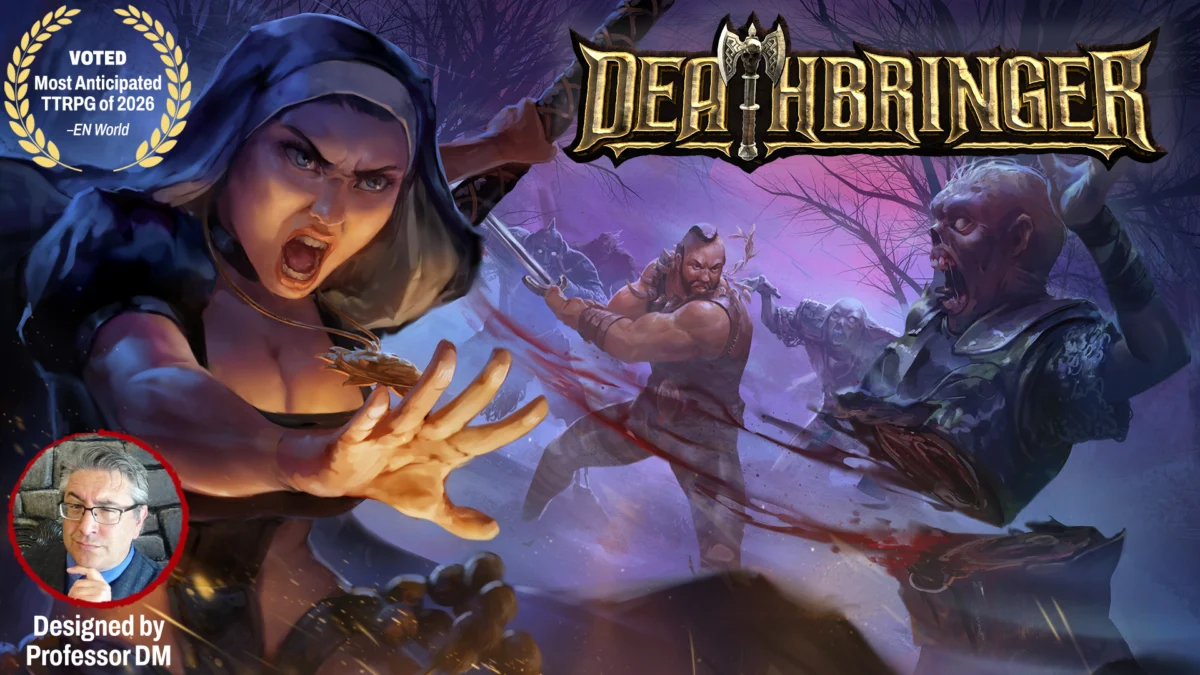
[City, State] – [Date] – The highly anticipated tabletop roleplaying game, Deathbringer, from acclaimed designer Dan De Fazio, known to the community as Professor DM, and developed in partnership with Roll For Combat, has officially launched its crowdfunding campaign on Backerkit. Heralded as EN World’s Most Anticipated TTRPG of 2026, Deathbringer promises a visceral and uncompromising return to the roots of tabletop gaming, where combat is swift, victories are hard-won, and death is not merely an inconvenience but a pivotal element of the narrative journey.
This brutal new system, fully compatible with the popular Shadowdark RPG and designed to seamlessly integrate into any Old-School Renaissance (OSR) framework, invites players into a world where every decision carries weight and survival is a testament to wit, skill, and sheer grit. The campaign’s launch signals a significant moment for the TTRPG community, particularly those yearning for a high-stakes, low-fantasy experience that challenges conventional notions of player agency and consequence.
Main Facts: A New Era of Savage Tabletop Adventures
The core premise of Deathbringer revolves around delivering an unvarnished, high-lethality experience. In an era where many TTRPGs lean towards narrative safety nets and hero-centric power fantasies, Deathbringer boldly reintroduces a sense of genuine peril, echoing the unforgiving nature of early tabletop adventures. Its creators position it not just as a game, but as a philosophy – a challenge to players to adapt, to strategize, and to embrace the full spectrum of their character’s fate, even when that fate is grim.
The Campaign Launch: Backerkit Takes Center Stage
The decision to host the Deathbringer campaign on Backerkit, a platform increasingly favored by seasoned creators for its robust features and creator-friendly ecosystem, underscores the project’s professional aspirations. Backerkit’s platform offers a streamlined experience for backers, from pledge management to add-ons and fulfillment, ensuring that the focus remains on the innovative game itself. Dan De Fazio’s long-standing reputation as Professor DM, a prominent voice in the TTRPG space known for his insightful commentary and engaging actual plays, provides a strong foundation of trust and enthusiasm for the project. Partnering with Roll For Combat, a studio renowned for its high-quality TTRPG content and community engagement, further solidifies Deathbringer‘s position as a well-supported and professionally executed venture.
The campaign page showcases compelling artwork, evocative descriptions, and early glimpses into the game’s mechanics, all designed to immerse potential backers in the bleak, dangerous world Deathbringer promises. Initial responses from the community indicate a strong resonance with the game’s gritty aesthetic and challenging design philosophy, suggesting that the market is ripe for a game that doesn’t shy away from the darker aspects of adventure.
Critical Acclaim Before Launch: EN World’s Most Anticipated
Perhaps one of the most significant indicators of Deathbringer‘s potential impact is its recognition as EN World’s Most Anticipated TTRPG of 2026. EN World, a venerable institution within the TTRPG news and community landscape, conducts annual polls and features that often predict future trends and highlight projects with significant buzz. Earning this title well in advance of its release is an extraordinary feat, speaking volumes about the pervasive excitement surrounding Dan De Fazio’s vision.
This accolade is not merely a vanity award; it represents a collective vote of confidence from a diverse cross-section of the TTRPG community – from veteran OSR enthusiasts to curious newcomers. Such early recognition provides Deathbringer with a significant visibility boost, drawing attention from across the industry and establishing it as a title to watch. It suggests that the game taps into a collective desire for a specific type of play experience, one that emphasizes danger, exploration, and the raw, unfiltered essence of adventuring. The anticipation built by this award creates a powerful narrative, positioning Deathbringer as a game that the community actively wants and believes in, even before its final form is revealed.
OSR Compatibility and Innovation
A cornerstone of Deathbringer‘s appeal lies in its inherent compatibility. Billed as "fully compatible with Shadowdark and built to drop into any OSR system," the game strategically positions itself within a thriving and passionate niche of the TTRPG market. Shadowdark, known for its streamlined rules, dungeon-crawling focus, and high-lethality gameplay, shares significant DNA with the ethos of Deathbringer. This direct compatibility means that existing Shadowdark players can easily transition to or incorporate elements of Deathbringer without a steep learning curve, leveraging their existing character sheets, monsters, and adventures with minimal conversion.
Beyond Shadowdark, the broader OSR compatibility ensures a wide appeal. The Old-School Renaissance movement champions a return to the gameplay style of early tabletop roleplaying games, emphasizing player skill, emergent storytelling, and often, a greater sense of danger and consequence. By designing Deathbringer to be adaptable to various OSR systems, Professor DM is essentially offering a toolkit that can inject its unique brand of brutal combat and death-as-journey mechanics into countless existing campaigns. This approach respects the diverse preferences within the OSR community while offering a fresh, innovative take on established principles. It signals that Deathbringer isn’t just another game, but a modular system designed to enrich and challenge the very fabric of old-school play.
Chronology: From Concept to Crowdfunding
The journey of Deathbringer to its current crowdfunding phase is one built on deliberate design, community engagement, and a clear vision for a distinct gaming experience.
The Genesis of Brutality: Professor DM’s Vision
Dan De Fazio, through his persona Professor DM, has long been a vocal proponent of challenging TTRPG experiences, often discussing the merits of high lethality, player agency, and the impact of meaningful consequences in gameplay. It is from this philosophical bedrock that Deathbringer emerged. The game’s conceptualization likely began as an exploration of how to create a system where the threat of death isn’t a deterrent to adventure, but rather an intrinsic motivator and a narrative catalyst. Professor DM’s design philosophy often critiques modern gaming trends that may inadvertently dilute the sense of genuine risk, and Deathbringer appears to be his definitive answer to this critique.
Early development would have focused on distilling the core mechanics that enable "fast, savage combat" while simultaneously embedding the idea that "death isn’t the end – it’s part of the journey." This unique approach to character mortality is a sophisticated design challenge, requiring careful balancing to ensure it feels impactful without being overtly punitive or frustrating. The game likely underwent extensive internal playtesting, iterating on combat rules, character creation, and the unique systems that govern a character’s fate after falling in battle.
Building Anticipation: Early Buzz and Community Engagement
The buzz around Deathbringer didn’t materialize overnight. Professor DM, with his established online presence through YouTube and other platforms, has a direct line to a dedicated audience eager for his insights and creations. Early mentions, concept art reveals, and discussions about the game’s philosophical underpinnings would have gradually built a groundswell of anticipation. The involvement of Roll For Combat, a professional outfit with experience in TTRPG development and marketing, would have further amplified this early buzz, ensuring consistent messaging and a polished presentation.
The EN World "Most Anticipated" award itself is usually the culmination of months, if not years, of quiet development and strategic information dissemination. It suggests that the creators were successful in communicating the unique selling propositions of Deathbringer to a broader audience, demonstrating its potential to be a significant player in the TTRPG landscape of the coming years. This period of pre-launch excitement is crucial for any crowdfunding campaign, laying the groundwork for a successful launch by cultivating a community of interested backers.
The Crowdfunding Journey: Backerkit’s Strategic Choice
The decision to launch on Backerkit, rather than a more traditional platform like Kickstarter, reflects a growing trend among established TTRPG creators. Backerkit, originally known for its pledge manager services, has evolved into a full-fledged crowdfunding platform that offers creators more flexibility, deeper analytics, and often, a more streamlined process for managing complex campaigns with multiple add-ons and stretch goals. For a project as ambitious as Deathbringer, with its potential for numerous supplementary adventures, modules, and accessories, Backerkit provides the robust infrastructure necessary to handle a high volume of pledges and diverse reward tiers.
The campaign’s progression, even in its early stages, will be closely watched by the industry. The initial funding velocity, the rate at which stretch goals are unlocked, and the level of community engagement on the campaign page will all serve as indicators of Deathbringer‘s market appeal and the effectiveness of its pre-launch strategy. A successful crowdfunding campaign on Backerkit would not only secure the necessary funding for production but also validate the creators’ vision and the widespread demand for a game that dares to be different.
Supporting Data: Delving Deeper into Deathbringer’s Mechanics and Ethos
To truly understand Deathbringer, one must delve into the specific design choices that underpin its brutal yet compelling gameplay.
The Philosophy of Death: "Not the End, But Part of the Journey"
This tagline is arguably the most intriguing aspect of Deathbringer. In most TTRPGs, character death is the ultimate failure state, often leading to a player rolling a new character, which can disrupt the narrative flow and diminish emotional investment. Deathbringer subverts this expectation. While details remain somewhat under wraps to maintain an element of mystery, the implication is that death serves as a transformative experience rather than an outright termination.
This could manifest in several ways: perhaps characters return as revenants, spectral beings, or cursed entities, bearing the marks of their demise and gaining new, often double-edged, abilities. It might involve a system of reincarnation where a character’s essence carries over, influencing their next incarnation. Or perhaps, falling in combat triggers a unique narrative arc where surviving party members must undertake perilous quests to retrieve or resurrect their fallen comrade, imbuing their return with immense narrative weight. Whatever the specific mechanics, this philosophy elevates death from a mere endpoint to a critical juncture, enriching the player’s story and making every encounter with mortality a meaningful event. It encourages players to embrace risks, knowing that even failure can lead to unforeseen and compelling narrative developments.
Combat Prowess: Fast, Savage, and Earned
The emphasis on "fast, savage combat" suggests a system designed for quick resolution while maintaining a high degree of lethality and tactical depth. This is a common aspiration in OSR games, which often prioritize player ingenuity over character statistics. Deathbringer likely employs streamlined combat rules that minimize extensive calculations, allowing for rapid exchanges and dynamic action. "Savage" implies that combat is visceral and unforgiving, with attacks having tangible consequences and powerful foes posing genuine threats.
Victories being "earned" speaks to the game’s high difficulty curve and the need for strategic thinking. Players won’t simply hack and slash their way through encounters; they’ll need to utilize terrain, environmental hazards, clever tactics, and perhaps even non-combat solutions to overcome challenges. Resources are likely scarce, and every blow, every spell, every arrow fired must be considered. This design choice fosters a deep sense of accomplishment when players emerge victorious, knowing they truly outmaneuvered, outsmarted, or outfought their adversaries against overwhelming odds. It’s a game where every hit point matters, and every potion feels like a lifeline.
OSR Roots and Modern Sensibilities
Deathbringer proudly wears its OSR badge, promising a return to the principles of emergent gameplay, sandbox exploration, and challenging encounters. However, its compatibility with Shadowdark and its innovative approach to death suggest it’s not merely a retro-clone. It appears to blend the best aspects of old-school design – resource management, dungeon delving, player skill – with modern game design sensibilities that enhance narrative engagement and provide more structured systems for unique concepts like character mortality.
The game likely avoids excessive rules bloat, favoring clarity and conciseness, a hallmark of many successful OSR titles. Yet, its brutal core and unique death mechanics position it as an evolution within the movement, demonstrating how classic principles can be reinterpreted for contemporary audiences. It’s a game for those who appreciate the challenge and freedom of old-school play but are also open to fresh perspectives on familiar tropes.
The Creative Conclave: Illustrious Contributors
The crowdfunding campaign also highlights a "dark conclave of amazing adventure writers" assembled by Professor Dungeon Master to contribute to Deathbringer. While the full roster of this ‘dark conclave’ is eagerly awaited, the initial announcement of Justin Alexander’s involvement has generated considerable excitement. Justin Alexander, known for his seminal work on The Alexandrian blog, is a highly respected figure in the TTRPG design and analysis community. His rigorous approach to game design theory, his insightful critiques, and his innovative adventure design principles make him an invaluable asset to any project.
Alexander’s contribution of an adventure for Deathbringer signals a commitment to high-quality, thoughtfully crafted supplementary content. His involvement lends significant credibility to the project, assuring potential backers that the adventures will be well-designed, challenging, and deeply aligned with the game’s core ethos. This collaborative approach promises a rich and diverse array of content, ensuring that the game’s brutal core is explored through various compelling narratives and challenging scenarios, each brought to life by a distinct creative voice. The anticipation for the full list of contributors further builds hype, promising a collective of talent that will undoubtedly elevate Deathbringer beyond just its core rulebook.
Official Responses and Stakeholder Perspectives
The launch of Deathbringer has naturally prompted responses from its creators, partners, and those observing its trajectory. These statements offer valuable insights into the game’s vision and its potential impact.
Professor DM’s Vision: Dan De Fazio’s Voice
In a statement following the campaign launch, Dan De Fazio (Professor DM) expressed profound gratitude and excitement: "This has been a passion project years in the making, a distillation of everything I love about challenging, meaningful TTRPGs. With Deathbringer, we’re not just offering a game; we’re inviting players to experience true adventure, where every victory is hard-won and every defeat leaves a mark. The support from the community, especially the incredible recognition from EN World, has been truly humbling. We’ve poured our hearts into creating a system that honors the old-school spirit while daring to innovate on core concepts like character mortality. I believe Deathbringer will offer a truly unforgettable and brutally rewarding experience." His words underscore a deep commitment to delivering a game that is both nostalgic and forward-thinking, rooted in a clear design philosophy.
Roll For Combat’s Role: Amplifying the Message
A representative from Roll For Combat commented on their partnership: "Working with Dan on Deathbringer has been an exhilarating journey. His vision for a brutal, high-stakes TTRPG is exactly what a significant portion of the community has been craving. We’re proud to bring our expertise in production, marketing, and community engagement to help realize this incredible project. Deathbringer represents the pinnacle of innovative OSR design, and we’re confident that players will be captivated by its unique approach to combat and consequences. We believe this game has the potential to leave a lasting mark on the genre." This statement highlights Roll For Combat’s strategic support and their belief in the game’s market potential and innovative design.
The Contributor’s Enthusiasm: Justin Alexander’s Perspective
Justin Alexander shared his enthusiasm for joining the project: "I’ve been following Professor DM’s work for a long time, and the core concept of Deathbringer immediately resonated with my own design philosophies. The idea that death isn’t the end, but a catalyst for new journeys, is a brilliant subversion of a common TTRPG trope. It opens up so many fascinating narrative and mechanical possibilities. I was absolutely thrilled when Dan invited me to contribute an adventure. I’m excited to explore the brutal depths of this system and craft a scenario that truly challenges players and showcases Deathbringer‘s unique strengths. It’s an honor to be part of such a talented team." Alexander’s endorsement speaks to the game’s intellectual appeal and its potential to inspire compelling storytelling.
EN World’s Recognition: A Testament to Anticipation
While no direct quote from EN World was provided in the source material, the significance of their "Most Anticipated TTRPG of 2026" award cannot be overstated. This recognition implicitly communicates the sentiment within the broader TTRPG community. It signals that Deathbringer has successfully captured the collective imagination, tapping into a desire for innovative, challenging gameplay experiences. Such an award suggests a robust preliminary engagement with the project through early previews, designer interviews, or community discussions, confirming that the game resonates with the current pulse of the hobby.
Implications: Shaping the Future of Brutal TTRPGs
The launch of Deathbringer carries significant implications, not only for its creators but for the wider landscape of tabletop roleplaying games.
Impact on the OSR Movement
Deathbringer is poised to become a flagship title within the Old-School Renaissance movement. Its explicit compatibility with Shadowdark and other OSR systems, combined with its innovative approach to player mortality, could invigorate the scene. It might attract new players who are curious about OSR principles but are also drawn to fresh mechanics and compelling narratives. By demonstrating that OSR games can be both faithful to their roots and boldly innovative, Deathbringer could help broaden the appeal and influence of the movement, pushing its boundaries and inspiring other designers to experiment with core tenets. Its success would underscore the enduring appeal of challenging, player-skill-focused gameplay.
The Business of Brutality: Crowdfunding Success and Industry Trends
The performance of Deathbringer‘s Backerkit campaign will serve as a bellwether for industry trends. A highly successful campaign would reaffirm the viability of crowdfunding for independent TTRPGs, particularly those with a distinct niche. It would also highlight the growing importance of platforms like Backerkit as legitimate alternatives to Kickstarter. Furthermore, a strong showing would signal a robust market demand for high-lethality, dark fantasy games, potentially encouraging more publishers to explore similar themes and mechanics. This could lead to a diversification of the TTRPG market, offering more choices for players who prefer challenging and unforgiving adventures over more forgiving systems.
Community and Longevity
The success of any TTRPG relies heavily on its community. Deathbringer‘s emphasis on shared brutal experiences and the unique journey of each character, even through death, could foster a fiercely loyal and engaged player base. The game’s potential for extensive module development, both official and community-created, could ensure its longevity. Players who embrace the game’s philosophy are likely to become passionate advocates, sharing their harrowing tales of survival and death-defying feats. This organic growth, fueled by memorable gameplay moments, is crucial for establishing Deathbringer as a lasting presence in the TTRPG canon, potentially leading to future expansions, spin-offs, and a vibrant ecosystem of third-party content.
A Call to Arms for Adventurers
Ultimately, Deathbringer is a call to arms for those adventurers who crave genuine challenge, who find beauty in the bleak, and who understand that true heroism is forged in the fires of adversity. It’s a game for those who are ready to face their mortality, not as an end, but as a defining chapter in an epic, brutal saga. The campaign offers not just a rulebook, but an invitation to a different kind of adventure – one where the stakes are real, and every earned victory feels monumental.
Conclusion
The launch of Deathbringer‘s crowdfunding campaign marks the beginning of an exciting, and undoubtedly brutal, new chapter in tabletop roleplaying. With its compelling premise, robust OSR compatibility, and a team of acclaimed creators, Professor DM’s vision for a game where "Combat is fast. Victories are earned. Death is real." is set to carve out a significant space in the hearts of players seeking a truly challenging and unforgettable experience. As the campaign unfolds, the TTRPG community watches with bated breath, ready to embrace the darkness and embark on a journey where even death is just another step on the path to legend.
Explore the campaign and join the ranks of the Deathbringers at: https://www.backerkit.com/c/projects/roll-for-combat/deathbringer-ttrpg