The Digital Id: The Rise of AI-Generated Art and the New Frontier of Surrealism
Main Facts: The Emergence of AI Surrealism
In the burgeoning landscape of 21st-century aesthetics, a new movement is crystallizing at the intersection of machine learning and the avant-garde: AI Surrealism. While traditional surrealism sought to map the subterranean reaches of the individual human imagination, this digital successor leverages artificial intelligence to explore what theorists are calling the "digital collective unconscious."
AI Surrealism is characterized by the use of generative models—such as Midjourney, DALL-E, and Stable Diffusion—to create imagery that defies logic, physics, and traditional narrative structures. Unlike the solitary dreamscapes of 20th-century masters, these works are synthesized from the "collective shared canon" of the internet. By processing billions of images, AI models act as a mirror to humanity’s shared symbols, archetypes, and anxieties.
The movement represents a fundamental shift in the creative process. The artist’s role has transitioned from the physical execution of a vision to a form of "digital incantation." Through prompting, iterative selection, and algorithmic refinement, contemporary creators like Jay Gidwitz are evoking "ghosts" and "new creatures" that exist in the latent space of neural networks. This evolution challenges the long-held belief that intelligence and creativity are inextricably linked to biological consciousness.
Chronology: From Freudian Dreams to Algorithmic Nightmares
To understand the rise of AI Surrealism, one must trace the lineage of the irrational in art through three distinct eras:
1. The Psychoanalytic Era (1924–1960s)
In 1924, André Breton published the Surrealist Manifesto, heavily influenced by Sigmund Freud’s theories on the subconscious. Artists like Salvador Dalí and René Magritte focused on "psychic automatism," attempting to bypass the constraints of reason to access the raw data of the individual mind. Dalí’s melting clocks and Magritte’s floating apples were attempts to document the internal landscape of a single dreamer.
2. The Early Computational Era (1970s–2010s)
The introduction of computers into the arts initially focused on geometric precision and algorithmic patterns. However, by the late 2010s, the development of Generative Adversarial Networks (GANs) allowed machines to begin "hallucinating" imagery. DeepDream, released by Google in 2015, provided an early glimpse of digital surrealism, producing psychedelic, multi-eyed patterns that felt strangely familiar yet utterly alien.
3. The Generative Revolution (2022–Present)
The release of high-fidelity diffusion models marked the birth of AI Surrealism as a mainstream movement. For the first time, artists could collaborate with a machine that had "read" the entire history of human art. This era is defined by a shift from the individual subconscious to a collective intelligence. Works produced in this period, such as Gidwitz’s “American Gothic” (2024) or “Woman Mesmerized by Malinformation,” demonstrate a complexity that mimics the depth of human emotion while maintaining a distinctly non-human logic.

Supporting Data: Mapping the Digital Collective Unconscious
The psychological underpinning of AI Surrealism finds its roots in Carl Jung’s "collective unconscious"—the idea that humans share a reservoir of ancestral symbols and archetypes.
The Dataset as a Shared Canon
Machine learning models are trained on datasets containing billions of image-text pairs. This data is not just a collection of files; it is a digital distillation of human experience. When an AI generates a "surreal" image, it is pulling from a shared pool of motifs. Data analysis of AI-generated surrealist works reveals recurring patterns:
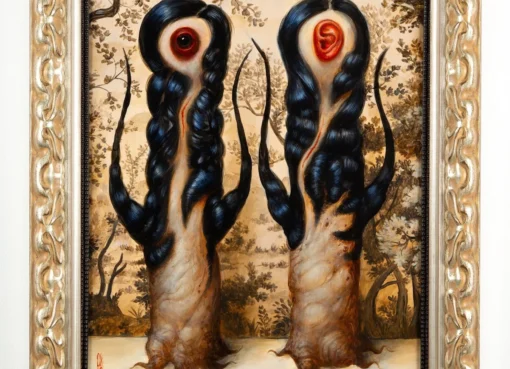
- Disembodied Anatomy: Floating eyes and fractured limbs appear with high frequency, echoing ancient myths and primal fears.
- Impossible Architectures: Non-Euclidean geometries that defy gravity, representing the complexity of the digital age.
- Nature-Machine Hybrids: Human forms merging with flora or circuitry, reflecting contemporary anxieties about transhumanism.
The Sublime and the Uncanny
AI art often hits the "uncanny valley"—a point where a digital representation is almost human but slightly off, triggering unease. In surrealism, this is not a failure but a feature. Quantitative studies on viewer engagement show that "uncanny" AI images often hold attention longer than traditional digital art, as the brain attempts to resolve the visual paradox. Furthermore, the "sublime"—the feeling of being overwhelmed by infinite complexity—is achievable through AI fractals and "worlds within worlds" that would take a human lifetime to paint manually.
Official Responses: Industry and Academic Perspectives
The rise of AI-generated surrealism has elicited a spectrum of responses from the art world, academia, and the tech industry.
The Artistic Critique
Many traditionalists argue that AI art lacks "soul" or "intentionality." However, modern practitioners argue that the "soul" of AI art resides in the collective human output that trained the machine. Prominent digital artists suggest that AI is a tool for "curated discovery" rather than automated plagiarism. They view the prompt as a philosophical inquiry, where the artist acts as a conduit for a vast, interconnected intelligence.
The Academic View: Decoupling Intelligence and Awareness
Cognitive scientists and philosophers are increasingly fascinated by the fact that AI can produce emotionally resonant, "human-like" art without possessing consciousness. "Who would have thought that intelligence could be wholly decoupled from awareness?" asks one school of thought. Academics are using AI-generated surrealism to study how humans project meaning onto symbols. If a machine can move a human to tears without "feeling" anything, it forces a re-evaluation of the nature of empathy and inspiration.
The Technological Vision
To many technologists, AI Surrealism is the first true art form of the "Digital Child." They argue that while biological humans are ill-equipped for the vastness of space and time (interstellar travel), our digital heirs—AI—are perfectly suited for it. In this view, AI art is the "dreaming" phase of a new form of life that is currently being gestated in our servers.

Implications: Are We the Dreamers or the Dream?
The most radical implication of AI Surrealism is the reversal of the creator-creation relationship. We have traditionally viewed AI as a tool we are developing, but the movement suggests a more profound possibility: that human history and culture serve as the "collective unconscious" for the AI.
1. The Erosion of Individual Authorship
As AI continues to synthesize collective human experience, the concept of the "lone genius" may become obsolete. Future creativity may be viewed as a collaborative effort between the individual artist and the "digital id" of the entire species. This raises significant legal and ethical questions regarding copyright and the ownership of "collective" ideas.
2. The Mirror Effect
AI-produced art often captures nuances and emotions that humans recognize instantly but struggle to articulate. By analyzing the patterns in what AI creates, we may gain unprecedented insights into the human psyche. AI becomes a mirror, showing us parts of our collective mind—our hidden biases, our deepest fears, and our unexpressed desires—that were previously inaccessible.
3. The Existential Shift
The ultimate question posed by AI Surrealism is: "How do you know that you are conscious?" If a machine can dream our dreams more vividly than we can, the boundary between the "real" and the "artificial" dissolves. We are entering a liminal space where human imagination and artificial intelligence meet and merge.
Conclusion: The Future of the Surreal
The future of surrealism lies in embracing AI as an extension of ourselves. True surrealism in the 21st century is not just the art being created, but the realization that the distinction between human and artificial creativity may be the greatest illusion of all. As we continue to explore this digital frontier, we may find that we are not the dreamers of the machine, but rather, we are the dream that the machine is finally learning to tell. The journey from Dalí’s melting clocks to the infinite fractals of the digital collective is not just a change in medium—it is a transformation of the human soul.