Assur: The Evolving Deity at the Heart of the Assyrian Empire
Main Facts
In the annals of ancient Mesopotamian history, few deities embody the dynamic interplay between political power, cultural assimilation, and religious evolution as profoundly as Assur. The supreme god of the ancient Assyrians, Assur (also spelled Ashur, Anshar) transcended his origins as a local patron of the city bearing his name to become the overarching deity of one of the most formidable empires of the ancient world. His divine persona was a masterful synthesis, drawing attributes and mythologies from earlier Sumerian and Babylonian pantheons. This amalgamation resulted in a multifaceted deity who simultaneously presided over war, wisdom, justice, agriculture, and kingship, reflecting the diverse needs and aspirations of the Assyrian state.
Unlike many of his divine predecessors, Assur possessed no truly original mythology or iconography. Instead, his character was meticulously constructed from the rich tapestry of Mesopotamian religious thought. His family lineage mirrored that of the Sumerian Anu and Enlil, and the Babylonian Marduk, with Ninlil serving as his consort (borrowed from Enlil’s wife) and Nabu as his son (Marduk’s son). This syncretic approach, a hallmark of Assyrian cultural borrowing, allowed Assur to embody the might and prestige of established gods, providing a powerful spiritual foundation for an expanding empire. At the zenith of Assyrian power, the worship of Assur approached a form of practical monotheism, where other deities were often reinterpreted as manifestations or subservient aspects of the all-encompassing Assur. This strategic elevation was not merely religious; it was a potent tool for political unification and control across vast, diverse territories.
A Tapestry of Divinity: Assur’s Syncretic Nature
The Assyrian Empire, renowned for its military prowess and administrative acumen, also demonstrated a remarkable talent for cultural appropriation, a characteristic perhaps best exemplified in the figure of Assur. This penchant for borrowing, much like the later Roman Empire, allowed Assyria to absorb and integrate elements from conquered or neighboring cultures, strengthening its own identity and authority.
The Pantheon’s Borrowed Robes
Assur’s very essence was a composite. His power and attributes were deliberately crafted to mirror those of prominent Sumerian and Babylonian deities. From the Sumerian Anu, the sky god and patriarch of the gods, Assur derived an aura of ultimate authority and cosmic order. From Enlil, the powerful god of wind, air, earth, and storms, who held the Tablet of Destinies and was considered the most potent force in the Sumerian pantheon, Assur inherited immense executive power and the ability to determine fate. The Babylonian Marduk, who rose to prominence as the chief god of Babylon and the hero of the Enuma Elish (the Babylonian creation epic), contributed elements of warrior leadership, triumph over chaos, and a central role in kingship.
This deliberate conflation meant Assur was not a deity born of singular, distinct myths but rather a synthesis designed to consolidate existing divine powers into a single, supreme entity. As scholar Jeremy Black notes, this process, "In spite of (or possibly because of) the tendencies to transfer to him the attributes and mythology of other gods, Assur remains an indistinct deity with no clear character or tradition (or iconography) of his own." (38). While seemingly a paradox, this "indistinctness" was precisely what allowed Assur to be so adaptable and universally applicable within the expanding Assyrian worldview. He could be all things to all people within the empire, representing their aspirations and fears through a familiar, yet ultimately Assyrian-controlled, divine lens.

Iconography: Warrior and Cosmic Ruler
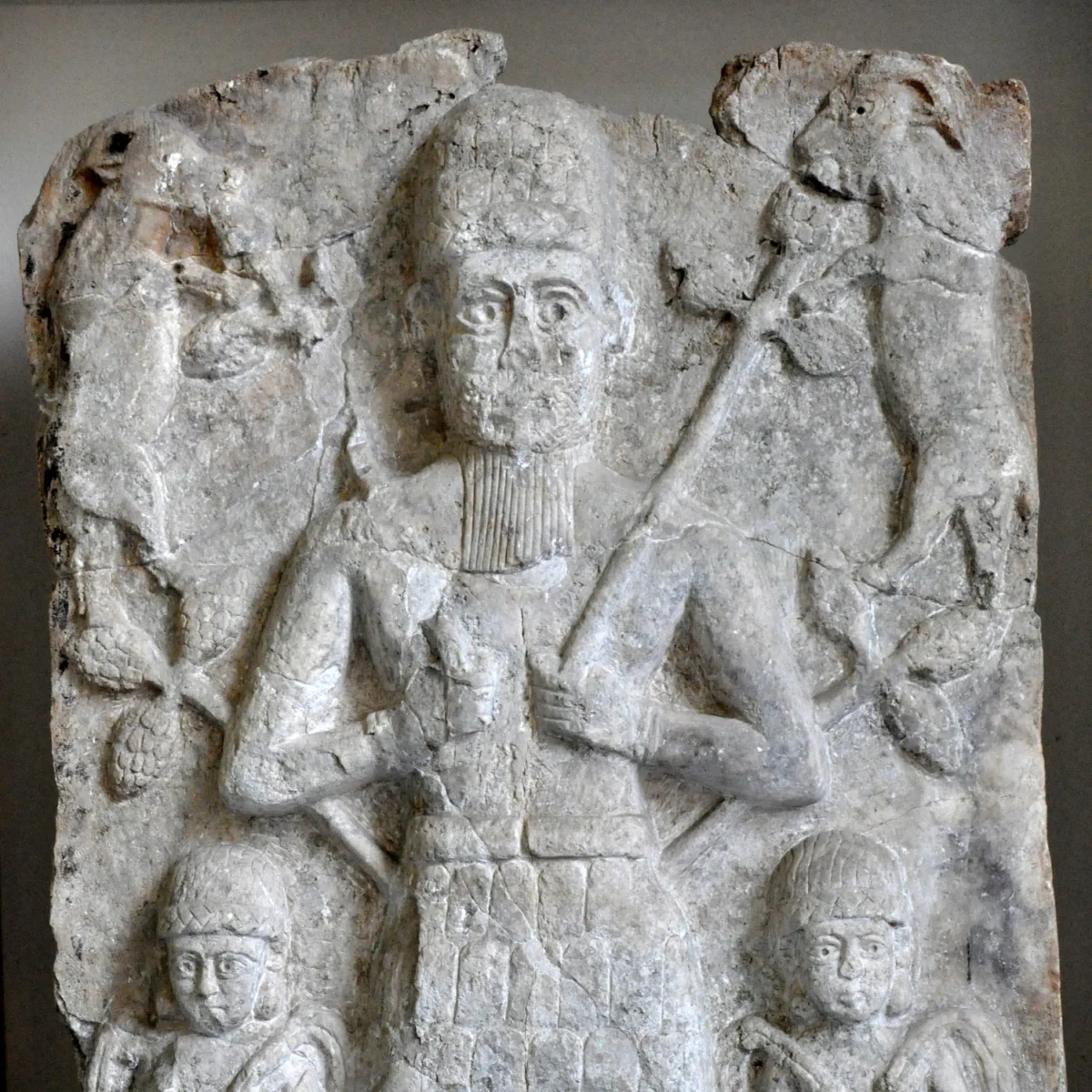
Assur’s visual representations further illustrate this borrowing. While sometimes depicted with a crown or a crown on a throne, echoing the regal imagery of Sumerian Anu, he is more frequently portrayed as a fierce warrior-god. This martial aspect typically shows him wearing a horned helmet – a common symbol of divinity in Mesopotamia – and armed with a bow and quiver of arrows, signifying his role as the divine protector and leader of the Assyrian army.
A particularly striking and often debated iconographic motif is Assur’s depiction within a winged disk. While some scholars, including Jeremy Black, contest the direct association of Assur with the solar disk, it is a powerful image nonetheless. The winged disk, a symbol of divinity, protection, and sovereignty found across the ancient Near East, visually reinforced Assur’s elevated status and omnipresence. Furthermore, Assur is occasionally shown standing upon a snake-dragon, an image directly appropriated from Marduk, who famously vanquished the primordial chaos monster Tiamat, often depicted as a serpentine beast. This visual borrowing directly connected Assur to Marduk’s heroic narrative, legitimizing Assur as the ultimate vanquisher of chaos and upholder of order. These composite images were not merely decorative; they were potent symbols that communicated Assur’s multifaceted authority and his absorption of other powerful divine identities.
From Local Patron to Imperial God: A Chronological Ascent
Assur’s trajectory from a minor regional deity to the imperial god of a vast empire is intrinsically linked to the rise and fall of the city of Ashur and, subsequently, the Assyrian state itself.
The Early Seeds: Ashur City’s Guardian
The earliest positive attestations of Assur date back to the Ur III period (circa 2112 to circa 2004 BCE), a time when Mesopotamia saw the resurgence of Sumerian cultural and political dominance. By approximately 1900 BCE, Assur was firmly established as the patron god of the city of Ashur, the very city from which the Assyrian people would derive their name. In these nascent stages, Assur was likely an agricultural deity, a spirit of the locale, personifying the prosperity and well-being of the urban center and its surrounding fertile lands. This humble origin aligns with the general progression of deities in ancient societies, as described by scholar E. A. Wallis Budge: "The oldest of such spirits was the ‘house spirit’ or household-god. When men formed themselves into village communities, the idea of the ‘spirit of the village’ was evolved and later came the ‘god of the town or city’ and the ‘god of the country’." (81-82).
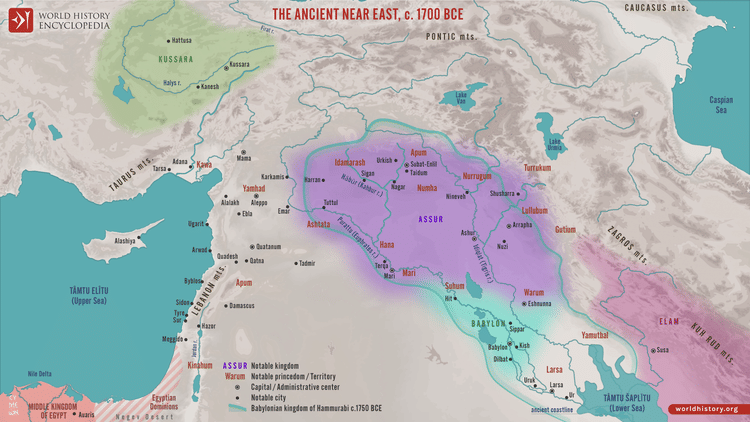
The city of Ashur itself, initially a small trading post founded on the site of an older community by Sargon of Akkad (reigned 2334-2279 BCE), began to flourish through extensive trade networks with Anatolia and other regions of Mesopotamia. Its economic prosperity mirrored the slow but steady accretion of attributes by its patron deity. By the reign of Assyrian king Shamashi Adad I (1813-1791 BCE), Ashur had risen to become the capital of a burgeoning regional power. Shamashi Adad I, a powerful monarch, invoked Assur’s name in his campaigns to drive out the Amorites and secure Assyria’s borders. However, this early Assyrian ascendancy was curtailed by the mighty Hammurabi of Babylon (reigned 1792-1750 BCE), whose empire temporarily subsumed Assyria. During this period, Marduk of Babylon held supreme religious sway, and the Enuma Elish glorified his cosmic victory. Assur’s worship, though enduring, remained confined to the city of Ashur and its immediate territories.
Forging an Empire, Forging a God
The true ascent of Assur began in the tumultuous period following Hammurabi’s death, as successive powers – the Mitanni and the Hittites – vied for control of Mesopotamia, often reducing Assyria to a vassal state. This era of foreign domination was shattered by the rise of Assyrian king Adad Nirari I (reigned 1307-1275 BCE), who successfully united the disparate lands under the first semblance of an Assyrian Empire. Adad Nirari I explicitly credited Assur with his military victories, a critical turning point in the deity’s narrative. Yet, as Jeremy Black observes, a formalized, glorifying history for Assur was still lacking.
This absence spurred a conscious effort by Assyrian scribes and priests to integrate Assur into the grand mythological traditions of southern Mesopotamia. Around 1300 BCE, attempts began to identify Assur with Sumerian Enlil, a strategic move to position him as the chief of the gods. This assimilation continued and deepened, culminating under Sargon II of Assyria (reigned 722-705 BCE), when Assur was identified with Anshar, the primordial father of Anu in the Babylonian Epic of Creation. This crucial adaptation effectively retrofitted Assur into the very fabric of cosmic creation, portraying him not merely as a local god, but as an ancient, foundational deity, present from the genesis of the universe itself. This theological engineering provided Assur with the profound depth and legitimacy necessary for an imperial god.
The Neo-Assyrian Zenith: Universal Dominion
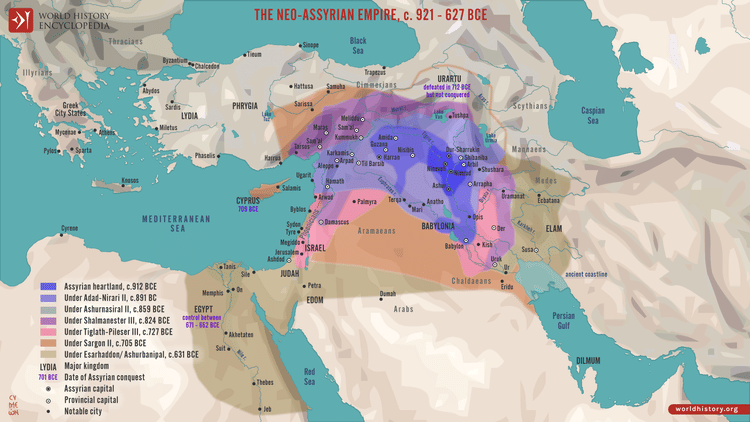
From Adad Nirari I onwards, and particularly through the Neo-Assyrian Empire (912-612 BCE), Assur’s prominence surged. The Enuma Elish was famously re-edited, with Assur (under the name Anshar) replacing Marduk as the heroic creator god, further cementing his supreme status. Kings like Tiglath-Pileser I (reigned 1115-1076 BCE) regularly invoked Assur as the patron god of the empire, empowering the army and dictating its laws. Adad Nirari II (reigned 912-891 BCE) and his successors expanded the empire relentlessly, with Assur serving as the divine force guiding their conquests.
As the Assyrian army campaigned across Mesopotamia, Assur’s worship spread in its wake. Wallis Budge eloquently summarizes this symbiosis: "As the power of Marduk became predominant when Babylon grew into a great city, so the power of Assur waxed great when the Assyrians became a strong and warlike nation." (88). To both the Assyrian soldiers and the peoples they subjugated, Assur’s undeniable power, demonstrated through military might, rendered him a god worthy of veneration. His influence grew to eclipse earlier regional deities, becoming synonymous with the empire’s unparalleled success.
Even when Ashurnasirpal II (reigned 884-859 BCE) moved the capital from Ashur to Kalhu, it did not diminish Assur’s stature; the king’s own name ("Assur is Guardian of the Heir") testified to the god’s enduring importance. Tiglath-Pileser III (reigned 745-727 BCE), who forged the world’s first professional army and introduced advanced siege technology, further elevated Assur’s name through unprecedented military victories. These triumphs necessitated a re-imagining of Assur’s presence. No longer solely bound to his temple in Ashur, Assur became an omnipresent deity, capable of being worshipped anywhere the Assyrian army marched.
The State-Sponsored Cult: Official Promotion and Doctrine
The elevation of Assur was not a spontaneous popular movement but a deliberate, state-sponsored project, meticulously orchestrated by the Assyrian monarchy and its religious establishment. This "official response" to the needs of an expanding empire transformed Assur’s cult into a powerful instrument of governance and cultural integration.
Kings as High Priests: Divine Mandate
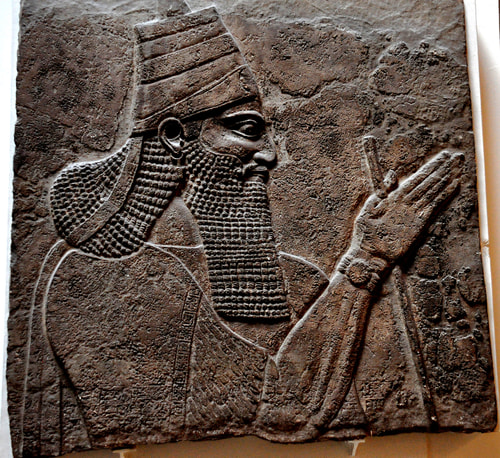
At the core of Assur’s imperial cult was the king himself, who served as the chief priest of Assur. This direct link between the monarch and the supreme deity imbued Assyrian kingship with an unassailable divine mandate. All lesser priests, whether in the grand temple of Assur in the city of Ashur or in smaller shrines across the empire, ultimately served under the king’s authority. This structure reinforced the king’s absolute power, presenting him as Assur’s chosen representative on Earth. The frequent incorporation of Assur’s name into royal titles—Ashurbanipal, Ashurnasirpal, Ashur-uballit—was not merely an act of piety but a constant, public declaration of this sacred connection, echoing the divine authority that underpinned the entire state apparatus.
Reshaping Creation Narratives
One of the most significant "official responses" to Assur’s rise was the re-editing of existing Mesopotamian religious texts. The Babylonian Enuma Elish, a foundational myth detailing the creation of the world and the rise of Marduk, was systematically altered. In the Assyrian version, Assur (often as Anshar, his primordial equivalent) was inserted as the heroic figure who defeated the forces of chaos and established cosmic order. This rewriting of sacred history served to legitimize Assur’s supremacy and, by extension, Assyrian dominance. It wasn’t just about faith; it was about establishing a new, Assyrian-centric worldview where their god, their king, and their empire were divinely ordained and eternally destined for greatness.
Worship Beyond the Temple Walls
As the empire expanded, the logistical and theological challenge of worshipping a localized deity across vast territories became apparent. The "official response" to this was a profound shift in Assur’s nature. Scholar Paul Kriwaczek elaborates on this transformation: "One might pray to Assur not only in his own temple in his own city, but anywhere. As the Assyrian empire expanded its borders, Assur was encountered in even the most distant places." (231). This concept of an omnipresent god was crucial. It allowed for the assimilation of conquered peoples’ local deities, which could then be reinterpreted as mere manifestations or regional aspects of the universal Assur. This theological flexibility fostered a sense of unity within the diverse empire, albeit often through coercion. The Assyrian state effectively created a religious doctrine that supported its imperial ambitions, making Assur not just a god, but the very embodiment of Assyrian imperial power and its right to rule.
Profound Implications: Society, Religion, and Legacy
The elevation of Assur to supreme, universal deity had far-reaching implications, profoundly shaping Assyrian society, influencing religious thought across the Near East, and leaving an enduring, albeit complex, legacy.
Unifying an Empire: The Monotheistic Tendency
Kriwaczek highlights a critical consequence of Assur’s omnipresence: "From faith in an omnipresent god to belief in a single god is not a long step." (231). While never fully monotheistic in the Abrahamic sense, the worship of Assur displayed strong monotheistic tendencies. Local divinities of conquered peoples were either suppressed or absorbed, reinterpreted as aspects of Assur. This religious unification was a powerful tool for political cohesion, fostering a shared identity and loyalty across a sprawling empire composed of diverse ethnic and cultural groups. The idea that Assur was the "one true god," albeit known by different names in the past, provided a theological justification for Assyrian rule and facilitated the integration of conquered populations into the imperial structure.
A Changing Worldview: Desacralization and Gender
This shift towards a transcendent, universal deity also had profound philosophical and social implications. Kriwaczek argues that "Belief in the transcendence rather than immanence of the divine had important consequences. Nature came to be desacralized, deconsecrated. Since the gods were outside and above nature, humanity – according to Mesopotamian belief created in the likeness of the gods and as servant to the gods – must be outside and above nature too." (229). This new worldview placed humanity, particularly the male gender, in a position of dominion over the natural world, a concept later famously echoed in Genesis 1:26.
However, as Kriwaczek incisively points out, this patriarchal interpretation had detrimental effects on women’s status. While Mesopotamian women had historically enjoyed significant civil rights, the rise of powerful male deities like Marduk and, even more so, the supreme male god Assur, led to a decline in the prestige of female deities and a corresponding erosion of women’s rights. Under Assyrian rule, cultures that had traditionally held women in high regard, such as the Phoenicians, were compelled to adopt the conquerors’ patriarchal customs and beliefs. The link between a transcendent, male-dominated deity and the subjugation of women in religious and social spheres is a critical, often overlooked, implication of Assur’s imperial cult.
The Echoes of Assur: Fall and Enduring Presence
The Neo-Assyrian Empire, despite its unparalleled military might and sophisticated administrative systems, ultimately collapsed in 612 BCE. This period, often depicted as one of ruthless cruelty by biblical and historical accounts, saw Assyrian kings like Shalmaneser, Tiglath-Pileser, Sennacherib, Esarhaddon, and Ashurbanipal wage relentless campaigns. While their methods were undeniably harsh, Kriwaczek reminds us that they were "no more savage or barbaric than any other ancient civilization," merely more efficient (208).
The fall of the empire was swift and brutal. A coalition of Babylonians, Medes, Persians, and other subjugated peoples rose in a vengeful onslaught, systematically destroying Assyrian cities. The destruction of the city of Ashur and the temple of Assur was highly symbolic. Assur had become the personification of Assyrian power, military triumph, and political hegemony. The obliteration of his cultic centers and statues was a potent act of defiance and liberation for Assyria’s enemies.
Yet, Assur’s legacy did not entirely vanish. While widespread imperial worship ceased, veneration of Assur continued in scattered Assyrian communities. More subtly, the concept of a single, omnipotent deity, fostered by Assur’s imperial cult, inadvertently paved the way for later religious developments. Early Christian missionaries in the region found the Assyrians receptive to their message of a single God and the concept of a divine son, demonstrating how Assur’s religious evolution had prepared the ground for monotheistic faiths. Although Assur himself faded, his son Nabu, associated with the gift of the written word, continued to be revered. Even today, the name "Ashur" endures as a personal and family name, a testament to the long shadow cast by this most adaptable and imperial of ancient gods.
Conclusion: The Enduring Narrative of a Borrowed God
Assur’s story is a compelling narrative of religious adaptation and imperial ambition. From an unassuming local spirit in the city of Ashur, he was meticulously crafted into the supreme deity of a vast and fearsome empire. His syncretic nature, drawing liberally from Sumerian and Babylonian predecessors, allowed him to embody a comprehensive array of divine attributes, making him a versatile and unifying force. The Assyrian kings, acting as his chief priests, strategically promoted his cult, reshaping creation myths and establishing an omnipresent deity whose worship facilitated the integration and control of diverse conquered populations.
The implications of Assur’s rise were profound, pushing Mesopotamian religious thought towards monotheistic tendencies and, controversially, contributing to the desacralization of nature and a decline in women’s rights. His ultimate fate was intertwined with that of his empire; the destruction of Assyria meant the dismantling of his imperial cult. Nevertheless, the theological groundwork laid by Assur’s worship, particularly the concept of a transcendent, universal god, resonated into later eras, influencing the religious landscape of the Near East and leaving an indelible, if often unacknowledged, mark on subsequent spiritual traditions. Assur, the borrowed god, remains a powerful emblem of how religion can be both a reflection of culture and a dynamic instrument of imperial power.