The Tablet Revolution of 2026: A Definitive Guide to the Year’s Best Tablet Keyboards

The technology landscape of 2026 has officially bridged the gap between mobile portability and desktop-class productivity. For years, the industry teased the arrival of the "Post-PC" era—a time when the traditional clamshell laptop would no longer be the default tool for professionals and students. Today, that transition is largely complete. As mobile processors like Apple’s M5 series and Samsung’s latest Exynos and Snapdragon iterations reach performance parity with high-end workstations, the tablet has moved from a secondary consumption device to a primary production powerhouse.
However, the hardware inside the tablet is only half the story. The true catalyst for this shift has been the refinement of the tablet keyboard. No longer flimsy plastic covers with mushy keys, the best tablet keyboards of 2026 offer haptic feedback, glass trackpads, and seamless integration that rivals the best ultrabooks on the market. This report examines the top four tablet keyboards currently dominating the market, analyzing their evolution, technical specifications, and the broader implications for the future of mobile computing.
Main Facts: The Elite Four of 2026
In the current market, four specific models have emerged as the gold standard for tactile input. These devices are judged not just on their typing feel, but on their ability to transform a slate of glass into a functional workstation without adding excessive bulk.
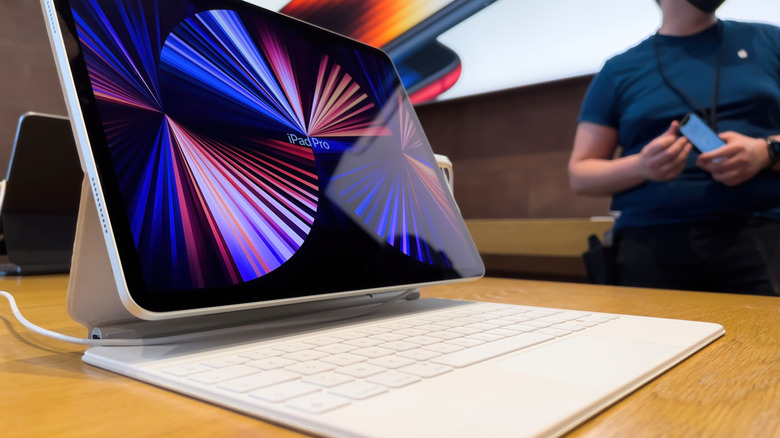
- Apple Magic Keyboard (for iPad Pro): The premium benchmark, featuring a cantilevered "floating" design and a high-precision haptic trackpad.
- Samsung Book Cover Keyboard Slim: The efficiency leader for the Android ecosystem, specifically designed for the Galaxy Tab S11 series with a focus on AI integration.
- Apple Magic Keyboard Folio: The versatile mid-range option for the base iPad, utilizing a two-piece detachable design and a functional kickstand.
- Logitech Combo Touch: The premier third-party alternative that often outperforms first-party offerings in terms of protection and value, compatible across various iPad models.
While these devices vary in price and platform, they share a common goal: eliminating the friction between a user’s thoughts and the digital page.
Chronology: The Evolution of the Tablet Interface
To understand where we are in 2026, we must look back at the decade-long evolution of the tablet keyboard.

- The Early Years (2010–2015): Following the original iPad’s release, keyboards were largely an afterthought. Most were third-party Bluetooth accessories that required separate charging and suffered from significant latency. They were bulky, awkward, and often required the tablet to be propped up with unreliable magnets.
- The "Smart" Era (2015–2019): Apple introduced the Smart Connector, and Samsung followed with Pogo pins. This allowed keyboards to draw power directly from the tablet, eliminating the need for internal batteries and Bluetooth pairing. However, these "Smart Keyboards" lacked trackpads, forcing users to constantly reach for the screen—a major ergonomic hurdle.
- The Haptic Revolution (2020–2024): The introduction of the first Magic Keyboard with a trackpad changed the narrative. It introduced a cursor to iPadOS, making the tablet feel like a laptop for the first time. During this period, Samsung refined its "DeX" mode to better utilize keyboard and mouse inputs.
- The AI and Precision Era (2025–2026): We have now entered an era where keyboards are "intelligent." Samsung has integrated dedicated AI keys for immediate access to large language models, and Apple has perfected the haptic engine in its glass trackpads, providing a click feel that is entirely software-simulated but feels indistinguishable from a mechanical click.
Supporting Data: Technical Deep Dive and Pricing
Choosing the right keyboard in 2026 requires a look at the granular data. Connectivity, key travel, and weight are the primary metrics that define the user experience.
1. Apple Magic Keyboard ($299)
Designed exclusively for the iPad Pro (M4 and M5 models), this is the most expensive accessory in the category.
- Design: Floating cantilever allows for granular angle adjustment.
- Features: Backlit keys, a full function row (introduced in recent iterations), and a secondary USB-C port for pass-through charging.
- The X-Factor: The glass haptic trackpad. Unlike mechanical trackpads, it provides uniform feedback across the entire surface, making multi-touch gestures exceptionally fluid.
2. Samsung Book Cover Keyboard Slim ($100 – $170)
For the Galaxy Tab S11 and S11 Ultra, Samsung has prioritized a "slim-first" philosophy.
- Connectivity: Pogo pin physical connection (no Bluetooth lag).
- Key Feature: A dedicated AI key that triggers Samsung’s integrated assistant for real-time drafting and search.
- Trade-offs: It lacks backlighting and a protective back cover for the tablet, focusing instead on being the lightest possible typing solution.
3. Apple Magic Keyboard Folio ($249)
Aimed at the iPad (10th Gen and newer), this model favors versatility over the "pro" aesthetic.
- Modular Design: The keyboard can be detached entirely, leaving a protective backplate with a kickstand.
- User Experience: While it lacks the haptic trackpad of the Pro model, its 14-key function row makes it a favorite for students who need quick access to media controls and brightness.
4. Logitech Combo Touch ($199)
Logitech remains the only third-party manufacturer to gain access to Apple’s proprietary Smart Connector technology for high-performance peripherals.

- Durability: Offers significantly more edge protection than Apple’s own keyboards.
- Value: At roughly $100 less than the Magic Keyboard Pro, it includes backlighting and a high-quality trackpad.
- Compatibility: It is the "universal" choice, with versions available for the iPad Air, Pro, and standard iPad.
Official Responses and Expert Consensus
Market analysts and tech reviewers have reached a rare consensus regarding the 2026 lineup. According to reports from TechSpot and Macworld, the divide between "tablet" and "laptop" is now purely a matter of operating system preference rather than hardware capability.
Reviewer Sentiment:
- On Apple: Experts at GSMArena note that while the Magic Keyboard remains the "gold standard," its price remains a significant barrier. The cantilever design, while iconic, is often criticized for being "top-heavy," making it difficult to use on one’s lap compared to a traditional laptop.
- On Samsung: Industry analysts have praised Samsung for including an AI key, noting that it reflects the current shift toward AI-assisted workflows. However, some durability concerns have been flagged regarding the hinge mechanism on the Slim model after long-term use.
- On Logitech: Many tech journalists now recommend the Logitech Combo Touch as the "best overall buy." They cite the combination of a detachable keyboard, full backlighting, and rugged protection as the ideal configuration for the average user.
The general consensus is that for long-form writing, the Apple Magic Keyboard is unmatched, but for the hybrid user who frequently switches between drawing with a stylus and typing, the detachable Folio and Logitech designs are superior.
Implications: The Death of the Mid-Range Laptop?
The excellence of these keyboard accessories has profound implications for the global hardware market.
The Workforce Shift
In 2026, corporate IT departments are increasingly issuing tablets instead of laptops. The modular nature of a tablet with a detachable keyboard allows for a "three-in-one" device: a creative canvas (with a stylus), a media consumption device (handheld), and a workstation (with the keyboard). This reduces the "device fatigue" of carrying multiple pieces of hardware.
Educational Impact
In the education sector, the Apple Magic Keyboard Folio and Logitech Combo Touch have become the standard. The ability to rip the keyboard off to take photos for a science project or use an AR app, then snap it back on to write a report, has made the traditional Chromebook look antiquated.
Environmental and Economic Factors
Economically, the "tablet-first" approach is changing consumer spending. While a top-tier keyboard costs $200–$300, it extends the life of a tablet by making it a viable laptop replacement for 5–7 years. Environmentally, producing one powerful tablet with a high-quality keyboard accessory uses fewer raw materials than producing both a tablet and a laptop.
The Future: Beyond the Physical Key
As we look toward 2027 and beyond, the industry is already experimenting with "solid-state" keyboards—surfaces with no moving parts that use advanced haptics to trick the brain into feeling a key press. For now, however, the mechanical and haptic hybrids of 2026 represent the pinnacle of mobile input technology.
Whether you are an iPad Pro power user or a Galaxy Tab enthusiast, the message of 2026 is clear: your tablet is no longer just a screen. With the right keyboard, it is the most versatile computer you have ever owned.