Unearthing a Classic: Reassessing A1: Slave Pits of the Undercity in the Modern Era
Originally Published March 16th, 2002
The landscape of tabletop role-playing games has transformed dramatically since the early 1980s. Yet, some adventures from that nascent era continue to cast long shadows, their influence undeniable, their mystique enduring. Among these venerable relics stands the A-series of modules for Advanced Dungeons & Dragons (AD&D), a collection that once defined high-stakes tournament play and captivated a generation of nascent adventurers. Decades later, as digital accessibility breathes new life into these classics, a pertinent question arises: Do these storied modules, particularly the inaugural A1: Slave Pits of the Undercity, possess anything beyond mere nostalgia to offer the contemporary gamer? This journalistic exploration delves into the historical context, intricate design, inherent flaws, and remarkable strengths of A1, ultimately seeking to determine its enduring value in a vastly evolved gaming world.
Chronological Context: The Golden Age of AD&D and the Birth of a Legend
The early 1980s represented a pivotal period for tabletop role-playing games. TSR, Inc., under the visionary guidance of Gary Gygax and others, was at the zenith of its influence, solidifying Dungeons & Dragons as a cultural phenomenon. It was within this vibrant crucible that the A-series modules – often collectively known as the "Slavers series," the "Slave Lords series," or, following its comprehensive omnibus edition, Scourge of the Slavelords – made their indelible mark.
Origins and Release
The series unfolded between 1980 and 1981, a rapid succession of releases that included A1: Slave Pits of the Undercity, A2: Secret of the Slavers Stockade, A3: Assault on the Aerie of the Slave Lords, and A4: In the Dungeons of the Slave Lords. This quartet was initially conceived not merely as standalone adventures but as a crucible for competitive play, serving as the official AD&D Tournament at Gen Con XIII. This foundational purpose profoundly shaped their design, embedding a complete tournament scoring system within their pages and influencing the structured, almost puzzle-like nature of the adventures themselves. While token efforts were later made to introduce greater flexibility for home campaigns, the tournament DNA remained evident. Today, these historical artifacts are readily available in electronic form through the official channels of Wizards of the Coast, making them accessible to a new generation of players and DMs.
The Slavers Saga Unfolds
The progression from A1 to A4 promised an escalating confrontation with a shadowy organization, drawing players deeper into a web of intrigue and danger. A1 served as the initial foray, a brutal introduction to the slavers’ reach. Subsequent modules meticulously peeled back layers of the conspiracy, leading adventurers from hidden stockades to formidable aeries, culminating in a climactic confrontation within the very dungeons of the Slave Lords. This narrative arc, though presented in discrete tournament segments, established a compelling meta-plot that contributed significantly to the series’ reputation. The eventual release of Scourge of the Slavelords as an omnibus edition in the mid-1980s further cemented the series’ status as a definitive AD&D campaign experience, allowing DMs to run the entire saga seamlessly.
Evolving Art and Design
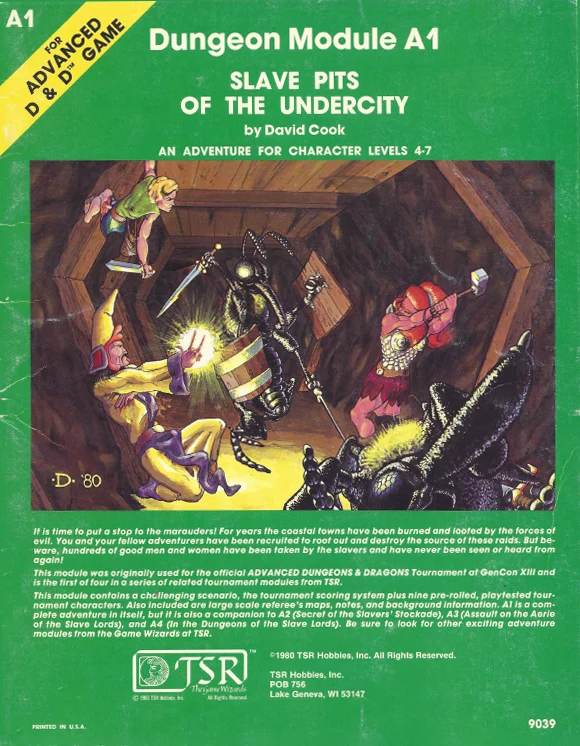
Viewing these modules through a contemporary lens immediately highlights the stylistic shifts in RPG publication. The artwork, notably by Jeff Dee in A1 and others across the series, might strike modern eyes as primitive or even quaint. While Dee would mature into a highly regarded artist, his work in 1980, though brimming with raw creativity and fantastical cleverness—as evidenced by the multi-limbed aspis or the halfling clinging to the ceiling on A1‘s cover—still represented an earlier stage of his technical skill. This artistic simplicity was mirrored by the sparse, almost constrained presentation of the material itself, penned by David Cook. Cook, who would later achieve widespread recognition as the primary designer for the second edition of AD&D, crafted a style that, while economical, conveyed the necessary information for a tournament setting. This contrast between the functional, often minimalist design of early modules and the elaborate, richly illustrated tomes of today speaks volumes about the evolution of game design philosophy and player expectations over the decades.
Deconstructing the "Slave Pits": A Critical Examination
As industry classics, the A-series modules, and A1 in particular, demand our attention. Their enduring reputation for greatness in the gaming community necessitates a thorough examination of the foundations upon which that glory rests.
The Enduring Concept
At its core, the entire A-series revolves around a compelling premise: the existence of a far-reaching, insidious network of slavers, secretly guided by the enigmatic "Slave Lords." The catalyst for the adventurers’ involvement in A1 is the recent escalation of slaver activity, marked by the brutal burning and looting of coastal towns. This outrage finally compels the local nobility, traditionally mired in their own petty squabbles, to set aside differences and take decisive collective action. This premise immediately provides player characters (PCs) with a clear, morally justifiable objective, tapping into classic fantasy tropes of heroism and liberation.
A1: Slave Pits of the Undercity serves as the entry point into this sprawling conspiracy. The adventurers are dispatched to a ruined temple compound, a site that, despite being largely gutted by fire years prior, has been repurposed by a local slaver sect. It functions not as their primary base but rather as a critical access point to their subterranean operations. The adventure’s progression is relatively linear, reflecting its tournament origins: PCs must battle their way through the compound’s surface structures to uncover the hidden entrance to the sewers beneath.
Once underground, the challenges intensify. Players are likely to navigate a treacherous colony of aspis – a species of giant insect – before finally reaching the grim underground slave pens. The ultimate objective is twofold: liberate the captive slaves and eliminate the local Slave Lord responsible for this specific branch of the operation. This clear, sequential objective structure, while perhaps less open-ended than modern sandbox campaigns, provided a focused and immediate sense of purpose for tournament participants.
Design Anomalies and Early Pitfalls
Despite its compelling premise, A1 is not without its design peculiarities and outright flaws, which often reveal the pressures and conventions of early RPG development.
Architectural Flaws: Perhaps the most glaring issue for a Dungeon Master (DM) attempting to run A1 is a significant oversight in the temple compound’s map. As originally published, there appears to be no logical or discernible path connecting the left and right halves of the compound. This architectural discontinuity forces DMs to improvise a solution on the fly, breaking immersion and demanding an immediate fix. A simple gateway, perhaps between Area 9 and Area 16A, is a common and necessary house rule to ensure the adventure flows without arbitrary barriers. This flaw speaks to potential last-minute changes, tight deadlines, or a lack of rigorous playtesting for campaign use beyond the strict tournament environment.
Ecological Illogic: Another point of contention lies in the module’s environmental logic, particularly concerning the aspis encounters. The presence of a thriving colony of giant, hostile insects within the immediate vicinity of the slave pens raises immediate questions: Why would the slavers establish their operations in such a dangerous locale? Why wouldn’t they prioritize driving out or eradicating these creatures that pose a constant threat to their captives and personnel? Furthermore, the existence of a direct tunnel leading from the aspis hive straight to the local Slave Lord’s underground office beggars belief. Such contrivances, while providing combat encounters, undermine the verisimilitude of the setting and often require DMs to craft elaborate, often unsatisfactory, justifications.
The Gygaxian Puzzle Box: A more philosophical criticism, but one that resonates deeply with many modern DMs, is the module’s adherence to a "Gygaxian" style of adventure design. This approach often structures the game world as a series of intricate puzzles that PCs must "solve" through specific, often counter-intuitive, interactions with the environment and its inhabitants. The original article vividly compares this to old Infocom text adventures, where progress depended on precise commands like "Enter room 5A. Pick up barrel of stale vinegar. Go to room 5B. Throw vinegar at glue-like creature in 5B." This style, while perhaps rewarding for players who relish intellectual challenges and meticulous exploration, can lead to frustrating dead ends if the specific solution isn’t intuited. It prioritizes a designer’s intended solution over player agency and logical problem-solving, a stark contrast to the more open-ended, emergent narratives favored in contemporary RPG design.
The Unmistakable Strengths
Despite these weaknesses, A1: Slave Pits of the Undercity possesses an undeniable core of excellence that justifies its classic status. It offers a "rock solid foundation" for adventure, demonstrating that its strengths far outweigh its easily rectifiable flaws.
Foundational Excellence: The scenario itself is inherently engaging. The moral imperative to rescue slaves from a ruthless organization provides a powerful hook for players, fostering a sense of immediate purpose and heroism. The structure, while linear, is sound, guiding players through distinct phases of infiltration, combat, and discovery. The maps, despite their basic presentation, are well-drawn and functional, clearly delineating the areas and facilitating tactical play.
Evocative Atmosphere and Memorable Encounters: David Cook’s descriptive text, though concise, is often evocative, painting vivid pictures of the ruined temple, the dank sewers, and the oppressive slave pens. This ability to conjure atmosphere with limited words is a testament to his skill. The character concepts within the module, particularly the various slaver types and their hierarchical structure, offer considerable potential for role-playing and strategic engagement. Moreover, the encounters, even those involving problematic elements like the aspis, are generally well-designed and memorable, providing a satisfying blend of combat, exploration, and mystery. With a few minor adjustments, Slave Pits of the Undercity transforms into a genuinely great adventure, a testament to its robust underlying design.
Modernizing a Classic: Adaptation and Relevance
The true test of a classic module lies not just in its historical significance, but in its adaptability. Can A1: Slave Pits of the Undercity be revitalized for a new generation of players, or for DMs who prefer modern design sensibilities? The answer is a resounding "Yes."
Bridging the Eras: DM Modifications
The original review highlights that adapting A1 into a highly enjoyable adventure requires only "a little bit of work" from the DM. The suggested modifications are straightforward and focus on enhancing logical consistency, streamlining gameplay, and improving atmosphere:
- Logical Flow: The addition of a gateway between Area 9 and Area 16A rectifies the glaring architectural flaw, ensuring that the two halves of the compound are no longer inexplicably segregated. This simple change allows for more organic exploration and tactical movement.
- Environmental Cohesion: The complete removal of the aspis tunnels and the creatures themselves, along with the goblin caverns in the sewers, dramatically improves the module’s verisimilitude. Their absence is "barely felt," and the remapping results in a far more utilitarian and logical slaver base, free from inexplicable ecological threats that undermine the slavers’ operational intelligence.
- Streamlining Gameplay: The elimination of the Gygaxian puzzles is crucial for a modern play experience. Instead of requiring specific, often obscure, item interactions, the module is re-imagined with more intuitive challenges. For instance, the "sundew" in Area 5B (the glue-like creature) can be transformed into a more conventional monster, such as a tendriculus, explicitly placed to guard against unauthorized access. This shift allows for more dynamic problem-solving and reduces player frustration. Applying "basic logic and sense" to slaver activities throughout the compound further grounds the adventure in believable fantasy.
- Atmospheric Consistency: The removal of "automated slave pens with remote-control doors" is a matter of taste, but for many, such anachronistic elements can be atmosphere killers. By replacing these with more traditional, manually operated security measures, the module maintains a consistent low-fantasy tone, enhancing immersion.
These modifications collectively transform A1 from a challenging historical artifact into a flexible, engaging adventure that respects player agency and DM logic, proving that its core scenario is resilient enough to transcend its original design quirks.
System Agnosticism and Stat Blocks
For DMs looking to adapt A1 to later editions of D&D (such as D&D 3rd Edition, 5th Edition, or even other fantasy RPG systems), the process is remarkably simple. Once the problematic aspis and sundew are removed, the majority of the remaining monsters in Slave Pits of the Undercity are standard fantasy fare, easily found in core rulebooks like the Monster Manual. This allows DMs to quickly substitute current edition statistics for creatures like goblins, gnolls, bugbears, and various humanoids. Non-player characters (NPCs) can be redesigned using modern class structures, providing a familiar and balanced challenge.
Furthermore, the module’s structure makes it relatively easy to balance for almost any desired party level. DMs can modify the number of creatures in an encounter, grant them additional class levels, or introduce environmental hazards to scale the difficulty up or down as needed. This inherent flexibility ensures that A1 is not merely a relic of AD&D 1st Edition but a robust template adaptable across various game systems and power levels.
The Enduring Legacy
The continued relevance of A1: Slave Pits of the Undercity lies in its ability to offer both a window into the past and a viable adventure for the present. It represents a foundational piece of RPG history, showcasing early adventure design principles and the nascent stages of iconic figures like David Cook. For "old school" gaming enthusiasts, it offers a direct connection to the roots of the hobby. For newer players, it provides a chance to experience a classic narrative without being bogged down by archaic mechanics or design choices, provided the DM is willing to act as a curator and adaptor. The preservation of such content through digital releases by Wizards of the Coast underscores its perceived value and ensures its continued accessibility. Ultimately, A1 serves as a powerful reminder that while game design evolves, the core elements of a compelling story, memorable encounters, and a clear objective remain timeless.
Behind the Pages: Production Details
A1: Slave Pits of the Undercity is more than just an adventure; it’s a piece of gaming history, embodying the spirit of early AD&D.
- Author: David Cook
- Publisher: TSR, Inc.
- Price: $4.99 (Original publication price)
- ISBN: 0-935696-25-3
- Product Code: TSR9039
- Pages: 24
- Year Published: 1980
A final note on the artwork: While the initial assessment might label Jeff Dee’s work in A1 as primitive, it’s crucial to acknowledge the context. While he may not have reached the zenith of his skills at that specific moment, the raw creativity and fantastical cleverness of his compositions were already evident. His ability to convey dynamic action, along with the technical detail evident in his backgrounds, was a hallmark even then. Consider the iconic cover of A1: not only the daring halfling clinging to the ceiling, but also the multi-limbed fighting techniques of the menacing aspis. These elements speak to an artist with a burgeoning vision, contributing significantly to the module’s enduring imagery.
Conclusion
So, what is the final verdict on A1: Slave Pits of the Undercity? Is it worth the investment of time and effort for modern DMs and players?
Unequivocally, yes.
A1: Slave Pits of the Undercity is a genuine diamond in the rough. It demands a bit of polishing, a thoughtful DM willing to make a few logical adjustments and streamline some of its more dated elements. However, once that care is applied, what emerges is a real jewel – a highly enjoyable, impactful adventure that stands the test of time. Its strengths lie in its engaging premise, robust structure, and memorable encounters, elements that transcend specific editions or design trends. By embracing its core and judiciously addressing its quirks, DMs can introduce players to a foundational piece of D&D history that remains as thrilling and rewarding today as it was at Gen Con XIII.
Style: 2/5 (Reflecting its basic, functional presentation from 1980)
Substance: 4/5 (Highlighting its strong core design and adaptability)
For those eager to continue the saga, the next adventure awaits: A2: Secret of the Slavers Stockade.