Unearthing the Genesis: Shannon Appelcline’s "Designers & Dragons: Origins" Promises Definitive History of Early D&D
FOR IMMEDIATE RELEASE
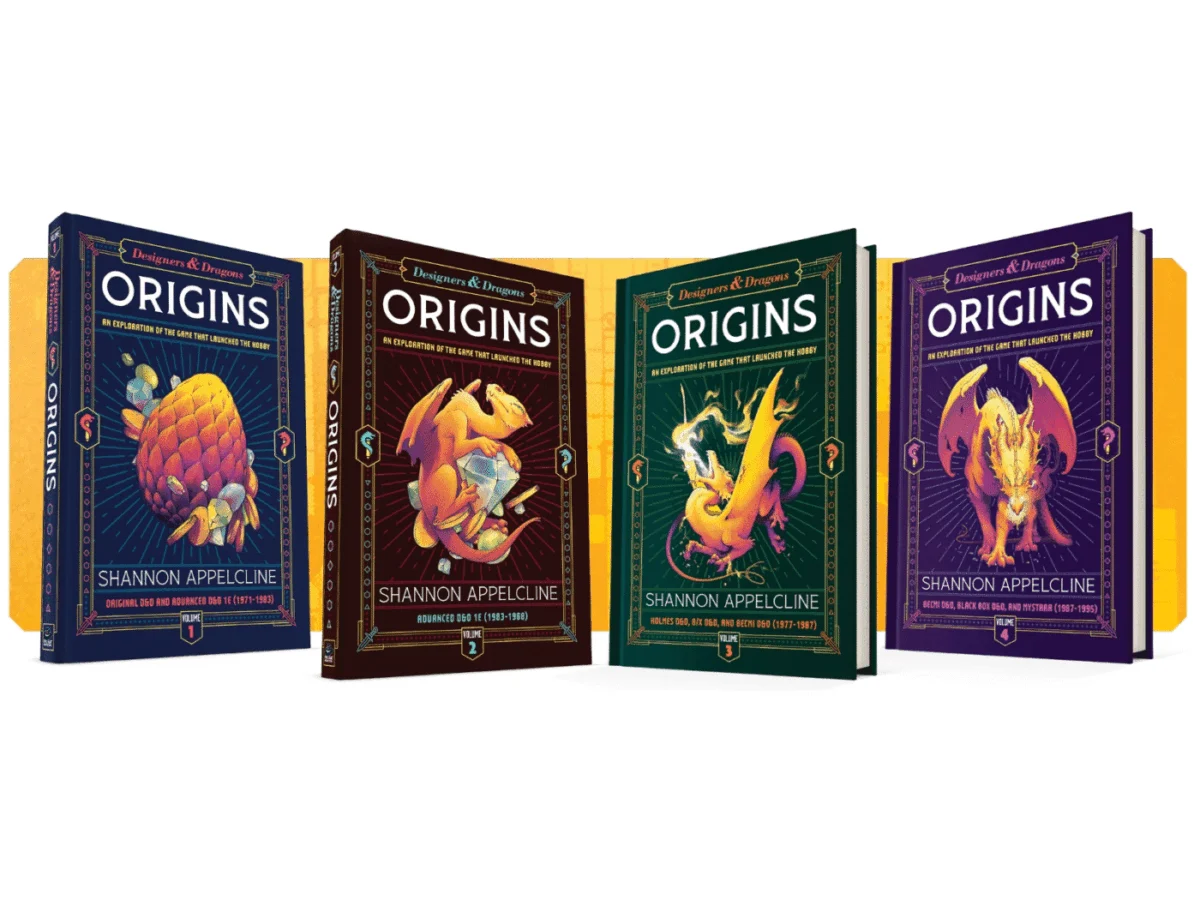
A monumental undertaking is set to redefine the understanding of tabletop roleplaying games’ foundational years. Renowned RPG historian Shannon Appelcline, celebrated for his meticulous research and engaging narratives, is poised to release "Designers & Dragons: Origins," a colossal four-volume set charting the intricate history of Original Dungeons & Dragons (OD&D), Basic D&D, and Advanced Dungeons & Dragons 1st Edition (AD&D 1e). This comprehensive collection promises an unprecedented deep dive into every single product released by TSR, Inc. for these seminal systems, from the very spark of roleplaying’s inception to the iconic landscapes of the Forgotten Realms and the fabled fall of Mystara.
The project, spearheaded by the authoritative voice of Appelcline and brought to life through Evil Hat Productions, represents the most ambitious historical examination of Dungeons & Dragons’ formative era to date. Far from a mere compilation, "Designers & Dragons: Origins" is positioned as the definitive chronicle, meticulously detailing the design philosophies, development challenges, market reception, and enduring legacies of the thousands of products that collectively built the bedrock of an entire industry. With a live BackerKit campaign now underway, enthusiasts and scholars alike have the opportunity to support the realization of this invaluable historical archive.
Main Facts: A Definitive Chronicle Unveiled
Shannon Appelcline’s "Designers & Dragons: Origins" is not simply a book series; it is an exhaustive, scholarly expedition into the heart of early tabletop roleplaying game (TRPG) history. Comprising four substantial volumes, the set is dedicated exclusively to the foundational period of Dungeons & Dragons, specifically focusing on Original D&D, the various iterations of Basic D&D, and the first edition of Advanced Dungeons & Dragons. This era, spanning roughly from the early 1970s through the mid-1980s, is widely acknowledged as the crucible in which the entire TRPG genre was forged.
What sets "Designers & Dragons: Origins" apart is its extraordinary commitment to granularity: it aims to cover the historical context, development, and impact of every single product released by TSR for these systems. This includes not just the core rulebooks and iconic modules like "Tomb of Horrors" or "Ravenloft," but also lesser-known supplements, expansions, and even ancillary materials that contributed to the burgeoning D&D ecosystem. Appelcline, a historian celebrated for his previous "Designers & Dragons" series which explored the histories of various RPG companies, brings his signature rigor and narrative flair to this focused undertaking.
The project seeks to illuminate the creative minds, business decisions, and cultural shifts that shaped D&D during its most embryonic and explosive growth phase. From the initial garage experiments of Dave Arneson and Gary Gygax that birthed OD&D, to the strategic development of Basic D&D as an accessible entry point, and the sophisticated, often complex, evolution of AD&D 1e, the series promises a holistic understanding of how D&D became a global phenomenon. The inclusion of beloved settings like the Forgotten Realms and Mystara underscores the narrative breadth, illustrating how these imaginative worlds were conceived and expanded product by product. The ongoing BackerKit campaign serves as the primary avenue for funding and pre-orders, signaling a direct engagement with the passionate community eager to possess this unparalleled historical resource.
Chronology: Tracing the D&D Narrative and Project’s Evolution
The story of "Designers & Dragons: Origins" is intrinsically linked to the history it seeks to document, as well as the author’s longstanding commitment to preserving RPG history.
The Genesis of D&D (1970s – Mid-1980s)
The narrative spine of "Designers & Dragons: Origins" begins in the early 1970s with the experimental wargaming sessions of Dave Arneson and Gary Gygax, culminating in the 1974 release of Original Dungeons & Dragons. This initial white box set, published by the fledgling Tactical Studies Rules (TSR), Inc., is considered the birth certificate of roleplaying games. Its immediate, albeit grassroots, success led to a rapid expansion of supplemental materials.
As D&D gained traction, TSR recognized the need for different entry points. The Basic D&D line emerged, initially simplified versions intended for new players, evolving through various editions (Holmes, Moldvay, Mentzer) and ultimately leading to the "BECMI" (Basic, Expert, Companion, Master, Immortal) rules that introduced many to the hobby. Concurrently, Gary Gygax spearheaded the development of Advanced Dungeons & Dragons (AD&D) in the late 1970s. AD&D 1st Edition, with its Dungeon Master’s Guide, Player’s Handbook, and Monster Manual, became the flagship product line, targeting a more dedicated and experienced player base. This era also saw the creation and expansion of iconic settings, notably Mystara (through Basic D&D) and the foundational elements of the Forgotten Realms (through AD&D 1e), which would become cornerstones of the D&D multiverse. This period, characterized by explosive creativity, rapid iteration, and the establishment of core TRPG mechanics and tropes, forms the precise chronological scope of Appelcline’s new series.
Shannon Appelcline’s Historical Journey
Shannon Appelcline’s dedication to RPG history spans decades. His initial foray into comprehensive RPG company histories began with his "Designers & Dragons" column on RPGnet, which evolved into a highly acclaimed multi-volume book series published by Mongoose Publishing and later by Evil Hat Productions. These earlier volumes provided overviews of hundreds of RPG companies, their key personnel, and their product lines across the entire spectrum of the industry. This established Appelcline as the preeminent historian of the tabletop roleplaying game industry.
The Conception of "Origins"
The idea for "Designers & Dragons: Origins" likely emerged from Appelcline’s recognition that while his previous works offered broad strokes, the foundational era of D&D warranted a much deeper, product-by-product excavation. The sheer volume and impact of TSR’s early D&D output demanded a dedicated, multi-volume treatment that couldn’t be accommodated within the existing "Designers & Dragons" framework. The project represents a natural progression, focusing his renowned research capabilities on the most critical period of TRPG development.
Project Development and BackerKit Launch
The research and writing for a project of this scale would undoubtedly span several years, involving extensive archival work, cross-referencing of historical documents, interviews, and meticulous cataloging of thousands of products. Evil Hat Productions, having partnered with Appelcline on previous "Designers & Dragons" volumes, became the natural publisher for "Origins," demonstrating their continued commitment to preserving and presenting RPG history.
The decision to launch via BackerKit reflects a modern publishing strategy that leverages community support for ambitious niche projects. The BackerKit campaign, launched recently, allows the publisher to gauge demand, secure funding for production costs (including extensive editing, layout, illustration, and printing), and build a direct relationship with the readership. The campaign’s success will be crucial in determining the scope and quality of the final physical product, ensuring it lives up to the promise of being a definitive historical work. While specific publication dates for each volume are often staggered in such multi-volume projects, the success of the campaign will set the stage for their eventual release, allowing readers to anticipate a journey through D&D’s earliest, most influential years.
Supporting Data: The Pillars of a Historic Undertaking
The ambitious scope of "Designers & Dragons: Origins" is underpinned by several critical factors: the author’s unparalleled expertise, the historical significance of the chosen era, the detailed methodology promised, and the quality expected from the publisher.
Shannon Appelcline: The Architect of RPG History
Shannon Appelcline is not merely a chronicler; he is widely regarded as the foremost authority on the history of the tabletop roleplaying game industry. His prior "Designers & Dragons" series, comprising multiple volumes, has been lauded for its comprehensive coverage, meticulous research, and insightful analysis of hundreds of RPG companies. Appelcline’s work is characterized by an ability to synthesize vast amounts of information, trace complex lineages of design and business, and present it in an engaging, accessible narrative. He combines the rigor of an academic historian with the passion of a lifelong gamer, making his accounts both authoritative and deeply resonant with the community. His reputation ensures that "Origins" will be a work of profound historical integrity and depth.
The Undeniable Significance of OD&D, Basic D&D, and AD&D 1e
The era covered by "Designers & Dragons: Origins" represents the foundational period of an entire entertainment medium.
- Original D&D (OD&D): The "white box" set of 1974 wasn’t just a game; it was a paradigm shift. It introduced the core concepts of character classes, levels, hit points, experience points, dungeon crawling, and the Dungeon Master as a storyteller and arbiter. It literally invented a genre.
- Basic D&D: This line, through its various iterations (Holmes, Moldvay, Mentzer, BECMI), served as the gateway drug for millions of players. It simplified complex rules, presented clear adventures, and often accompanied by iconic art, made D&D accessible to a broader audience, including younger players. Its impact on introducing generations to roleplaying is immeasurable.
- AD&D 1st Edition: Positioned as the "advanced" version, AD&D 1e codified many of the genre’s enduring tropes. Its three core rulebooks (Player’s Handbook, Dungeon Master’s Guide, Monster Manual) became the template for countless RPGs that followed. It fostered a vibrant community, spawned an immense catalogue of modules and supplements, and gave birth to iconic settings that continue to thrive today, like the Forgotten Realms.
These systems collectively established the vocabulary, mechanics, and cultural touchstones of TRPGs. Their influence extends beyond gaming, impacting literature, film, video games, and popular culture at large. Understanding their origins is crucial for comprehending the evolution of interactive storytelling and fantasy media.
The Promise of "Every Single Product"
The claim that the series will cover "each and every product" released by TSR for these systems is a staggering commitment. This level of detail implies:
- Comprehensive Cataloging: A full list and description of every module, supplement, boxed set, accessory, and even some ancillary materials.
- Developmental Context: Insights into why a product was created, the designers involved, the challenges they faced, and how it fit into TSR’s broader strategy.
- Design Philosophy: Analysis of the game design choices, rule innovations, and creative directions taken with each release.
- Market Reception & Impact: Discussion of how products were received by players and critics, their sales performance (where data is available), and their long-term influence on the game line and the hobby.
- Evolution of Settings: Tracing the growth of iconic worlds like Mystara (through Basic D&D) and the nascent Forgotten Realms (through AD&D 1e), showing how they were built piece by piece through various product releases.
This level of detail moves beyond mere historical recounting into deep analytical territory, offering a true intellectual history of D&D.
Quality from Evil Hat Productions
Evil Hat Productions, known for publishing critically acclaimed RPGs like "Fate Core" and "Monster of the Week," also has a strong track record as a publisher of significant historical and theoretical works in the RPG space, including previous "Designers & Dragons" volumes. Their involvement signals a commitment to high production values, rigorous editing, and an understanding of the niche market for such a specialized historical series. The "massive 4-volume set" suggests a physical presentation worthy of the content, likely featuring high-quality paper, binding, and potentially rare archival images.
Official Responses: Voices Behind the Vision
While direct quotes from Shannon Appelcline and Evil Hat Productions specific to the BackerKit launch of "Designers & Dragons: Origins" are not yet widely disseminated, we can anticipate their perspectives based on the nature of the project and their established commitment to RPG history.
Shannon Appelcline: The Historian’s Perspective
Appelcline would undoubtedly emphasize the passion and dedication required for such a monumental task. One might imagine him stating: "This project has been a labor of love, a culmination of decades spent immersed in the rich, often tumultuous, history of tabletop roleplaying. To finally dedicate four entire volumes to the genesis of Dungeons & Dragons, exploring every single product from the original white box to the sprawling worlds of AD&D 1e and Basic D&D, is incredibly fulfilling. My hope is that ‘Origins’ will not only serve as a definitive historical record but also offer new insights into the creative genius, the pioneering spirit, and the sheer audacity that characterized TSR’s early years. It’s a story of innovation, community, and the birth of an industry, told through the lens of every single module, supplement, and rulebook that made it happen."
He would likely also touch upon the challenges and rewards of the research: "The sheer volume of material is daunting, but uncovering the forgotten stories behind these iconic products – the designers’ intent, the market’s reaction, the subtle shifts in design philosophy – has been an endlessly rewarding journey. It’s about piecing together a complex mosaic to reveal the full picture of how D&D became D&D."
Evil Hat Productions: The Publisher’s Commitment
Evil Hat Productions, as the publisher, would likely highlight the strategic importance of this work and their pride in bringing it to fruition. A representative might say: "Evil Hat is honored to once again partner with Shannon Appelcline on ‘Designers & Dragons: Origins.’ Shannon’s work is unparalleled in its depth and scholarly rigor, and this particular series addresses a critical gap in RPG historiography. The foundational era of Dungeons & Dragons is not just history; it’s the DNA of an entire industry. We believe this four-volume set will be an essential resource for academics, collectors, and anyone who has ever rolled a d20. Our commitment is to ensure that the physical product matches the intellectual quality of Shannon’s research, providing a beautiful and enduring tribute to these pivotal games."
They would also likely speak to the BackerKit campaign: "The BackerKit campaign is crucial for a project of this magnitude. It allows us to engage directly with the passionate D&D community, ensuring that ‘Origins’ receives the support it needs to be produced to the highest possible standard. It’s an opportunity for fans to be part of bringing this definitive history to life, and we’re incredibly grateful for their enthusiastic response."
The Role of BackerKit
The BackerKit platform itself, while not issuing an official "response" to a specific project, plays a vital role in enabling such ambitious niche publications. It serves as a modern mechanism for crowdfunding and pre-orders, allowing publishers to mitigate financial risk and directly connect with their most dedicated audience. The success of the "Designers & Dragons: Origins" campaign on BackerKit underscores the vibrant demand for meticulously researched historical accounts within the tabletop gaming community.
Implications: Reshaping the Narrative of RPG History
The release of "Designers & Dragons: Origins" carries significant implications for the understanding of tabletop roleplaying games, both within academic circles and among the broader gaming community.
Advancing RPG Historiography
This four-volume set promises to be a seminal work in RPG historiography. By cataloging and analyzing every single product from D&D’s foundational era, Appelcline is providing an unprecedented level of granular detail that will allow scholars to trace design evolutions, market strategies, and cultural impacts with greater precision than ever before. It will serve as a primary reference for future research, offering a robust framework for understanding the early development of game mechanics, narrative structures, and world-building paradigms that continue to influence game design today.
Preservation of Gaming History
Tabletop roleplaying games, especially in their early forms, often suffer from a lack of formalized historical preservation. Many early documents, design notes, and even published products are rare and difficult to access. "Designers & Dragons: Origins" acts as a vital act of historical preservation, consolidating scattered information, providing context for forgotten products, and ensuring that the intellectual and creative legacy of TSR’s formative years is not lost to time. This is particularly important for an art form that began as a niche hobby and rapidly evolved into a global phenomenon.
Informing Future Game Design and Industry Practices
By meticulously documenting the successes, experiments, and even missteps of early D&D, the series offers invaluable lessons for contemporary and future game designers. Understanding the origins of core mechanics, the evolution of intellectual property, and the challenges of a rapidly expanding market can inform current design choices, publishing strategies, and community engagement efforts. It can provide context for why certain tropes endure, why certain systems resonated, and how a creative industry navigates growth and change.
Reinforcing D&D’s Cultural Status
Dungeons & Dragons has transcended its origins to become a cultural touchstone, influencing countless forms of media and entertainment. "Designers & Dragons: Origins" will further solidify this status by providing a deep, authoritative narrative of its earliest and most influential period. It will offer a richer understanding of how D&D not only reflected but also shaped popular culture’s engagement with fantasy, storytelling, and collaborative play. For long-time players, it will be a nostalgic journey through the games that defined their youth; for newer players, it will be an essential education in the roots of their hobby.
Setting a New Standard for Historical Documentation
The sheer scope and ambition of "Origins" could establish a new benchmark for historical documentation within the tabletop gaming industry. Should it be successful and critically acclaimed, it may inspire similar deep dives into other foundational game lines or pivotal periods in RPG history, fostering a greater appreciation for the academic and cultural value of game studies.
In conclusion, "Designers & Dragons: Origins" is poised to be more than just a series of books; it is a vital historical artifact in its own right. It promises to be the definitive account of Dungeons & Dragons’ birth and infancy, a testament to the pioneering spirit of its creators, and an indispensable resource for anyone seeking to understand the enduring power and pervasive influence of tabletop roleplaying games. The BackerKit campaign offers a unique opportunity to contribute to this monumental work, ensuring that the origins of an entire genre are comprehensively and elegantly preserved for generations to come.