From Plow to Pantheon: Unearthing the Enduring Legacy of Ninurta, Mesopotamia’s Evolving Hero-God
Baghdad, Iraq – In the annals of ancient Mesopotamia, few deities embody the complex evolution of human civilization as profoundly as Ninurta. Known across Sumerian and Akkadian cultures, this hero-god, identified variously as Ningirsu, Pabilsag, and even the biblical Nimrod, was a potent force associated with war, hunting, and the south wind. Yet, his story is one of remarkable transformation, beginning as a patron of agriculture before ascending to the formidable role of a divine warrior, reflecting the shifting priorities and increasing militarization of the ancient world.
Ninurta’s multifaceted identity, captured in ancient texts and monumental art, reveals a deity who was both a fearsome champion against chaos and a protector of humanity’s fundamental needs. From the fertile crescent’s earliest agricultural communities to the sprawling, imperial ambitions of the Neo-Assyrian Empire, Ninurta’s cult adapted, persisted, and left an indelible mark on religious thought and cultural narratives, influencing even later mythologies like those of Greece and Rome.
The Genesis of a God: Main Facts and Core Identity
Ninurta’s persona is a fascinating tapestry woven from diverse attributes. He is primarily recognized as the Sumerian and Akkadian hero-god of war and hunting, with dominion over the south wind. However, his origins reveal a more pastoral beginning: he first appears in texts from the early 3rd millennium BCE as Ningirsu, an agricultural god and local deity of the Sumerian town of Girsu. Concurrently, as Pabilsag, he was revered in the city of Larak, another Sumerian community.
His lineage places him as the son of the supreme god Enlil, often with Ninhursag, the mother goddess, or in some traditions, Ninlil. His divine consort was Gula, the goddess of healing, though earlier inscriptions as Ningirsu link him to Bau (also known as Baba), a goddess associated with dogs who later merged into Gula’s identity. This association with healing, despite his aggressive nature, highlights a crucial duality: Ninurta was frequently invoked in magical spells to ward off danger, demons, and disease, underscoring his role as a protector.
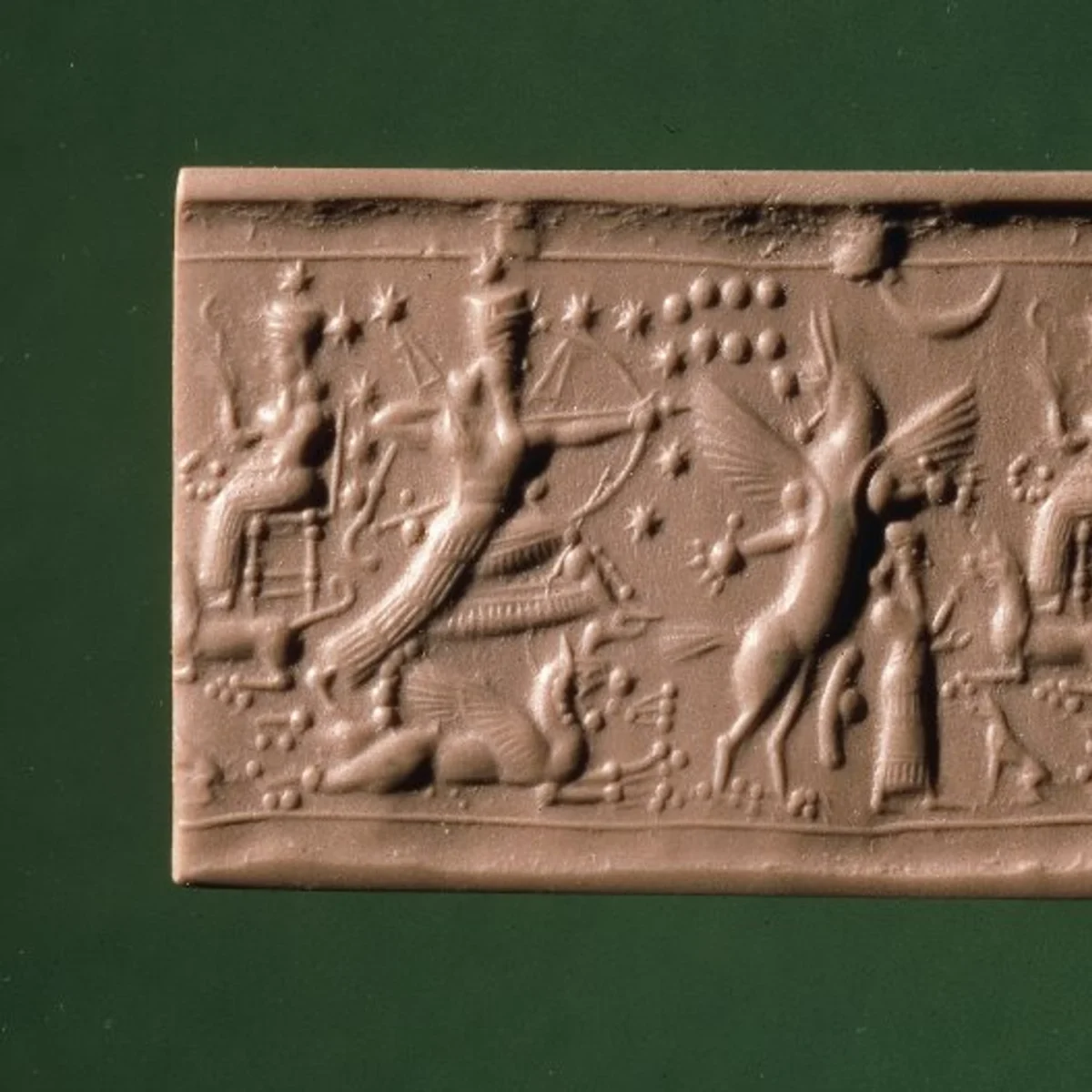
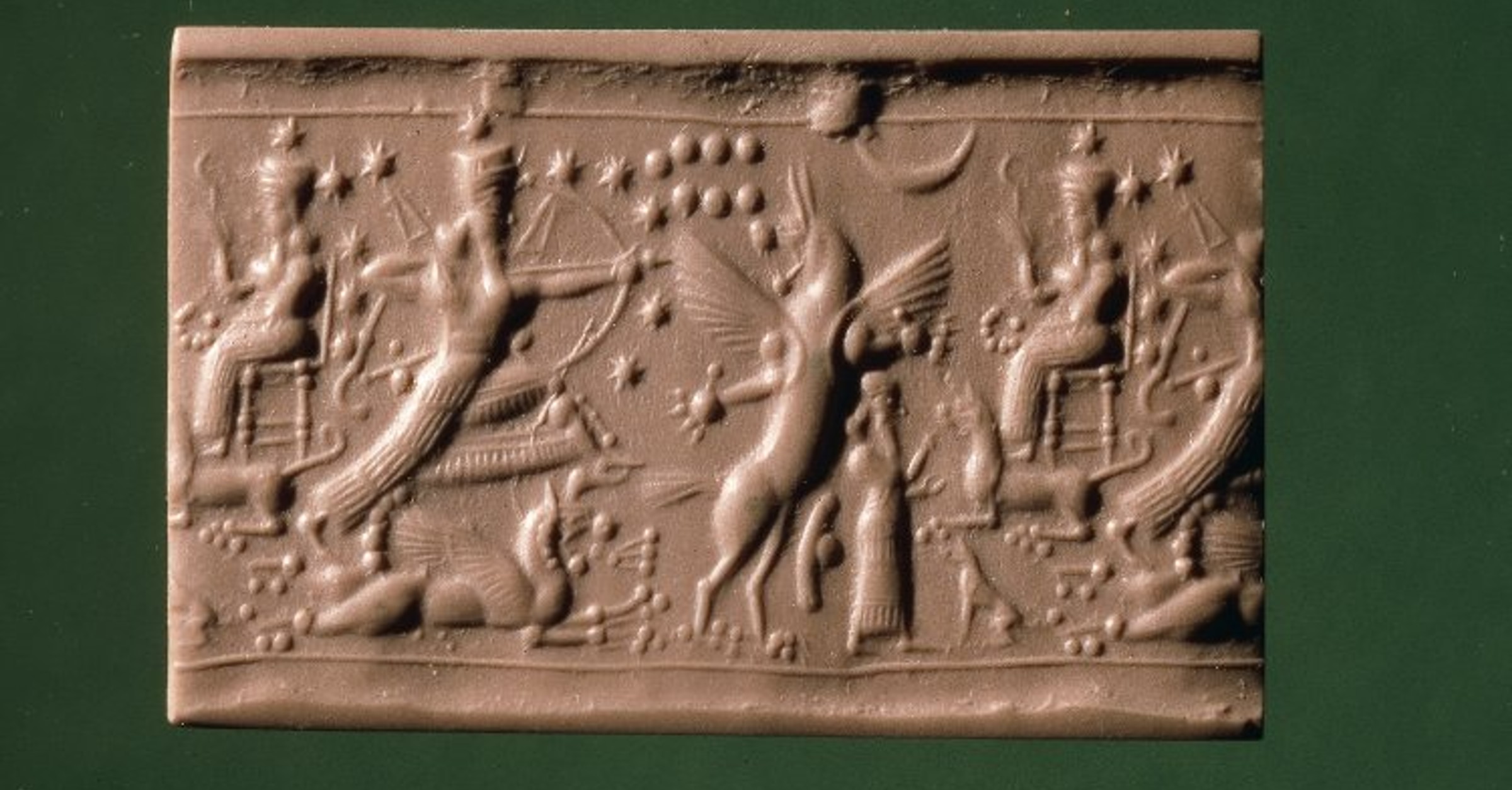
Visually, Ninurta is most often depicted as a powerful warrior, sometimes adorned with upraised wings, signifying his divine might. His iconic armaments include a bow and arrow, and his legendary mace, Sharur – a weapon imbued with sentience, capable of speech and reason. In Babylonian art, he is dynamically portrayed standing or running atop a scorpion-tailed lion-beast, a creature that itself symbolizes strength and ferocity. Yet, even as late as circa 1500 BCE, his agricultural roots remained, with depictions showing him as a complex individual, capable of both heroic feats and mortal flaws, ever connected to growth and harvest.
A Divine Evolution: Ninurta’s Chronology and Transformations
The trajectory of Ninurta’s worship mirrors the dramatic societal changes of ancient Mesopotamia, a land perpetually reshaped by conquest and conflict.
Early Agricultural Roots (Early 3rd Millennium BCE)
Initially, Ninurta’s primary domain was the bountiful earth. Scholar Stephen Bertman succinctly captures this transformation: "Ninurta began his divine career as a god of irrigation and agriculture. In fact, ‘The Instruction of Ninurta’ is the title of an ancient Sumerian ‘farmer’s almanac.’ But with the rise of imperialism he was transformed into a young and vigorous god of war." (Bertman, 124). This shift from a deity of irrigation canals and fertile fields to a formidable warrior god was not sudden but a gradual reflection of Mesopotamia’s burgeoning city-states, which increasingly engaged in militarized campaigns of conquest against one another.
The Rise of the Warrior (2nd Millennium BCE)
By the 2nd millennium BCE, Ningirsu, the early iteration of Ninurta, was firmly recognized as a war god. This era saw his prominence in major literary works like the Babylonian Epic of Anzu, a myth that would later be revised in the 1st millennium BCE, explicitly renaming the hero to Ninurta. Despite the gradual adoption of the name Ninurta (whose meaning remains unknown) by circa 2600 BCE, Ningirsu continued to be referenced in Sumerian texts, but Ninurta became the widely recognized name across Mesopotamia.
A pivotal figure in this period was Gudea of Lagash (reigned 2144-2124 BCE), a ruler renowned for his profound piety. Gudea dedicated himself to Ningirsu, and his successor, Ur-Ningirsu, even adopted the god’s name to honor him. Gudea’s devotion is immortalized in the Gudea Cylinders, two terracotta texts (circa 2125 BCE) recording his dream and the subsequent construction of Ningirsu’s temple – a monumental undertaking detailed in what remains the longest Sumerian text discovered to date, The Building of Ningirsu’s Temple. This epic narrative solidified Ningirsu’s status, associating him not just with agriculture, but with grand civic projects and divine endorsement for earthly rulers.
Imperial Patronage and Assyrian Ascendancy (1st Millennium BCE)
The 1st millennium BCE marked Ninurta’s zenith, particularly with the rise of the Neo-Assyrian Empire. The Assyrians, known for their martial prowess, readily embraced Ninurta, integrating him into their pantheon as the son of their supreme deity, Assur. This period saw unprecedented royal patronage.
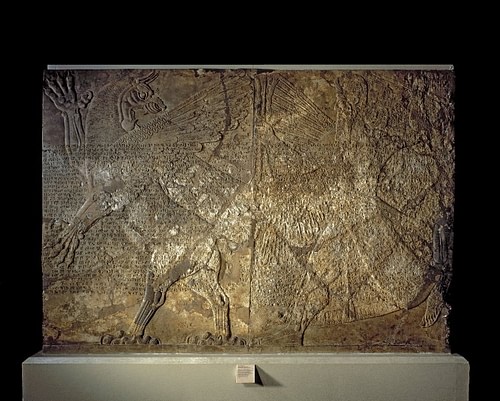
Under the reign of Ashurnasirpal II (884-859 BCE), Ninurta’s cult reached its imperial peak. Ashurnasirpal II, the architect of the new Assyrian capital, Kalhu (modern Nimrud), made the construction of a magnificent temple and towering ziggurat dedicated to Ninurta his premier project. The walls of this temple were richly decorated with reliefs celebrating Ninurta’s triumphs, cementing his image as the empire’s divine champion. Seals from this era often depicted Assur as a winged disc, with Ninurta’s name inscribed beneath, signaling their near-equal standing and Ninurta’s crucial role in the imperial ideology.
Numerous Assyrian kings before and after Ashurnasirpal II also honored Ninurta. Tukulti-Ninurta I (circa 1244-1208 BCE) famously adopted the god’s name, crediting Ninurta with his spectacular military victories. Tiglath-Pileser I (circa 1115-1076 BCE) and Adad Nirari II (circa 912-891 BCE) similarly invoked the god for protection and aid in military matters.
However, Ninurta’s prestige was not entirely uninterrupted. Sargon II (722-705 BCE), while building his own capital, Dur-Sharrukin ("Fortress of Sargon"), shifted royal favor towards Nabu, the god of writing, who was also considered a son of Assur. This temporary decline was short-lived, as Sargon II’s successors, Esarhaddon (681-669 BCE) and Ashurbanipal (668-627 BCE), once again elevated Ninurta, frequently mentioning him in royal inscriptions and associating him with their military successes.
Decline and Lingering Influence (Post-612 BCE)
The fall of the Neo-Assyrian Empire in 612 BCE, at the hands of a coalition of Medes, Babylonians, Persians, and Scythians, marked a catastrophic end to Assyrian power. Great cities like Nineveh, Kalhu, and Ashur were sacked, and the statues and temples of their gods, including Ninurta, were destroyed. With the collapse of the imperial structure, Ninurta, intimately tied to Assyrian rule, largely fell out of favor as a worshipped deity. Yet, his heroic narratives and archetypal struggles would continue to resonate, influencing the myths and legends of subsequent cultures.
Unveiling the Narrative: Supporting Data and Mythological Insights
Ninurta’s character is most vividly portrayed through the rich tapestry of Mesopotamian myths and the practical wisdom attributed to him.
The World’s First Farmer’s Almanac: "The Instruction of Ninurta"
The Sumerians were pioneers in technological invention, particularly in agriculture. Orientalist Samuel Noah Kramer highlights their ingenuity: "Some of the more far-reaching technological achievements of the Sumerians were connected with irrigation and agriculture. The construction of an intricate system of canals, dikes, weirs, and reservoirs demanded no little engineering skill and knowledge." (Kramer, 104). It is within this context of advanced agricultural practice that "The Instruction of Ninurta" finds its significance.
Dating between 1700 and 1500 BCE, this manual, considered the world’s first farmer’s almanac, provides meticulous instructions on preparing the earth, planting seeds, deterring birds, and proper harvesting techniques. Framed as advice from a father to his son, the text concludes with a revelation: "These are the instructions of Ninurta, son of Enlil. O Ninurta, trustworthy farmer of Enlil, your praise is good." This divine attribution elevated practical agricultural knowledge to a sacred decree, lending immense authority to the guidance provided and showcasing Ninurta’s enduring connection to the land even as his martial aspect grew.
Ninurta in Myth: Champion of Order, Master of Chaos
Ninurta’s power and position within the Mesopotamian pantheon lent significant weight to any document attributed to him, especially considering he would have had to momentarily set aside his heroic feats to offer such mundane, yet vital, suggestions. His myths share thematic parallels with those of the Babylonian god Marduk, both triumphing over chaotic forces to establish order, and the later Greek hero Heracles, particularly in his trials and occasional struggles with hubris.
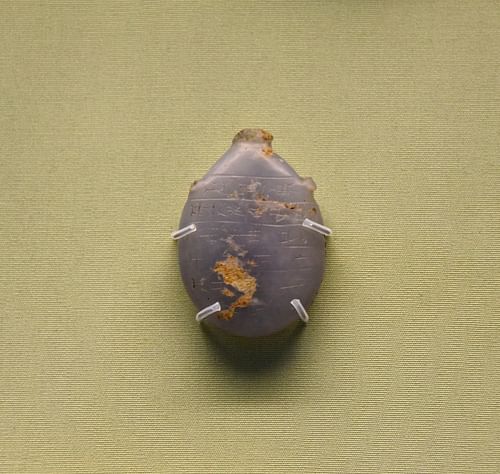
The Epic of Anzu: One of Ninurta’s most celebrated exploits is chronicled in The Epic of Anzu, also known as The Defeat of Zu. The myth recounts how the monstrous Anzu bird, a divine creature of immense size, audacioussly stole the Tablets of Destiny from Enlil while he was washing his face. These tablets were not merely symbols of authority; they contained the fates of both gods and mortals, legitimizing the rule of their possessor. When the other gods hesitated, only Ninurta stepped forward to pursue the thief.
The Tablets of Destiny, however, possessed the power to reverse time. As Ninurta fired his arrows, they would miraculously disintegrate mid-air, their components returning to their origins: shafts to the canebrake, feathers to birds, stone tips to the quarry. Even Ninurta’s bow reverted to wood, and the bowstring to sheep’s wool. Driven back, Ninurta invoked the south wind, a force under his own dominion, which tore off Anzu’s wings, bringing the creature crashing to the ground. Ninurta then slit Anzu’s throat, recovering the Tablets of Destiny and restoring cosmic order.
Lugale: The Exploits of Ninurta: This epic poem, Lugale, details Ninurta’s confrontation with Asag (or Agag), a monstrous demon of sickness and disease dwelling in the underworld. The conflict is instigated by Sharur, Ninurta’s sentient mace, which praises its master’s strength and encourages him to battle Asag. Ninurta initially hesitates, even "flees like a bird" upon seeing Asag’s formidable army of rock monsters and rebellious plants. However, Sharur’s continued encouragement, reminding Ninurta of past glories, spurs him to face his enemies. Ninurta utterly destroys Asag and his forces with his mace, bow, and other weapons.
The aftermath of this victory, however, presented a new crisis. Asag and his followers had held back the primeval waters of the underworld. With their defeat, these brackish waters surged, threatening to flood the land and render it infertile. Ninurta, ever the problem-solver, piled the corpses of his enemies to form a massive wall, then sculpted them higher into a mountain range, effectively containing the underworld waters. He then raised the River Tigris, ensuring fresh water for the land. Kramer’s translation beautifully captures the outcome: "Behold, now, everything on earth/Rejoiced afar at Ninurta, the king of the land/The fields produced abundant grain/The vineyard and orchard bore their fruit/The harvest was heaped up in granaries and hills/The lord made mourning to disappear from the land/he made happy the spirit of the gods." (Kramer, 152). Ninurta’s mother, Ninmah, arrives to celebrate his triumph, and he dedicates the new mountain to her, renaming her Ninhursag ("Lady of the Mountain"). The goddess Nisaba then records this monumental achievement, and the poem concludes with a powerful endorsement of writing, the art that preserves such moments eternally.
The Slain Heroes: In another cycle of myths, Ninurta undertakes a series of trials reminiscent of Heracles’ Labors, defeating an array of bizarre creatures, including the Six-Headed Wild Ram, the Palm-Tree King, the Strong Copper, and the Seven-Headed Snake. These antagonists range from inanimate objects like the Magillum Boat (which ferried souls to the underworld) to personifications of valuable materials. This myth, with its theme of successive heroic victories, strongly suggests a direct influence on the later Greek narratives of Heracles.
Ninurta and the Turtle: Not all of Ninurta’s tales portray him in an unblemished heroic light. In Ninurta and the Turtle, his pride proves his downfall. Set after his victories over Anzu and Asag, the story finds Ninurta being honored by Enki, the god of wisdom and water, in his home, the absu (primeval watery depths) of Eridu. While Enki praises Ninurta, the hero, angered by mere accolades, desires even greater glory, setting "his sights on the whole world." Enki, perceiving his arrogance, fashions a giant turtle and releases it behind Ninurta. The turtle bites and holds Ninurta’s ankle, and as they struggle, the creature digs an enormous pit into which both fall. Enki then mocks the trapped Ninurta, asking, "You who made great claims – how will you get out now?" Though the tablet is broken, it is understood that Enki’s scheme successfully humbled Ninurta, forcing him to recognize his limitations and accept praise with gratitude rather than seeking endless glory.
Royal Endorsement and Religious Practices: Official Responses
The extensive royal patronage and religious practices surrounding Ninurta underscore his profound significance in Mesopotamian society, particularly within the Assyrian Empire.
Royal Patronage and Imperial Cult
The Assyrian kings’ "official response" to Ninurta was nothing short of fervent devotion. Taking on the god’s name, as Tukulti-Ninurta I did, was a powerful declaration of divine favor and a means of legitimizing their rule and military campaigns. Kings consistently invoked Ninurta in battle, crediting him with their successes and attributing their spectacular military victories to his intervention.
Ashurnasirpal II’s dedication of Kalhu as the capital and his massive building projects there epitomize this imperial embrace. The Temple of Ninurta in Kalhu was not merely a place of worship; it was a vibrant civic hub that "ministered to the poor, orphans, the homeless, and found work for itinerant laborers." This blend of religious reverence and social welfare highlights how the god’s cult was deeply interwoven with the functioning of the state and the well-being of its populace. The fame of Kalhu’s grand temple and towering ziggurat dedicated to Ninurta spread far beyond Mesopotamia, becoming a symbol of Assyrian power and piety.
Shifting Tides of Favor
Even within the context of royal patronage, there were subtle shifts. Sargon II’s temporary favoring of Nabu, the god of writing and knowledge, reflects a moment when intellectual and administrative prowess might have been emphasized over sheer military might. However, Ninurta’s swift restoration to prominence under Esarhaddon and Ashurbanipal demonstrates his enduring appeal as a champion and protector, essential for an empire constantly engaged in warfare and territorial expansion. The fact that the queens of the empire were buried at Kalhu, Ninurta’s city, while kings were buried at the traditional site of Ashur, suggests a continuing, albeit nuanced, respect for Kalhu as a sacred imperial center.
Echoes Through Time: Implications and Enduring Legacy
Ninurta’s story did not end with the destruction of the Assyrian cities. His influence reverberated through subsequent cultures, leaving an enduring legacy.
The Biblical Connection: Nimrod and Calah
Perhaps one of the most intriguing implications of Ninurta’s cult is its connection to the Bible. The fame of the hero-god and his city, Kalhu, is attested in Genesis 10:8-12, where Ninurta is identified with Nimrod, described as "a mighty hunter before the Lord," and Kalhu as Calah, "a great city." This biblical reference testifies to the widespread renown of Ninurta and his imperial city in the ancient Near East.
While some scholars have attempted to link the biblical Nimrod directly to Tukulti-Ninurta I, this claim is generally considered untenable. It is more plausible that the Hebrew scribes who authored the Genesis narrative remembered the profound association between Ashurnasirpal II and Ninurta’s city, Kalhu, which later became known as Nimrud in the 19th and 20th centuries by archaeologists who took it for the city of Nimrod. This cultural memory underscores the deep impact Ninurta’s cult had on neighboring peoples.
Cultural Transmission: The Proto-Heracles
The striking thematic parallels between Ninurta’s myths and those of the Greek hero Heracles (Roman Hercules) are a testament to cultural transmission across ancient civilizations. The Slain Heroes myth, with its series of trials against monstrous adversaries, clearly prefigures Heracles’ famous Labors. Both deities embody the archetype of the strong, often flawed, hero who battles forces of chaos, protects humanity, and undertakes seemingly impossible tasks. Even the moral lesson of humility, as seen in Ninurta and the Turtle, finds echoes in the Greek narratives where heroes like Heracles or Achilles grapple with their own pride. This cross-cultural resonance highlights Ninurta’s role as a foundational heroic archetype.
The Enduring Archetype
Ninurta’s journey from a god of agriculture to a warrior champion against chaos, yet retaining his connections to healing and the earth, speaks to a fundamental human understanding of the divine. He represents the complex interplay between humanity’s reliance on nature and its drive for order, defense, and expansion. His story reflects the evolution of societies themselves – from agrarian communities to militarized empires – and the gods they created to embody their highest aspirations and deepest fears.
Though his temples lie in ruins and his name is no longer invoked in prayer, the hero-god Ninurta lives on through the echoes of his myths, influencing narratives of heroism, divine justice, and the eternal struggle between order and chaos, demonstrating the profound and lasting impact of ancient Mesopotamian thought on the human story.