The Cartography of Memory: Christian Quintin and the Synthesis of Surrealism and Landscape
I. Main Facts: A Unified Vision of the Psyche and Nature
Christian Quintin does not merely paint what he sees; he paints the resonance of memory and the pre-linguistic architecture of the human soul. For over four decades, the French-born, California-based artist has cultivated a body of work that defies the reductive labels of modern art. His practice is a rare synthesis of Romanticism, Surrealism, and classical discipline, resulting in what critics often describe as a "visual philosophy."
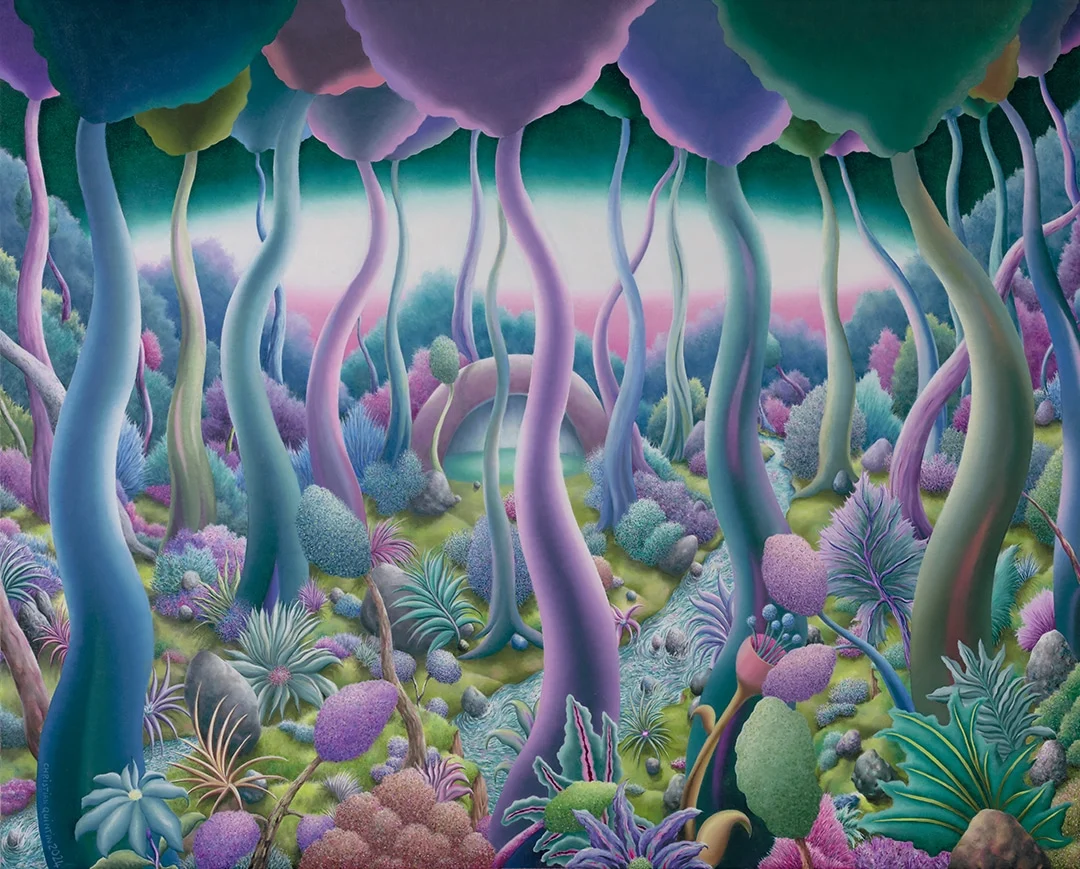
Quintin’s work is characterized by an extraordinary technical precision, often utilizing pen and ink, oil, graphite, and pastel to create images that feel like déjà vu. His canvases are populated by trees that sway with the grace of dancers, faces that dissolve into architectural interiors, and landscapes that appear to breathe with sentient intent. Unlike the jarring or intentionally shocking Surrealism of the early 20th century, Quintin’s approach is invitational. He eschews slogans and manifestos in favor of a poetic invitation: "See the art as one would read poetry, hopeful that one would wander into its imagery."
Operating from his studio in Northern California, Quintin has bridged two distinct worlds—the moody, myth-laden coastlines of his native Brittany and the vibrant, sacred ecology of the American West. This dual heritage has allowed him to develop a symbolic language that connects inner consciousness with outer terrain, creating a "kaleidoscopic consciousness" that has recently captured the attention of the international art market, from Paris to Seoul.

II. Chronology: The Atlantic Bridge and the Evolution of Style
1957–1974: The Roots in Brittany
The foundation of Quintin’s aesthetic was laid in Saint Brieuc, a port town on the northern coast of Brittany, France. Born in 1957, Quintin spent his formative years immersed in a landscape of ruined castles, storm-lashed cliffs, and the melancholic beauty of the Atlantic. A recurring motif in his work, the L’Île de la Comtesse, became a mythic point of reference—a solitary island that represents the isolation and storybook aura that would later permeate his surrealist compositions.
1975–1980: The Discipline of Paris
In 1975, Quintin moved to Paris to study at the prestigious École des Beaux-Arts. It was here that his romantic instincts were refined through classical rigor. Under the tutelage of the academy, he mastered the precise draftsmanship and control of form that define his current work. While he absorbed the legacy of French Surrealism, he found himself more aligned with the Symbolists and the 19th-century Romantics, seeking to reveal hidden truths rather than merely provoke the viewer.
1981–1998: The California Integration
The most significant turning point in Quintin’s life occurred in 1981 when he relocated to Northern California. Settling in the vineyards and valleys of Sonoma County, he discovered a second vocabulary in the rugged beauty of the Pacific coast and the ancient groves of the West. He famously noted, "I feel the same spirit in a tree as in myself." During this period, he established himself as a prominent regional artist, completing numerous public commissions, murals, and hospital lobby installations across California, while winning accolades such as the Grumbacher Award (1987) and the California State Fair Award of Excellence (1990).

1999–Present: Global Recognition
In 1999, Quintin’s career entered a new echelon when he began a collaboration with the Vorpal Gallery, the institution famously responsible for introducing M.C. Escher to the American public. This association solidified his reputation as a master of "mind-bending" technical art. By the 2020s, with representation by Lorin Gallery (Los Angeles and Paris), Quintin’s work transitioned to the global stage, appearing at major international fairs including KIAF in Seoul and Art Central in Hong Kong.
III. Supporting Data: Technical Mastery and Symbolic Depth
Quintin’s portfolio is divided into two primary modes—surrealist "interior constellations" and "emotive landscapes"—though he views them as a single, unified practice.
The Surrealist Mind-Maps
His surrealist works are characterized by "kaleidoscopic consciousness," where boundaries between the self and the environment are erased.

- The Aviary: A seminal piece that required six months of labor. In this work, Quintin’s face emerges from a crystal, his neck transforms into a tree trunk, and his hair becomes a leafy canopy. It is an ecosystem of the self, rendered with microscopic detail.
- La Porte Ouverte: Inspired by the Sufi poet Rumi’s question, "Why stay in prison when the door is wide open?", this work took seven months to complete. Using dense cross-hatching and ink work, Quintin creates a visual meditation on freedom and the blurring of logical boundaries.
The Emotional Terrains
Quintin’s landscapes are not documentations of geography but rather "emotional terrains" where color serves as a proxy for feeling.
- Color Theory: In pieces like A Lake Color of Emeralds, Quintin utilizes a non-naturalistic palette—brown-orange skies and violet undertones—to evoke specific moods.
- Arboreal Sentience: Works such as Leaves of Absence and Les Amants treat trees as sentient actors. In Les Amants, two trees are depicted in an embrace, suggesting that nature is the ultimate mirror of human intimacy.
The Process
Quintin’s methodology is a rejection of modern "automatism." While he advises artists to "draw the first thing that comes to mind" to capture intuition, the execution is slow and deliberate. He matches each work to a specific medium—pastel for light-filled atmosphere, oil for depth, and graphite or ink for structural complexity. This "slow art" approach stands in direct opposition to the rapid-fire consumption of the digital age.
IV. Official Responses: Critical and Curatorial Perspectives
The critical reception of Christian Quintin’s work has remained remarkably consistent over four decades, focusing on the redemptive power of beauty and technical excellence.

Alhia Warren, a noted art critic, described his work as a "beautiful intimate mystery," highlighting the way his paintings pull the viewer into a private, meditative space. Similarly, Suzanne Munich titled her review "Mental Landscapes," acknowledging that Quintin’s geography is as much about the mind as it is about the earth.
In a 2022 review for the Calabi Gallery, curators noted a profound cultural shift in how Quintin’s work is perceived: "In an era largely devoid of it, his work is beautiful. We could all use more beauty in our lives." This sentiment reflects a growing exhaustion with the irony and cynicism that have dominated contemporary art for decades. Quintin’s work is seen as a necessary corrective—a "wondrous sanctuary for the soul."
Dan Taylor, writing for the Press Democrat, used the phrase "Emerging Beauty" to describe Quintin’s career trajectory. This "emergence" is particularly notable because Quintin did not change his style to meet market trends; rather, the art world, fatigued by conceptual minimalism, "caught up" to his meticulous and soulful representationalism.

V. Implications: Beauty as Resistance and the Visionary Continuum
The rise of Christian Quintin’s international profile carries significant implications for the contemporary art world. His success suggests a resurgence of interest in "Visionary Art"—a movement that seeks to make the impossible legible. While he shares DNA with the psychedelic spiritualists of the 1960s Northern California scene, his work is distinguished by its classical restraint and European discipline.
The Bridge Between Traditions
Quintin serves as a vital bridge between three distinct traditions:
- French Surrealism: The intellectual exploration of the subconscious (Dalí, Magritte).
- American Visionary Art: The spiritual and ecological connection to the land.
- Classical Realism: The rigorous technical training of the Beaux-Arts.
Beauty as a Form of Defiance
Perhaps the most significant implication of Quintin’s legacy is the reclamation of "beauty" as a radical act. In a contemporary art market often preoccupied with didactic messages and political critique, Quintin’s refusal to provide a "message" is itself a statement. He argues that by creating something beautiful, he provides a space for the viewer to feel rather than to think.
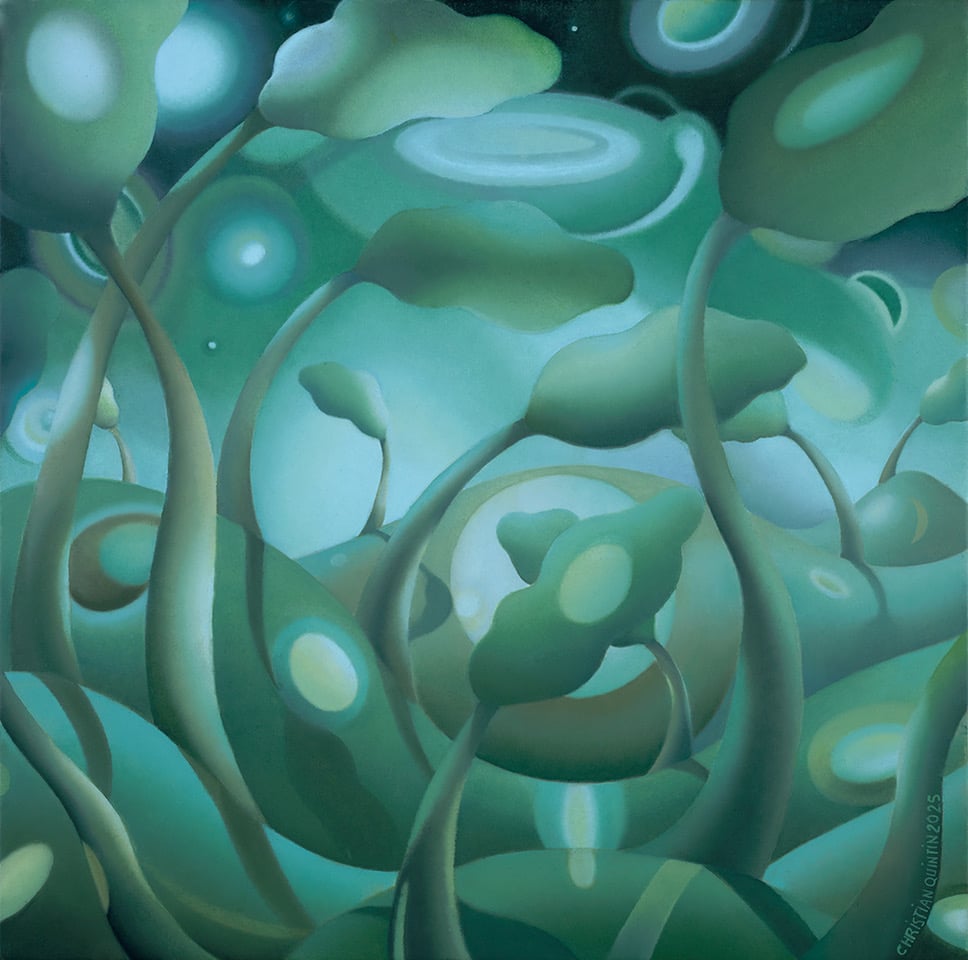
This philosophy positions art as a form of resistance against the speed, spectacle, and fragmentation of modern life. By demanding slowness—both in the creation and the viewing of the work—Quintin restores a sense of wonder to the artistic experience.
VI. Conclusion: A Legacy of Wonder
As Christian Quintin continues to exhibit at prestigious venues like the Morrison Gallery in Connecticut and the Lorin Gallery in Paris, his influence as a master of the "inner/outer world" grows. He remains an artist of the "slow burn," a practitioner who has spent forty years perfecting a language that speaks to the universal human experience of nature and memory.
His work reminds us that the landscape is not something we merely inhabit, but something that inhabits us. Whether through the moody cliffs of Brittany or the golden hills of Sonoma, Quintin offers a "wondrous sanctuary," proving that when art is made with sufficient attention and soul, it becomes a permanent map of the human spirit. For those who encounter his work, the advice is simple: take your time, notice the metaphors buried in the bark, and listen to the color. In the world of Christian Quintin, beauty is not an escape—it is a homecoming.