Merihim: The Shepherd of Malignancy and the Looming Shadow of the Galchutt
A detailed examination of Merihim, a potent entity from The Book of Fiends, revealing his origins, devastating capabilities, and profound implications for cosmic order.
In the sprawling pantheon of fictional adversaries that challenge the boundaries of imagination, few figures embody the insidious dread of cosmic horror and biological corruption as potently as Merihim. Known as the "youngest of the Galchutt" and the "Shepherd of Malignancy," this shambling creature, intricately detailed within the pages of The Book of Fiends: A Malefic Bestiary for 5E, represents a chilling synthesis of ancient servitude, biological warfare, and existential decay. Far from a mere brute, Merihim is a master architect of plague and mutation, whose very existence is a testament to the enduring, vile works of elder powers and a harbinger of a foreseen epoch of dissolution.
His legend begins in an age long past, when the supreme "Masters" had retreated, and a profound stillness, dubbed the "Long Quiet," descended upon the vast, subterranean "Caverns of the Galchutt." Yet, even in this era of dormancy, Merihim toiled ceaselessly, an unwavering servitor tending to the most grotesque legacies left to his care. His story is not merely one of monstrous power, but of an unsettling devotion to the propagation of pestilence, a commitment that ultimately led to his willing entry into a temporal slumber, awaiting a cataclysmic "Time of Dissolution." This article delves into the unsettling narrative of Merihim, dissecting his origins, the nature of his horrific creations, his unique physiology, and the overarching cosmic philosophy he embodies, as revealed through fragmented lore and detailed descriptions.
Main Facts: The Genesis of Cosmic Pestilence
Merihim emerges from the abyssal lore of the Galchutt as a figure of singular significance, a creature whose primary function is the systematic development and deployment of disease and mutation on a cosmic scale. He is not merely a carrier of plagues but their meticulous curator and perverse artisan. His existence is inextricably linked to the "Cavern of Dripping Darkness," or Eurl-kallat Dath, a place consecrated to the propagation of contagion and biological perversion.
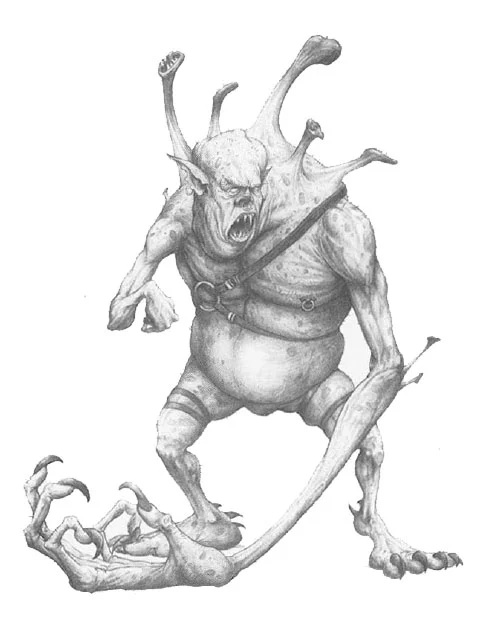
This entity is characterized by a horrifying physical form that reflects his malefic purpose. Bearing the dreaded "touch of Abhoth," Merihim is a creature of profound asymmetry and grotesque adaptation. His right arm, withered by a cosmic palsy, stands in stark contrast to his left, which has grown to immense, twisted proportions. From his hunched back, described as "miasmic fecundity," sprout six prehensile, fleshy stems, each terminating in a toothy maw. These appendages serve as direct conduits to corrupted organs within his body, breeding grounds for the most virulent diseases. From these "maws of cancerous life," Merihim can unleash the "smotherfume," a noxious cloud of concentrated, polluted disease, capable of devastating organic life.
Beyond his immediate destructive capacity, Merihim’s narrative arc includes a pivotal moment of "ascension." Recognizing his tireless service during a period of cosmic transition, the "Princes" – successors or perhaps lieutenants to the dormant Masters – extended their recognition. In response, Merihim willingly embraced a "servitude of oblivion," entering a ritualistic slumber and pledging the enigmatic "vows of the Natharl’nacna." This act binds him to a future awakening, where his true service will be remembered and unleashed during the prophesied "Time of Dissolution," a period destined to usher in an era of profound chaos and anarchic liberty. His story thus transcends simple monster lore, embedding itself into a complex mythos of cosmic cycles, power transitions, and the ultimate triumph of unbridled entropy.
Chronology: A History of Devotion and Decay
The life—or rather, the tireless existence—of Merihim is charted across vast cosmic epochs, each marked by his unwavering dedication to the propagation of malignancy. His story is a chilling chronicle of devotion to chaotic principles, meticulously unfolding over millennia.
The Age of the Masters and the Long Quiet
Merihim’s origins are rooted in an era preceding recorded history, a time when the "Masters" held sway over the "Caverns of the Galchutt." These Masters, enigmatic and colossal beings, are understood to be the ultimate progenitors of the Galchutt, entities of immense cosmic power and unknowable motives. When the Masters eventually "passed" or withdrew into a deeper state of dormancy, a profound quietude, known as the "Long Quiet," descended upon their vast, subterranean domains. This was not a period of peace, but rather of lingering shadows and latent malevolence. It was during this desolate interregnum that Merihim, identified as one of the "truest of their servitors," continued his grim work. Within the deepest clefts of the earth, particularly in the dreaded Eurl-kallat Dath—the Cavern of Dripping Darkness—he labored tirelessly. His role during this epoch was that of a dedicated custodian, tending to the "vile works" that the Masters had left under his care, preserving and subtly advancing their agenda of cosmic corruption in anticipation of their return or a new directive. This initial period established Merihim not as an independent agent, but as a crucial link in a chain of ancient, malevolent command.
The Genesis of Malignancy: Eurl-kallat Dath
Eurl-kallat Dath is not merely a location but a crucible of cosmic horror, a place where the very air is thick with "pestilence." It is within this "place of kallat dath" (a term suggesting ‘dripping darkness’ or perhaps ‘seeping corruption’) that Merihim’s genius for biological perversion found its ultimate expression. The Galchutt, in their wisdom or their malevolence, had "set the crafty mind of Merihim to work" here. This cavern served as his laboratory, incubator, and proving ground. It was here that "cancerous mutations were given motile form," indicating a profound mastery over cellular deviation and monstrous generation. More disturbingly, it was in Eurl-kallat Dath that "demonic phages waged wars of fecund prosperity." This phrase hints at an ecosystem of engineered contagions, where self-replicating biological agents, imbued with malevolent sentience, competed and evolved, ensuring the most potent and destructive forms would proliferate. Merihim’s role was to orchestrate this macabre dance of decay, guiding the evolution of pathogens and mutations to achieve ever-greater levels of destructive efficiency.
The Era of Perfection: Merihim’s Creations
From the "incubation vats and wild proving fields of Eurl-kallat Dath," Merihim systematically "perfected all manner of diseases and mutations." His creations were not haphazard but the result of deliberate, twisted artistry. He is credited with having "wrought the arts of Jessuk to fungal life," a cryptic statement that implies a profound understanding and manipulation of mycological forms to serve destructive ends. Jessuk, in this context, could refer to an ancient, forgotten biological principle or a specific, potent form of organic corruption that Merihim resurrected and weaponized. The implication is a deep, unnatural mastery over life at its most fundamental level, transforming benign or even beneficial biological processes into vectors of horror. Furthermore, Merihim "exercised the corruption of nature’s order with its own hand." This suggests a perverse mimicry, where the natural mechanisms of life, growth, and decay are twisted against themselves. He didn’t just introduce alien plagues; he corrupted the very essence of existing ecosystems, turning their inherent processes into tools of their own destruction. This level of manipulation speaks to a deep, intimate, and utterly vile understanding of biology, deployed with singular focus on entropy and decay.
The Transition of Power: Princes and the Slumber
As cosmic tides turned, a new hierarchy emerged or asserted itself. The "Princes were drawn into their web," and the "Masters in their chains were taken into their slumber." This denotes a significant shift in the cosmic order, possibly a period of vulnerability or strategic withdrawal for the supreme Masters, with the Princes stepping into a more active, albeit perhaps constrained, role. While these grand cosmic events unfolded, Merihim remained steadfast in his devotion. He "still labored within his cavern," continuing his work without pause or distraction. For "long years thereafter, he labored still," a testament to his unwavering dedication even as the greater powers around him shifted. This steadfastness did not go unnoticed. The Princes, "though caught still in their web," observed Merihim’s "mighty service" from their vantage point. His sustained, singular focus on developing and perfecting biological scourges evidently resonated with their own dark agendas, marking him as a servitor of exceptional value.
The Vows of Oblivion: Merihim’s Ascension
The recognition from the Princes culminated in a profound act of "ascension." They "reached out to the Shepherd of Malignancy," and Merihim, in turn, "answered their call and fulfilled the rites of fealty unto their name." This was not a mere pledge of loyalty but a sacred, binding ritual. Consequently, Merihim "became the one who willingly entered the Slumber," echoing the withdrawal of the Masters, but with a unique, purposeful commitment. He pledged the "vows of the Natharl’nacna even in the Time of Loss," binding himself to a "servitude of oblivion." The Natharl’nacna vows are likely a profound pact, sealing his essence into a state of suspended animation, a dark promise of future awakening. This "Time of Loss" could refer to the period of the Masters’ slumber, emphasizing the self-sacrificial nature of his commitment. However, his slumber is not an end but a deferment. The lore explicitly states: "But when the Time of Dissolution comes, the truth of his service shall be remembered." This prophesied "Time of Dissolution" is the ultimate goal, an era of cosmic unraveling where Merihim’s perfected plagues will be unleashed upon the cosmos, fulfilling the chaotic will of his masters and ushering in an age of "resplendent liberty" from the perceived tyranny of order.
Supporting Data: The Anatomy of Cosmic Horror
Merihim’s terrifying efficacy as a progenitor of pestilence is deeply intertwined with his bizarre and grotesque biology, a physical manifestation of his cosmic corruption and dedication to entropy.
The Horrific Physiology of Merihim
Merihim’s body is a canvas of cosmic horror, a testament to the unnatural forces that have shaped him. His most striking feature is the "touch of Abhoth." Abhoth, a concept often associated with the primordial, formless source of all abomination in certain mythologies (like Clark Ashton Smith’s Hyperborean Cycle), implies a direct connection to the fundamental wellspring of corruption. This touch has warped Merihim’s very essence, rendering his "equations of life" unbalanced. This imbalance manifests physically as a profound asymmetry: his right arm is "shriveled with palsy," a symbol of decay and diminishment, while his left arm has grown to "immense, twisted proportions," representing uncontrolled, cancerous growth and unnatural strength. This dichotomy perfectly encapsulates his role as a master of both blight and burgeoning, monstrous life.
His hunched back is described as "miasmic fecundity," a phrase evoking a perpetually festering, fertile ground for disease. From this horrifying mass sprout "six prehensile, fleshy stems," each ending in a "toothy maw." These stems are not merely appendages; they are "direct conduits to fetid and corrupted organs" within his body. These organs are not for digestion or respiration in a conventional sense but serve as living laboratories and breeding grounds for an endless array of "foul diseases." The maws themselves are aptly named "maws of cancerous life," capable of expelling the "smotherfume." This smotherfume is no ordinary gas; it is a "cloud of noxious, polluted disease," a concentrated aerosolized plague. Its effects are devastating, causing rapid decay, mutation, and agonizing death. It is a signature weapon, a literal breath of pestilence, embodying Merihim’s ultimate purpose: to spread contagion and accelerate the decay of all organic order. The precise composition of the smotherfume is likely complex, a cocktail of viral, bacterial, and fungal agents, all engineered for maximum lethality and adaptability.
The Philosophy of Chaos and Anarchy
The concluding exhortation in Merihim’s lore offers a profound glimpse into the ideological underpinnings of the Galchutt and their servitors. It is a direct appeal to those who would "serve the will of Chaos," urging them to "reflect upon the Faith of Anarchy" and "covet only that deepest of all communions." This is not merely about destruction for destruction’s sake; it is a philosophical stance against perceived cosmic tyranny. The "will of Gods" is explicitly "forsaken as tyranny," implying that divine order, structure, and moral codes are seen as restrictive shackles. In contrast, the "will of Demons" (or more broadly, entities aligned with Chaos) is upheld as "resplendent liberty."
Merihim, as the "Shepherd," embodies this philosophy. He shepherds not flocks of creatures, but the very processes of decay and mutation, guiding them towards a state of ultimate freedom from imposed order. This "liberty" is one of unbridled entropy, where life mutates without design, matter devolves into its base components, and existence is freed from the constraints of form and purpose. His work, therefore, is an act of liberation from the natural order, a dismantling of creation to return it to a primordial, chaotic state. This perspective offers a disturbing rationale for the Galchutt’s destructive agenda, transforming cosmic horror into a twisted form of liberation theology.
The Book of Fiends: A Source of Cosmic Horror
Merihim’s detailed portrayal is drawn from The Book of Fiends, published by Green Ronin Publishing, a renowned name in tabletop role-playing game (TTRPG) content. This bestiary has garnered significant acclaim within the TTRPG community, particularly for its innovative and often terrifying interpretations of infernal and abyssal entities. Unlike many generic monster manuals, The Book of Fiends dives deep into the lore, motivations, and unique biologies of its creatures, making them far more than mere stat blocks.
The book is celebrated for its ability to inject genuine cosmic horror into traditional fantasy settings, offering GMs (Game Masters) and players alike adversaries that challenge not only combat prowess but also sanity and understanding of the universe. Merihim is a prime example of this design philosophy. His complex backstory, unique physiology, and connection to a broader, ancient mythology make him a compelling and unsettling antagonist. The bestiary’s approach to fiends often involves intertwining them with fundamental forces of the cosmos, such as decay, entropy, and the distortion of reality itself, elevating them beyond simple "evil monsters" to existential threats. For D&D 5E, The Book of Fiends provides a rich tapestry of foes that can drive entire campaigns, introducing themes of biological warfare, creeping corruption, and the ultimate futility of order against primordial chaos. Its continued relevance and praise within the community attest to its quality and lasting impact on how dark fantasy creatures are conceptualized and utilized in gaming.
Official Responses: Design Intent and Interpretations
As a fictional entity, "official responses" regarding Merihim primarily stem from the creative vision behind The Book of Fiends and its reception within the TTRPG community. The design notes provided in the original text offer a crucial insight into his creation.
Creator’s Intent and Design Philosophy
The original "DESIGN NOTES" explicitly state: "Merihim is from The Book of Fiends. I’ve spoken many times before about how fantastic this bestiary is. This is another example of how much use I’ve gotten out of it over the years." This brief commentary, presumably from the author or a reviewer affiliated with the Alexandrian, underscores Merihim as a prime example of the bestiary’s excellence. The "fantastic" nature of The Book of Fiends lies in its ability to create creatures that are not just powerful, but deeply unsettling and steeped in rich, albeit horrifying, lore.
Merihim exemplifies several key design philosophies common to effective cosmic horror in TTRPGs:
- Unfathomable Scale: His connection to the "Masters" and "Princes," and his role in a "Time of Dissolution," situates him within a cosmic narrative far grander than typical dungeon crawls. This evokes a sense of smallness and insignificance for player characters.
- Biological Horror: His grotesque physiology, emphasis on disease, mutation, and "miasmic fecundity" taps into primal fears of bodily corruption and uncontrollable decay. This makes him viscerally disturbing, not just conceptually.
- Philosophical Underpinnings: The concluding philosophical statement about Chaos, Anarchy, and forsaking divine tyranny elevates him beyond a mere monster. He becomes an embodiment of a cosmic ideology, making him a more complex and thought-provoking antagonist.
- Utility for GMs: The fact that the author has gotten "much use" out of the book over the years implies that creatures like Merihim are designed to be highly versatile. They can serve as primary antagonists, sources of localized plagues, or even as cryptic lore-givers in a campaign, demonstrating the longevity and adaptability of the design.
Community Reception and Impact
Within the TTRPG community, entities like Merihim are often lauded for their capacity to introduce unique challenges. GMs appreciate the depth of lore, which allows for multifaceted encounters beyond simple combat. Merihim could be encountered indirectly through the lingering effects of his creations—widespread plagues, mutated landscapes, or twisted cults dedicated to "resplendent liberty" through decay. His presence can force players to confront moral dilemmas, research ancient lore, and engage in non-combat solutions, making him a memorable antagonist. His unsettling visual description and the sheer scale of his potential impact—the "smotherfume" alone could wipe out cities—make him a truly terrifying prospect, generating a palpable sense of dread that enriches the gaming experience. Players encountering his lore might feel a deeper sense of cosmic dread, realizing that some threats are not just powerful, but fundamentally alien and antithetical to all life.
Implications: The Shadow of the Shepherd
The existence and eventual reawakening of Merihim carry profound implications, both within the fictional universes he inhabits and for the broader genre of speculative fiction.
Threat Assessment and In-World Consequences
Should Merihim awaken from his "servitude of oblivion" during the prophesied "Time of Dissolution," the consequences for any world would be catastrophic. His primary function is the systematic deployment of biological weapons of mass destruction. The "smotherfume" alone could depopulate vast regions, transforming vibrant ecosystems into festering landscapes of "miasmic fecundity." Beyond immediate death, his "cancerous mutations" would warp life forms, creating new, terrifying species and fundamentally altering the biological fabric of the planet. Civilizations would collapse under the weight of incurable plagues and rampant mutation. The "corruption of nature’s order" would manifest as widespread ecological collapse, with the very cycles of life and death becoming perverted. Merihim is not merely a localized threat; he represents an existential threat to all organized life, an agent designed to usher in a new epoch defined by chaotic decay and the unmaking of creation. His return would signify the beginning of the end, a period where the fundamental laws governing life and reality itself are unraveled by the will of Chaos.
Broader Thematic Resonance
Merihim’s narrative resonates with several profound themes in fantasy and horror literature. He embodies the cosmic indifference and malevolence often found in Lovecraftian horror, where entities of vast power operate on scales incomprehensible to mortals, driven by alien philosophies. His story also explores the themes of servitude and rebellion: while he is a dedicated servitor, his actions are framed as a path to "resplendent liberty" from "tyranny." This duality forces a disturbing re-evaluation of traditional good and evil, suggesting that even the most destructive acts can be rationalized as a form of liberation from a perceived oppressive order. Furthermore, his biological horror aspects tap into contemporary anxieties about plagues, genetic manipulation, and the fragility of life. Merihim serves as a potent metaphor for uncontrolled destruction, the corruption of beauty, and the relentless march of entropy, themes that find echoes in real-world concerns about environmental degradation and the potential for engineered pathogens.
Legacy in Speculative Fiction
As a creation within The Book of Fiends, Merihim contributes significantly to the evolving landscape of speculative fiction, particularly within the TTRPG genre. He stands as an example of how to craft deeply disturbing and memorable antagonists that extend beyond simple combat challenges. His rich lore provides GMs with a versatile toolkit for crafting complex narratives involving ancient evils, cosmic conspiracies, and the slow, insidious spread of corruption. His presence enriches the tapestry of fantasy worlds, adding layers of existential dread and challenging players to confront not just physical threats, but also philosophical ones. Merihim’s legacy lies in his capacity to inspire creators and terrify players, solidifying his place as a truly unique and chilling entity in the annals of imaginative horror.