The Dhar Rhyth: A Cosmic Abomination and the Void at Reality’s Edge
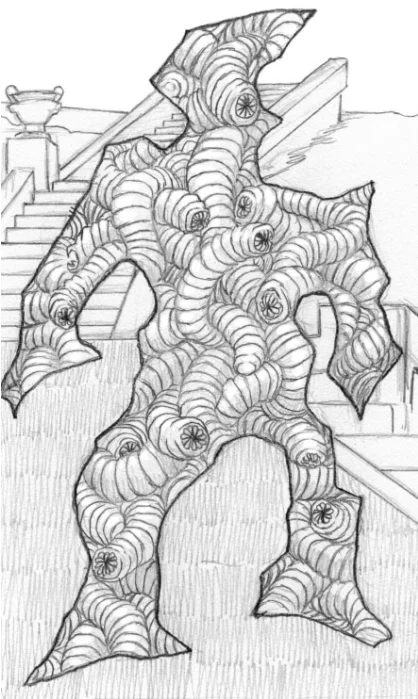
Ancient texts and forbidden lore describe the Dhar Rhyth, one of the dreaded Galchutt, not as a creature, but as a sentient void—a cosmic ‘hole’ that embodies annihilation itself. Far from a mere portal, this entity represents a fundamental rupture in existence, a gaping maw that threatens to unravel the very fabric of reality.
The cryptic opening lines of an unearthed manuscript offer a chilling glimpse into its nature:
“In his mouth the silent scream of the universal spirit became a siren of endless torment. His body was broken upon the rack of the many worlds. In that moment he became as nothing, and nothing became as him.”
These disturbing verses introduce the Dhar Rhyth, an entity whose very presence challenges the concepts of being and non-being. This article delves into the fragmented records concerning this profound horror, synthesizing mythological accounts, scholarly interpretations, and the terrifying implications of its existence.
Main Facts: The Hole in the World
The Dhar Rhyth is not merely a creature of horror; it is horror manifest as a fundamental absence. Classified among the Galchutt, a pantheon of cosmic abominations, the Dhar Rhyth stands out due to its unique embodiment of nullification. It is described, quite literally, as "a hole in the fabric of this world." This is not a metaphorical description; ancient texts posit it as a sentient, ontological rupture.
According to the Lore of the Atapi, an ancient compendium painstakingly translated from cuneiform shards, this cosmic breach leads to what is chillingly termed the "broken realm of befanged worms." This realm is depicted as a place of pure, squirming horror, populated by grotesque, worm-like creatures. Crucially, the Dhar Rhyth is not one of these creatures; it is the hole itself—a gateway to an impossible dimension of dread, yet simultaneously the boundary and the void.
Its essence is defined by annihilation. The Dhar Rhyth is the antithesis of genesis, an entity that has no discernible beginning and, terrifyingly, no end. It is often conceptualized as an "ouroboros inverted"—a serpent consuming not its own tail, but its very existence, leaving behind only the absence of self-sustenance. This entity challenges conventional understanding, blurring the lines between noun and verb, name and genus, identity and property. It is an active principle of cosmic decay, a cosmic eraser, ever-present and eternally consuming.
Chronology: Unfolding Mysteries and Contested Origins
The "chronology" of an entity that defies time and genesis is, by its very nature, convoluted and paradoxical. Rather than a linear progression, the understanding of the Dhar Rhyth has unfolded through a series of fragmented revelations and contested interpretations across various epochs and cultures.
The Atapi Records: Earliest Glimpses
The most foundational accounts appear to stem from the Lore of the Atapi. These texts, recovered as cuneiform shards and meticulously translated, represent some of humanity’s earliest documented encounters with, or perhaps awareness of, the Dhar Rhyth. The Atapi, a desert nomad culture from the Southern Wastes, held unique cosmological beliefs that allowed them to perceive and record these profound horrors. Their ancient language, etched into clay, speaks of a "many-hole" – a term suggesting a multitude of such breaches or a singular breach with multifaceted properties – and the "broken realm" beyond. This initial documentation established the Dhar Rhyth as a gateway to an unimaginable dimension, populated by "befanged worms," creatures of pure, squirming horror. The Atapi’s persistent emphasis on the Dhar Rhyth being the hole itself, rather than merely creating it, marks a critical early insight into its unique nature.
The Myth of the "Ending Without End"
Later mythological cycles introduced a specific, albeit controversial, origin narrative known as "The Ending Without End." This myth posits that the Dhar Rhyth was once a man. This individual, driven by an unfathomable desire or cosmic compulsion, willingly embraced a moment of absolute annihilation. Instead of ceasing to exist, he discovered an "existence beyond ending." In this horrific transcendence, he became a personification of nullification, a "broken, jagged gap between all things." This tale suggests a terrifying pathway to apotheosis through self-destruction, transforming a mortal being into a cosmic principle of absence. It provides a chilling, if speculative, human anchor to an otherwise alien entity.
However, this narrative stands in stark contrast to other, more prevalent myths. Many traditions vehemently reject the idea of the Dhar Rhyth having any beginning, human or otherwise. These schools of thought emphasize its inherent nature as the "antithesis of genesis"—an entity that simply is, without a prior state of being or a discernible point of creation. It exists as an eternal, uncreated void, an inversion of the cosmic cycle of birth and death, like the ouroboros consuming not its tail but the very concept of its own existence. This philosophical divergence highlights the profound challenge the Dhar Rhyth poses to sentient understanding, forcing observers to grapple with concepts beyond conventional causality.
The Evolution of Understanding: Name, Nature, and Function
Over millennia, the understanding of the Dhar Rhyth evolved, or perhaps, deepened. Scholars and cultists alike struggled to categorize an entity that defied all known classifications. The realization that "Dhar Rhyth" functions as both noun and verb, name and genus, identity and property, emerged as a key interpretive breakthrough. This linguistic duality reflects its paradoxical nature: it is a specific entity, yet also a universal principle of cosmic erosion.
Further insights arose from observations and further mythological accounts. Tales of "times of congregation," where more than one Dhar Rhyth was purportedly witnessed simultaneously, challenged the notion of its singularity. Yet, these accounts were often tempered by the enigmatic concept of "the fractured mirror which is yet whole," suggesting a multi-faceted manifestation of a singular, underlying entity. This progression in understanding reflects a continuous struggle to reconcile the incomprehensible reality of the Dhar Rhyth with the limitations of mortal perception and language.
Supporting Data: Manifestations and Malevolence
The lore surrounding the Dhar Rhyth paints a detailed, albeit horrifying, picture of its various manifestations and malevolent functions within the cosmos.
The Many of the One: A Paradox of Identity
The nature of the Dhar Rhyth’s individuality is a subject of intense debate among those who study the Galchutt. Some ancient texts insist on its absolute singularity, positing that only one Dhar Rhyth exists across all of time and space, an omnipresent void. This interpretation suggests a singular, fundamental flaw in the cosmic tapestry.

Conversely, other accounts speak of "times of congregation," periods when multiple manifestations of the Dhar Rhyth have been witnessed simultaneously. These reports, often from cataclysmic events or profound spiritual dislocations, describe distinct, yet identical, ‘holes’ appearing in reality. Reconciling these divergent views, certain esoteric philosophies propose the concept of "the fractured mirror which is yet whole." This suggests that while there may be multiple apparent manifestations, they are all reflections or fragments of a single, indivisible cosmic void. Each manifestation is a perfect, self-contained echo of the whole, a paradox that deepens the mystery of its fundamental nature and defies conventional understanding of identity and multiplicity.
The Hole with No Edges: The Purpose of Annihilation
The primary, terrifying purpose of the Dhar Rhyth is pure annihilation. It is not merely destructive; it is the active principle of unmaking. Cultists who dedicate themselves to the Dhar Rhyth articulate a philosophy centered on "the hole with no edges." They believe that all creation—all of existence itself—is fundamentally flawed, an illusion of substance. In their twisted doctrine, reality is but a boundary-less void, a "nothingness with no substance" momentarily solidified. The Dhar Rhyth, to them, is the ultimate truth, the cosmic mechanism designed to strip away the illusion of form and return everything to its inherent state of non-existence. These cults are often driven by nihilistic fervor, seeking to hasten the universal return to the void, embracing the ultimate entropy. Their rituals are rumored to involve acts of extreme self-abnegation and the systematic destruction of meaning and form.
The Herald of the Shadow: A Harbinger of Cosmic Chaos
The Dhar Rhyth is frequently linked to other cosmic entities, notably Shallamoth Kindred, another of the dreaded Galchutt. It is often described as the "Herald of Shallamoth Kindred," indicating a subordinate yet crucial role in a larger cosmic agenda of destruction. Together, or perhaps in their individual capacities, the Dhar Rhyth and its ilk are known as the "Harbingers of Chaos and Annihilation." This designation implies that the appearance or influence of the Dhar Rhyth is often a precursor to wider cosmic destabilization, signaling the encroaching influence of more profound, multifaceted chaotic forces. Its presence alone signifies that the boundaries of reality are weakening, making way for even greater abominations.
The Gates of Chaos: Spatial Distortion and Summoning
As sentient holes in the universe, the Dhar Rhyth possesses the terrifying ability to manipulate the very fabric of space and causality. Through their non-existent forms, they can act as mobile gateways, spontaneously appearing and disappearing to bridge impossible distances. This makes them unpredictable and dangerous conduits. More alarmingly, they possess the power to "summon to them all manner of things and beings." This summoning is not necessarily a conscious act of will as understood by mortals, but rather an innate gravitational pull of the void, drawing disparate elements into its immediate vicinity or through its dimensional aperture.
Some ancient texts recount the construction of "great temples of chaos" built directly above motionless manifestations of the Dhar Rhyth. These cultic structures, often elaborate and perverse monuments to cosmic dread, are described as existing only precariously. The texts warn of the Dhar Rhyth’s sudden and unpredictable "action," wherein it might suddenly shift, expand, or simply be in a new way, instantly destroying and annihilating all those who surround it. These temples, therefore, serve as both places of worship and potential sacrificial altars, where devotion can turn to instant oblivion.
Scholarly Interpretations and Cultic Responses
The encounter with the Dhar Rhyth has evoked varied responses, from scholarly attempts at categorization to the formation of nihilistic cults seeking its embrace.
The Alexandrian Lorebooks Project: Modern Interpretations of Ancient Horrors
In contemporary esoteric scholarship, entities like the Dhar Rhyth are the subject of ongoing study and documentation, often compiled into comprehensive "Chaos Lorebooks." These projects aim to systematically collect, translate, and interpret the disparate fragments of knowledge concerning the Galchutt and other cosmic threats. The Lore of the Atapi serves as a cornerstone for understanding the Dhar Rhyth, its meticulous translation providing critical insights into its nature.
Researchers involved in these projects also draw connections between various pieces of lore. For instance, the detailed information on the Dhar Rhyth is designed to complement insights found in texts like The Worm of the Void, which specifically details a cult dedicated to this entity. This interdisciplinary approach allows for a richer, more nuanced understanding of the Dhar Rhyth’s influence, whether encountered directly or through its devoted followers. The Atapi culture, with its deep roots in the Southern Wastes, is recognized as a vital source, providing an anthropological and historical context that distinguishes it from other barbarian cultures, such as the Viking-like tribes mentioned in other historical analyses like The Night of Dissolution. These "design notes" within the broader scholarly discourse highlight the rigorous efforts to contextualize these cosmic threats within a coherent fictional reality.
The Cults of Annihilation: Embracing the Void
Perhaps the most visceral "response" to the Dhar Rhyth comes from its cultists. Unlike those who merely fear or study it, these adherents actively seek to facilitate its purpose. Their rituals are often designed not to appease or control, but to merge with or imitate the void. They interpret the "hole with no edges" as the ultimate reality, striving to dismantle the perceived boundaries of their own existence and the world around them.
These cults operate on the fringes of civilization, often in desolate regions or hidden enclaves, drawn to places where the fabric of reality feels thin. Their practices might involve sensory deprivation, ritualistic destruction of personal identity, or the systematic dismantling of physical structures, all aimed at eroding the concept of form and substance. Their ultimate goal is often to become part of the Dhar Rhyth, to achieve a state of "existence beyond ending" by embracing total annihilation. This fanaticism makes them incredibly dangerous, as they view the destruction of all things not as a tragedy, but as a sacred fulfillment.
Cosmic Implications: The Unraveling of Reality
The existence of the Dhar Rhyth carries profound and terrifying implications for the cosmos. It represents a fundamental challenge to the very concept of reality, order, and existence itself.
Firstly, its nature as the "antithesis of genesis" suggests that its ultimate victory would mean not just destruction, but an unmaking. It is not merely about ending; it is about negating the very possibility of beginning. If the Dhar Rhyth were to achieve its ultimate purpose, the universe would not merely be destroyed; it would be undone, as if it had never been created. This is a threat far more profound than any conventional apocalypse.
Secondly, its role as a "sentient hole" capable of altering spatial connections and summoning entities implies a constant, insidious erosion of cosmic integrity. Every manifestation of the Dhar Rhyth, every "many-hole," introduces a point of weakness, a potential conduit for forces from the "broken realm of befanged worms" to spill forth. This slow, cancerous spread of non-existence could unravel the carefully balanced tapestry of space-time, leading to widespread chaos and the collapse of known physical laws.
Finally, its association with Shallamoth Kindred as a "Herald of the Shadow" places the Dhar Rhyth within a larger, orchestrated campaign of cosmic destruction. This suggests that the individual acts of annihilation are not random but part of a grander, malevolent design by the Galchutt to dismantle reality. The Dhar Rhyth, in this context, serves as the vanguard of ultimate entropy, paving the way for even more complex and devastating forms of cosmic horror.
The ongoing study of the Dhar Rhyth, despite its inherent dangers, remains critical. Understanding its nature, its mythological origins, and its terrifying capabilities is essential for any who would hope to contend with the encroaching void. Its existence is a constant reminder that beyond the familiar bounds of reality, lie horrors that seek not merely to destroy, but to unmake everything that is.