The Intersection of Athletics and Abstraction: Sharmistha Ray’s "Geometry of Play" Transforms Pittsburgh’s Urban Landscape
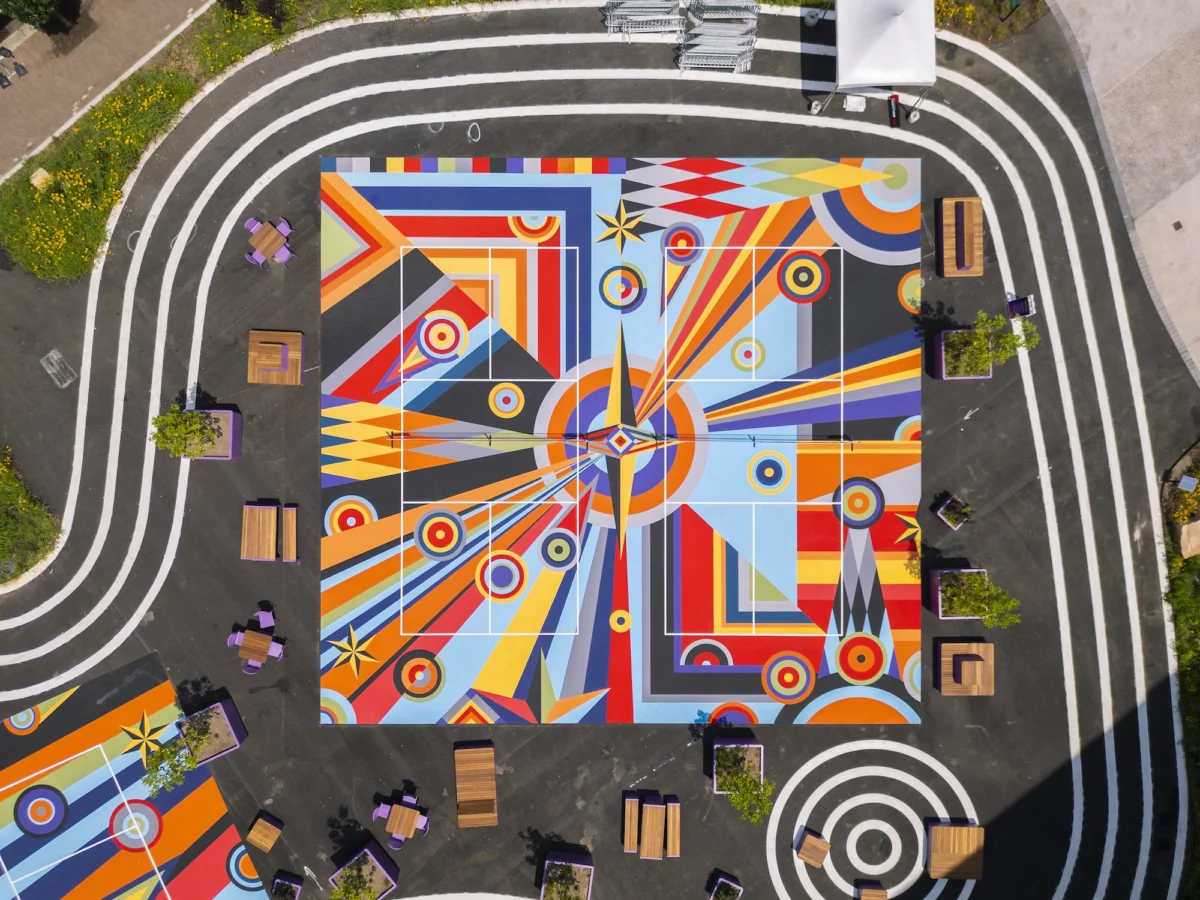
In the heart of Pittsburgh’s bustling Cultural District, a new form of public engagement has emerged, blurring the lines between high-concept contemporary art and community recreation. Across three pickleball courts, artist Sharmistha Ray has unveiled Geometry of Play, a series of large-scale murals that serve as a vibrant canvas for both athletic competition and visual contemplation. This installation marks a significant milestone in American public art, representing the first artist-designed pickleball courts in the United States.
By translating vivid, geometric abstractions onto a playable surface, Ray has reimagined the traditional "white cube" gallery space, moving art from the vertical walls of a museum to the horizontal pavement of a civic park. The project, which spans a 22-by-40-foot area per court, represents a bold experiment in "placemaking"—the multifaceted approach to the planning, design, and management of public spaces that capitalizes on a local community’s assets to promote people’s health, happiness, and well-being.
Main Facts: A New Frontier for Playable Art
The Geometry of Play installation is more than a decorative overlay; it is a fundamental rethinking of how urban infrastructure can facilitate social connection. The project was commissioned as a cornerstone of "Arts Landing," a four-acre civic development project designed to revitalize Pittsburgh’s downtown core.

Key Details of the Installation:
- Location: Pittsburgh Cultural District, Pennsylvania.
- Artist: Sharmistha Ray, a Brooklyn-based artist and co-founder of the feminist art collective Hilma’s Ghost.
- Scope: Three regulation-sized pickleball courts, each featuring unique but interconnected geometric designs.
- Dimensions: Each court follows the standard 20-by-44-foot footprint (including out-of-bounds lines), with the mural art integrated into the 22-by-40-foot playable zones.
- Historical Context: This is recognized as the first instance in the U.S. where professional artists have been commissioned to design the surface of pickleball courts as a primary medium.
Ray’s work utilizes a palette of high-contrast, saturated colors and precise geometric forms—spheres, diamonds, and stars—that intersect across the rectangular planes of the courts. When viewed from above, the two side-by-side courts create a near-square symmetry, anchored by a central compass-like dial that evokes the image of a watchful eye. This design choice is not merely aesthetic; it serves to ground the players within the space, providing a sense of orientation and rhythm that mirrors the fast-paced nature of the sport.
Chronology: From Urban Planning to Vibrant Reality
The realization of Geometry of Play is the result of a multi-year effort to integrate art into the fabric of Pittsburgh’s urban renewal.
1. The Inception of Arts Landing (2021–2022):
The Pittsburgh Cultural Trust and local urban planners identified a four-acre stretch in the Cultural District that was underutilized. The vision for "Arts Landing" was born: a multi-use park that would combine performance spaces, public seating, and interactive art to serve as a "living room" for the city.

2. The Selection of Sharmistha Ray (Late 2023):
Curators sought an artist whose work could bridge the gap between complex social themes and accessible visual language. Ray’s history of exploring themes of belonging, queer identity, and multiculturalism made them an ideal candidate for a project centered on the "communal nature" of sport.
3. Design and Fabrication (Early 2024):
Ray spent months translating their studio-based abstract paintings into a format suitable for industrial-grade pavement coatings. The challenge was to ensure that the art did not interfere with the functionality of the courts—maintaining the necessary friction for players while preserving the integrity of the colors.
4. The Unveiling (Mid-2024):
The courts opened to the public, accompanied by a series of pickleball paddles also designed by Ray. This extended the artwork from a stationary landscape to a handheld object, further emphasizing the "geometry" of the game itself.

Supporting Data: The Rise of Pickleball and Public Art
The decision to use pickleball as a medium for public art is backed by significant cultural and demographic trends. Pickleball has been the fastest-growing sport in America for three consecutive years, with over 36 million participants nationwide. Its popularity is largely attributed to its low barrier to entry and its reputation as a social, multi-generational activity.
The Economic and Social Impact of Public Art:
- Property Value and Foot Traffic: Studies by the Americans for the Arts have shown that cities with robust public art programs see a 20-30% increase in foot traffic in commercial districts, leading to higher revenue for local businesses.
- Mental Health: Research into "neuroaesthetics" suggests that exposure to vibrant colors and geometric patterns in urban environments can reduce cortisol levels and improve community morale.
- Inclusivity: By placing Ray’s work—which is deeply rooted in queer and feminist theory—in a public park, the project democratizes access to contemporary art, reaching audiences who might not step foot in a traditional gallery.
Ray’s involvement as a co-founder of "Hilma’s Ghost" also brings a scholarly weight to the project. The collective focuses on spiritualism and abstraction, drawing inspiration from pioneers like Hilma af Klint. By applying these "spiritualist" aesthetics to a sports court, Ray suggests that the act of play can be a form of moving meditation or a ritual of community bonding.
Official Responses: A Vision for a "Playable City"
The Pittsburgh Cultural Trust and local officials have hailed the project as a triumph of modern urban design. In a statement regarding the launch of Arts Landing, project coordinators emphasized that the goal was to create a "frictionless" environment where art and daily life coexist.

"Sharmistha Ray’s Geometry of Play is a testament to the transformative power of the Cultural District," noted a spokesperson for the development project. "We aren’t just building a park; we are building a destination. By integrating world-class art into a recreational space, we are telling our residents that their leisure time is worthy of beauty and intellectual engagement."
Art critics have also weighed in, noting the project’s alignment with the Bauhaus philosophy—a school of thought that famously sought to eliminate the hierarchy between the "fine arts" and "applied crafts." By treating a pickleball court with the same reverence as a canvas, Ray validates the Bauhaus belief that design should serve the people and that art should be functional.
Implications: The Future of Urban Placemaking
The success of Geometry of Play in Pittsburgh sets a precedent for other American cities looking to revitalize their downtown cores in a post-pandemic world. As remote work changes the way people interact with city centers, "destination-based" public spaces are becoming essential for maintaining urban vitality.

1. The "Sportification" of Art
We are seeing a growing trend where athletic spaces—basketball courts, skate parks, and now pickleball courts—are being utilized as canvases. This trend (seen in other projects like Lakwena’s basketball murals in Arkansas) suggests that the next generation of public art will be interactive and "playable" rather than purely observational.
2. Art as a Tool for Social Equity
Ray’s focus on queer identity and multicultural inheritance is subtly woven into the geometric forms. The intersection of different shapes and colors serves as a metaphor for the intersectionality of the human experience. In a public setting, this visual language fosters an environment of radical inclusion, where the "rules of the game" are played out on a field of diversity.
3. Sustainability of Public Commissions
The technical success of applying Ray’s designs to a high-traffic athletic surface proves that public art can be durable. This encourages municipalities to invest in high-quality artist commissions for infrastructure projects, knowing that the aesthetic value will last as long as the physical utility of the site.

In conclusion, Sharmistha Ray’s Geometry of Play is more than a series of painted lines on a court; it is a vibrant declaration that art belongs to the people. As players engage in the rhythmic back-and-forth of a pickleball match, they are simultaneously participating in a living masterpiece. In the heart of Pittsburgh, the "Geometry of Play" has proven that when we change the ground we stand on, we change the way we see the world.