The Synthetic Hearth: Analyzing Hirokazu Kore-eda’s Sci-Fi Departure ‘Sheep in the Box’
The intersection of grief and technology has long been a fertile ground for speculative fiction, yet few directors are as uniquely qualified to navigate the emotional labyrinth of the family unit as Hirokazu Kore-eda. Known for his Palme d’Or-winning masterpiece Shoplifters and the poignant Monster, Kore-eda has spent decades redefining what constitutes a "family," often favoring emotional bonds over biological ones. In his 2026 feature, Sheep in the Box, the auteur ventures for the first time into the realm of science fiction, exploring the boundaries of mourning in an age of generative artificial intelligence.
While the film arrived with immense expectations, its reception—beginning at the Cannes Film Festival—has been uncharacteristically divisive. By blending his trademark "slice-of-life" humanism with a near-future premise involving "humanoid" child replacements, Kore-eda attempts to answer a haunting question: Can technology truly fill the void left by the dead, or does it merely create a new, more complex form of haunting?
Main Facts: A New Frontier for Kore-eda
Sheep in the Box stars Haruka Ayase and Daigo Yamamoto as Otone and Kensuke Komoto, a professional couple living in a sterile, architecturally precise near-future. The narrative engine is ignited by a profound tragedy: the death of their young son, Kekaru (played by Kuwaki Rimu). Following his passing, the couple is approached by the REbirth Corporation, a tech conglomerate specializing in "humanoid" replicas designed to assist with the grieving process.
The film’s title is a direct homage to Antoine de Saint-Exupéry’s The Little Prince, specifically the scene where the narrator draws a box and tells the prince that the sheep he desires is inside. This metaphor serves as the film’s philosophical backbone, suggesting that the "reality" of the AI child depends entirely on the imagination and emotional projection of the parents.

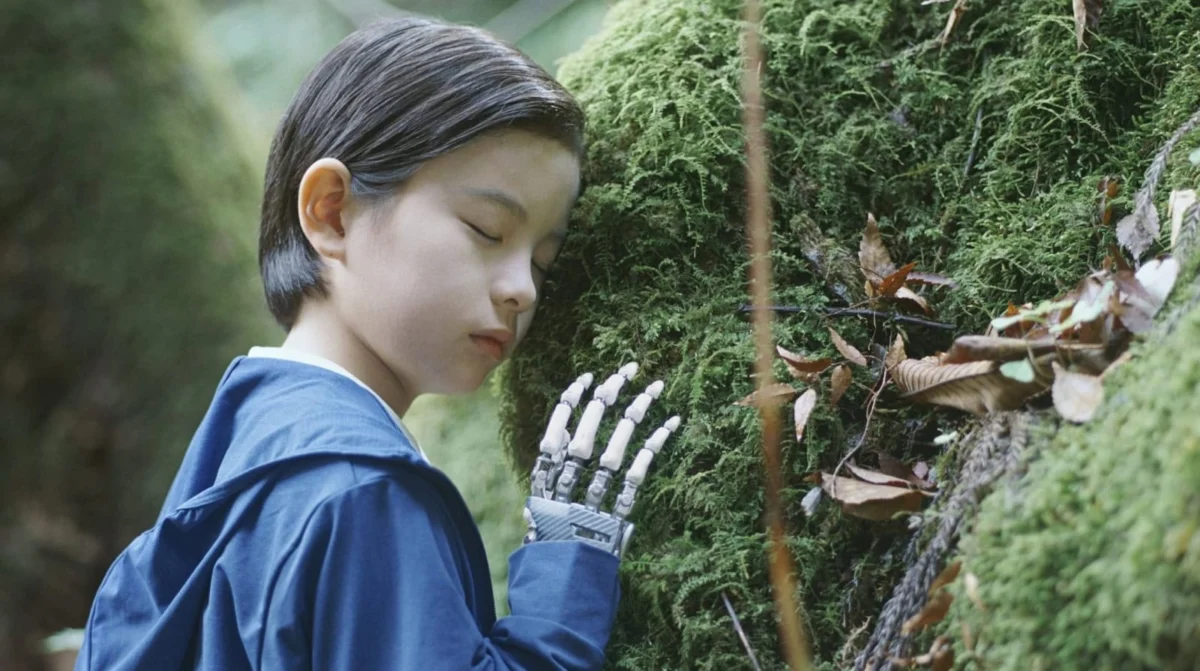
Produced with the high-caliber craftsmanship typical of a Kore-eda production, the film features a sprawling ensemble cast including Nana Seino, Kanichiro, Hinata Hiiragi, and the legendary Min Tanaka. Despite the technological premise, the film eschews the neon-soaked aesthetics of traditional cyberpunk, opting instead for lush green landscapes and domestic interiors that feel grounded and tactile.
Chronology: From Grief to Generative Replacement
The film’s narrative structure follows the Komoto family through the three distinct phases of their "trial" with the humanoid Kekaru.
Phase I: The Void and the Proposal
The story opens in the aftermath of Kekaru’s death, which occurred under ambiguous circumstances involving a train station and a potential kidnapping attempt. Otone, an architect, is paralyzed by grief, unable to find meaning in the structures she designs. Kensuke, who runs a construction company, attempts to move forward through labor and stoicism. Their lives are interrupted when a REbirth Corporation drone delivers a package containing a "humanoid" trial offer. Despite Kensuke’s initial skepticism—comparing the machine to a high-tech "Tamagotchi"—Otone’s desperation leads them to accept the trial.
Phase II: The Uncanny Valley of Domesticity
The middle act focuses on the integration of the humanoid into the Komoto household. This version of Kekaru is constructed using archival audio, video, and photographs. However, the simulation is intentionally curated; all data regarding trains is deleted to prevent "traumatic" feedback loops, given the nature of the real Kekaru’s death.

As the humanoid begins to learn, a fascinating role reversal occurs. Otone, who initially championed the project, begins to feel a growing sense of emptiness. She notes that the machine cannot replicate her son’s high energy or his genuine love for food—the "hollowness" of the synthetic form becomes impossible to ignore. Conversely, Kensuke finds himself seduced by the machine’s efficiency. The humanoid picks up skills, such as baseball and woodworking, with a speed the real Kekaru never possessed, providing Kensuke with a shallow but effective form of emotional catharsis.
Phase III: Revolt and the Return to Nature
The final act takes a sharp turn away from domestic drama and toward a sociopolitical thriller. Humanoid Kekaru encounters a group of "misfit" teenagers and fellow synthetics led by a charismatic rebel (Kanichiro). This group plots a "revolt" that is less about violence and more about a return to the wild. The leader removes Kekaru’s GPS tracker, encouraging him to reject his role as a parental emotional crutch. The film concludes with a controversial leaning toward "co-existence," where the distinction between the biological and the synthetic is blurred through their shared connection to the natural world.
Supporting Data: Production and Casting Context
The production of Sheep in the Box represents a significant investment in Japanese cinema’s speculative genre.
- The Cast: Haruka Ayase delivers a restrained, internal performance that captures the "skeptical caving" of a grieving mother. Daigo Yamamoto provides a necessary foil, representing the segments of society that view AI as a utility rather than a soul.
- Visual Language: Cinematography emphasizes the contrast between the rigid, "boxed" life of the city and the sprawling, uninhibited greenery of the forest where the humanoids eventually seek refuge.
- Technological Context: The film focuses on "REbirth Corporation," a fictional entity that mirrors real-world developments in "Grief Tech"—companies currently experimenting with AI chatbots and VR avatars of deceased loved ones.
Official Responses: Critical Disappointment and Director Intent
The critical reception of Sheep in the Box has been notably cooler than Kore-eda’s previous outings. While Flickering Myth awarded the film a 3/5 for its "movie" value (entertainment and production) but only a 2/5 for its "film" value (artistic depth), the consensus among critics at Cannes was that the movie suffered from a "naively optimistic" view of technology.
The Critic’s Critique
Reviewers have pointed out that the film largely ignores the darker implications of AI, such as privacy invasion, data harvesting by corporations like REbirth, or the inherent "tastelessness" of commodifying death. Robert Kojder noted that the film "fails for the same reasons as many others: a disinterest in condemning or denouncing AI… or even examining how such a replica could go wrong." The transition from a family drama to a "revolt in nature" was also described as baffling and uninspired.
Kore-eda’s Defense
In interviews following the film’s premiere, Hirokazu Kore-eda clarified his artistic stance. He admitted to being "less concerned with the AI aspect" and more interested in the narrative as a vehicle for "giving life to the dead." To Kore-eda, the humanoid is less a robot and more a "vessel" for the parents’ memory. He views the story as a ghost story told through the lens of modern technology, rather than a cautionary tale about Silicon Valley. This explains the film’s lack of "corporate criticism"—Kore-eda is focused on the internal landscape of the heart, not the external ethics of the industry.
Implications: The Future of Memory and AI
Sheep in the Box raises significant questions that extend beyond the cinema screen, touching on the evolving ethics of the digital age.
1. The De-Stigmatization of "Synthetic Grief"
By framing the humanoid as a part of nature by the film’s end, Kore-eda suggests a future where AI is not an "other" but an extension of the human ecosystem. This has profound implications for how society views "ghost bots." If we begin to view AI replicas as "natural" evolutions of memory, the traditional boundaries of the mourning process may permanently shift.

2. The Erasure of Flaws
The film highlights a dangerous aspect of generative AI: the curation of personality. By omitting the real Kekaru’s "train obsession" to protect the parents, the REbirth Corporation creates a "perfected" version of the child. This implies a future where we choose to remember only the convenient parts of our loved ones, effectively erasing their true, flawed identities in favor of a comfortable simulation.
3. The "Tamagotchi" Effect in Parenting
Kensuke’s comparison of the humanoid to a Tamagotchi underscores a shift in the parental bond from one of responsibility to one of entertainment and "emotional catharsis." If a child can be "terminated at any time" (as per the REbirth contract), the fundamental weight of the parent-child relationship is altered, potentially devaluing the permanence of human life.
4. Kore-eda’s Legacy
For fans of the director, Sheep in the Box represents a fascinating, if flawed, experiment. It shows a master filmmaker struggling to reconcile his deep-seated belief in human goodness with a technology that many find inherently dehumanizing. While it may not reach the emotional heights of Shoplifters, it remains a vital entry in the 2026 cinematic landscape, forcing audiences to look inside their own "boxes" and ask what they would be willing to believe in to see a lost loved one again.
In conclusion, Sheep in the Box is a film that succeeds as a visual and atmospheric experience but falters as a piece of social commentary. Its "kumbaya-with-AI" approach may alienate those looking for a more rigorous critique of tech-capitalism, but as a meditation on the lengths we go to avoid the finality of death, it remains a haunting, lingering work of speculative fiction.