"Fooly Cooly": The Enduring Legacy of a Generation-Defining Anime as a New Coming-of-Age Story Emerges

July 26, 2026 – In the landscape of anime, certain works transcend their initial release to become cultural touchstones, resonating with audiences for decades. As the highly anticipated Chinese donghua False Memory prepares for its free YouTube debut next month, a striking parallel emerges with a six-episode anime that redefined the coming-of-age narrative over two decades ago: FLCL. Both series, despite their temporal distance, seem to speak a shared language, exploring the bewildering, often inexplicable journey of adolescence through the lens of surrealism, potent metaphor, and a unique blend of youthful angst and optimistic resilience.
The Genesis of a Phenomenon: FLCL’s Groundbreaking Approach
Released in 2000 by the legendary Gainax studio, renowned for its groundbreaking works like Neon Genesis Evangelion and Tengen Toppa Gurren Lagann, FLCL (short for Furikuri, or "Fooly Cooly" in English) was an audacious departure from conventional storytelling. Directed by Kazuya Tsurumaki and penned by Yōji Enokido, a duo later responsible for Mobile Suit Gundam GQuuuuuuX and Diebuster, FLCL centered on the seemingly mundane life of 12-year-old Naota Nandaba. His world is violently upended by the arrival of Haruko Haruhara, an enigmatic woman who introduces herself as a space pirate and proceeds to run him over with a Vespa, igniting a chain of absurd events.
The series plunges headfirst into a visual and narrative whirlwind. Robots spontaneously emerge from Naota’s forehead, everyday guitars transform into powerful weapons, and a colossal, iron-shaped factory looms ominously over the protagonist’s sleepy hometown. This fantastical chaos, however, is not mere spectacle. It serves as a visceral manifestation of Naota’s internal turmoil and the bewildering transition into adulthood. The adults in FLCL often exhibit a perplexing lack of emotional maturity, mirroring the immaturity of children, while the series’ young protagonists are left to grapple with complex feelings they are ill-equipped to comprehend.
A Metaphorical Masterclass: Navigating Adolescence Through the Absurd
FLCL‘s genius lies in its ability to weave profound emotional truths through its utterly bizarre premise. The series eschews logical explanations, presenting its surreal elements as simple facts of existence. This allows FLCL to delve deeply into the universal themes of adolescence: the inherent awkwardness of growing up, the suffocating feeling of being trapped in a stagnant environment, and the yearning to transcend one’s current self before truly understanding who that self is.
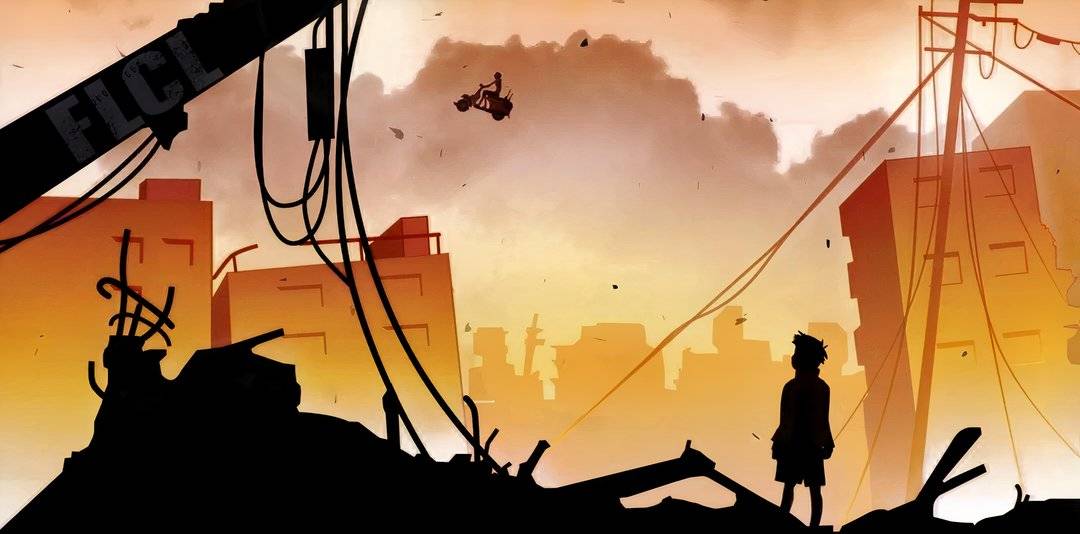
In this regard, FLCL shares a thematic kinship with its predecessor, Neon Genesis Evangelion. Both series feature protagonists who struggle with profound self-resentment and a general disdain for their surroundings. Naota Nandaba, like Shinji Ikari, embodies a certain detached cynicism. However, their narrative trajectories diverge significantly. While Evangelion charts an inward spiral of self-loathing and existential dread, FLCL explodes outward. Beneath its cacophony of electric guitars, anthropomorphic robots, slapstick humor, and visual anarchy, FLCL delivers an unexpectedly optimistic message about embracing change rather than fearing it. It encourages viewers to shed the pretense of having already grown up and to allow themselves to evolve into their true selves.
The Sonic Heartbeat of FLCL: The Pillows’ Unforgettable Soundtrack
Integral to FLCL‘s enduring appeal is its revolutionary integration of music into the narrative. Director Tsurumaki, a fervent admirer of the Japanese alternative rock band The Pillows, handpicked their songs to score the series. The result is a vibrant, punk-infused, garage-rock soundscape that imbues every scene with an electrifying energy. The fuzzy, melodic riffs of The Pillows become the very heartbeat of the show, transforming quiet, introspective conversations into moments of profound longing and elevating explosive action sequences into cathartic emotional crescendos.
This symbiotic relationship between music and animation made FLCL a natural fit for the burgeoning world of anime music videos (AMVs) in the early 2000s. The now-legendary "Fuel – Shimmer" AMV, created nearly two decades ago, likely served as an introduction to the series for many, including this author. While FLCL may not have achieved the same viral internet spread as titles like Serial Experiments Lain, it became intrinsically linked to the early days of online anime fandom. In an era predating the effortless accessibility of modern streaming, shows like FLCL thrived on word-of-mouth, fan forums, and the creative energy of fan edits, which played a crucial role in introducing new worlds and narratives to burgeoning communities. The enduring legacy of this era is further cemented by the availability of original VHS rips on platforms like the Internet Archive.
The Influence Endures: FLCL’s Impact on Modern Anime
The release of FLCL coincided with a pivotal moment in anime history, a period when the medium was pushing the boundaries of its traditional frameworks. FLCL stood out by masterfully blending experimental animation techniques, cutting-edge alternative music, and deeply personal, introspective storytelling in a way that felt revolutionary for television at the time. Its influence continues to ripple through contemporary anime, most notably in projects like the upcoming False Memory.

False Memory, a donghua from China’s Flint Sugar studio, helmed by the acclaimed Shuyu Li and Wenyu Liu, promises an introspective coming-of-age narrative steeped in surreal science fiction. The story of a young boy who discovers a reality-altering device and embarks on a journey through a surreal universe echoes FLCL‘s fascination with adolescence, its embrace of bizarre imagery, and its exploration of the emotional turbulence inherent in growing up.
The timing of False Memory‘s release, just two days shy of the 23rd anniversary of FLCL‘s debut in the United States, feels particularly poignant. It serves as a powerful reminder of the enduring impact that the anime of that era continues to have on creators today. Whether False Memory can capture the same lightning-in-a-bottle magic of FLCL or simply builds upon its thematic foundations remains to be seen. However, its very existence is a testament to the groundbreaking work of FLCL, a series that proved anime could be simultaneously strange, intimate, experimental, and profoundly human.
A Timeless Masterpiece: The Lasting Impression of Fooly Cooly
FLCL‘s enduring power lies in its ability to offer a unique and deeply resonant exploration of adolescence. It stands as one of the greatest six-episode anime binges imaginable, but more importantly, it is a profound testament to the power of harmonious synergy between music and storytelling. When these elements coalesce, particularly when exploring the poignant themes of growing up, the result can leave an indelible impression that transcends the limitations of time.
The series’ ability to reveal new emotional layers with each rewatch is remarkable. Characters who may have initially seemed irritating, such as Mamimi, Eri Ninamori, and even the formidable Atomsk, reveal unexpected depths of sympathy upon further viewing. Conversations that once felt random or nonsensical gradually unfold to expose surprising vulnerability. Each return to the world of FLCL offers a chance to experience emotions that may have lain dormant for years, a testament to its timeless relevance.

FLCL is available to stream on HBO Max and Crunchyroll. Its legacy continues to inspire, proving that even the most absurd narratives can carry the weight of profound human experience, resonating with audiences across generations and inspiring new creators to explore the complex tapestry of growing up.