Digital Nostalgia: Using High-End Mixed Reality to Resurrect Century-Old 3D Technology
Introduction: The High-Tech Return to Low-Tech Roots
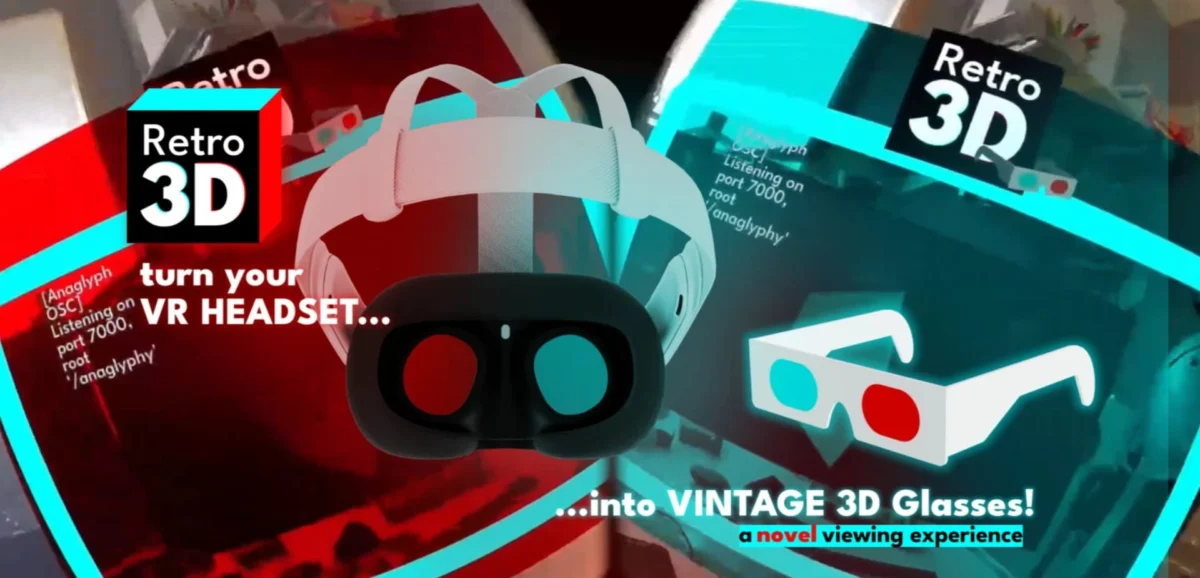
In the rapidly evolving landscape of spatial computing, the Meta Quest 3 and Quest 3S are typically marketed as gateways to the future—devices capable of rendering complex 3D environments, facilitating high-fidelity remote collaboration, and delivering "spatial" media that feels indistinguishable from reality. However, a new application titled Retro3D is taking a decidedly different approach. Instead of pushing the boundaries of what modern polygons can do, it uses the Quest’s sophisticated color passthrough cameras to emulate the experience of wearing "dirt-cheap" cardboard 3D glasses.
At first glance, using a headset costing upwards of $500 to replace a piece of cardboard worth fifty cents seems like an exercise in absurdity. Yet, as early adopters are discovering, this paradox is exactly what makes Retro3D a compelling addition to the VR ecosystem. By digitally recreating the anaglyph effect—the classic red-and-cyan filtering method—the app allows users to interact with over a century of stereoscopic history through the lens of modern mixed reality (MR).
Main Facts: How Retro3D Reimagines the Anaglyph Experience
Retro3D is currently an Early Access title designed specifically for the Meta Quest 3 and Quest 3S. Its primary function is to serve as a digital "filter" for the user’s real-world vision. While traditional VR apps transport you to a virtual world, Retro3D keeps you in your living room but modifies how your eyes perceive external light sources.
The Mechanics of Digital Filtering
The application utilizes the Quest’s dual front-facing color cameras to capture a live feed of the user’s environment. It then applies a specific digital post-processing layer: a red filter is assigned to the left eye’s display, and a cyan filter is assigned to the right eye’s display.
This digital recreation of the anaglyph process "decodes" 3D content that has been encoded using the red/cyan method. When a user looks at an anaglyph image or video on a physical screen (like a TV or tablet) or even a printed photograph, the brain merges the two offset color channels into a single image with perceived depth.
Current Features and Limitations
As an Early Access proof of concept, the app’s feature set is intentionally lean:
- Passthrough Integration: Full utilization of the Quest 3’s high-resolution color passthrough.
- Simple UI: Users can toggle the filters on and off via a minimalist menu.
- Input Versatility: Supports both standard Meta Quest Touch controllers and optical hand tracking, allowing for seamless transitions when the user needs to interact with external devices like a laptop or smartphone.
- External Content Dependency: Currently, the app does not host its own media library. Users must provide their own "screens" by looking at external monitors or physical prints.
Chronology: From the 19th Century to the Quest 3
To understand why Retro3D is significant, one must look at the timeline of stereoscopic technology, which predates modern computing by more than a century.
1838–1858: The Birth of Stereoscopy
Sir Charles Wheatstone first described the principles of stereopsis in 1838, proving that the brain creates a sense of depth by combining two slightly different 2D images. By the 1850s, the anaglyph method—using color to separate these images—was developed by Joseph d’Almeida and Wilhelm Rollmann.
1950s: The Golden Age of 3D Cinema
The anaglyph method saw a massive commercial boom in the 1950s. Iconic films like The Creature From the Black Lagoon (1954) and It Came from Outer Space (1953) used these techniques to thrill audiences. This era cemented the image of the "cardboard glasses" in the public consciousness.
2010s: The VR Renaissance
The release of the Oculus Rift and subsequent headsets moved 3D away from color-filtering toward "active shutter" and "dual-panel" stereoscopy. Anaglyph 3D became a relic, relegated to "retro" nostalgia and occasional NASA Mars Rover photos.
2023–2024: The Passthrough Era
With the launch of the Quest 3, color passthrough became high-quality enough to read text on a phone or watch a TV through the headset. This technical milestone paved the way for developers to experiment with "Augmented Reality" filters, leading directly to the creation of Retro3D.
Supporting Data: The Science of Depth Perception
The effectiveness of Retro3D relies on two distinct physiological and technical phenomena: Anaglyph Encoding and the Pulfrich Effect.
The Anaglyph Process
Anaglyph 3D works through "spectroscopic synthesis." An image is composed of two color layers, superimposed but offset to represent the different perspectives of the left and right eyes.
- Left Eye (Red Filter): Blocks the cyan light, allowing only the red-tinted image to pass through.
- Right Eye (Cyan Filter): Blocks the red light, allowing only the cyan-tinted image to pass through.
By replicating this digitally, Retro3D eliminates the "ghosting" often caused by poor-quality physical plastic lenses. The digital filters can be tuned to the exact wavelength of the Quest 3’s LCD panels, potentially offering a cleaner separation than cheap cardboard alternatives.
The Pulfrich Effect (Upcoming Feature)
The developer has signaled intent to add a "Pulfrich Mode." This is a psychophysical percept where lateral motion of an object is interpreted by the visual cortex as having a depth component.
- The Science: By placing a darker filter over one eye, the brain takes slightly longer to process that eye’s signal (a delay of several milliseconds).
- The Result: If a camera is moving sideways (e.g., footage shot from a moving train), the "delayed" eye sees the frame from a fraction of a second ago, while the "clear" eye sees the current frame. This creates a synthetic stereoscopic view from 2D footage.
Content Availability
While Retro3D is a "viewer," the data shows a surprisingly large archive of compatible content. YouTube currently hosts thousands of anaglyph-encoded videos, ranging from NASA’s 3D Mars panoramas to converted clips of 1950s horror films. Furthermore, the "Spatial Video" trend sparked by Apple and Meta has renewed interest in legacy 3D formats as users look for ways to view their historical archives.
Official Responses: Insights from the Developer
In discussions held on community platforms like Reddit, the developer of Retro3D (known by the handle zhuliks) has addressed the current "proof of concept" state of the app and outlined the roadmap for future updates.
On the In-App Browser
One of the primary criticisms of the current version is the requirement to look at an external screen. The developer confirmed that a prototype for an in-app browser is already functional.
"The goal is to make external screens optional," the developer stated. "A future update will allow users to browse YouTube or web galleries directly within the filtered view, eliminating the need to balance the headset while looking at a physical monitor."
On Community Feedback
The addition of the Pulfrich effect was a direct response to user suggestions. The developer noted that because the app already handles per-eye image manipulation, adding a "shutter" or "darkening" filter to one eye is a minor technical adjustment that adds significant value for users looking to watch old 2D travelogues or side-scrolling content.
On Hardware Longevity
When asked why someone would use a Quest instead of $0.50 glasses, the developer pointed to the "convenience of the ecosystem." Physical cardboard glasses are easily lost, damaged, or warped. For a VR enthusiast, the Quest is a "permanent" tool that is always charged and ready, providing a consistent, high-quality filter that doesn’t degrade over time.
Implications: The Future of Spatial Media Preservation
The existence of Retro3D points toward a larger trend in the XR (Extended Reality) industry: the use of cutting-edge hardware for media archeology and preservation.
1. Digital Archives of Stereoscopic History
As headsets become more ubiquitous, apps like Retro3D could evolve into interactive museums. Imagine a curated gallery where users can toggle through every 3D method used since the 1800s—from Victorian stereoscopes to 1950s anaglyph, to 1980s polarized lenses, all simulated through a single MR headset.
2. The Democratization of 3D Viewing
By removing the need for specialized physical hardware (like 3D TVs or specific glasses), software-based filters make historical 3D content accessible to anyone with a modern headset. This is particularly relevant as AI-driven tools now allow users to convert their old 2D family photos into 3D formats; Retro3D provides a bridge to view those conversions in a way that feels tactile and "retro."
3. The "Niche-ification" of VR Apps
Retro3D represents a shift away from "do-everything" apps toward highly specialized, "boutique" experiences. Not every app needs to be a productivity suite or a AAA game. There is a growing market for "utility-nostalgia"—apps that perform one specific, whimsical task perfectly.
4. Overcoming the "Absurdity"
While the idea of a $500 pair of 3D glasses remains humorous, it highlights the versatility of the Quest 3’s passthrough technology. It proves that the hardware is robust enough to act as a "universal lens," capable of altering our perception of the physical world in real-time. Whether it’s for professional architectural overlays or watching The Creature From the Black Lagoon in a digital recreation of a 1950s cinema, the potential for "filtered reality" is only just beginning to be explored.
Conclusion
Retro3D is a testament to the fact that progress does not always mean moving away from the past. By using the most advanced consumer optics available today to recreate a technique from the Victorian era, the app creates a bridge across nearly 200 years of visual history. As it moves out of Early Access and incorporates features like an internal browser and the Pulfrich effect, it may very well become the definitive way for a new generation to experience the "absurd fun" of 3D’s early years.