AutoRemesher – Free & Open Source Retopology Tool
Revolutionizing 3D Workflow: AutoRemesher 1.0 Ushers in a New Era of Quad-Based Topology
A groundbreaking, free, and open-source tool promises to dramatically streamline the retopology process for 3D artists, offering unparalleled speed and flexibility.
[City, State] – [Date] – The 3D modeling landscape is poised for a significant transformation with the official release of AutoRemesher 1.0, a powerful and innovative application developed by the same visionary behind the acclaimed Dust3D modeling software. This new, free, and open-source tool is set to revolutionize how 3D artists approach retopology, enabling them to convert complex, triangle-heavy meshes into clean, edge-loop-friendly quad-based topology with remarkable ease and speed. Available for Windows, macOS, and Linux, AutoRemesher 1.0 represents a substantial leap forward in making advanced 3D asset creation more accessible and efficient.
The initial announcement of AutoRemesher, which has been in development and available in earlier forms, has now culminated in a stable 1.0 release. A notable development accompanying this milestone is the shift in its open-source licensing. Previously operating under the more restrictive GPLv3 license, AutoRemesher has now transitioned to the permissive MIT license. This strategic move significantly broadens the scope of how developers and studios can integrate, modify, and utilize its source code, fostering a more collaborative and innovative ecosystem around the tool.
The Core of AutoRemesher: Intelligent Quad Remeshing
At its heart, AutoRemesher is an automatic quad remeshing engine designed to tackle one of the most time-consuming and often tedious aspects of 3D asset creation: retopology. For those unfamiliar with the term, retopology is the process of reconstructing a 3D model’s surface with a new, cleaner mesh, typically composed of quadrilaterals (quads). This is crucial for several reasons:
- Animation and Rigging: Quads deform more predictably and naturally during animation than triangles, allowing for smoother and more lifelike character movements.
- UV Unwrapping: Clean quad topology simplifies the process of UV unwrapping, which is essential for applying textures to a 3D model.
- Performance: Optimized quad meshes generally offer better performance in real-time applications like video games and interactive simulations.
- Subdivision Surface Modeling: Many advanced modeling techniques, particularly those involving subdivision surface modifiers, rely heavily on quad-based topology for smooth, predictable results.
Traditionally, retopology has been a manual, labor-intensive process requiring significant skill and artistic judgment. Artists would meticulously draw new polygons over a high-resolution sculpt or scan data. AutoRemesher aims to automate much of this, taking a "triangle soup" – a common output from 3D scanning or sculpting software – and intelligently transforming it into a structured quad mesh. The promise is a process that can be accomplished in "just a click or two," a claim that, while perhaps a slight simplification for highly complex scenarios, underscores the tool’s intended efficiency.
The developer describes AutoRemesher as:
"AutoRemesher is a cross-platform automatic quad remeshing tool that converts high-polygon meshes into clean quad-based topology. It is built on top of libraries: Geogram, libigl, isotropicremesher and others."
This technical description highlights the robust foundation upon which AutoRemesher is built. The integration of established libraries like Geogram (a C++ geometry processing library), libigl (a C++ library for geometry processing and mesh manipulation), and isotropicremesher (a specialized algorithm for generating isotropic remeshing) suggests a well-researched and technically sound approach to the complex problem of automated quad generation. These libraries provide the underlying algorithms and data structures necessary for efficient mesh analysis, manipulation, and the generation of new topology that adheres to desired properties.
A Chronology of Development and Release
While the 1.0 release marks a significant official milestone, the journey of AutoRemesher has likely been one of iterative development and refinement. The creator of Dust3D, known for its unique approach to quick 3D concepting, has demonstrated a commitment to innovating in the 3D space. The development of AutoRemesher can be seen as a complementary effort, addressing a critical bottleneck in the typical 3D asset pipeline that Dust3D, or indeed any 3D modeling workflow, encounters.
The existence of earlier versions of AutoRemesher, available for users to experiment with, suggests a period of beta testing and community feedback. This developmental phase is crucial for identifying bugs, refining algorithms, and ensuring the tool meets the practical needs of 3D artists. The transition from GPLv3 to MIT license is a strategic decision that often occurs as a project matures and its developers seek wider adoption and contribution. The MIT license, being exceptionally permissive, allows for proprietary use of the code, which can encourage commercial integration and further development by a broader range of entities, without the reciprocal obligations of the GPLv3.
The official release of version 1.0 solidifies the tool’s stability and feature set, making it a more reliable option for professional workflows. This release is accompanied by a clear call to action for the community:
- AutoRemesher GitHub Repository: This is the central hub for the project, providing access to the source code, issue tracking, and contribution guidelines. It signifies the project’s commitment to transparency and community involvement.
- Dust3D 3D Modelling Application: This link serves as a reminder of the developer’s broader contributions to the open-source 3D community and suggests a potential synergy between the two tools.
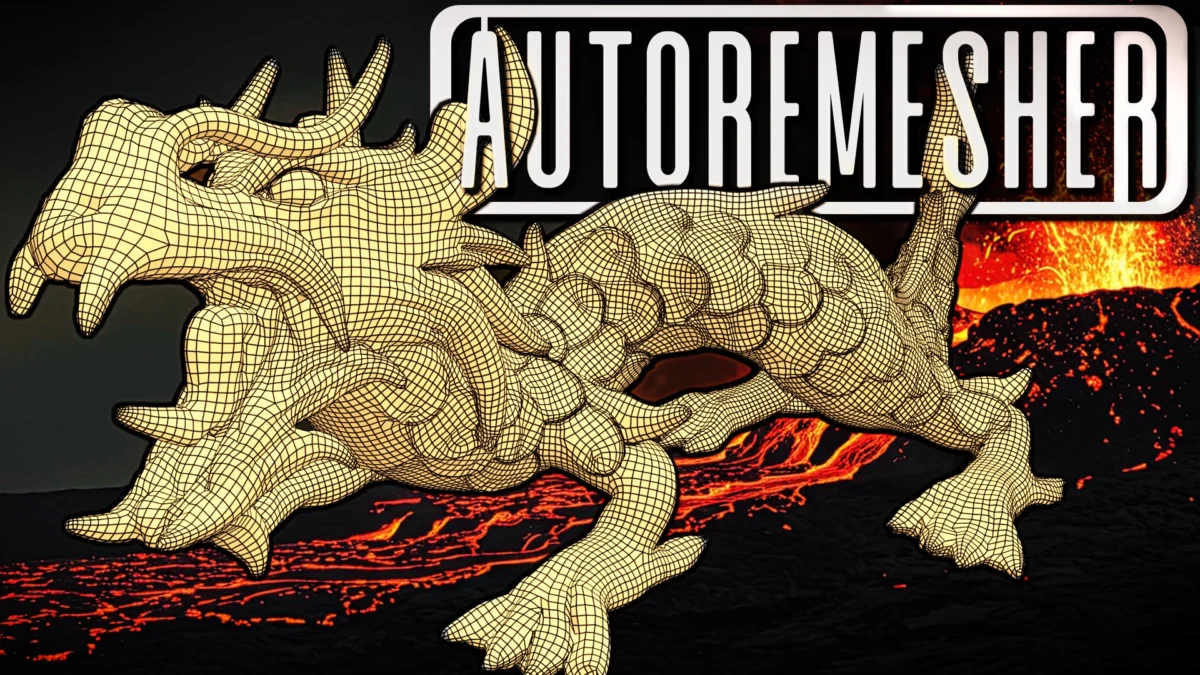
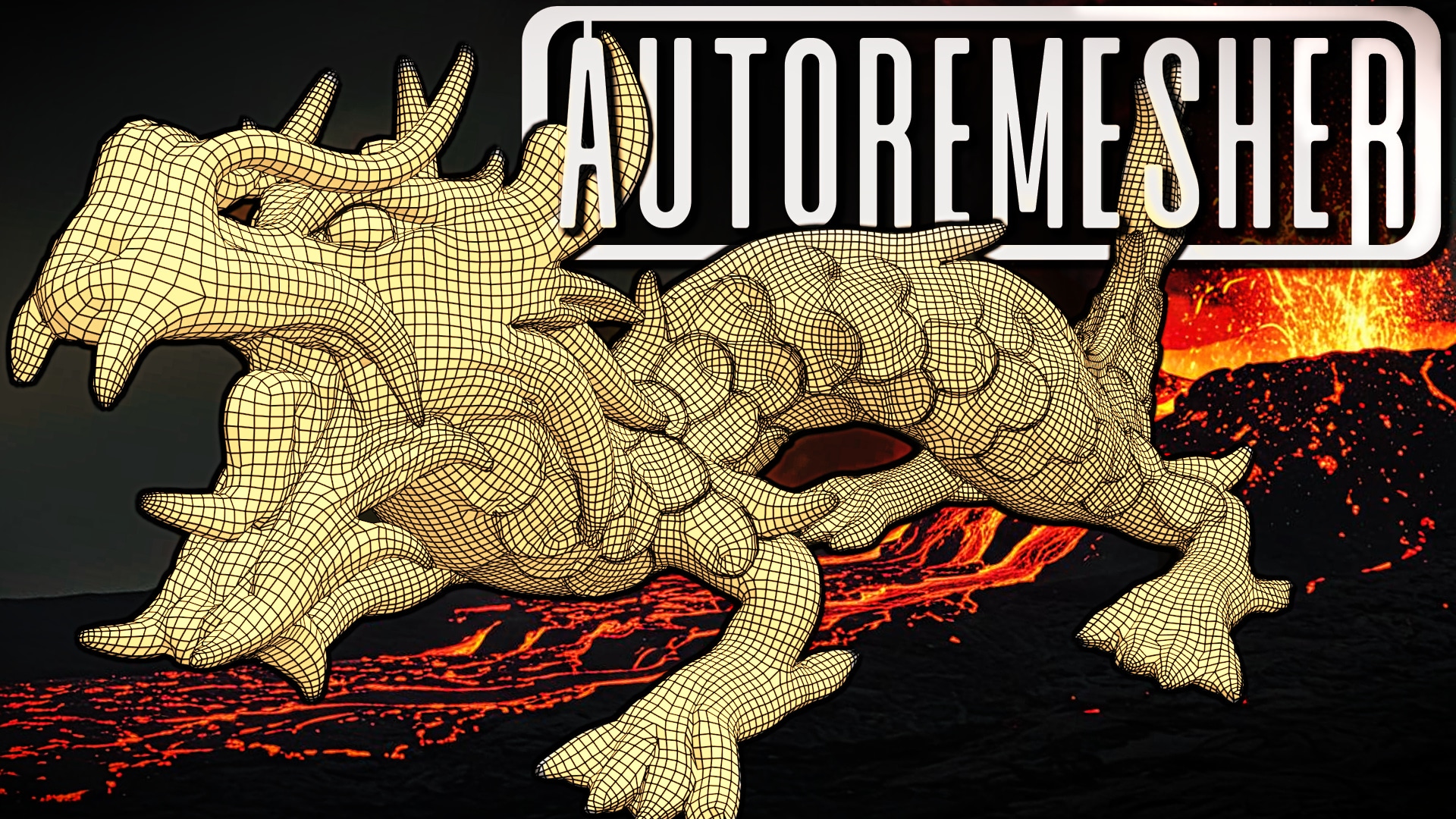
A video demonstration has also been provided, offering a visual representation of AutoRemesher in action. Such visual aids are invaluable for understanding the practical application of the software and showcasing its capabilities in a tangible way. Users can see firsthand how a dense, triangulated mesh can be transformed into a clean, quad-based structure, highlighting the speed and quality of the generated topology.
Supporting Data and Technical Underpinnings
The effectiveness of AutoRemesher hinges on the sophisticated algorithms and libraries it employs. Let’s delve deeper into the significance of these components:
- Geogram: This C++ library, developed by researchers at Inria (French National Institute for Research in Digital Science and Technology), is a powerful platform for computational geometry and digital geometry processing. It provides a rich set of tools for mesh manipulation, analysis, and visualization, forming a solid foundation for complex geometric operations.
- libigl: Another highly respected C++ library, libigl, is a comprehensive toolkit for 3D geometry processing. It offers algorithms for mesh generation, surface parameterization, mesh editing, and optimization. Its widespread use in academic research and commercial applications attests to its robustness and versatility.
- Isotropic Remesher: This specific library, often referring to algorithms that aim to create remeshed elements of roughly equal size and aspect ratio, is crucial for generating visually pleasing and functionally sound quad topology. Isotropic remeshing tends to produce more uniform edge lengths and angles, which is highly desirable for animation and rendering.
The combination of these libraries allows AutoRemesher to perform intricate geometric analyses on input meshes, understand their underlying structure, and then generate new topology that respects curvature, sharp edges, and desired polygon density. The "automatic" nature of the tool implies that these complex computations are abstracted away from the user, who can focus on the outcome rather than the intricate process.
The ability to convert "triangle soup" to "smooth edge loop friendly quads" is the ultimate goal. Triangle soup often arises from 3D scanning, photogrammetry, or even some sculpting workflows where the primary concern is capturing geometric detail, not mesh structure. These meshes are typically dense with triangles, making them difficult to work with in downstream applications. AutoRemesher’s success lies in its ability to simplify this complex geometry into a more manageable and artist-friendly quad-based mesh, preserving key features while optimizing for usability.
Official Responses and Community Impact
While direct quotes from the developer regarding the 1.0 release are not extensively detailed in the provided text, the action of releasing the software and making its source code available speaks volumes. The transition to the MIT license is a proactive step that signals an intention to foster wider adoption and contribution. This move is likely to be met with enthusiasm by developers and studios looking for flexible and powerful 3D tools.
The open-source nature of AutoRemesher is a significant factor in its potential impact. It democratizes access to advanced retopology capabilities, which were previously often the domain of expensive commercial software or required specialized expertise. By making this tool freely available, the developer empowers individual artists, indie game studios, and educational institutions to leverage powerful technology without financial barriers.
The community’s response to AutoRemesher, particularly in its earlier iterations, has likely been positive, given the known demand for efficient retopology solutions. The availability of the source code on GitHub further encourages community engagement. Developers can inspect the code, report bugs, suggest improvements, and even contribute new features. This collaborative model is a hallmark of successful open-source projects and can lead to rapid innovation and adaptation.
Implications for the 3D Industry
The implications of a robust, free, and open-source automatic quad remesher are far-reaching for the 3D industry:
- Democratization of 3D Asset Creation: Artists who previously lacked access to expensive retopology software or the time to master manual techniques can now achieve professional-quality results. This lowers the barrier to entry for aspiring 3D creators.
- Accelerated Production Pipelines: For studios, AutoRemesher can drastically reduce the time and cost associated with asset creation. Automating retopology frees up artists to focus on more creative tasks like sculpting, texturing, and look development.
- Enhanced Interoperability: By generating clean quad topology, AutoRemesher improves the compatibility of assets across different software packages and game engines. Models that are well-structured are easier to import, export, and manipulate.
- Innovation in Open-Source 3D Tools: The success of AutoRemesher can inspire further development of open-source tools in other critical areas of the 3D pipeline, fostering a more vibrant and collaborative ecosystem.
- Potential for New Workflows: The speed and efficiency of AutoRemesher might enable entirely new workflows. For example, artists could potentially generate high-resolution sculpts from scanned data and then instantly retopologize them for use in real-time applications, blurring the lines between sculpting and game-ready asset creation.
- Impact on Education: Educational institutions can incorporate AutoRemesher into their curriculum, providing students with practical experience in modern 3D asset creation techniques without the burden of expensive software licenses.
The move to the MIT license is particularly significant. It allows commercial entities to integrate AutoRemesher’s technology into their proprietary software or services without the obligation to open-source their own modifications. This can lead to wider adoption and deeper integration into commercial pipelines, potentially leading to further refinements and specialized versions of the tool.
In conclusion, the release of AutoRemesher 1.0 is a momentous occasion for the 3D community. It represents a powerful stride towards making advanced 3D modeling techniques more accessible, efficient, and collaborative. As the tool matures and benefits from community contributions, it is poised to become an indispensable part of the modern 3D artist’s toolkit, empowering creators worldwide to bring their visions to life with greater speed and artistic freedom.