The Architecture of Absurdity: Brad Neely’s Creased Comics and the Legacy of the American Single Panel
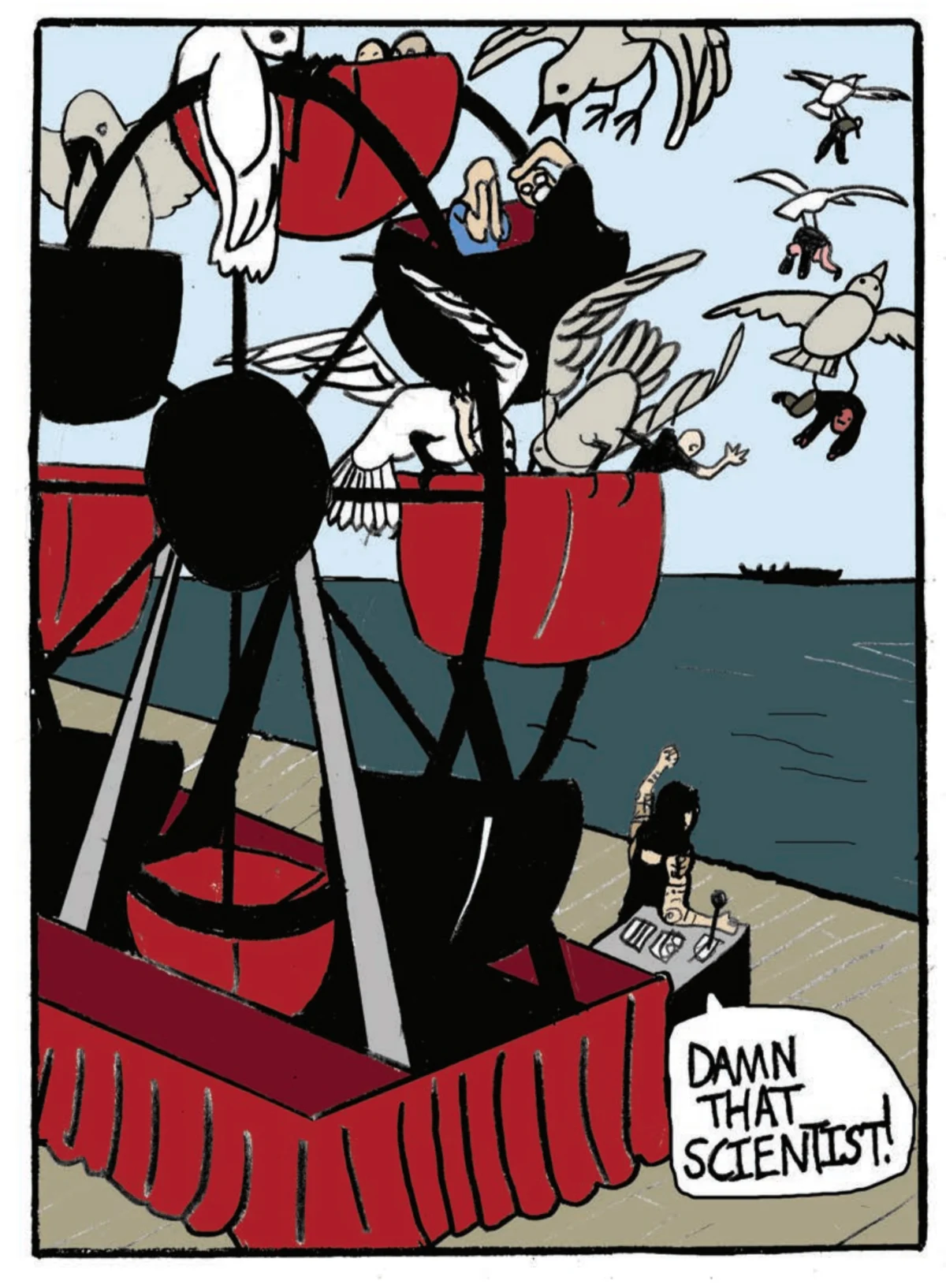
Main Facts: A Retrospective of Institutional Rot and Artistic Individualism
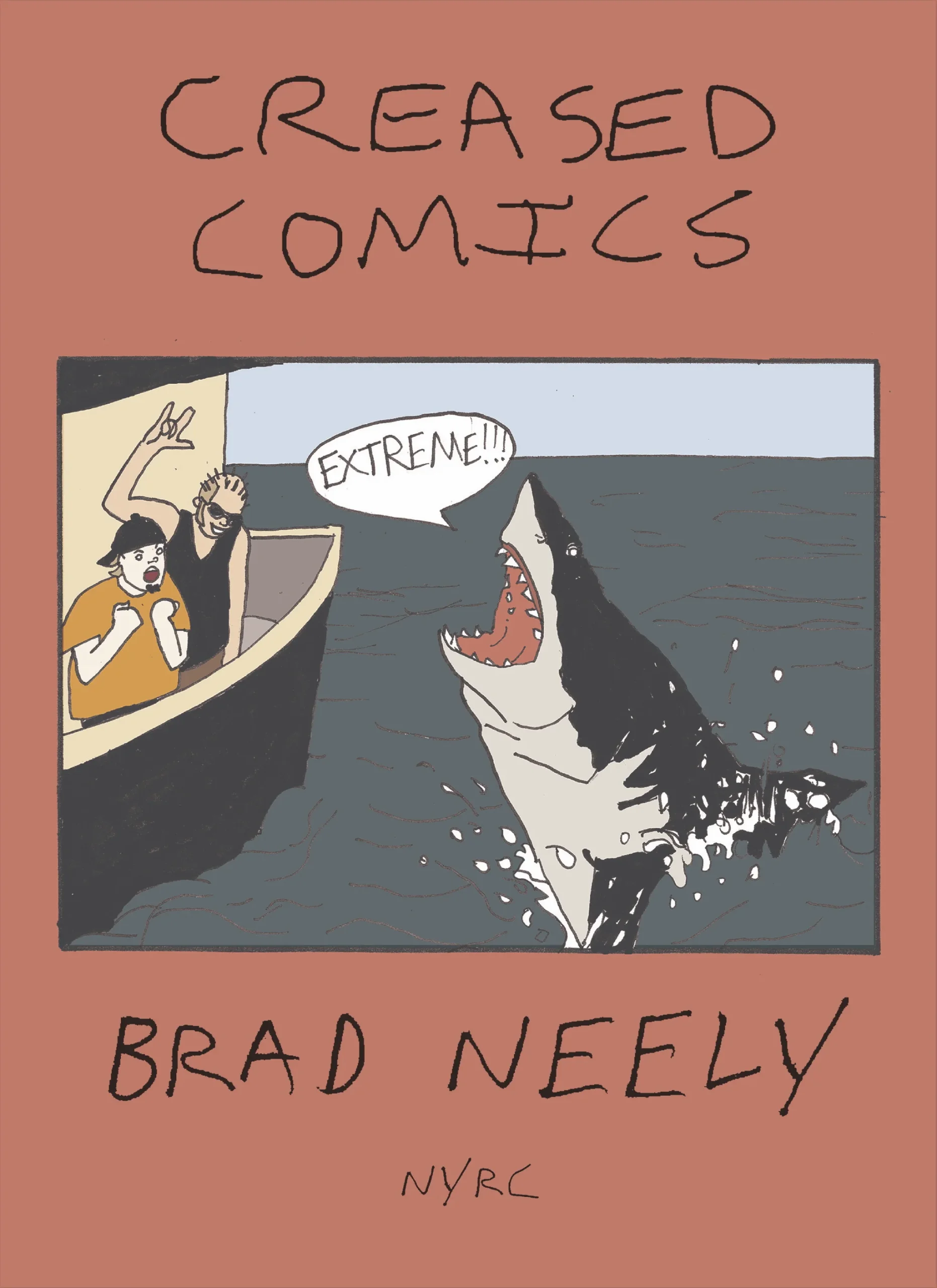
In the mid-2020s, the landscape of American graphic remains a battlefield between high-concept prestige volumes and the raw, unrefined energy of the digital underground. Emerging into this milieu is Creased Comics, a significant new collection by Brad Neely, published by New York Review Comics (NYRC). This volume, which recently crossed the desks of critics and historians alike, serves as a comprehensive archive of Neely’s output between 1995 and 2010—a fifteen-year window that tracks the artist’s evolution from an underground provocateur to a staple of late-night animation.
Brad Neely is perhaps most widely recognized as the creative force behind the Adult Swim series China, IL, a show that defined a specific era of "institutional rot" humor. However, Creased Comics strips away the kinetic energy of animation to reveal the foundational DNA of Neely’s wit: the single-panel comic. The collection highlights a period where the "slacker" aesthetic of the 1990s began to merge with a more aggressive, surrealist nihilism. Neely’s work is characterized by a "plainly strong" start, featuring a consistent aesthetic that aligns with the "anti-craft" movements championed in publications like Kramers Ergot.
At its core, the book is an interrogation of the American psyche, filtered through a lens that is simultaneously crass, frank, and deeply indebted to the giants of 20th-century newspaper syndication. It is a document of a world falling apart "quite vigorously," yet remaining inexplicably on its feet.
Chronology: From the Underground to Adult Swim
To understand the weight of Creased Comics, one must trace the trajectory of Neely’s career through the shifting sands of the American media landscape:
- The Formative Years (1995–2000): This period, heavily represented in the early pages of the collection, captures Neely in the "end of his youth." These comics were often intended for private circulation or college newspapers. They established his penchant for the "dispassionate 1000-yard stare" of his characters and a sense of humor that felt distinctively individual.
- The Digital Proliferation (2000–2010): As the internet became the primary delivery system for alternative comedy, Neely’s work began to gain a cult following. His "anti-craft" instinct found a home among a generation that was beginning to reject the polished aesthetics of mainstream media in favor of something more visceral and "weirder."
- The Adult Swim Era (2011–2015): The success of his static work eventually led to China, IL, which ran for four seasons on Cartoon Network’s Adult Swim block. The show arrived during a period when Adult Swim was transitioning from a novelty outlet to a cultural powerhouse. China, IL served as a critique of higher education, where behavior incentives for both students and faculty had become fundamentally "out of whack."
- The Retrospective Era (2026): The publication of Creased Comics by NYRC marks the "canonization" of Neely. In a world where political and social realities have arguably caught up to Neely’s most absurd premises—such as the "President for Life" gags of 2011—the work is now viewed through a lens of "purely descriptive" realism rather than mere satire.
Supporting Data: The Larson Imprint and the 1980s "Roman Spring"
A critical analysis of Creased Comics reveals a profound, almost genetic connection to the golden age of the American comic strip. Neely, born in 1976, came of age during what can be described as the "Roman Spring" of the medium—the 1980s. This era was dominated by three juggernauts: Gary Larson’s The Far Side, Bill Watterson’s Calvin & Hobbes, and Berke Breathed’s Bloom County.
While Peanuts remained a formidable force and Garfield brought mass-market eyes back to the funny pages, it was Gary Larson who "imprinted his thumb" most intimately on Neely’s creative brain. The data of influence is visible in several key areas:
- The Aesthetic of the "Funny Look": Like Larson, Neely understands that a joke begins with the visual. Before a character speaks, the character must look inherently funny. Neely’s figures often possess a flat, wide-eyed quality that makes their most horrific or absurd pronouncements land with greater comedic impact.
- The Single-Panel Economy: Neely masters the Larsonesque "explosion in a room" technique—squeezing an entire world, a conflict, and a punchline into a single frame.
- The Subversion of the Mundane: Where Larson used talking cows and prehistoric humans to mock modern social conventions, Neely uses pilgrims, EMTs, and middle-American "slackers."
The reviewer notes that while Calvin & Hobbes is often lauded for its craft and Bloom County for its topicality, Larson’s The Far Side is frequently taken for granted despite its "staggering" achievement. Neely is positioned as the primary heir to this tradition, albeit a more "crass and frank" version suited for a post-syndication world.
Official Responses: The Critical Re-Evaluation of the Canon
The release of Creased Comics has prompted a moment of self-reflection within the "august" institutions of comic criticism. Specifically, The Comics Journal (TCJ) has had to reckon with its historical oversight of the single-panel format.
In a notable admission, critics have pointed out that Gary Larson—arguably the most influential cartoonist of the late 20th century—was nowhere to be found on TCJ’s "Top 100 Comics of the 20th Century" list. This omission is now viewed as a failure to recognize the "sinkhole" Larson opened in the collective imagination. Neely’s work serves as the evidence of that influence, proving that the Larson model of "individual sense of humor" was a more durable template for the future of the medium than the more traditional "big craft" approaches.
The critical consensus emerging in 2026 is that Neely’s "interesting sense of humor" is, in itself, a significant achievement. The "official" response from the literary establishment, signaled by NYRC’s involvement, suggests that Neely is no longer viewed as a mere "internet cartoonist" or "TV guy," but as a vital practitioner of a uniquely American art form.
Implications: From Satire to Descriptive Realism
The most striking aspect of Creased Comics in 2026 is how its tone has shifted from "funny" to "descriptive." The collection features several recurring themes that have gained a dark new resonance in the current decade:
The "Free Country" Nihilism
One of the most praised panels in the book depicts a man pointing a pistol at a burning Christmas tree while declaring, "Free country." Another shows a man urinating on a snowman with the same caption. In the late 1990s, these were viewed as sharp bites of cynicism. In 2026, they are seen as "purely descriptive" of a cultural landscape where the "great screaming maw of oblivion" is a daily reality.
Institutional Decay
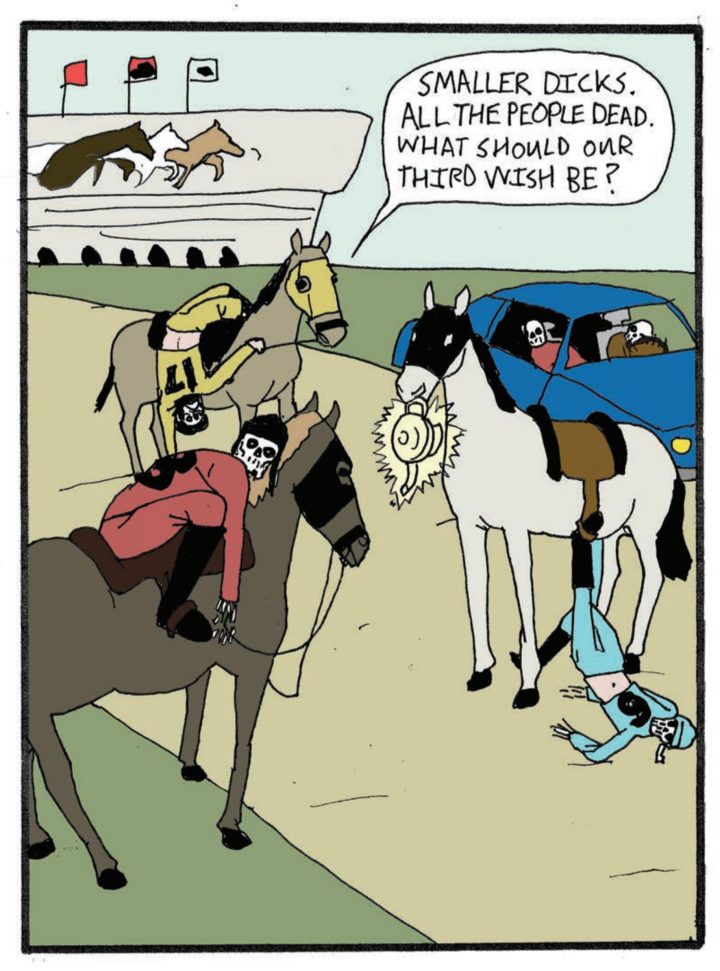
Neely’s preoccupation with institutions—whether they be the higher education system in China, IL or the medical professionals and religious figures in Creased Comics—reflects a society where the structures are still standing, but the "behavior incentives" are broken. The panel featuring an EMT yelling "Clear!" while a bystander comments on her attractiveness ("pretty hot") encapsulates this disconnect between professional duty and base human impulse.
The Evolution of the "Slacker"
The collection documents the transition of the "slacker" archetype. While the slacker era was beginning to wane at the turn of the millennium, Neely helped transition that "anti-craft" energy into something more surreal. This movement, pushed forward by figures like Frank Santoro and Chris Onstad, eventually "bubbled onto the TV screen," changing the face of adult animation forever.
Conclusion: The Need for More
The overarching implication of Creased Comics is that Brad Neely remains a singular voice in a medium often crowded with imitators. His ability to find humor in the "dyspepsia" of modern life is not just a comedic skill but a survival mechanism. As the reviewer concludes, Neely has a "distinctive sense of humor" that justified a television show and now justifies a prestige archival volume. The call for a second volume is not just a request for more jokes, but a desire to continue mapping the "remarkable" and "weird" world that Neely has spent thirty years documenting.
In the final analysis, Creased Comics is more than a book of cartoons; it is a ledger of the American imagination’s slow descent into the absurd, recorded by one of its most "talented" and "insightful" observers.