Tracing the Threads of Time: Shan Winn’s "Heaven, Heroes, and Happiness" Unearths Indo-European Roots of Western Thought
FOR IMMEDIATE RELEASE
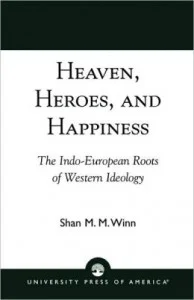
[City, State] – [Date] – In an intellectual landscape often preoccupied with highlighting cultural distinctions across epochs, Shan Winn’s seminal work, Heaven, Heroes, and Happiness: The Indo-European Roots of Western Ideology, offers a compelling counter-narrative. The book, lauded for its insightful exploration, posits that a significant degree of continuity exists between the ancient worldviews of pre-Christian Europeans and our contemporary Western thought. This perspective challenges conventional wisdom, inviting readers to reconsider the profound and enduring legacy of the Proto-Indo-Europeans on the ideological bedrock of Western civilization.
The reviewer, while acknowledging their personal tendency to emphasize divergence, readily concedes the "considerable degree of continuity" that forms the central thesis of Winn’s scholarly endeavor. Far from being a mere historical curiosity, the book argues that the intellectual and social frameworks laid down by these ancient peoples continue to resonate, often subtly, within the very fabric of modern Western societies.
Unearthing Ancient Roots: The Proto-Indo-Europeans and Their Enduring Legacy
At the heart of Winn’s argument lies the Proto-Indo-Europeans, a fascinating and influential group of peoples whose impact on global history is often underestimated. Originating, by most scholarly consensus, in the Pontic-Caspian steppe – a vast grassland region encompassing parts of modern-day Ukraine, Russia, and Kazakhstan – during the Bronze Age (roughly 3500-1000 BCE), these were a dynamic, nomadic or semi-nomadic pastoralist society. Their innovations were transformative: they were among the first to master the domestication of horses and to utilize wheeled carts, technologies that revolutionized transportation, warfare, and migration across vast distances.
The expansion of the Proto-Indo-Europeans throughout the Bronze Age was not merely a territorial conquest but a profound cultural diffusion. As they settled in and profoundly shaped numerous societies across Eurasia, they laid the groundwork for many of the foundational cultures of Europe. The Celts, Slavs, Greeks, Romans, Germanics, and countless other groups were all, to varying degrees, Indo-European societies, their structures, mythologies, and languages derived in large part from this original Bronze Age model. This linguistic legacy is particularly striking: almost all modern European languages, with notable exceptions such as Basque and Finnish, belong to the vast Indo-European language family, directly descended from the original Proto-Indo-European language. This linguistic family also extends far beyond Europe, encompassing languages spoken across the Iranian plateau and the Indian subcontinent, underscoring the immense reach of these ancient peoples.
Winn meticulously demonstrates that the Proto-Indo-Europeans bequeathed to us far more than just the languages we speak. Their influence permeated societal structures, religious beliefs, and philosophical concepts, shaping the very way subsequent civilizations understood the world and their place within it. The book acts as a guide, revealing these deep-seated connections that, despite millennia of societal evolution and cultural shifts, continue to inform Western thought.
The Blueprint of Society: Tripartite Ideology and Its Modern Echoes
One of the most compelling examples presented by Winn, drawing heavily from the pioneering work of Georges Dumézil, is the pervasive tripartite hierarchical structure found across all Indo-European societies. This structure was not arbitrary but deeply ingrained, manifesting in both the terrestrial organization of human communities and the celestial ordering of the divine realm.
At its zenith was the first and most powerful tier, comprising the rulers and priests – those who governed and mediated the sacred. Below them, in the second tier, were the warriors, responsible for protection, conquest, and the maintenance of order through force. Finally, the third tier encompassed the commoners: the farmers, merchants, craftspeople, and laborers who formed the economic and productive base of society.
This specific societal division, which might appear unremarkable to a modern observer accustomed to various forms of social stratification, is, as Winn highlights, "almost uniquely Indo-European." While other civilizations developed hierarchies, the consistent and religiously underpinned tripartite division seen across the Indo-European world stands out. Its remarkable uniformity, manifesting in diverse cultures from ancient India (the Varna system with Brahmins, Kshatriyas, Vaishyas) to Rome (the flamines maiores, the military, and the Quirites) and the Norse sagas (where gods like Odin, Thor, and Freyr embody aspects of these functions), speaks to a shared ideological heritage.
The cosmology underpinning this structure further solidifies its Indo-European uniqueness. The divine realm mirrored the human, with gods and goddesses closely tied to their respective positions within this tripartite framework. The number three frequently appears as a sacred or significant digit, much as seven held sway in the ancient Middle East or four in many American Indian traditions. This sacred tripartism extended to mythical narratives, ritual practices, and even legal codes, providing a comprehensive framework for understanding both the mundane and the transcendent.
While modern Western societies no longer adhere to this structure with the strictness of their Bronze and Iron Age forebears, Winn argues convincingly that it remains a primary, albeit often subconscious, reference point around which our societies are ordered. The enduring presence of distinct, though fluid, categories akin to intellectual/spiritual leadership, military/protective forces, and economic/productive classes in our political discourse, social institutions, and even our collective unconscious, serves as a testament to this deep-seated legacy. From the separation of powers in government to the cultural valorization of certain professions, faint echoes of this ancient tripartite division persist, influencing our perceptions of power, status, and societal function.
Spiritual Legacies: Zarathustra and the Seeds of Monotheism
Beyond societal structures, the Proto-Indo-Europeans also left an indelible mark on the spiritual landscape, perhaps most notably through the teachings of Zarathustra (Zoroaster). The Iranian prophet of the second millennium BCE, whose teachings would profoundly influence later monotheistic religions, particularly Christianity, was himself a priest within an Indo-European society.
Zarathustra’s philosophy represented a significant evolution, and in many ways, a radical departure from the polytheistic traditions of his ancestors. He championed a monotheistic (or dualistic monotheistic) vision centered on Ahura Mazda, the Wise Lord, as the supreme, uncreated deity of goodness and light, engaged in an eternal struggle against Angra Mainyu, the destructive spirit. However, Winn points out that Zarathustra, despite his revolutionary insights, did not create his cosmology ex nihilo. Instead, he skillfully utilized and reinterpreted many existing Indo-European mythical themes and concepts as raw materials.
For instance, the emphasis on cosmic struggle between opposing forces (light/dark, truth/falsehood), the concept of a final judgment, the notion of a savior figure, and a renewed world are themes that, while radically reframed by Zarathustra, possess precursors or conceptual analogues within broader Indo-European mythologies. The dualistic framework, in particular, resonates with earlier Indo-European understandings of cosmic balance and conflict. The profound influence of Zoroastrianism on post-exilic Judaism, and subsequently on Christianity and Islam, is well-documented, making it a critical bridge through which ancient Indo-European conceptual patterns found their way into the very core of Abrahamic spiritual traditions. This demonstrates how even seemingly radical religious innovations can be understood as transformations built upon a pre-existing cultural and intellectual foundation.
Navigating Scholarly Currents: Dumézil, Gimbutas, and the Academic Discourse
Winn’s comprehensive approach draws extensively from the foundational work of two of the most revered and influential scholars in the field of Indo-European studies: Georges Dumézil and Marija Gimbutas. Their contributions have profoundly shaped our understanding of these ancient peoples, though their methodologies and conclusions have often been subject to intense academic scrutiny.
Georges Dumézil (1898-1986) was a French comparative philologist and mythographer whose work revolutionized Indo-European studies. His most significant contribution was the identification and meticulous analysis of the tripartite ideology discussed earlier. Dumézil meticulously compared mythologies, social structures, and religious systems across diverse Indo-European cultures – from ancient India and Iran to Rome, Norse Scandinavia, and Celtic societies – revealing a consistent pattern of three functions: sovereignty (sacred and juridical), force (military), and fecundity (economic and productive). His rigorous methodology and extensive evidence base have led to his ideas being widely accepted as fundamentally sound, forming a cornerstone of modern Indo-European scholarship. The reviewer’s ready acceptance of Dumézil’s insights reflects this widespread academic consensus.
Marija Gimbutas (1921-1994), a Lithuanian-American archaeologist, introduced the "Old Europe" hypothesis and the Kurgan hypothesis, both of which sparked considerable debate. Gimbutas’s "Old Europe" theory posited that prior to the arrival of the Indo-Europeans, Europe was inhabited by uniformly peaceful, egalitarian, harmonious, and matriarchal agrarian societies that worshipped a Great Goddess. These societies, she argued, developed highly complex cultures and placed immense value on art and spiritual expression. The subsequent arrival of the "big, bad Indo-Europeans," whom she associated with the Kurgan culture, was depicted as a violent conquest, leading to the subjugation of these peaceful peoples and the erasure of their way of life, replacing it with a patriarchal, hierarchical, and war-like ethos.
The reviewer, while acknowledging that pre-Indo-European European societies might indeed have lived in a manner closer to Gimbutas’s imagined utopia than the incoming Indo-Europeans, expresses significant reservations about her overall portrayal. The critique highlights that Gimbutas "greatly overstates her case," creating a "stark dichotomy" that may have inadvertently served a particular ideological agenda. By casting the peoples of "Old Europe" in an idealized light, her work "played directly into the unrealized hopes and dreams of mid-to-late-twentieth-century liberalism/progressivism," offering a supposedly historical "utopian model to look back (and therefore, of course, forward) to."
This critique resonates with broader academic debates surrounding Gimbutas’s work. While her focus on pre-Indo-European cultures brought much-needed attention to previously overlooked aspects of European prehistory, her interpretations of archaeological evidence – particularly regarding the extent of matriarchy, egalitarianism, and the nature of the Indo-European "invasion" – have been fiercely contested. Many scholars argue that her conclusions sometimes outpaced the available archaeological data, leading to a romanticized and somewhat anachronistic vision of "Old Europe." Alternative interpretations emphasize cultural diffusion and gradual acculturation rather than outright conquest, and suggest a more complex, less starkly dualistic interaction between incoming and indigenous populations.
Winn’s approach to Gimbutas’s scholarship is identified by the reviewer as a point of contention. The book is noted for "mostly accept[ing] Gimbutas’s work uncritically," especially concerning the origin of goddesses. The reviewer finds an "annoying habit of assuming that Indo-European goddesses could only be holdovers from Gimbutas’s Old Europe, as if the Indo-Europeans were so completely, cartoonishly patriarchal that they couldn’t have had any original goddesses of their own." This criticism points to a potential blind spot in Winn’s analysis, where a valuable critical lens is not applied to one of the book’s primary sources. However, the reviewer does acknowledge that Winn makes "one passing reference to the obvious, almost Zoroastrian dualism inherent in Gimbutas’s vision," suggesting an underlying awareness of the ideological framing within Gimbutas’s narrative.
The Enduring Echoes: Modern Relevance and Implications
The implications of Winn’s work extend far beyond the confines of academic history. By meticulously tracing the ideological threads from the Bronze Age Proto-Indo-Europeans to the present day, Heaven, Heroes, and Happiness provides invaluable insights into the enduring nature of cultural memory and the profound ways in which ancient patterns continue to shape our contemporary world.
Understanding these deep roots allows for a more nuanced appreciation of Western identity. It helps to explain why certain social structures feel "natural," why particular narratives resonate deeply, and why specific philosophical concepts have achieved such prominence in Western thought. From the foundational principles of law and governance to the archetypal heroes and narratives embedded in our literature and popular culture, the Indo-European imprint is pervasive.
The book implicitly encourages a critical self-reflection on how historical narratives are constructed and how academic theories can intersect with broader societal aspirations. By highlighting the continuity of ideas, Winn compels readers to consider the long arc of history and the invisible currents that connect us to our distant ancestors. It challenges us to look beyond superficial differences and recognize the profound, often subconscious, legacy that defines much of what we call "Western."
Conclusion
Ultimately, Shan Winn’s Heaven, Heroes, and Happiness: The Indo-European Roots of Western Ideology stands as an excellent introduction to the complex tapestry of Indo-European society and mythology. Despite the reviewer’s specific critiques regarding the uncritical acceptance of certain aspects of Gimbutas’s work, the book is praised as a "fascinating study of the ways in which aspects of their worldviews and ways of life have survived down to the present day." It is a recommended read for anyone seeking to understand the deep historical underpinnings of Western culture and the enduring power of ancient ideologies to shape the modern mind.
For further exploration or to purchase Heaven, Heroes, and Happiness, please visit Amazon.com.