The Intersection of Fandom, History, and Industry: A Comprehensive Analysis of Modern Speculative Media
The landscape of science fiction and popular culture is currently undergoing a period of profound reflection and commercial expansion. From the legal repercussions of high-stakes marketing in San Diego to the historical deconstruction of genres like cyberpunk, the speculative fiction community finds itself at a crossroads between its rebellious roots and its corporate future. This report examines the major developments across the industry, including legal disputes, significant anniversaries, and the evolving sociological study of fringe beliefs.
I. Main Facts: Corporate Ambition and Genre Evolution
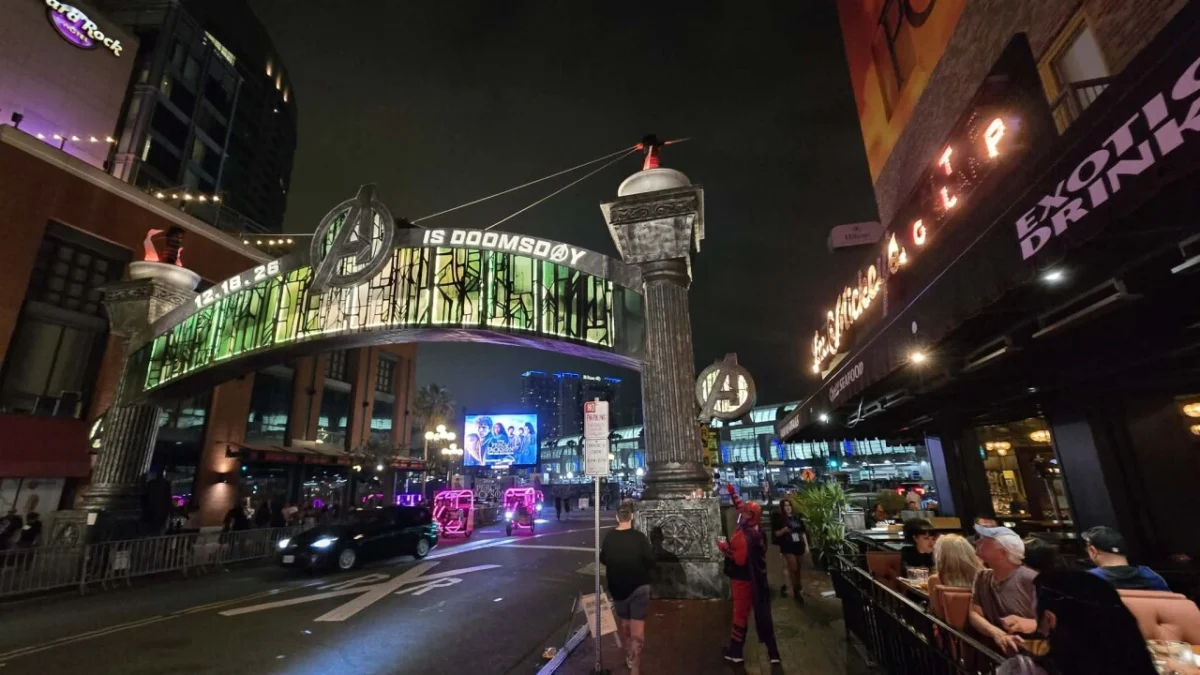
The most immediate news within the industry involves a significant legal penalty levied against a marketing partner of Marvel. During the most recent San Diego Comic-Con, a "boutique outdoor media company" named Elevue was fined $160,000 by the City of San Diego. The fine was issued following the unauthorized installation of an Avengers: Doomsday advertisement over the iconic Gaslamp Quarter Archway sign. Despite repeated warnings from city officials that the installation was prohibited, the company proceeded, leading to a five-day accumulation of fines and concerns over public safety.
Simultaneously, the commercial boundaries of the "Big Two" franchises are blurring further. Marvel and Lucasfilm have officially announced their first-ever direct crossover event, titled Star Wars/Marvel: Hope Assembles. The five-issue miniseries, penned by Kevin Smith with art by David Marquez, represents a historic moment for Disney-owned properties, merging the Marvel Cinematic Universe’s aesthetics with the Star Wars galaxy.

In the realm of genre history, recent scholarship and interviews are challenging the origins of "Cyberpunk." Once viewed as a radical counter-cultural movement, new analyses suggest the term was popularized more as a marketing category than a cohesive literary philosophy. This shift in perspective coincides with the passing of Ted White (1938–2026), a titan of science fiction editing and criticism, whose life’s work spanned the evolution of the genre from fanzines to mainstream dominance.
II. Chronology: From the Carrington Event to the Digital Age
To understand the current state of speculative fiction, one must look at the timeline of events that have shaped its narrative tropes:
- September 1859: The Carrington Event. A massive solar storm induced such powerful currents in telegraph lines that operators could send messages without batteries. This real-world event serves as the historical foundation for modern "EMP apocalypse" narratives.
- 1916: Publication of "Enoch Soames." Max Beerbohm’s short story introduced a comedic yet haunting take on time travel and literary posterity, setting the stage for a century of "what if" storytelling.
- 1952: "A Sound of Thunder." Ray Bradbury published his seminal short story in Collier’s, popularizing the "butterfly effect" in time travel—a concept that would be adapted for television decades later.
- 1980–1982: The Birth of Cyberpunk. A group of writers, including William Gibson and Bruce Sterling, began a "propaganda campaign" to revitalize science fiction, leading to the codification of the cyberpunk subgenre following a series of Nebula Award losses.
- 1989: Ray Bradbury Theatre. The television adaptation of "A Sound of Thunder" aired, cementing the story’s place in the visual lexicon of science fiction.
- 2024–2026: Modern Synthesis. The release of the sociological study Bigfooters and Scientific Inquiry and the production of the EMP thriller One Second After demonstrate a modern preoccupation with blending empirical methods with speculative or fringe subjects.
III. Supporting Data: The Sociology of the Hero and the Hunter
The "Everyman" Appeal of Spider-Man
Pop culture historian Roy Schwartz recently argued that the enduring popularity of Spider-Man—despite a "bajillion movies"—stems from his status as a "blue-collar schmuck." Unlike the "demi-gods" of the DC Universe or the billionaire status of Iron Man, Peter Parker’s narrative is defined by struggle, unlucky-in-love tropes, and the heavy price of doing the right thing. Schwartz notes that the Green Goblin serves as a perfect foil because he represents a "sociopathic tech billionaire," a figure increasingly relevant in modern discourse.

The Science of Bigfooting
In their 2026 book Bigfooters and Scientific Inquiry, sociologists Andrew Bartlett and Lewis conducted over 160 interviews with "Sasquatch seekers." Their data suggests that while the community is often dismissed as anti-science, many participants are "dedicated empiricists." They utilize sophisticated methodologies to collect DNA, hair samples, and footprint casts, modeling their behavior on professional scientific research despite being positioned on the "borderlands of legitimate science."
The Marketing of Cyberpunk
Data from the early 1980s reveals that the "Cyberpunk movement" was, in part, a strategic response to the declining momentum of the "New Wave" of science fiction. William Gibson himself has noted that the term "trivializes" his work, acting more as a label for bookstores and publishers than a reflection of his artistic intent. This suggests that genre labels are often retrospective constructs used to monetize rebellious art.
IV. Official Responses and Industry Perspectives
The San Diego Fine
The City of San Diego was explicit in its condemnation of the Elevue installation. A city spokesperson stated, "The contractor knowingly created a safety risk and refused to address it." The city emphasized that Elevue was told weeks in advance that the Gaslamp sign was off-limits. The refusal to halt construction despite "several additional reminders" resulted in the $160,000 penalty, which the city framed as a necessary measure to protect public infrastructure from corporate overreach.

Kevin Smith on "Hope Assembles"
Regarding the Marvel/Star Wars crossover, writer Kevin Smith expressed a lifelong ambition to see these universes collide. "Nobody had to Force my hand!" Smith remarked, noting that as a child of the 80s, he frequently imagined Spider-Man or Doctor Doom interacting with Luke Skywalker. His perspective reflects a broader industry trend where "fan-service" has become the primary driver of high-budget comic book events.
Josh Holloway on Technological Vulnerability
Actor Josh Holloway, starring in the upcoming EMP thriller One Second After, describes the project as a "warning." Holloway’s perspective is rooted in a wariness of modern technology. "Anything with a chip is done. Burnt," he stated, describing the film’s premise. He argues that the story is a "study about what to do and how to survive," emphasizing community and resourcefulness over digital convenience.
V. Implications: The Future of Speculative Narrative
The current developments in the genre suggest several long-term implications for creators and consumers alike:

1. The Professionalization of the "Fringe"
The sociological study of Bigfooters and the continued interest in "hard" science fiction (like EMP thrillers) indicate that audiences are increasingly interested in the intersection of myth and methodology. There is a growing demand for stories and subcultures that apply "real-world" logic to "unreal" scenarios.
2. Corporate Encroachment on Public Space
The $160,000 fine in San Diego serves as a cautionary tale for the "guerrilla marketing" tactics often employed by major media brands. As franchises like the MCU attempt to dominate physical and digital spaces, municipal governments are likely to tighten regulations to prevent the "cost of doing business" from becoming a license to ignore public safety.
3. The Rebranding of Subgenres
As the history of cyberpunk shows, the labels we use to define science fiction are often fluid and driven by market forces. The passing of figures like Ted White marks the end of an era where genre boundaries were policed by critics and fans in zines. In the modern era, these boundaries are more likely to be defined by streaming algorithms and cross-platform synergy (as seen in the Marvel/Star Wars crossover).

4. The Enduring Power of Relatability
Despite the scale of modern "multiverse" storytelling, the insights from Roy Schwartz regarding Spider-Man suggest that the "core" of a successful franchise remains the human element. Whether it is a time traveler facing a ruined reputation or a "poor schmuck" from Queens trying to pay rent, the most enduring speculative fiction remains that which reflects the struggles of the reader.
In conclusion, the science fiction community is currently balancing a deep respect for its historical roots—celebrating Bradbury’s anniversaries and Ted White’s legacy—with a pragmatic, often skeptical view of its corporate-driven future. As the "Carrington Events" of the past meet the "Doomsday" signs of the present, the genre continues to serve as both a playground for the imagination and a mirror for our societal anxieties.