Simulating the Curve: How a Game Designer’s Blueprint Helped Visualize the Global Pandemic
Six years have passed since the initial tremors of the COVID-19 pandemic reshaped global society. For many, the memory of early 2020 is a blur of confusion and shifting directives. However, for those trained in systemic thinking—epidemiologists, statisticians, and game designers—the crisis was heralded by the cold, inexorable logic of exponential growth.
Raph Koster, a legendary figure in game design known for his work on Ultima Online and Star Wars Galaxies, recently reflected on his role during those early days. What began as a series of ignored warnings on social media evolved into a functional design blueprint that catalyzed the development of educational simulations. These games, created by independent developers across the globe, aimed to do what news reports could not: make the abstract mathematics of a pandemic feel "visceral" to the average citizen.
Main Facts: The Catalyst of a Design Sketch
In late 2019 and early 2020, Koster found himself in a frustrating position. While the general public and many policymakers remained skeptical of the virus’s potential impact, Koster was tracking the data in spreadsheets. He recognized that the Infection Fatality Rate (IFR) and the basic reproduction number ($R_0$) pointed toward a catastrophic death toll if left unchecked.
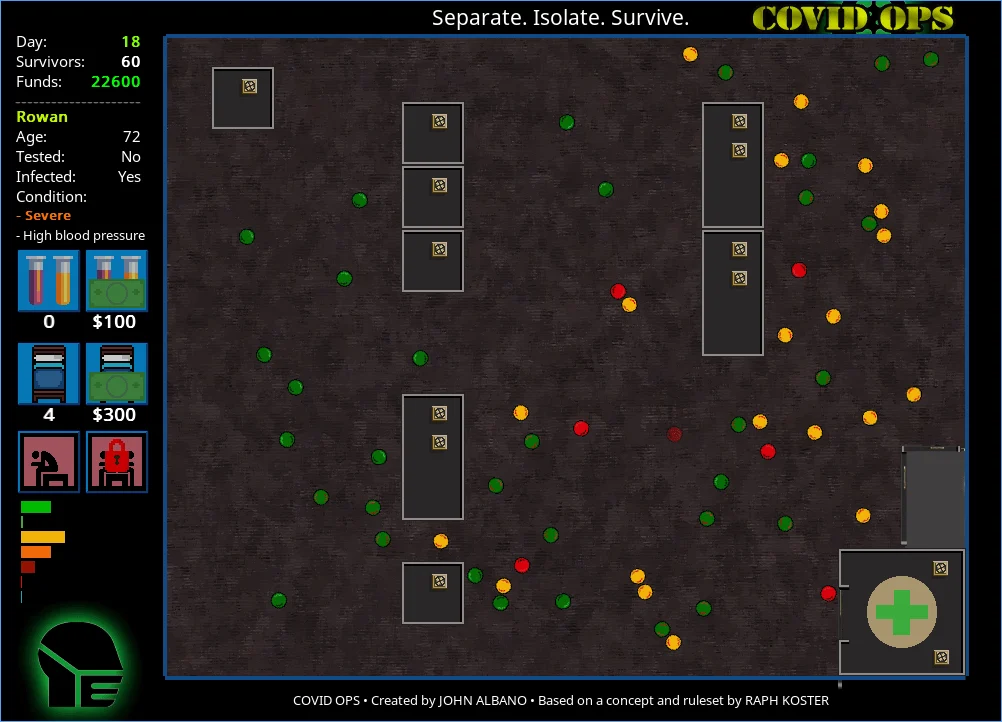
On March 24, 2020, Koster posted a detailed "design sketch" on Facebook. His goal was to provide a framework for a simple, interactive simulation that would demonstrate how social distancing, testing, and healthcare capacity interact. He envisioned a field of "little circles" representing human beings, each assigned a name, an age, and statistically accurate comorbidities.
The sketch was not merely a theoretical exercise. It was a call to action for the game development community. Within days, two distinct projects emerged from this blueprint:
- Covid Ops: Developed by John Albano and released just six days after Koster’s post.
- In the Time of Pandemia: Developed by a team in the Philippines led by Khail Santia, which eventually became a highly decorated educational tool vetted by medical professionals.
These games sought to bridge the gap between "numerate" data and human empathy, transforming statistical probabilities into the life-or-death struggles of named digital avatars.
Chronology: From Rumors to Viral Simulations
The timeline of Koster’s involvement and the subsequent game developments highlights the rapid escalation of the crisis and the speed of the creative response.
- November 2019: Koster begins tracking rumors of a novel respiratory illness in China.
- Early 2020: Koster engages in social media discourse, attempting to explain the mathematics of exponential spread. His predictions of "millions dead" are largely met with derision and skepticism.
- March 24, 2020: Koster publishes his design sketch on Facebook. He outlines the states of infection (Healthy, Asymptomatic, Diagnosed, Critical, Dead) and the player’s intervention options (Testing, Social Distancing, Closing Schools).
- March 30, 2020: John Albano releases the first version of Covid Ops on Itch.io. The game incorporates real-world comorbidity data and forces players to manage limited resources to save specific, named individuals.
- April 6, 2020: Khail Santia and his team participate in "Jamdemic 2020," developing the prototype for In the Time of Pandemia in Cebu City, Philippines—at the time a major COVID-19 hotspot.
- July 2020: In the Time of Pandemia launches on Newgrounds. It features validated data from mathematical biologists and medical experts, eventually topping the site’s charts and gaining international press coverage.
- Present Day (Late 2025): Koster reflects on the 6-year anniversary, noting that while the acute phase of the pandemic has passed, the lessons of systemic preparedness remain more relevant than ever given the emergence of new threats like H5N5 bird flu.
Supporting Data: The Mathematics of Denial
The skepticism Koster faced in 2020 was rooted in a fundamental human inability to process exponential curves. To combat this, his design sketch insisted on using "statistically valid" numbers.
At the time, Koster proposed a "low-end" death estimate based on an IFR of 0.4% and a herd immunity threshold of 60% of the population. The resulting calculation for a country the size of the United States (approx. 330 million) suggested a death toll in the millions. While critics laughed at these figures in early 2020, the historical record has largely vindicated Koster’s "back-of-the-envelope" math. Current estimates place the U.S. death toll between 1.2 and 1.4 million, with global estimates ranging from 15 to 28.5 million.
Koster’s design also emphasized the prevalence of comorbidities, arguing that the "at-risk" population was far larger than the public realized. He cited data that remains sobering:
- Hypertension: According to the American Heart Association, nearly 46% of U.S. adults have high blood pressure.
- Diabetes: The American Diabetes Association notes that over 10% of the population is diabetic, with another 34.5% being pre-diabetic.
- Obesity: Studies in the Journal of the American Medical Association (JAMA) indicate that obesity—a significant risk factor for respiratory distress—affects over 42% of the U.S. adult population.
By building these variables into the "circles" of the simulation, the games forced players to realize that protecting the vulnerable meant isolating nearly half the population—a logistical reality that many political leaders were slow to accept.
Official and Academic Responses
The games spawned by Koster’s sketch received significant attention from the medical and academic communities, particularly in Southeast Asia. Unlike many commercial games, In the Time of Pandemia was treated as a legitimate public health tool.
Dr. Mariane Faye Acma, a resident physician who consulted on the game’s medical plausibility, noted that the simulation developed "critical thinking, analysis, and multitasking." She argued that the game allowed players to realize "how challenging the work of the health sector is in this crisis."
Gregg Victor Gabison, Dean of the University of San Jose-Recoletos College of Information, Computer & Communications Technology, integrated the game into classroom environments. He described it as a "game that mindful individuals would want to check out," noting its ability to connect storyline with the grim reality of the pandemic.
The viral success of these projects across the Pacific Rim—featured in The Star Malaysia, IGN Southeast Asia, and The Philippine Star—demonstrated that interactive media could serve as a bridge for government and health organizations to communicate complex "flatten the curve" strategies to a younger, tech-savvy demographic.
Implications: Games as a Tool for Future Crises
Looking back, Koster’s contribution was not in the coding of the games, but in the "mechanization" of empathy. By suggesting that every digital circle have a "name out of a baby book," he forced players to move past the "wall" of statistics.
The implications of this work extend beyond the COVID-19 era. Koster argues that the same people who understood the pandemic early—quants, statisticians, and game designers—share a common trait: they "live with exponential curves." In a world where global threats like climate change, viral evolution, and economic shifts operate on these same non-linear scales, the ability to simulate these systems is a vital civic skill.
Koster’s reflection serves as a reminder of the "softness" of the initial global response. He contends that the discourse has shifted too heavily toward the economic and educational costs of lockdowns, often ignoring the fact that a more "forceful and concerted" initial action could have mitigated both the health and economic hits. The health response, in his view, was often too lenient, resulting in a "worst of both worlds" scenario where society took the full hit of the virus and the full hit of prolonged, ineffective restrictions.
As the world monitors the first human cases of H5N5 bird flu, the tools developed in 2020 remain on standby. For Koster, Albano, and Santia, these games were more than just software; they were a "thread connecting a diversity of talents" during a time of profound isolation. They proved that games can be more than entertainment—they can be a "visceral understanding" of our collective responsibility to one another.
The legacy of the 2020 design sketch is a testament to the power of open-source ideas. By providing the logic, Koster empowered others to build the shields. As he concluded in his recent reflection, making a difference to even a handful of people is "not a bad thing for a game to aspire to." In the face of the next "World War" or "Great Depression," the ability to play through the possibilities may be our best chance at finding the path through.