The Ghost Store: Analyzing the Microsoft Store’s Discovery Crisis Through the Lens of Nowhere Prophet
The digital distribution landscape for PC gaming has long been dominated by a few key players, with Valve’s Steam maintaining a seemingly unshakable stranglehold on the market. However, the industry remains baffled by the persistent underperformance of the Microsoft Store—a platform pre-installed on over 1.4 billion active Windows devices. In August 2022, a viral revelation from indie developer Martin Nerurkar regarding his game, Nowhere Prophet, cast a harsh spotlight on this disparity, revealing a "zero-sale" phenomenon that continues to spark debate among industry analysts and software developers.
Main Facts: The Zero-Sale Paradox
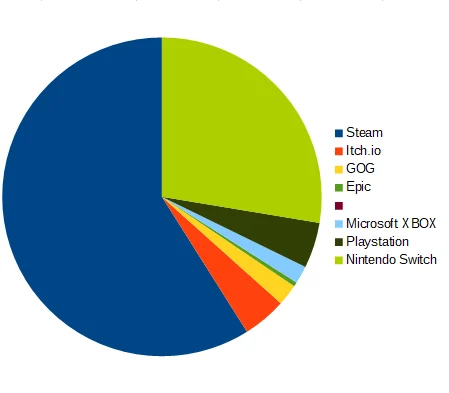
In a series of data-driven disclosures shared on social media, Martin Nerurkar, the founder of Sharkbomb Studios and creator of the acclaimed "dustpunk" deck-builder Nowhere Prophet, revealed a startling statistic. Despite the game having achieved a respectable lifecycle and an estimated 20,000 units sold across various platforms, the Microsoft Store accounted for exactly zero of those sales.
The revelation was accompanied by a revenue chart illustrating the game’s performance on platforms like Steam, GOG, and various console storefronts. While Nowhere Prophet found a dedicated audience on PC via Steam and experienced significant engagement on the Nintendo Switch and PlayStation, the Microsoft Store—the native storefront for the operating system the game runs on—failed to convert a single customer into a paying buyer.
This "zero-sale" metric is particularly jarring when contrasted with Microsoft’s own reach. As of 2022, Windows 10 and 11 boasted a combined user base of approximately 1.4 billion monthly active users (MAUs). The fact that a critically well-received indie title could sit on a platform with a ten-figure reach and fail to move a single unit suggests a systemic failure in the store’s architecture, discovery algorithms, and consumer perception.
Chronology: From Launch to the "Zero-Sale" Realization
The journey of Nowhere Prophet provides a clear timeline of how a game can thrive in the broader ecosystem while remaining invisible in Microsoft’s native environment.
- July 2019: Nowhere Prophet officially launches on Steam. It receives positive reviews for its unique blend of tactical combat and rogue-like progression.
- 2020-2021: The game expands to consoles, including the Nintendo Switch, PlayStation 4, and Xbox. During this period, the game is also included in the Xbox Game Pass library, Microsoft’s subscription service.
- Late 2021: The game leaves the Xbox Game Pass service. This is a critical juncture where, theoretically, players who enjoyed the game via subscription might be inclined to purchase it to keep it in their library.
- August 5, 2022: Martin Nerurkar publishes the sales breakdown by platform. He notes that while the game saw a healthy "long tail" of sales on Steam and consoles, the Microsoft Store (the standalone retail arm on Windows) remained at zero.
- Post-August 2022: The discussion goes viral, prompting industry veterans like Nicholas Lovell of Gamesbrief to weigh in on the structural identity crisis of the Microsoft Store.
Supporting Data: The 1.4 Billion Disconnect
To understand the magnitude of this failure, one must look at the comparative data of the PC gaming market. According to industry reports, Steam consistently hosts between 20 million and 30 million concurrent users. While this is a fraction of the 1.4 billion total Windows users, Steam’s users are "high-intent" gamers.
In contrast, the Microsoft Store suffers from a "diluted audience." The 1.4 billion MAUs are not necessarily on the store to buy games; they are often interacting with the OS for productivity, education, or web browsing.
Key Comparisons:
- Conversion Rates: For Nowhere Prophet, the conversion rate on Steam was healthy enough to sustain the studio. On the Microsoft Store, the conversion rate was effectively 0.00%.
- The Game Pass Effect: It is important to note that Nowhere Prophet was available on Xbox Game Pass. While this provided the developer with an upfront fee and "reach," it did not translate into retail sales on the same platform. Data suggests that users on the Microsoft ecosystem have been trained to "subscribe" rather than "buy," a consumer behavior shift that appears to have cannibalized the retail side of the Microsoft Store.
- Discovery Metrics: On Steam, a game’s visibility is driven by user reviews, "wishlisting," and algorithmic recommendations. On the Microsoft Store, the UI has historically prioritized first-party titles (like Halo or Forza) and utility apps (like Netflix or WhatsApp), leaving niche indie titles buried under layers of non-gaming content.
Official Responses and Developer Sentiment
While Microsoft has not issued a specific statement regarding the Nowhere Prophet case, the company has historically acknowledged that the Microsoft Store needed a "reimagining." In the years leading up to 2022, Microsoft launched a "New Microsoft Store" alongside Windows 11, promising better performance and a more open ecosystem for developers (including allowing Win32 apps and alternative payment engines).
However, the sentiment among indie developers remains skeptical. Martin Nerurkar’s experience is not an isolated anecdote but a representative case study. Nicholas Lovell, a prominent voice in the business of games, characterized the store’s failure as an "identity crisis."

"The Microsoft store is terrible," Lovell noted in his analysis. "It can’t work out whether it is a retail store for $59.99 games or an app store offering safe, free, quality-of-life apps for Windows. It’s trying to be both and failing at both."
Developers frequently cite the "UWP (Universal Windows Platform) legacy" as a deterrent. Early versions of the store required games to be packaged in a way that limited modding and made file access difficult for users—a major "red flag" for the PC gaming community, which prizes flexibility and customization.
Implications: What This Means for the Future of PC Distribution
The fact that a platform with 1.4 billion potential customers cannot sell a single copy of a quality game carries several heavy implications for the industry.
1. The Entrenchment of Steam
Valve’s dominance is not merely a result of being first to market; it is a result of building a community-centric ecosystem. The Microsoft Store’s failure proves that "pre-installation" does not equal "market share." Even when the store is sitting on the taskbar of every PC in the world, gamers will go out of their way to download a third-party client (Steam) because that is where their friends, their achievements, and their trust reside.
2. The Subscription Trap for Indies
The Nowhere Prophet data suggests a precarious future for indie developers who rely on Microsoft. While Game Pass offers immediate financial security through licensing fees, it may be destroying the "long-tail" retail value of games within the Microsoft ecosystem. If a game is not on Game Pass, it effectively does not exist for the Windows Store user. This creates a "monopsony" where Microsoft becomes the only viable buyer for certain types of content on their platform.
3. The UI/UX Identity Crisis
For Microsoft to fix this, they must decouple the "App Store" from the "Game Store." Currently, a user looking for a calculator app is navigated through the same interface as a user looking for a deep tactical RPG. This creates a "noise" problem where high-value gaming content is perceived as "disposable apps." Until Microsoft creates a dedicated, high-performance gaming environment that mirrors the social and technical features of Steam, the "zero-sale" phenomenon is likely to continue for many indie creators.
4. The Loss of Revenue for Platform Holders
By failing to optimize the store, Microsoft is leaving billions of dollars in potential commissions on the table. While they take a 12% cut of games (reduced from 30% to compete with Epic), 12% of zero is still zero. The missed opportunity to monetize the 1.4 billion-strong user base represents one of the greatest "fumbled plays" in the history of digital retail.
Conclusion
The case of Nowhere Prophet serves as a cautionary tale for the digital age. It demonstrates that reach is meaningless without relevance. As Martin Nerurkar’s data shows, being visible to everyone is not the same as being findable by someone. For the Microsoft Store to become a legitimate contender in the PC gaming space, it must move beyond being a pre-installed utility and evolve into a destination that gamers actually want to visit. Until then, it remains a "ghost store"—a vast, populated territory where, for the independent developer, no one is buying.