New Father Navigates Birth and Political Tensions Amidst Concerns of "Leftist Violence"
A recent birth has coincided with a father’s heightened anxieties about his public platform and perceived threats, leading to a discussion on navigating political discourse and family privacy in an increasingly polarized climate.
[City, State] – [Date] – For many new parents, the arrival of a child is a time of profound joy, marked by sleepless nights and the overwhelming experience of welcoming a new life. For Thomas, a public figure whose family is often in the spotlight, this period has also become a focal point for discussions about political polarization and the perceived safety of his family. The birth of his son, George Washington Umstattd, on July 5th, has been intertwined with his concerns about online harassment and what he describes as "leftist violence."
Thomas’s wife, who labored through the July 4th holiday, narrowly missed the chosen name for their son. "I kept saying, ‘Come on, George Washington,’" Thomas recounted, recalling the fireworks illuminating the sky as his wife experienced contractions. He expressed deep admiration for his wife’s strength during childbirth, calling it a "miraculous event." While the birth itself went smoothly, Thomas alluded to subsequent complications that necessitated hospital visits, a detail he chose not to elaborate on further.
The family is currently in a state of temporary displacement, what Thomas’s daughter has termed their "crisis home." This situation arose because his daughter did not have her own residence prepared to receive the new baby. Despite this, Thomas emphasized that they do possess a home and are making the best of their current circumstances. Proximity to his parents offers a silver lining, providing his wife with a supportive network of in-laws for childcare.
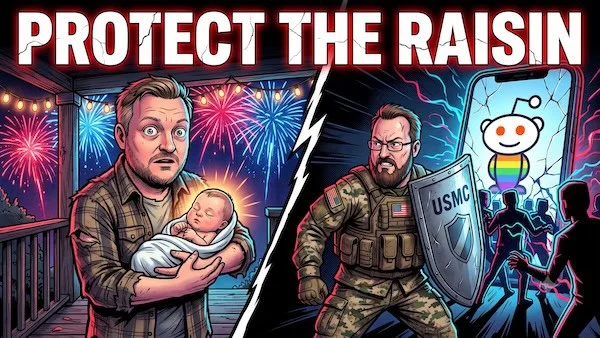
However, the personal milestone has been overshadowed by external pressures. Thomas revealed that a "leftist subreddit" began targeting him concurrently with his son’s birth. This development has prompted him to dedicate a segment of his platform, which he terms a "Zeitgeist segment," to addressing how to "navigate leftist violence as an influencer."
The Nexus of Public Life and Family Safety
Thomas explained that his audience expresses a strong interest in his children and family life, often requesting photos. While he initially shared a picture of his newborn, he described the infant as resembling a "little wrinkled raisin," a common observation for newborns. This decision, however, stems from a broader concern: protecting his children from what he perceives as escalating leftist aggression.
"With leftists becoming more violent, I want to protect my children," Thomas stated. He articulated a desire for any perceived threats or online "brigading" against him to be directed through him personally, implying a protective stance. "You don’t want to come through me," he asserted, conveying a sense of formidable defense.
Defining "Leftist Violence" in the Current Discourse
To contextualize Thomas’s concerns, Jonathan, a co-host or commentator in the discussion, offered a broader perspective on the term "leftist violence." He stressed the importance of understanding this not as a blanket indictment of all Democrats, but rather as a descriptor for a particular "problem-solving pattern" observed across the political spectrum.
"If you vote blue, we don’t think you’re going to come out and kill us," Jonathan clarified, drawing a distinction between mainstream political affiliation and the behaviors he is critiquing. He elaborated on what he termed the "speech-is-violence" ideology, where individuals may perceive words they dislike as a direct attack, justifying a violent response for self-preservation. This, he argued, is a misinterpretation of genuine dialogue, leading to disproportionate reactions.
Jonathan cited an example of what he considers "deranged wackos" posting violent rhetoric under the posts of a public figure he compared to Charlie Kirk, questioning the individual’s physical well-being with comments like, "Hey, why is there a hole in his neck?" This, he argued, exemplifies the "problem-solving pattern" where disagreement is framed as a personal attack, necessitating a survival response. He likened this mindset to psychosis, where everyday interactions are perceived as existential threats.
"That’s what Thomas is talking about here," Jonathan concluded, emphasizing that "leftist" in this context refers to this specific, "deranged" strain of problem-solving, not necessarily all individuals who identify as left-leaning. He reiterated that if confronted with such behavior, he would prioritize protecting himself and his children.
Beyond Lethal Force: The Scope of Perceived Violence
Thomas expanded on the definition of "violence" in this context, moving beyond purely physical harm. He included instances of public harassment, such as "shouting at my children or making them unsafe in a public environment." He referenced an incident where he claims leftists were "shouting at JD Vance’s kids at Disney World," arguing that while political disagreement is acceptable, targeting children is not.
He criticized what he perceived as a lack of media attention to such events, suggesting an "acceptance of left-wing violence" within broader societal narratives. Thomas then drew a historical parallel to the "Weather Underground" era, a period marked by left-wing terrorism. He noted that many individuals involved in such activities later achieved prominent positions as academics and commentators, and that the group’s violent past was often downplayed as mere "overzealousness."

"When you’re the victim of that, or you could be the victim of that, you don’t care that they were overzealous," Thomas stated, underscoring the personal impact of perceived threats. This fuels his reluctance to expose his children’s identities.
The Tightrope Walk: Public Persona and Private Sanctuary
The discussion then shifted to the practicalities of maintaining a public profile while safeguarding family privacy. Thomas identified Charlie Kirk as a model for this approach, noting Kirk’s strategy of making his children public figures without revealing their faces or names. This, Thomas suggested, offered a degree of protection, allowing his children to navigate public spaces safely.
However, he acknowledged that for public figures like Kirk’s wife, notoriety comes with increased security needs, a direct consequence of what he termed "violence for the left [being] a form of communication."
Thomas then offered a stark contrast regarding violence attributed to the right. He stated that while "violence for the right is not a form of communication," it can be "just as violent," and in some instances, "worse, because for the right it’s a switch." He invoked a biblical narrative from the Book of Judges, illustrating a scenario where prolonged tolerance of an egregious act by one tribe leads to a sudden, devastating reprisal from other tribes.
"At some point the switch on the right may flip, and that’s very scary, because suddenly there are burning houses everywhere and suddenly there are lots of dead people," Thomas warned, urging for a de-escalation of violent rhetoric to avert such an outcome. He reiterated that until this occurs, individuals in public life must "take precautions," particularly in the face of online targeting.
He admitted to a strategic shift in his own approach to sharing family photos. Initially, he shared numerous baby photos, a practice that resonated with his audience. However, as his platform has become more politically charged and the "left gets meaner and more violent," he has begun "slowly purging photos," a departure from his earlier openness.
The Aftermath of Perceived Attacks and Shifting Dynamics
Jonathan then introduced another critical element: the perceived "celebration" of what he referred to as the "Charlie Kirk assassination." This event, he argued, has fundamentally altered the landscape of political discourse, eroding a prior understanding of civility.
"Before, we could all agree, ‘I hate you, you hate me, but I love your babies.’ ‘I love your kids. I’m going to take care of your kids.’ Now we don’t have that understanding anymore," Jonathan lamented, suggesting a breakdown in fundamental societal norms.
Thomas recounted a tragic incident involving a federal judge’s son, who was killed when assailants intended to harm the judge. He also highlighted testimony from Amy Coney Barrett regarding the "violent threats" she and her family have received, noting how these threats have allegedly influenced her judicial decisions, pushing her towards more "left-voting" out of fear of "the mob."
He expressed complex emotions, acknowledging the maternal instinct to protect children above all else. "As a mom, she’s saying, ‘Forget the country, I care about my babies.’ Moms are genetically programmed to defend their children, and they need to be for the continuation of the species," Thomas observed. He contrasted this with his own perspective as a citizen, urging for adherence to principles that safeguard the nation.
Navigating the Present and Future
Returning to the personal, Thomas mused about using the name "George Washington" as a coded reference within his podcast, a suggestion he found appealing, though uncertain of his wife’s reaction. He described his newborn son as "the cutest thing" and embraced the challenges of fatherhood, even the lack of quality sleep.
"I have consumed a huge amount of coffee in preparation for this episode," he admitted, offering a humorous takeaway: "quantity is a quality all its own," a principle he attributed to Napoleon, but found applicable to both newborns and military campaigns. He described their current living situation as a "challenge," with the entire family sharing limited space and resources, but emphasized that they are "making it work" and creating "good memories."
The overarching narrative presented is one of an individual grappling with the intersection of public influence, personal milestones, and the escalating tensions of political discourse. Thomas’s concerns, while framed through a specific ideological lens, highlight a broader societal anxiety about the impact of online rhetoric and the potential for real-world consequences on families. The discussion serves as a window into a particular segment of public commentary, reflecting a worldview where perceived threats necessitate a recalibration of personal and familial boundaries in the public sphere.