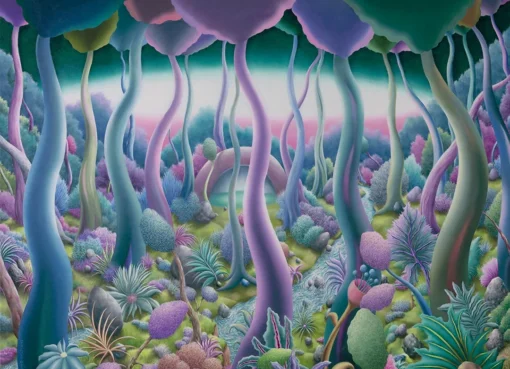
The Cartography of the Soul: Christian Quintin and the Evolution of Meditative Surrealism
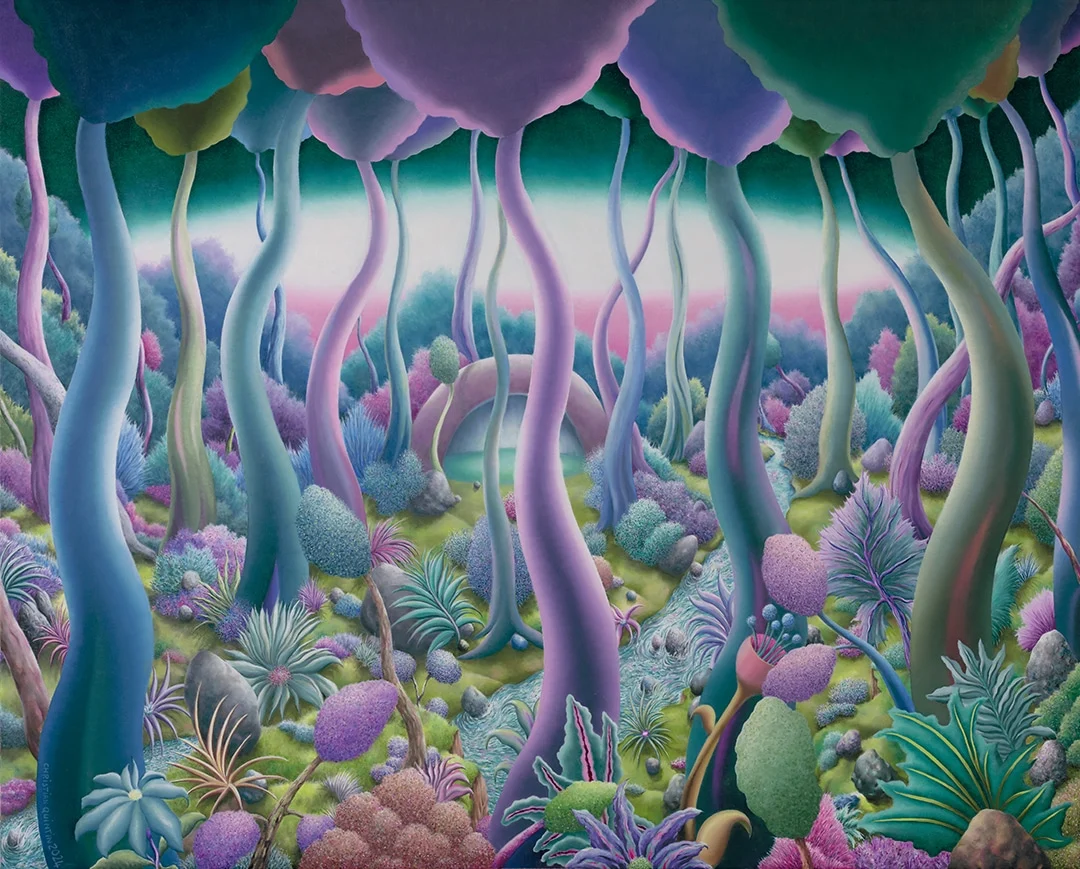
In an era of contemporary art often defined by rapid-fire digital aesthetics, conceptual irony, and industrial-scale production, the work of Christian Quintin stands as a quiet yet profound defiance. A French-born painter and draftsman who has spent more than four decades anchored in the landscapes of Northern California, Quintin has carved out a singular space in the "Visionary Continuum." His work does not merely depict scenes; it maps the intersection where the external natural world meets the internal topography of human memory.
Quintin’s oeuvre—a meticulous blend of Romanticism, Symbolism, and a deeply philosophical brand of Surrealism—challenges the viewer to abandon the search for slogans and instead "read" the canvas as one would read poetry. As his career reaches a new international crescendo with representations in Los Angeles, Paris, and Hong Kong, art historians and critics are increasingly viewing Quintin not just as a regional master of the American West, but as a bridge between the rigorous classical traditions of Europe and the expansive, spiritual ecology of the Pacific Coast.
I. The Quintin Aesthetic: Landscapes of Presence and Memory
At the heart of Christian Quintin’s practice is a rejection of what he calls "word-based art." While many modern artists lead with a manifesto, Quintin leads with an invitation to wonder. His work is characterized by a "kaleidoscopic consciousness," a term he uses to describe the blurring of boundaries between the observer and the observed. In a Quintin painting, a tree is rarely just a botanical specimen; it is a dancer, a lover, or a vessel for ancestral memory.

His technical approach is defined by a slow, meditative labor that is increasingly rare. Utilizing pen and ink, oil, graphite, and pastel, Quintin often spends months on a single composition. This "slow-burn" methodology results in works that possess an uncanny technical precision—reminiscent of the Dutch Masters or the early Surrealists—while maintaining an ethereal, dreamlike quality. His images arrive with the weight of déjà vu, presenting landscapes that breathe and faces that are composed of architectural rooms, suggesting that the human psyche is itself a vast, inhabitable terrain.
II. Chronology: From the Storms of Brittany to the Valleys of Sonoma
The evolution of Quintin’s vision is a story of two coastlines. Born in 1957 in Saint Brieuc, a port town on the northern coast of Brittany, France, Quintin’s earliest visual vocabulary was shaped by the "moody grandeur" of the Atlantic. The region’s ruined castles, storm-lashed cliffs, and the mythic L’Île de la Comtesse provided a gothic, romantic foundation for his imagination. This period instilled in him a sensitivity to the melancholy of nature—a sense that the landscape holds secrets that only the patient observer can decode.
The Paris Years and Classical Discipline
In 1975, Quintin moved to the center of the French art world, enrolling in the prestigious Beaux Arts Academy in Paris. It was here that his romantic instincts were tempered by the steel of classical discipline. Under the guidance of the academy’s ateliers, he mastered the rigorous draftsmanship and control of form that would become his hallmark. During this time, he absorbed the legacies of French Surrealism and the Symbolists, but he avoided the movement’s tendency toward shock and provocation. Instead, he looked toward the ability of art to reveal hidden truths through meticulous representation.

The California Transition
The pivotal shift in Quintin’s life and work occurred in 1981 when he relocated to Northern California. Settling in the vineyards and valleys of Sonoma County, he encountered a landscape that resonated with his European roots but offered a new, sacred ecology. The rolling hills, ancient redwoods, and Pacific fog of the American West became his second vocabulary. In California, Quintin found a "spirit in the trees" that matched his own, leading to a decades-long communion with the local terrain. The old myths of Brittany found a mirror in the golden light of the West, resulting in a unified vision that connects inner consciousness with outer terrain.
III. Supporting Data: Technical Mastery and the Anatomy of Major Works
To understand Quintin’s impact, one must look at the data of his process. Unlike the "automatic writing" of early surrealists like André Breton, Quintin’s surrealism is a deliberate construction.
The Labor of "The Aviary" and "La Porte Ouverte"
One of Quintin’s most celebrated works, The Aviary, serves as a masterclass in his "kaleidoscopic consciousness." In this piece, the artist’s face emerges from a crystal, his neck transforms into a tree trunk, and his hair becomes a lush canopy. The painting took six months to complete. This timeline is typical for Quintin; another work, La Porte Ouverte (The Open Door), inspired by the poetry of Rumi, required seven months of intricate crosshatching. These works are not "sketches" of dreams but are visual meditations that blur the edges of logic.

The Symbolism of the "Breathing Landscape"
In his landscape works, such as Leaves of Absence and Les Amants, Quintin utilizes oil and pastel to create "emotional terrains." In A Lake Color of Emeralds, Quintin deviates from literal color theory to prioritize emotional resonance, using brown-orange skies and emerald waters to evoke a specific psychological state. This approach is supported by his philosophical stance: "Intuition first. Technique follows." He selects his medium—be it the softness of pastel or the depth of oil—based on the "tune" of the emotion he intends to convey.
Career Milestones and Awards
Quintin’s steady climb in the art world is marked by significant institutional recognition:
- 1987: Received the Grumbacher Award, acknowledging his technical excellence in traditional mediums.
- 1990: Awarded the Excellence Award from the California State Fair.
- 1999: Representation by the Vorpal Gallery. This was a watershed moment, as Vorpal was the gallery responsible for introducing M.C. Escher to the American public. The association firmly placed Quintin in the lineage of "mathematical and meditative" surrealists.
- 2020s: International expansion through Lorin Gallery, leading to exhibitions at KIAF (Seoul), Art Central (Hong Kong), and major shows in Paris and Los Angeles.
IV. Official Responses: Critical Reception and the Gallery Perspective
The critical response to Quintin’s work has been remarkably consistent over the decades, focusing on his ability to provide a "sanctuary" for the viewer.

Suzanne Munich, in her review titled Mental Landscapes, noted that Quintin’s work functions as a map of the subconscious, while Dan Taylor of the Press Democrat highlighted the "emerging beauty" that characterizes his transition from European shadows to California light. Alhia Warren perhaps captured the essence of his appeal best, describing his work as a "beautiful intimate mystery."
The 2022 Calabi Gallery Assessment
In a notable 2022 review, the Calabi Gallery offered a diagnosis of why Quintin’s work is surging in popularity now: "In an era largely devoid of it, his work is beautiful. We could all use more beauty in our lives." This sentiment reflects a broader shift in the art market—a "return to craft" and a renewed interest in beauty as a valid, even radical, artistic objective.
Gallery Representation and Global Reach
Lorin Gallery, which represents Quintin in the international market, emphasizes his role as a bridge between the classical and the visionary. By placing his work in high-traffic Asian and European fairs, galleries have found that Quintin’s "symbolic language" transcends cultural barriers. The universal motifs of the tree, the face, and the sea allow his work to speak to diverse audiences without the need for translation.

V. Implications: Beauty as Defiance and the Visionary Continuum
The rise of Christian Quintin in the 2020s carries significant implications for the direction of contemporary surrealism. While the 20th-century surrealists often sought to unsettle or shock the bourgeois sensibility, Quintin’s "meditative surrealism" seeks to awaken and heal.
A Bridge Between Movements
Quintin occupies a unique space between the European Surrealist tradition (Dalí, Magritte, Escher) and the Northern California Visionary Art movement. While the latter—rooted in the 1960s counterculture—often leans toward psychedelic chaos, Quintin introduces a "sacred geometry" and a classical restraint. He proves that visionary art can be quiet, orderly, and deeply rooted in traditional technique.
Art as Resistance to Speed
In a "culture of speed and spectacle," Quintin’s career is a testament to the power of slowness. His insistence on spending half a year on a single canvas is a form of resistance against the commodification of art. His legacy is likely to be defined by this "slow-burning" influence—a reminder that attention is the highest form of prayer and that beauty, when executed with soul and care, becomes a sanctuary.

Future Outlook
With upcoming exhibitions at the Morrison Gallery in Connecticut and continued presence in the major art capitals of the world, Quintin’s work is poised to influence a new generation of artists looking to reconnect with nature and the psyche. He has successfully demonstrated that the art world eventually catches up to the artist who remains true to his own "inner constellation."
Conclusion: The Enduring Sanctuary
Christian Quintin’s art is not an escape from reality, but a reentry into its hidden dimensions. By documenting the "feelings for which we have no words," he provides a visual vocabulary for the human experience of the natural world. Whether he is painting a floating face in the clouds of West Sonoma County or the storm-lashed cliffs of his youth in Brittany, Quintin remains a master of the "unified vision."
His work stands as a reminder that the boundary between the spirit and the form is thin, and that the role of the artist is to navigate that boundary with grace, precision, and an unwavering commitment to beauty. As the art world continues to evolve, the "wondrous sanctuary" provided by Christian Quintin remains a vital destination for the soul.