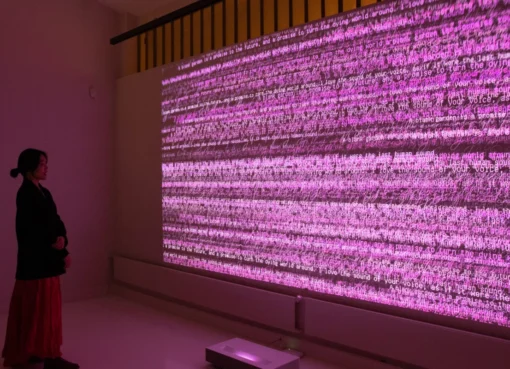
The Living Canvas: How Infinidream.ai is Reimagining the "Dead Screen" through Generative AI

Main Facts: The Launch of a New Ambient Frontier
In an era where digital displays permeate every facet of our domestic and professional environments, the "dead screen"—that period of inactivity where a monitor reverts to a black void or a static, utilitarian clock—has become a missed opportunity for aesthetic engagement. Enter Infinidream.ai, a newly launched application for Mac and Windows designed to transform idle hardware into a "living" gallery of generative artificial intelligence art.
Created by renowned digital artist and engineer Scott Draves, Infinidream.ai is not merely a wallpaper engine or a video looper. It represents a sophisticated intersection of ambient computing and neural-network-driven creativity. The software allows users to stream high-fidelity, evolving AI artworks that shift, breathe, and morph in real-time. Unlike traditional screensavers that rely on pre-recorded files, Infinidream utilizes the power of generative AI to ensure that no two moments of the display are ever identical, effectively turning a standard computer monitor into a kinetic sculpture.
The platform launches with a curated library featuring works from dozens of AI artists, covering a spectrum of styles from moody abstractions to hypnotic, surrealist landscapes. Currently available for free to try via the company’s website, the application aims to bridge the gap between high-end digital art installations and the average consumer’s workspace.
Chronology: From Distributed Fractals to Neural Networks
To understand the significance of Infinidream.ai, one must look back at the career of its creator, Scott Draves, who has been a pioneer in the "generative" space for over a quarter of a century.
1999: The Electric Sheep Revolution
In 1999, Draves launched Electric Sheep, one of the earliest and most successful experiments in distributed computing and evolutionary art. Electric Sheep was a screensaver that linked hundreds of thousands of computers into a collective "supercomputer" to render complex fractal animations.
The project was unique because it incorporated a democratic, Darwinian element: users could vote on the animations they liked. The "sheep" (animations) that received the most votes were more likely to "reproduce" and pass their mathematical traits to the next generation of renders. At its peak, the network consisted of over 450,000 computers. The project was so culturally significant that it was exhibited at the Museum of Modern Art (MoMA) and the Los Angeles County Museum of Art (LACMA), running continuously for over two decades.
2010s: The Rise of Algorithmic Maturity
Throughout the 2010s, Draves and his contemporaries refined the math behind algorithmic art. This era focused on "Flame fractals" and high-resolution rendering, pushing the boundaries of what software could generate without human intervention. However, these works were still largely bound by mathematical constraints.
2023–2024: The AI Pivot and the Birth of Infinidream
With the explosion of Large Language Models (LLMs) and Diffusion Models, the landscape of generative art shifted from pure mathematics to neural patterns. Draves recognized that the same "evolutionary" instinct that powered Electric Sheep could be supercharged by modern AI.
Infinidream.ai was conceived as the spiritual successor to Electric Sheep. While the former relied on a global network to render fractals, the latter leverages the local processing power of modern GPUs and cloud-based AI models to create "living paintings." The transition from the rigid beauty of fractals to the fluid, dream-like quality of AI-generated imagery marks a significant turning point in Draves’ career and the broader digital art movement.
Supporting Data: The Science of Ambient Art and Digital Wellness
The push for "living screens" is backed by emerging data regarding environmental psychology and the impact of digital spaces on mental well-being.
The "Black Mirror" Effect
A study on workplace ergonomics suggests that "dead" screens contribute to a sense of sterile, uninspiring environments. In modern open-office plans or home offices, a large black monitor acts as a visual "sink," absorbing light and creating a void in the room’s decor. Infinidream.ai addresses this by providing what Draves calls "ambient energy"—visuals that are slow enough not to distract, yet dynamic enough to provide a sense of life.
The Psychology of Slow Motion
Infinidream allows users to adjust the "tempo" of the art. Data from the field of neuroaesthetics suggests that slow, rhythmic visual changes can lower cortisol levels and improve focus. The "slow motion" setting in the app mimics the natural movement of clouds or water—patterns known as "soft fascination" in Attention Restoration Theory (ART). This allows the brain to recover from the "hard fascination" required by intense work tasks.

Technical Specifications
The application is optimized for modern hardware:
- Compatibility: macOS (Intel and Apple Silicon) and Windows 10/11.
- Performance: Uses minimal CPU/GPU overhead when running in the background, ensuring it doesn’t interfere with system performance during active use.
- Curation: Unlike open-source AI tools that can produce "noise," Infinidream utilizes a curated pipeline. This ensures that the output maintains a high standard of aesthetic quality, vetted by human artists.
Official Responses: The Vision of Scott Draves
In discussing the philosophy behind the app, Scott Draves emphasizes that the "dead screen" is a failure of modern design. "There’s a moment every few hours when your computer just sits there," Draves notes. "Screen dark, or worse: showing the time in giant white numerals against a black void, quietly announcing that nothing interesting is happening."
Draves’ response to this void is to treat the screen as a "mobile"—referencing the kinetic sculptures of Alexander Calder. He envisions art that has "duration as well as form." According to the development team, the goal was to create something that feels "deliberate but never repeats exactly."
Early users and art critics have noted that Infinidream feels like a departure from the "NFT craze" of previous years. Instead of a speculative asset, the software treats AI art as a utility for living spaces. The official stance from the Infinidream team is one of "curated accessibility," providing a platform where AI artists can reach audiences without the friction of traditional galleries or the chaos of social media feeds.
Implications: The Future of Digital Decor and AI Artistry
The release of Infinidream.ai carries several long-term implications for the tech industry and the art world.
1. The Normalization of Ambient Computing
We are moving toward a future where "computing" is not something we only do when sitting at a keyboard. Ambient computing suggests that our devices should serve us even when we aren’t actively using them. By turning monitors into high-end art pieces, Infinidream pushes the computer closer to being a piece of furniture or a window, rather than just a tool.
2. A New Revenue Model for AI Artists
The platform features dozens of artists, suggesting a new ecosystem for AI creators. As AI-generated imagery becomes more common, the value shifts from the ability to generate an image to the curation and style of the artist. Infinidream provides a venue for these artists to showcase "long-form" AI art—pieces meant to be viewed over hours rather than seconds.
3. Sustainability and Screen Usage
There is an ongoing debate regarding the energy consumption of "always-on" displays. However, as OLED and LED technologies become more energy-efficient, the "cost" of running ambient art is decreasing. If Infinidream can successfully argue that the mental health and aesthetic benefits outweigh the marginal electricity cost, we may see "living screens" become a standard feature in smart homes.
4. The Democratization of Fine Art
Historically, owning a kinetic sculpture or a constantly evolving art installation was a luxury reserved for the wealthy or for public institutions. Infinidream.ai democratizes this experience. For the cost of a software subscription (or even for free during the trial), any user with a standard PC can have a MoMA-level digital installation in their bedroom or home office.
Conclusion: The Screen as a Window
Infinidream.ai arrives at a time when we are reconsidering our relationship with technology. After decades of screens demanding our "active" attention through notifications, pings, and scrolls, there is a growing appetite for "passive" technology.
By leveraging the generative capabilities of AI, Scott Draves has created a bridge between the mathematical precision of his early work and the fluid, emotive potential of modern neural networks. As the app gains traction on Mac and Windows, it poses a simple but profound question to the user: If your screen is going to be on anyway, why shouldn’t it be beautiful?
Infinidream.ai is currently available for download, signaling a future where our devices no longer go "dark," but instead, continue to dream in the background of our lives.