The Architect of Mental Landscapes: The Evolution and Global Ascent of Christian Quintin

For over four decades, the Franco-American artist Christian Quintin has operated at the intersection of memory and topography, crafting a visual language that defies the fleeting trends of the contemporary art world. From the storm-lashed cliffs of northern France to the sun-drenched vineyards of Northern California, Quintin has cultivated a body of work that seeks to map the "kaleidoscopic consciousness" of the human experience.
In a recent surge of international interest—marked by high-profile exhibitions in Seoul, Hong Kong, Paris, and Los Angeles—Quintin’s meticulously crafted surrealism is finding a new, global audience. His work, which blends the rigorous draftsmanship of the French Beaux-Arts tradition with a profound, almost mystical engagement with the natural world, offers what critics describe as a "sanctuary for the soul" in an era often defined by irony and digital abstraction.
Main Facts: A Unified Vision of Inner and Outer Worlds
Christian Quintin (b. 1957) is a master of multiple mediums, including oil, ink, graphite, and pastel. His practice is characterized by an refusal to separate the "inner" world of dreams and psyche from the "outer" world of landscape and ecology. Instead, Quintin treats these two realms as a single, seamless continuum.

His work is generally categorized into two primary modes, though the artist views them as reflections of the same philosophy:
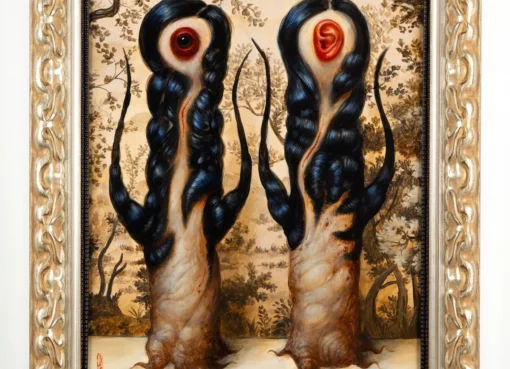
- Surrealist Compositions: Intricate, symbol-heavy works—often in pen and ink—that feature layered imagery where human faces dissolve into architectural spaces, and bodies transform into ecosystems.
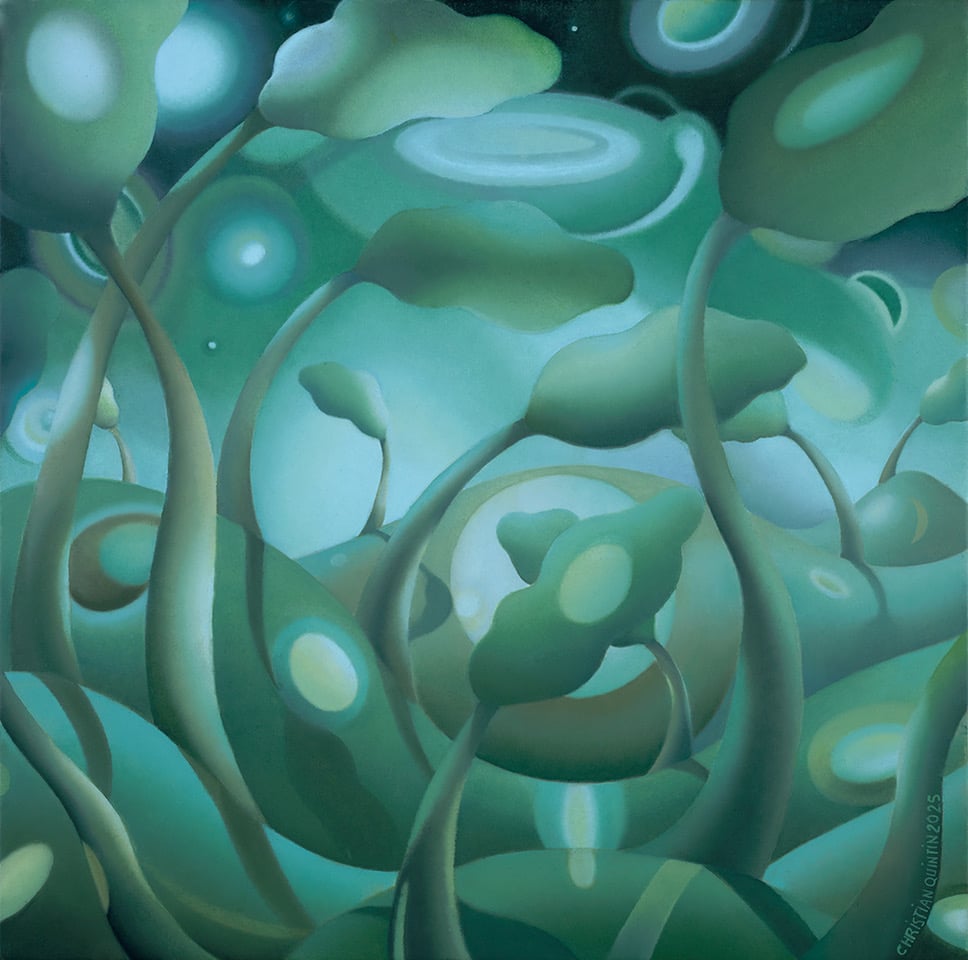
- Emotive Landscapes: Luminous oil and pastel renderings of the natural world where trees, rivers, and skies are imbued with human-like emotion and movement.
Quintin’s technical hallmark is his patience. A single work, such as the pen-and-ink masterpiece La Porte Ouverte, can take upwards of seven months to complete, involving thousands of minute crosshatched lines that create a sense of vibrating depth. This commitment to slow, deliberate creation has positioned him as a contemporary heir to the Visionary Art movement, echoing the precision of M.C. Escher and the atmospheric depth of the Romantic Symbolists.
Chronology: From the Armorican Coast to the Sonoma Valleys
The trajectory of Quintin’s career is a study in geographical and spiritual migration. His artistic identity was forged in three distinct environments: Brittany, Paris, and California.

1957–1974: The Brittany Foundation
Born in the port town of Saint Brieuc, Quintin’s earliest visual memories were shaped by the moody, dramatic landscapes of the Brittany coast. The region, known for its Celtic myths and ruined castles, instilled in him a "romantic melancholy." A central motif from this period is the L’Île de la Comtesse, a tidal island that would later reappear in his paintings as a symbol of solitude and the permeable boundary between land and sea.
1975–1980: The Discipline of Paris
In 1975, Quintin moved to Paris to study at the prestigious École des Beaux-Arts. This period provided the classical scaffolding for his imagination. Under the tutelage of masters of form and line, he mastered the techniques of the Old Masters. While the city’s surrealist legacy influenced his subject matter, it was the technical rigor of the Academy that allowed him to render the "impossible" with such convincing clarity.
1981–1998: The California Integration
The most significant turning point occurred in 1981, when Quintin moved to Northern California. Settling in Sonoma County, he encountered a landscape that felt like a spiritual mirror to Brittany, yet possessed a different, more expansive energy.

Throughout the 1980s and 90s, Quintin established himself as a vital force in the regional art scene. He won the Grumbacher Award in 1987 and received an Award of Excellence from the California State Fair in 1990. During this era, he also contributed to the public sphere, creating murals and large-scale commissions for hospitals and city buildings, proving that his "private" surrealism could resonate on a civic scale.
1999–Present: Global Recognition
In 1999, Quintin began a fruitful association with the Vorpal Gallery, the legendary institution that introduced M.C. Escher to the American public. This association validated Quintin’s position as a "thinking person’s artist."
The 2020s have seen Quintin’s career reach a new zenith. Now represented by Lorin Gallery, his work has transitioned from regional acclaim to international prestige. Recent appearances at KIAF Seoul and Art Central Hong Kong indicate that his "sacred ecology"—the idea that nature and spirit are one—resonates deeply with Asian aesthetic traditions, as well as Western surrealism.

Supporting Data: The Technicality of the "Kaleidoscopic"
Quintin’s work is often analyzed through the lens of "Kaleidoscopic Consciousness," a term he uses to describe the way human perception fragments and reassembles reality.
- Labor as Content: In an interview regarding his work The Aviary, Quintin revealed that the piece required six months of daily labor. The work depicts a face emerging from a crystal, with hair transforming into a leafy canopy. This investment of time is not merely a technical choice; it is a philosophical statement against the "speed" of modern life.
- Medium as Metaphor: Quintin selects mediums with the precision of a surgeon. He utilizes pen and ink for his most complex psychological maps, where the permanence of the ink mirrors the indelible nature of memory. He turns to pastels and oils for his landscapes, where the blendability of the media allows him to capture the "breath" of the atmosphere.
- Symbolic Recurrence: Quantitative analysis of his body of work shows recurring motifs: the "Tree-Dancer" (representing vitality), the "Room-Face" (representing the architecture of the mind), and the "Emerald Water" (representing the deep subconscious).
Official Responses and Critical Reception: Beauty as Resistance
The critical reception of Christian Quintin’s work has been remarkably consistent over four decades, often focusing on his refusal to abandon beauty in a century of deconstructive art.
The Gallery Perspective:
A representative from the Calabi Gallery noted during a 2022 retrospective: "In an era largely devoid of it, his work is beautiful. We could all use more beauty in our lives." This sentiment was echoed by the Lorin Gallery, which highlighted Quintin’s ability to bridge the gap between "classical technique and contemporary mystery," making him a unique asset in the international art market.

The Critic’s View:
Dan Taylor, writing for the Press Democrat, characterized Quintin’s evolution as "Emerging Beauty," noting that his landscapes do not merely depict Northern California but "channel its pulse."
Art critic Suzanne Munich famously coined the term "Mental Landscapes" to describe his work, arguing that Quintin is not a traditional surrealist seeking to shock the viewer (in the vein of Dalí), but rather a "poetic surrealist" seeking to comfort and awaken the viewer. Unlike the Freudian nightmares of early 20th-century surrealism, Quintin’s work is often described as "hopeful" and "invitational."
Implications: The Return of the Visionary
The recent global "catching fire" of Quintin’s career has several broader implications for the contemporary art world:

1. The Re-legitimization of Technical Mastery
For much of the late 20th century, "craft" was often secondary to "concept." Quintin’s success suggests a shift in collector appetite toward works that demonstrate undeniable manual skill and long-form dedication. His work appeals to a generation exhausted by the ephemerality of digital and AI-generated imagery.
2. The Trans-Pacific Resonance of Ecological Art
The strong performance of Quintin’s work in Hong Kong and Seoul suggests that his "European-style" surrealism is being re-interpreted through the lens of Eastern philosophies that emphasize the interconnectedness of all living things. His trees that "speak" and hills that "breathe" align with contemporary global concerns regarding the environment and our spiritual relationship with the earth.
3. The "Slow Art" Movement
Quintin stands as a standard-bearer for what might be called the "Slow Art" movement. By requiring the viewer to "read his art like poetry," he forces a deceleration of the viewing experience. In a market often driven by "Instagrammable" moments, Quintin’s work demands—and rewards—sustained contemplation.
Conclusion: A Sanctuary for the Soul
Christian Quintin’s career is a testament to the power of artistic persistence. By remaining true to his own "inner constellation" for forty years, he has eventually found the world moving toward him. His work does not offer a message or a manifesto; it offers a space.
As he prepares for upcoming exhibitions at the Morrison Gallery in Connecticut and continued representation in Paris and Los Angeles, Quintin continues to refine his unified vision. Whether he is drawing the minute bark of a Sonoma oak or the vast, symbolic halls of a remembered childhood home, he remains a bridge-builder: between Europe and America, between the conscious and the dream, and between the viewer and the profound, silent beauty of existence.
For those seeking to engage with his work, the advice from the artist remains simple: "Wander into its imagery." In doing so, one might just find a map to their own forgotten feelings.